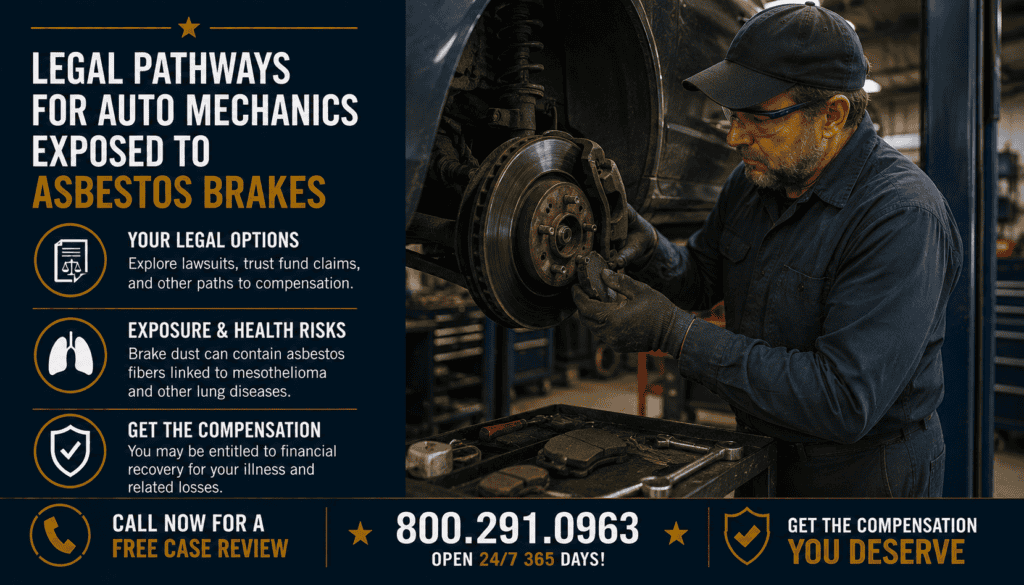
Legal Pathways for Auto Mechanics Exposed to Asbestos Brakes
Auto mechanics who worked with asbestos-containing brake or clutch components may have potential legal or compensation pathways if they later develop mesothelioma or another asbestos-related disease. A mechanic’s occupation alone does not prove exposure or establish a claim; the strongest cases connect specific employers, vehicles, friction products, manufacturers, repair tasks and time periods to documented asbestos-containing components.
OSHA has mandatory asbestos work-practice requirements specifically for automotive brake and clutch repair, and EPA states that some, but not all, automotive brakes and clutches may contain asbestos. These government records help establish that asbestos exposure during brake and clutch servicing is a recognized occupational issue, while an individual legal claim still requires its own medical, exposure, product, company and filing evidence.
Legal Pathways After Asbestos Brake Exposure
Potential pathways can differ depending on the mechanic’s diagnosis, exposure history, responsible companies, state law and whether an asbestos company established a bankruptcy trust. Depending on the facts, a worker may investigate civil claims against legally responsible companies, asbestos trust fund claims, workers’ compensation or other benefits.
No single pathway applies to every mechanic. A brake-repair history should first be reconstructed to determine whether the worker actually encountered asbestos-containing friction products and whether evidence can connect those products to identifiable companies.
Federal workplace records provide important context. OSHA’s general-industry asbestos standard requires specific controls during covered automotive brake and clutch inspection, disassembly, repair and assembly. Its mandatory Appendix F specifies negative-pressure/HEPA, low-pressure/wet-cleaning and qualifying equivalent methods intended to reduce employee exposure.
NIOSH separately published recommendations for engineering controls and work practices to reduce asbestos exposure during brake maintenance. Together, these primary sources establish the occupational exposure pathway without assuming that every brake job involved asbestos.
Related resources include automotive mechanics and heavy equipment workers asbestos exposure, auto mechanics brake and clutch dust exposure, truck mechanics asbestos exposure and bus mechanics asbestos exposure.
Proving Occupational Asbestos Brake Exposure
A legal evaluation generally starts with evidence showing where, when and how exposure may have occurred. EPA states that some, but not all, brakes and clutches may contain asbestos and that asbestos-containing and non-asbestos components cannot necessarily be distinguished simply by looking at them.
Useful evidence can include:
- Employer names, shop locations and dates of employment
- Vehicle makes, models, model years and fleet types
- Brake shoe, lining and clutch manufacturers or brands
- Part numbers, boxes, labels, invoices and distributor records
- Service manuals, catalogs and manufacturer literature
- Descriptions of drum removal, cleaning, grinding, fitting and clutch work
- Shop practices involving compressed air, dry cleaning, HEPA vacuuming or wet methods
- Coworker, supervisor, parts-counter and service-manager testimony
OSHA has stated that when it is unknown whether brake or clutch materials to be disturbed contain asbestos, covered work within 29 CFR 1910.1001(f)(3) still requires a preferred or documented equivalent control method. That regulatory approach reflects the difficulty of identifying asbestos-containing friction material by appearance alone.
For a legal claim, uncertainty about a particular component should be investigated rather than converted into an unsupported assertion that every brake contained asbestos.
Brake Product and Company Evidence
Product identification can be central to determining whether a viable legal or trust claim exists. A mechanic may remember performing thousands of brake jobs without remembering every brand. Historical records can help reconstruct the products used.
Parts and Purchasing Records
Invoices, purchase orders, distributor records, dealership records and fleet purchasing files can identify brake and clutch suppliers used by a shop during particular years.
Manufacturer Catalogs and Service Literature
Historical catalogs, technical bulletins, parts books and packaging can help connect a vehicle application to a manufacturer and component. These records should be evaluated for the correct product and time period.
Coworker and Parts-Department Evidence
Longtime coworkers, service managers and parts employees may remember brands, delivery practices, shop procedures and the types of brake or clutch components regularly installed.
Industrial-Hygiene and Government Records
NIOSH, OSHA and other government records can document recognized exposure mechanisms and historical work practices. They do not automatically prove which company’s product a particular mechanic handled, but they can provide reliable occupational context.
Why Product Identification Matters
Different legal defendants and bankruptcy trusts have different exposure requirements. Establishing the manufacturer, supplier or asbestos company connected to the mechanic’s work can therefore affect which pathways warrant investigation.
Asbestos Lawsuits for Auto Mechanics
A civil asbestos lawsuit may be considered when evidence supports exposure to an asbestos-containing product and applicable law provides a claim against a legally responsible party. The exact causes of action, defendants, proof requirements and damages depend on jurisdiction and case-specific facts.
A mechanic’s evidence may need to address occupational exposure, the asbestos-containing product, responsible companies, medical diagnosis and causation. Employment records alone may establish where a person worked but may not identify the product that allegedly caused exposure.
Potential defendants cannot responsibly be identified from an occupation title alone. Product and company evidence should be developed before conclusions are drawn about responsibility.
Compensation in asbestos litigation is not automatic. Outcomes depend on evidence, applicable law, defenses, jurisdiction and other case-specific factors.
Need help now? Call 800.291.0963
Live chat available 24/7, 365 days a year.
Submit Your Case
Asbestos Trust Fund Claims
Some companies that faced asbestos liabilities reorganized through bankruptcy and established trusts to resolve qualifying asbestos claims. A mechanic may potentially investigate trust claims when evidence connects occupational exposure to a company or product covered by a particular trust.
Each asbestos trust operates under its own governing documents and claim procedures. Requirements can include an eligible disease, qualifying exposure, approved site or occupation evidence, product or company evidence, specified exposure dates and supporting medical documentation.
A mechanic should not be described as eligible for a particular trust merely because brakes or clutches were repaired. The worker’s evidence must be compared with the requirements of the specific trust.
Trust claims and civil lawsuits can also interact. The timing and disclosure of claims may be governed by trust procedures, court rules or state law, so claim sequencing should be evaluated for the individual case.
Related information includes mechanics mesothelioma, asbestos exposure and lawsuits and maintenance mechanics asbestos exposure.
Filing Deadlines and Claim Strategy
Legal filing deadlines vary by jurisdiction, claim type and facts. A diagnosis date, death date, exposure history, residence, work locations and other events may affect which deadlines apply. Missing a legally applicable deadline can affect a claim, so individualized legal review is important.
Bankruptcy trusts can have their own procedures, documentation rules and claim-processing requirements. Civil litigation can have separate court deadlines, discovery obligations and disclosure requirements.
Because legal rules differ, this page does not assign a universal statute-of-limitations period to auto mechanics. A qualified attorney can determine which jurisdiction and deadline rules apply to a particular situation.
Preserving Evidence Early
Older automotive exposure histories can become harder to reconstruct as shops close, records disappear and witnesses become unavailable. Preserving employment records, Social Security earnings information, union records, parts records, photographs, catalogs and coworker contact information can be useful even before every product is identified.
Building an Auto Mechanic Exposure Record
A structured work-history record can help organize the facts needed to evaluate possible lawsuits and trust claims.
- Employment: list every repair shop, dealership, fleet, government garage and employer with approximate dates
- Job duties: describe brake, clutch, engine, body, maintenance and cleanup work separately
- Vehicles: identify passenger cars, trucks, buses, military vehicles or heavy equipment serviced
- Products: record remembered brake, clutch and friction-material brands and suppliers
- Work practices: note drum removal, compressed-air cleaning, grinding, bevelling, fitting, HEPA vacuuming and wet methods
- Documents: preserve W-2s, Social Security records, union files, invoices, catalogs, service manuals and photographs
- Witnesses: identify coworkers, supervisors, parts employees and others who can describe products and shop practices
- Medical evidence: preserve pathology, imaging, physician reports and other diagnosis records
EPA’s current brake-and-clutch guidance confirms why product identification matters: some, but not all, automotive brakes and clutches may contain asbestos, and appearance alone may not resolve the question.
Related Automotive Exposure Resources
Brake and clutch exposure: Auto Mechanics Brake & Clutch Dust Exposure
Automotive mechanics: Automotive Mechanics & Heavy Equipment Workers Asbestos Exposure
Truck and bus mechanics: Truck Mechanics Asbestos Exposure · Bus Mechanics Asbestos Exposure
Authoritative Sources
This page uses federal primary sources to document the occupational asbestos pathway for automotive brake and clutch mechanics. These sources establish recognized exposure mechanisms and mandatory workplace controls; they do not determine liability or eligibility in an individual legal claim.
- OSHA — 29 CFR 1910.1001 Asbestos Standard
- OSHA — Mandatory Appendix F for Automotive Brake and Clutch Work
- OSHA — Application of Brake and Clutch Repair Provisions
- NIOSH — Control of Asbestos Exposure During Brake Drum Service
- EPA — Current Best Practices for Brake and Clutch Repair Workers
- OSHA — Asbestos Inspection Procedures and Brake/Clutch Guidance
Legal Pathways for Auto Mechanics FAQ
Does working as an auto mechanic automatically create an asbestos claim?
No. A viable claim generally requires evidence of asbestos exposure, an asbestos-related disease and the additional legal elements required by the applicable claim or jurisdiction.
Why are brake and clutch records important?
EPA states that some, but not all, automotive brakes and clutches may contain asbestos. Parts records can help identify whether a mechanic worked with an asbestos-containing product and which company supplied it.
Can OSHA rules prove that a specific mechanic was exposed?
No. OSHA’s mandatory brake and clutch requirements establish that asbestos exposure is a recognized occupational concern and prescribe controls, but individual exposure still requires case-specific evidence.
What evidence can help identify an asbestos brake product?
Parts invoices, packaging, manufacturer catalogs, service manuals, distributor records, fleet purchasing files and coworker testimony can help reconstruct product use.
Can an auto mechanic pursue an asbestos lawsuit?
Potentially, when evidence and applicable law support a claim against a legally responsible party. Eligibility and liability must be evaluated individually.
Can an auto mechanic file an asbestos trust claim?
Potentially, if the mechanic satisfies the specific trust’s medical and exposure requirements and can connect the exposure to a company or product covered by that trust.
Can trust claims and lawsuits both be relevant?
Yes, depending on the exposure history and responsible companies. Their timing, disclosure and interaction can be governed by trust procedures, court rules and state law.
Is there one filing deadline for every auto mechanic asbestos claim?
No. Deadlines vary by jurisdiction, claim type and facts. Individual legal review is necessary to determine the applicable deadline.
Get Help Reviewing an Auto Mechanic Asbestos Claim
Call 800.291.0963
Live chat is available 24/7, 365 days a year.
Prior automotive brake or clutch work does not automatically prove asbestos exposure, disease causation, liability, lawsuit eligibility, trust eligibility or compensation. Each matter depends on the diagnosis, employer, dates, products, companies, work practices, exposure evidence, governing trust documents and applicable law. Compensation is not guaranteed.
⚕️ Legal & Medical Information Disclaimer
This page provides general educational information and is not medical or legal advice. The information does not establish asbestos exposure, diagnosis, causation, liability, claim eligibility or compensation. Medical concerns should be discussed with a qualified healthcare professional, and legal questions should be reviewed with a qualified attorney.