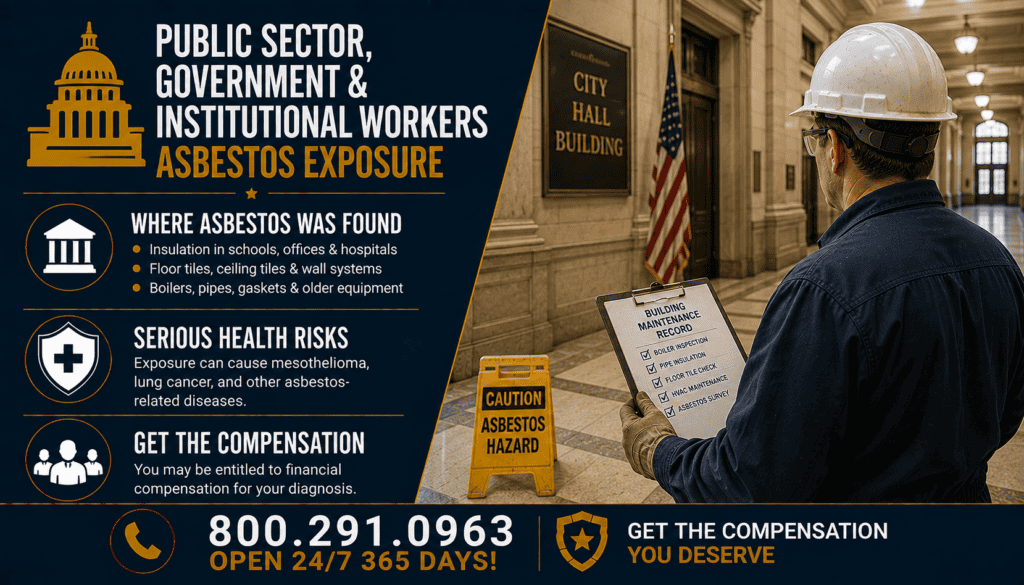
Public Sector, Government & Institutional Workers Asbestos Exposure
Public-sector and institutional employees can work in schools, government offices, hospitals, correctional facilities, maintenance buildings, utility facilities and other public properties. Employment in one of these settings does not prove asbestos exposure, but workers may have encountered asbestos when older asbestos-containing building or mechanical materials were damaged, repaired, renovated or otherwise disturbed.
EPA guidance provides particularly strong evidence for this category. Federal rules require public schools to inspect for asbestos-containing building material and maintain asbestos management plans, while EPA recommends operations-and-maintenance programs for other buildings containing asbestos. The most useful occupational history identifies the specific building, material, work activity, dates and opportunity for fibers to become airborne.
Public Sector, Government and Institutional Asbestos Exposure
Public-sector work covers many occupations and facilities. NIOSH identifies school employees as including teachers, paraprofessionals, clerical staff, administrators, information-technology staff, nurses, food-service workers, bus drivers and aides, maintenance and custodial staff, garage mechanics, groundskeepers and security personnel.
NIOSH also identifies asbestos among the potential hazards that school employees can encounter. That does not mean every employee or every public building involved asbestos exposure. Exposure depends on whether asbestos-containing material was actually present and whether the worker’s duties or nearby activities created a plausible opportunity to inhale released fibers.
Workers with hands-on maintenance, custodial, mechanical, renovation or demolition duties can have different exposure histories from office employees who did not disturb building materials.
EPA explains that asbestos-containing material can often remain safely managed in place when it is in good condition. The concern increases when material becomes damaged or is disturbed and fibers can become airborne.
Related resources include high-risk jobs asbestos exposure, asbestos exposure in buildings, maintenance workers asbestos exposure and electrical and utility power workers asbestos exposure.
Workers and Occupations That May Have Encountered Asbestos
Potential exposure varies by occupation, building and work assignment. Public-sector and institutional workers whose historical duties may merit investigation include:
- Maintenance mechanics and facilities employees
- Custodians and janitors working around damaged building materials
- Boiler-room and utility employees
- Electricians, plumbers, pipefitters and HVAC technicians
- School-district maintenance and facilities workers
- Government-building renovation and construction employees
- Garage mechanics and transportation-maintenance workers
- Hospital and institutional facilities personnel
- Correctional-facility maintenance employees
- Employees working near asbestos repair or renovation activity
NIOSH’s current custodial-services guidance describes cleaners performing sweeping, mopping, trash removal, surface cleaning and moving furniture, while recognizing that custodial work can involve multiple occupational hazards. For asbestos analysis, ordinary cleaning dust should not be labeled asbestos unless a source of asbestos-containing material is established.
Related occupation pages include electricians, plumbers and HVAC technicians at risk, boiler room operators asbestos exposure and fleet garage workers asbestos exposure.
Older Public Buildings and Asbestos-Containing Materials
EPA provides asbestos-management guidance for owners and managers of office buildings, hospitals and similar facilities. An older public building should not automatically be described as containing asbestos; material identity and condition matter.
Potential materials worth investigating can include:
- Documented asbestos-containing pipe and boiler insulation
- Thermal-system insulation and mechanical-room materials
- Asbestos-containing surfacing or fireproofing material where confirmed
- Flooring, ceiling or other building materials identified as asbestos-containing
- Asbestos-containing cement products
- Gaskets, packing or mechanical components where reliable product evidence establishes asbestos content
EPA’s operations-and-maintenance guidance is based on keeping asbestos-containing material in good condition, cleaning up previously released fibers, preventing further fiber release and monitoring material condition.
The existence of asbestos-containing material does not by itself prove that a particular employee inhaled asbestos. A worker-specific history should address location, condition, disturbance, proximity, frequency and duration.
Related building information includes industrial, manufacturing and utility buildings asbestos exposure.
Maintenance, Custodial, Renovation and Repair Work
Maintenance and renovation activities can be important because they may disturb asbestos-containing material that otherwise could remain managed in place.
- Pipe and boiler work: disturbing confirmed asbestos-containing thermal insulation
- Mechanical repair: removing documented asbestos gaskets, packing or insulation
- Electrical work: drilling, cutting or opening areas containing identified asbestos materials
- HVAC work: accessing spaces where confirmed asbestos-containing insulation or surfacing materials were present
- Custodial work: cleaning residue following a documented asbestos disturbance
- Renovation: cutting, removing or demolishing asbestos-containing building material
- Nearby work: remaining in an area while another trade disturbed confirmed asbestos material
EPA states that renovation and demolition of buildings containing regulated quantities of asbestos can trigger federal NESHAP work-practice requirements. EPA also requires accredited asbestos professionals for specified asbestos work in schools, public buildings and commercial buildings under its Model Accreditation Plan framework.
Custodial work deserves careful analysis rather than an automatic exposure assumption. EPA’s school rules specifically require asbestos-awareness training for custodial staff in buildings containing asbestos-containing building material, showing that custodians can have a recognized need to understand and avoid disturbance.
Related maintenance resources include maintenance mechanics asbestos exposure, demolition workers asbestos exposure and building inspectors asbestos exposure.
Need help now? Call 800.291.0963
Live chat available 24/7, 365 days a year.
Submit Your Case
Schools and Institutional Asbestos Requirements
Public schools provide unusually strong documentation opportunities because federal asbestos rules require formal inspections and management records.
EPA states that the Asbestos Hazard Emergency Response Act and its regulations require public school districts and nonprofit schools to inspect schools for asbestos-containing building material, prepare asbestos management plans and take action to prevent or reduce asbestos hazards.
EPA further requires periodic surveillance of known or suspected asbestos-containing material every six months and reinspection at least every three years. School asbestos management plans identify locations of asbestos-containing material and document inspections and response actions.
Maintenance and custodial staff who may work in a school containing asbestos-containing building material must receive asbestos-awareness training. EPA states that staff whose activities will disturb such material require additional training.
School-system maintenance, storage and utility facilities can also fall within AHERA’s definition of a school building when they are essential to school operations. EPA specifically identifies facilities such as bus garages and warehouses in explaining this requirement.
These records can be particularly valuable when reconstructing historical exposure because they may identify the building, material location, condition, surveillance history and response actions.
Mesothelioma and Other Asbestos-Related Health Risks
NIOSH’s review of workplace asbestos exposure recognizes asbestos as a carcinogenic occupational hazard. Asbestos exposure is associated with malignant mesothelioma, lung cancer and asbestosis.
Asbestos-related disease can develop long after occupational exposure. A retired public employee may therefore need records from an agency, school district, municipality, hospital or other institution to reconstruct work performed decades earlier.
Public and institutional workers also face many hazards unrelated to asbestos. NIOSH identifies cleaning chemicals, infectious agents, ergonomic stressors and other risks for custodial workers. Those hazards should not be presented as evidence of asbestos exposure.
Medical questions about past occupational asbestos exposure, symptoms, screening or diagnosis should be discussed with a qualified healthcare professional.
Documenting Public-Sector Occupational Exposure
Government and institutional employment can generate records that are especially useful for reconstructing an asbestos exposure history.
- Employment records: agency, municipality, school district, institution, job title, department and dates
- Personnel records: civil-service classifications, job descriptions, payroll, pension and union files
- Building records: asbestos surveys, AHERA management plans, inspection reports and abatement records
- Maintenance records: work orders, repair logs, shutdown records and contractor documents
- Material records: product specifications, manufacturers, purchasing files and laboratory reports
- Training records: asbestos-awareness, operations-and-maintenance or abatement training documentation
- Location evidence: building, floor, boiler room, mechanical room, school, garage or utility facility
- Witness evidence: custodians, mechanics, engineers, teachers, tradespeople, supervisors and contractors
For school employees, an asbestos management plan can be particularly useful because EPA requires it to document asbestos-containing building materials, their locations and response actions. Historical versions of plans, surveillance forms and renovation records may help establish a timeline.
Questions That Can Strengthen an Exposure History
Which agency or institution? Which building and years? What was the employee’s job classification? Did the worker enter boiler or mechanical rooms? Was asbestos-containing material identified? Did repairs, renovations or abatement occur? Are management plans, work orders, surveys, photographs, training records or coworker statements available?
Lawsuits, Trust Funds and Compensation
A public-sector or institutional worker diagnosed with mesothelioma or another asbestos-related disease may have potential legal or compensation options when evidence supports asbestos exposure and applicable requirements are met. Government employment alone does not establish liability, causation, trust eligibility or compensation.
Claims involving public employment can raise jurisdiction-specific issues involving responsible product companies, contractors, premises, public entities, workers’ compensation systems or asbestos bankruptcy trusts. Filing rules and deadlines can differ, so the applicable legal framework must be evaluated individually. Compensation is not guaranteed.
Related Worker and Building Resources
Maintenance: Maintenance Workers Asbestos Exposure · Maintenance Mechanics Asbestos Exposure
Buildings: Asbestos Exposure in Buildings · Building Inspectors Asbestos Exposure
Utilities: Utility Workers Asbestos Exposure · Industrial Electricians Asbestos Exposure
Authoritative Sources
This page was researched using EPA and NIOSH government sources. EPA’s school and building guidance provides unusually strong documentation of asbestos-management requirements affecting public buildings, custodial employees and maintenance personnel, while NIOSH provides occupational-health evidence concerning asbestos and institutional workers.
- EPA — Asbestos and School Buildings
- EPA — Local Education Agency Responsibilities Under AHERA
- EPA — Information for Owners and Managers of Buildings That Contain Asbestos
- EPA — Asbestos Operations and Maintenance Programs
- NIOSH — Safety and Health in the Education Sector
- NIOSH — Workplace Exposure to Asbestos: Review and Recommendations
Public Sector and Government Workers Asbestos FAQ
Were all public-sector and government workers exposed to asbestos?
No. Employment by a government agency, school or institution does not prove asbestos exposure. The building, material, work activity, location and time period should be documented.
Could school employees have encountered asbestos?
Potentially. EPA requires public schools to inspect for asbestos-containing building material and maintain asbestos management plans. An individual employee’s exposure still depends on the material and circumstances.
Why are maintenance and custodial workers important in asbestos investigations?
Their duties can place them near building and mechanical materials. EPA specifically requires asbestos-awareness training for school maintenance and custodial staff who may work in buildings containing asbestos-containing material.
Does asbestos in a building mean every occupant was exposed?
No. EPA explains that asbestos-containing material in good condition can often be managed in place. Exposure concern increases when asbestos material is damaged or disturbed and fibers become airborne.
What public buildings may have asbestos records?
Schools can have AHERA management plans, while government offices, hospitals and other facilities may have asbestos surveys, operations-and-maintenance records, abatement files and renovation documents.
Can a school asbestos management plan help document exposure?
Potentially. EPA requires these plans to identify asbestos-containing building material and document inspections, surveillance and response actions, making them useful historical records.
What employment records can help a government worker’s asbestos case?
Personnel files, civil-service classifications, pension records, union files, work orders, building assignments, maintenance logs, asbestos surveys and coworker statements can help reconstruct exposure.
Can public-sector workers qualify for asbestos trust fund claims?
Some may qualify if they satisfy a trust’s medical and exposure requirements and can connect their work to a covered asbestos company, product, site or qualifying exposure period. Public employment alone does not establish eligibility.
Get Help Reviewing Public-Sector Asbestos Exposure
Call 800.291.0963
Live chat is available 24/7, 365 days a year.
Prior public-sector, government or institutional employment does not automatically prove asbestos exposure, disease causation, liability, claim eligibility or compensation. Each situation depends on the employer, building, dates, job duties, asbestos-containing materials, maintenance or renovation activity, exposure evidence, medical evidence and applicable legal requirements. Compensation is not guaranteed.
⚕️ Legal & Medical Information Disclaimer
This page provides general educational information and is not medical or legal advice. The information does not establish asbestos exposure, diagnosis, causation, liability, claim eligibility or compensation. Medical concerns should be discussed with a qualified healthcare professional, and legal questions should be reviewed with a qualified attorney.