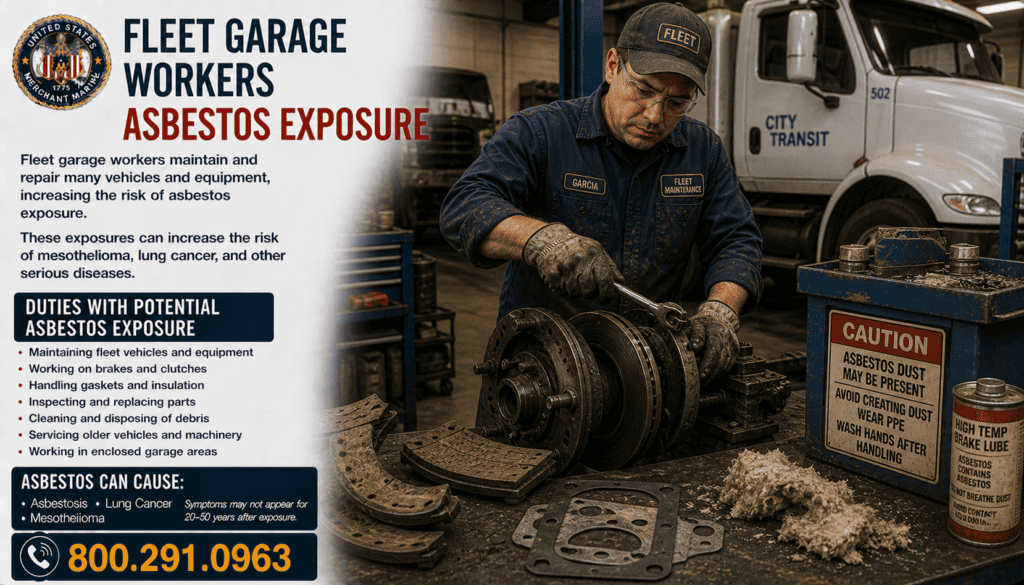
Fleet Garage Workers Asbestos Exposure
Fleet garages maintain groups of cars, trucks, buses and other vehicles for government agencies, transportation companies, utilities and private employers. Some historical brake linings and clutch facings contained asbestos, so mechanics and other garage workers could encounter asbestos-containing dust when covered components were inspected, cleaned, repaired or replaced.
Federal evidence directly addresses this work environment. NIOSH studied automobile and truck brake-service facilities and found that airborne asbestos exposure varied with cleaning methods, while EPA states that some, but not all, automotive brakes and clutches may contain asbestos. OSHA requires specific engineering controls and work practices for covered professional brake and clutch operations.
Fleet Garage Workers and Occupational Asbestos Exposure
Fleet garages can employ mechanics, helpers, technicians, service workers, parts employees, supervisors and other personnel who maintain vehicles used by a single organization or agency. Duties may include brake service, clutch work, wheel and axle repair, engine maintenance, inspections, lubrication and cleanup.
NIOSH’s industrial-hygiene study of six automobile and truck brake-service facilities assessed airborne asbestos during vehicle brake maintenance and repair. Personal and area samples showed that exposures varied with the assembly-cleaning method and time required for cleaning. Historical compressed-air cleaning produced particularly high peak concentrations in some samples.
NIOSH also evaluated vehicle maintenance settings used for heavy-duty fleets. At a federal vehicle research facility, investigators described heavy-duty straight trucks, tractor-trailers and buses and identified potential asbestos exposure during brake assembly inspection and rebuilding.
EPA’s current guidance is careful not to assume every friction component contains asbestos: some, but not all, automotive brakes and clutches may contain it. That distinction is important for fleet workers because a garage may service vehicles and replacement parts from many manufacturers and eras.
Related resources include automotive mechanics and heavy equipment workers asbestos exposure, repair shop auto mechanics asbestos exposure, truck mechanics asbestos exposure and bus mechanics asbestos exposure.
Potential Asbestos Sources in Fleet Garages
Potential sources depended on the vehicles, replacement components, garage inventory and time period. Historically relevant sources can include:
- Older asbestos-containing drum brake linings and brake shoes
- Older asbestos-containing clutch facings
- Dust generated by wear of confirmed asbestos-containing friction material
- Older replacement brake and clutch components whose records identify asbestos
- Other asbestos-containing vehicle or facility materials when independently documented
EPA explains that brake and clutch dust can be visible when a disk, drum, clutch cover or wheel is removed from a car, truck or other equipment. If the component contains asbestos, the dust may contain fibers small enough to be inhaled.
Appearance is not a reliable way to determine asbestos content. EPA notes that newer vehicle and parts information may identify composition, while older or previously replaced components can be difficult to verify.
Visible garage dust is not automatically asbestos. Road dirt, non-asbestos friction material, metal wear and other shop contaminants are separate. Product records and task-specific evidence are more reliable than assumptions based on dust alone.
Fleet Maintenance Tasks That Could Release Asbestos
Where asbestos-containing brake or clutch components were actually present, exposure could occur during direct servicing and nearby work.
- Brake drum removal: disturbing accumulated residue inside an assembly
- Brake inspection: handling asbestos-containing friction components and dust
- Brake replacement: removing older asbestos-containing shoes or linings
- Compressed-air cleaning: historically blowing brake dust into the garage air
- Grinding or fitting: mechanically altering asbestos-containing friction material
- Clutch work: opening housings and replacing asbestos-containing clutch facings
- Garage cleanup: disturbing settled residue from confirmed asbestos-containing repair operations
- Nearby work: sharing bays or work areas where asbestos-containing brake or clutch dust was dispersed
Historical NIOSH research specifically identified blowout of drum brake assemblies, grinding used truck brake linings and bevelling new truck brake linings as activities associated with elevated airborne asbestos where asbestos-containing friction material was involved.
EPA advises against compressed-air cleaning and dry cleaning practices that can disperse dust. Controlled HEPA and wet methods are intended to reduce airborne exposure.
Brake and Clutch Dust Controls in Fleet Garages
OSHA’s mandatory Appendix F specifies engineering controls and work practices for covered automotive brake and clutch inspection, disassembly, repair and assembly.
Negative-Pressure Enclosure and HEPA Vacuum
One preferred method encloses the brake or clutch assembly while a HEPA-filtered vacuum maintains negative pressure and captures asbestos-containing residue.
Low-Pressure Wet Cleaning
Another preferred method uses low-pressure fluid to wet the assembly and suppress dust while collecting runoff, reducing the chance that asbestos-containing residue becomes airborne.
Wet Method for Qualifying Low-Volume Facilities
OSHA provides a specified wet method for facilities performing no more than five pairs of brakes or five clutches per week. Dry brushing is prohibited under that method.
Fleet-Garage Control Evidence
NIOSH survey work at an Ohio Department of Transportation garage evaluated a brake-dust control device used by a mechanic with decades of brake-service experience. The survey described the device as appearing to do an excellent job containing and collecting brake dust and recommended the facility for more detailed evaluation.
These controls establish that asbestos-containing brake and clutch dust is a recognized occupational concern. They do not establish that a particular fleet worker encountered asbestos; the components and work history still need to be documented.
Need help now? Call 800.291.0963
Live chat available 24/7, 365 days a year.
Submit Your Case
Mesothelioma and Other Occupational Health Risks
Asbestos exposure is associated with serious diseases including mesothelioma, lung cancer and asbestosis. For a fleet garage worker, these risks become relevant to an occupational history when exposure to asbestos-containing brakes, clutches or another confirmed asbestos source can be supported.
EPA states that if brakes contain asbestos, brake dust may contain fibers that can be inhaled. The agency also notes that asbestos-related disease symptoms can take many years to develop after exposure.
Fleet garages also contain hazards unrelated to asbestos, including vehicle exhaust, solvents, fuels, welding fumes, noise, lifting hazards and moving vehicles. These exposures should be evaluated separately and should not be used as evidence that asbestos exposure occurred.
Medical questions about prior asbestos exposure, symptoms, screening or diagnosis should be discussed with a qualified healthcare professional.
Documenting a Fleet Garage Exposure History
A useful occupational history identifies the employer, garage, years, fleet composition, components and servicing methods associated with possible asbestos exposure.
- Employment evidence: employer, agency, fleet operator, payroll, W-2, union and Social Security records
- Fleet evidence: cars, trucks, buses, public works vehicles, utility vehicles and other equipment serviced
- Part evidence: brake shoes, linings, clutch facings, manufacturers, brands, part numbers and packaging
- Task evidence: drum removal, brake replacement, cleaning, grinding, fitting and clutch repair
- Garage-practice evidence: compressed air, HEPA vacuums, enclosures, wet cleaning and housekeeping methods
- Purchasing evidence: fleet invoices, parts inventories, supplier records, catalogs and service manuals
- Witness evidence: mechanics, helpers, fleet supervisors, parts workers and coworkers
Fleet purchasing records can be especially valuable because organizations may have bought the same replacement components repeatedly. Those records can help connect a worker’s duties to specific brands and time periods.
Questions That Can Strengthen an Exposure History
Which fleet and years? What vehicles were maintained? Which brake and clutch brands were stocked? How were drums cleaned? Was compressed air used? Were linings ground or fitted? Were HEPA or wet methods used? Did workers share bays? Are purchasing files, shop manuals, photographs or coworker statements available?
Asbestos Lawsuits, Trust Funds and Compensation
A fleet garage worker diagnosed with mesothelioma or another asbestos-related disease may have potential legal or compensation options when evidence supports occupational asbestos exposure and applicable requirements are met. Possible avenues can include claims involving legally responsible companies and asbestos bankruptcy trusts.
Fleet-garage employment alone does not establish liability or asbestos trust eligibility. Each claim has separate medical, exposure, company, product and filing requirements. Evidence connecting the worker to an asbestos-containing brake, clutch or another covered asbestos source may be necessary.
Potential evidence includes employment and Social Security records, union files, fleet purchasing records, parts invoices, manufacturer catalogs, packaging, service manuals, shop procedures, industrial-hygiene records, photographs, coworker statements and medical documentation. Applicable law and filing deadlines should be reviewed individually.
Related Fleet and Mechanic Resources
Automotive mechanics: Automotive Mechanics & Heavy Equipment Workers Asbestos Exposure · Repair Shop Auto Mechanics Asbestos Exposure
Brake and clutch exposure: Auto Mechanics Brake & Clutch Dust Exposure · Legal Pathways for Auto Mechanics Exposed to Asbestos Brakes
Fleet vehicles: Truck Mechanics Asbestos Exposure · Bus Mechanics Asbestos Exposure · Equipment Mechanics Asbestos Exposure
Authoritative Sources
This page was researched using OSHA, NIOSH and EPA government sources. The strongest evidence includes NIOSH studies of automobile and truck brake-service facilities, a federal heavy-duty vehicle maintenance facility and fleet-garage brake-dust controls, together with OSHA’s mandatory brake-and-clutch requirements.
- NIOSH — Industrial Hygiene Assessment of Asbestos Exposure for Brake Mechanics
- NIOSH — HHE 81-0135-0912, Vehicle Research and Test Center
- NIOSH — Control of Asbestos Exposure During Brake Drum Service
- OSHA — Mandatory Appendix F for Automotive Brake and Clutch Work
- OSHA — 29 CFR 1910.1001 Asbestos Standard
- EPA — Current Best Practices for Brake and Clutch Repair Workers
Fleet Garage Workers Asbestos Exposure FAQ
Were all fleet garage workers exposed to asbestos?
No. Fleet-garage employment alone does not prove exposure. The actual vehicle components, work tasks, time period and shop practices must be investigated.
Could fleet vehicle brakes and clutches contain asbestos?
Some historical components did. EPA states that some, but not all, automotive brakes and clutches may contain asbestos.
Did NIOSH study asbestos exposure in brake-service facilities?
Yes. NIOSH collected personal and area samples at six automobile and truck brake-service facilities and found that exposure varied with cleaning methods and the time required for cleaning.
Why is compressed-air cleaning important in an exposure history?
Historical NIOSH measurements found particularly high peak concentrations during some compressed-air cleaning operations. EPA advises against compressed-air cleaning because it disperses dust.
What OSHA controls apply to covered professional brake and clutch work?
OSHA Appendix F specifies negative-pressure/HEPA and low-pressure/wet-cleaning methods, qualifying equivalent methods and a specified wet method for qualifying low-volume facilities.
What records can document a fleet garage worker’s exposure?
Employment records, fleet purchasing files, parts invoices, manufacturer catalogs, service manuals, shop procedures, industrial-hygiene reports and coworker statements can help reconstruct exposure.
Could fleet garage workers have household asbestos exposure concerns?
Potentially, if clothing became contaminated during actual asbestos-containing brake or clutch work and fibers were carried home. Evidence of the original workplace source and contamination pathway is still needed.
Can fleet garage workers qualify for asbestos trust fund claims?
Some may qualify if they meet a trust’s medical and exposure criteria and can connect their work to a covered asbestos product, company or qualifying exposure period. Fleet-garage employment alone does not establish eligibility.
Get Help Reviewing a Fleet Garage Exposure History
Call 800.291.0963
Live chat is available 24/7, 365 days a year.
Prior fleet, garage or vehicle-maintenance work does not automatically prove asbestos exposure, disease causation, liability, claim eligibility or compensation. Each situation depends on the employer, dates, vehicles, components, work practices, asbestos-content evidence, medical evidence and applicable legal requirements. Compensation is not guaranteed.
⚕️ Legal & Medical Information Disclaimer
This page provides general educational information and is not medical or legal advice. The information does not establish asbestos exposure, diagnosis, causation, liability, claim eligibility or compensation. Medical concerns should be discussed with a qualified healthcare professional, and legal questions should be reviewed with a qualified attorney.