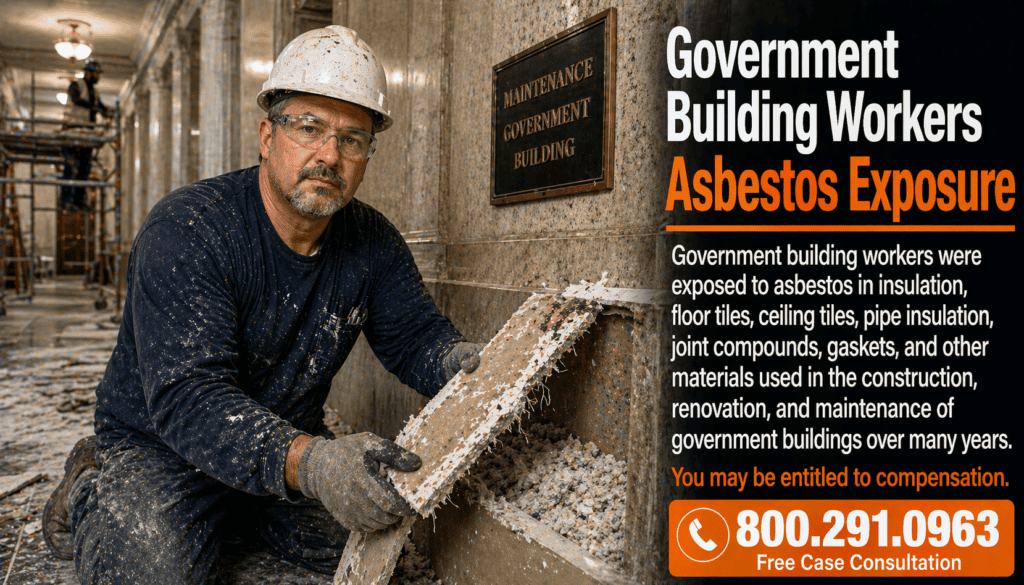
Government Building Workers Asbestos Exposure
Federal, state and local government employees may spend many years in offices, transportation departments, courthouses, administrative facilities and other public buildings. Government employment itself does not prove asbestos exposure, but OSHA recognizes that public and commercial buildings can contain installed asbestos materials, and NIOSH has investigated asbestos concerns in federal and state government workplaces.
A worker-specific history should identify the agency, building, employment dates, work areas, documented asbestos-containing material, its condition and any maintenance, renovation, water damage or cleanup that could have disturbed it. Government building records, asbestos surveys, industrial-hygiene evaluations and NIOSH Health Hazard Evaluation reports can provide unusually useful evidence when reconstructing historical exposure.
Government Building Workers and Asbestos Exposure
Government buildings can contain many different workplaces and occupations. Clerical employees, inspectors, custodians, maintenance workers, administrators and technical staff can have very different exposure circumstances even when assigned to the same facility.
OSHA states that employees performing housekeeping activities in public and commercial buildings with installed asbestos-containing materials may be exposed to asbestos fibers. OSHA also places duties on covered building owners and employers to identify and communicate information about asbestos-containing material and presumed asbestos-containing material.
For ordinary government office occupants, the stronger exposure scenario generally involves documented deterioration, contamination, renovation or a fiber-release episode affecting an occupied area. Maintenance and custodial personnel may have more direct contact with building materials and debris.
NIOSH’s 1987 evaluation of a Federal Office Building in Evansville, Indiana, found asbestos-containing fireproofing that was friable, water-damaged and exposed in the return-air plenum. Surface samples indicated a history of past airborne asbestos, and investigators concluded that a potential health hazard existed.
Related resources include public sector, government and institutional workers asbestos exposure, office building workers asbestos exposure, clerical and office workers asbestos exposure and asbestos exposure in buildings.
Federal, State and Local Government Buildings
Potential asbestos exposure is a building-specific question. Government employees can work in administrative offices, transportation facilities, public-safety buildings, warehouses, institutional facilities and other properties of different ages and construction types.
NIOSH has investigated asbestos concerns in government workplaces. In one evaluation involving a state transportation department, ceiling-tile insulation samples contained chrysotile asbestos. Investigators reported no health hazard during normal working conditions at the time of the survey but noted that asbestos exposure could occur during housekeeping and maintenance operations.
This distinction is important. Finding asbestos-containing material in a government building does not automatically prove exposure under normal occupancy conditions. The condition of the material and the worker’s proximity to disturbance matter.
NIOSH’s Health Hazard Evaluation Program allows employees, employers and union representatives to request evaluations of suspected workplace hazards. Published HHE reports can preserve historical evidence about materials, sampling, work practices and recommendations at particular government facilities.
Asbestos-Containing Materials and Work Areas
OSHA defines asbestos-containing material as material containing more than 1% asbestos. For purposes of its general-industry asbestos standard, installed thermal-system insulation and sprayed-on or troweled-on surfacing materials in buildings constructed no later than 1980 are treated as presumed asbestos-containing material unless the presumption is properly rebutted. Certain older flooring materials are also addressed by the standard.
Government Building Materials and Areas Worth Investigating
- Documented asbestos-containing sprayed or troweled fireproofing
- Asbestos-containing pipe, boiler, tank or duct insulation
- Surfacing materials confirmed to contain asbestos
- Flooring and associated materials identified as asbestos-containing
- Mechanical rooms and utility spaces containing ACM or PACM
- Ceiling plenums with documented asbestos-containing fireproofing
- Other materials confirmed by surveys, sampling or reliable government records
OSHA requires covered building and facility owners to determine the presence, location and quantity of ACM and PACM and maintain relevant records for the duration of ownership.
A government building’s age can help identify records worth reviewing, but age alone does not prove that a specific material contained asbestos or that an employee inhaled asbestos fibers.
Maintenance, Renovation and Fiber Release
Maintenance, renovation and demolition can change the condition of asbestos-containing building material. EPA states that federal asbestos NESHAP requirements establish work practices for covered demolition and renovation activities involving structures, installations and buildings.
Activities Worth Investigating
- Ceiling or wall work disturbing documented asbestos surfacing material
- Pipe, boiler or HVAC repairs involving asbestos thermal insulation
- Removal of asbestos-containing flooring or associated materials
- Work above suspended ceilings containing asbestos fireproofing
- Water damage affecting asbestos-containing insulation or surfacing material
- Renovation next to occupied government offices or work areas
- Cleanup following a documented asbestos fiber-release episode
NIOSH government-building evaluations demonstrate why these events matter. Friable or water-damaged asbestos-containing fireproofing, accessible ceiling spaces and maintenance activity can create different exposure circumstances from intact material left undisturbed.
Related occupation resources include custodians and janitors asbestos exposure, maintenance workers asbestos exposure, maintenance mechanics asbestos exposure and building inspectors asbestos exposure.
Need help now? Call 800.291.0963
Live chat available 24/7, 365 days a year.
Submit Your Case
Building Records, O&M and Exposure Controls
EPA describes an asbestos operations and maintenance program as a formulated plan of training, cleaning, work practices and surveillance intended to maintain asbestos-containing material in good condition and minimize exposure of building occupants to asbestos fibers.
OSHA requires covered building owners to retain information about the presence, location and quantity of ACM and PACM during ownership and transfer those records to successive owners. These requirements can make historical building files important when evaluating a government employee’s potential exposure.
Records Worth Requesting
- Asbestos surveys and bulk-sample laboratory reports
- Operations and maintenance plans
- Records identifying ACM or PACM locations and quantities
- Periodic surveillance and material-condition assessments
- Air-monitoring and surface-sampling results
- Maintenance, water-damage and repair records
- Renovation, abatement and demolition files
- Employee notices, warning signs and asbestos-awareness training records
- NIOSH Health Hazard Evaluation reports when an evaluation was requested
NIOSH HHE staff may review workplace reports, interview employees, observe work practices and measure exposures. Published HHE reports can therefore provide valuable independent evidence about historical workplace conditions.
Not every government building will have a NIOSH report, and the absence of one does not prove that asbestos was absent. Agency property records, procurement files, facility-management records and contractor documents may provide additional evidence.
Mesothelioma and Other Asbestos-Related Health Risks
NIOSH has long recognized asbestos as a carcinogenic occupational hazard. Asbestos exposure is associated with malignant mesothelioma, lung cancer and asbestosis.
Government employees can encounter many other workplace hazards unrelated to asbestos. Those hazards should be evaluated separately and should not be treated as evidence that asbestos exposure occurred.
Asbestos-related diseases can develop after long latency periods. Former government workers may therefore need decades-old employment files, asbestos surveys, facility records, renovation documents and coworker statements to reconstruct historical conditions.
Working in a government building containing asbestos does not by itself establish disease causation. Exposure opportunity, material condition, disturbance circumstances, medical evidence and other relevant factors must be evaluated individually.
Medical questions concerning prior occupational asbestos exposure, symptoms, screening or diagnosis should be discussed with a qualified healthcare professional.
Documenting Government Building Asbestos Exposure
A useful occupational history combines government employment evidence with building-specific asbestos documentation.
- Employment: federal, state or local agency, department, job title and dates
- Location: building, floor, office, shop, mechanical area or regularly occupied workspace
- Building evidence: asbestos surveys, O&M plans, inspection and property records
- Material evidence: type, location and condition of documented ACM or PACM
- Disturbance: maintenance, renovation, water damage, abatement or demolition
- Environmental evidence: air samples, surface samples and fiber-release reports
- Government records: HHE reports, work orders, contracts, procurement records and employee notices
- Witnesses: coworkers, custodians, maintenance staff, supervisors, building managers and contractors
Questions That Can Strengthen an Exposure History
Which agency and years? Which building and work area? Was asbestos documented nearby? Was it damaged or disturbed? Did renovation or maintenance occur while employees remained present? Was a NIOSH or industrial-hygiene evaluation performed? Are surveys, sampling results, work orders, photographs or coworkers available?
Lawsuits, Trust Funds and Compensation
A government building worker diagnosed with mesothelioma or another asbestos-related disease may have potential legal or compensation options when evidence supports occupational asbestos exposure and applicable requirements are met.
Government employment alone does not establish asbestos exposure, causation, liability, trust eligibility or compensation. Depending on the evidence and jurisdiction, potential issues can involve asbestos-product companies, contractors, premises-related parties, workers’ compensation systems or asbestos bankruptcy trusts.
Federal, state and local government employment may also involve special procedural rules, benefit systems, notice requirements or deadlines. Compensation is not guaranteed.
Related Government, Office and Building Resources
Public sector: Public Sector, Government & Institutional Workers Asbestos Exposure
Office workers: Office Building Workers Asbestos Exposure · Clerical & Office Workers Asbestos Exposure
Building work: Custodians & Janitors Asbestos Exposure · Asbestos Exposure in Buildings
Authoritative Sources
This page was researched using OSHA, EPA and NIOSH government evidence. OSHA directly addresses installed asbestos materials in public and commercial buildings, EPA provides asbestos management guidance for occupied buildings, and NIOSH has documented asbestos conditions and exposure concerns in government workplaces.
- OSHA — Asbestos, 29 CFR 1910.1001
- EPA — Information for Owners and Managers of Buildings That Contain Asbestos
- NIOSH — Federal Office Building, Evansville, Indiana Asbestos Evaluation
- NIOSH — Government Transportation Department Asbestos Evaluation
- NIOSH — Health Hazard Evaluation Program
- NIOSH — Workplace Exposure to Asbestos: Review and Recommendations
Government Building Workers Asbestos Exposure FAQ
Were all government building workers exposed to asbestos?
No. Government employment does not establish asbestos exposure. The building, material, condition, disturbance, work area and time period should be documented.
Can government offices contain asbestos without exposing workers?
Yes. EPA provides guidance for managing asbestos-containing material in place when it remains in suitable condition. Exposure concern increases when material deteriorates or is disturbed.
Has NIOSH investigated asbestos in government buildings?
Yes. NIOSH has conducted Health Hazard Evaluations in federal and state government workplaces involving asbestos-containing materials, sampling and employee exposure concerns.
What asbestos materials may be found in older government buildings?
Depending on the facility, documented materials can include fireproofing, surfacing materials, thermal-system insulation, flooring and other building products confirmed by surveys or laboratory testing.
Can maintenance or renovation create an asbestos exposure concern?
Potentially. Repair, renovation and demolition can disturb asbestos-containing materials. The material, work method, containment, location and employee proximity should be evaluated.
Does asbestos in a government building prove an employee was exposed?
No. Material presence and worker exposure are separate questions. Condition, disturbance, airborne or surface contamination, work location and duration are important.
What records can help document government-building asbestos exposure?
Employment records, asbestos surveys, O&M plans, HHE reports, sampling results, renovation files, work orders, contracts, employee notices, photographs and coworker statements can help reconstruct exposure.
Can government workers qualify for asbestos trust fund claims?
Some may qualify if they meet a trust’s medical and exposure requirements and can connect their exposure to a covered asbestos company, product, site or qualifying period. Government employment alone does not establish eligibility.
Get Help Reviewing Government Building Asbestos Exposure
Call 800.291.0963
Live chat is available 24/7, 365 days a year.
Prior employment in a government building does not automatically prove asbestos exposure, disease causation, liability, claim eligibility or compensation. Each situation depends on the agency, facility, employment dates, work location, asbestos-containing materials, condition and disturbance of those materials, exposure evidence, medical evidence and applicable legal requirements. Compensation is not guaranteed.
⚕️ Legal & Medical Information Disclaimer
This page provides general educational information and is not medical or legal advice. The information does not establish asbestos exposure, diagnosis, causation, liability, claim eligibility or compensation. Medical concerns should be discussed with a qualified healthcare professional, and legal questions should be reviewed with a qualified attorney.