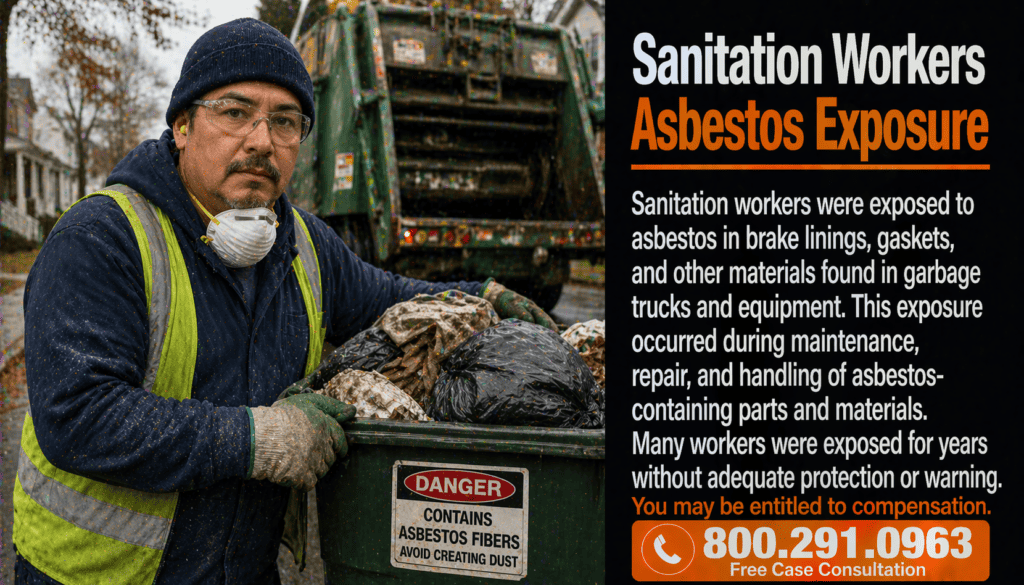
Sanitation Workers Asbestos Exposure
Sanitation workers can collect refuse, handle bulky waste, operate transfer or disposal equipment, clean public facilities and work around demolition or disaster debris. Sanitation work itself does not prove asbestos exposure, but certain assignments can create a potential pathway when waste contains documented asbestos-containing material and fibers are released during handling.
EPA regulates the packaging, transport and disposal of regulated asbestos-containing waste generated during covered demolition and renovation work, while NIOSH recognizes hidden hazards in refuse collection and asbestos hazards during emergency cleanup. A credible exposure history identifies the waste source, asbestos-containing material, task, location, dates and circumstances rather than treating ordinary garbage or dust as asbestos.
Sanitation Workers and Occupational Asbestos Exposure
Sanitation work can include residential refuse collection, municipal cleanup, transfer-station operations, landfill work, public-building cleaning, bulky-waste collection and debris removal. NIOSH’s residential waste-collection guidance emphasizes that collectors can encounter hidden chemical and other hazards in the waste stream.
Ordinary household trash, street dust and routine refuse should not be described as asbestos. The asbestos question becomes more specific when a worker handled waste or debris from a building, renovation, demolition, emergency response or asbestos-removal project where asbestos-containing material was documented.
EPA’s asbestos NESHAP program specifically addresses waste generated during regulated renovation and demolition and includes requirements designed to minimize fiber release during waste packaging, transportation and disposal.
Job duties matter. A driver who remained in an enclosed cab can have a different exposure history from a worker who manually loaded broken building debris, cleaned a contaminated area or worked at the point where asbestos waste was unloaded.
Related resources include public sector, government and institutional workers asbestos exposure, demolition workers asbestos exposure, asbestos exposure in buildings and maintenance workers asbestos exposure.
Waste Collection, Demolition Debris and Asbestos
Demolition and renovation debris is one of the strongest documented asbestos pathways relevant to sanitation and municipal cleanup work. EPA states that asbestos NESHAP requirements apply to most municipal demolition projects and require asbestos inspection for covered structures before demolition or renovation.
EPA explains that regulated asbestos-containing material may need to be removed before demolition and that asbestos waste is subject to work-practice and disposal requirements. Those controls are intended to limit fiber release.
Debris That May Merit Investigation
- Waste from a building known to contain regulated asbestos-containing material
- Broken asbestos-containing insulation or lagging from renovation work
- Asbestos-containing construction materials identified during demolition
- Waste bags, containers or drums generated by asbestos-abatement work
- Disaster debris from damaged buildings where asbestos contamination was documented
EPA’s catastrophic-emergency guidance specifically addresses asbestos concerns for responders, debris cleanup, demolition, transport and disposal after disasters. This supports investigating sanitation assignments involving damaged older structures while avoiding the assumption that all disaster debris contains asbestos.
Related demolition information is available through demolition workers asbestos exposure.
Transfer Stations, Landfills and Disposal Sites
EPA’s asbestos compliance program covers waste disposal sites as well as renovation and demolition activities. Regulated asbestos-containing material removed during covered work must be managed and disposed of according to applicable requirements.
NIOSH historically recommended that removed asbestos material be wetted, sealed in labeled containers and transported to an approved disposal site. Modern requirements should be checked under current federal, state and local rules.
Potential sanitation-worker exposure at a transfer station or landfill depends on whether asbestos-containing waste was actually present and whether packaging, handling or disposal conditions allowed fibers to escape.
Questions for Disposal-Site Exposure
- Was the facility authorized to receive asbestos-containing waste?
- Did the worker unload, compact, bury or handle asbestos waste?
- Were containers damaged, open or visibly leaking?
- Was dry debris broken, crushed or disturbed?
- Are manifests, disposal records, incident reports or landfill records available?
- Did the worker receive asbestos training or protective equipment?
A landfill job by itself does not establish asbestos exposure. Waste manifests, facility permits, shipment records, employer procedures and coworker testimony can help identify whether asbestos waste was part of the worker’s duties.
Cleanup, Handling and Maintenance Tasks
Asbestos exposure is more plausible when a sanitation worker directly handles or disturbs confirmed asbestos-containing waste or contaminated debris.
- Manual loading: lifting or moving broken confirmed asbestos-containing debris
- Cleanup: sweeping or shoveling residue after a documented asbestos disturbance
- Container handling: moving damaged asbestos-waste bags, drums or containers
- Compaction: disturbing asbestos-containing debris where applicable controls were absent or failed
- Disaster cleanup: removing debris from damaged structures with documented asbestos materials
- Facility maintenance: disturbing asbestos-containing materials in sanitation garages, shops or public buildings
- Nearby exposure: working close to asbestos removal, demolition or waste handling that released fibers
NIOSH recommends avoiding dry sweeping and dry shoveling when dealing with material known or presumed to be contaminated with asbestos and recommends wet methods, isolation and appropriate respiratory protection. EPA’s NESHAP likewise uses wetting, leak-tight containment and controlled disposal to minimize asbestos emissions.
NIOSH’s general custodial guidance shows that cleaners routinely sweep, mop, remove trash and move materials. Those ordinary tasks are not asbestos exposure unless a documented asbestos source is involved.
Need help now? Call 800.291.0963
Live chat available 24/7, 365 days a year.
Submit Your Case
Mesothelioma and Other Occupational Health Risks
NIOSH’s review of workplace asbestos exposure recognizes asbestos as a carcinogenic occupational hazard. Asbestos exposure is associated with malignant mesothelioma, lung cancer and asbestosis.
Sanitation workers also face many hazards unrelated to asbestos. NIOSH waste-collection guidance addresses traffic, equipment, lifting, hidden chemical hazards, compaction and unloading, while custodial guidance discusses cleaning chemicals, infectious agents and ergonomic risks. Those hazards should not be used as evidence of asbestos exposure.
Asbestos-related disease can develop long after exposure. Historical sanitation assignments, demolition projects, waste routes, landfill records and municipal documents may therefore become important decades after the work occurred.
Medical questions about prior occupational asbestos exposure, symptoms, screening or diagnosis should be discussed with a qualified healthcare professional.
Documenting Sanitation Worker Asbestos Exposure
A useful exposure history connects the worker to a specific waste stream, location, asbestos-containing material and task.
- Employment: municipality, sanitation district, waste company, contractor, department and dates
- Assignments: collection route, transfer station, landfill, cleanup crew, demolition site or public facility
- Waste source: renovation, demolition, abatement, disaster cleanup or other identifiable source
- Material evidence: asbestos surveys, inspection reports, laboratory results, labels and photographs
- Disposal evidence: manifests, landfill logs, shipment records, permits and waste tickets
- Work practices: loading, sweeping, shoveling, compaction, unloading, wetting and container handling
- Employer records: training, respirator, PPE, incident and safety records
- Witnesses: drivers, collectors, landfill operators, supervisors, demolition crews and abatement workers
Municipal records can be especially useful because demolition permits, asbestos notifications, inspection files and waste-disposal documentation may identify the source of debris handled by sanitation employees.
Questions That Can Strengthen an Exposure History
Which employer and years? What route or facility? Did the worker handle demolition or abatement debris? Was asbestos documented at the source building? Where was the waste taken? Were containers intact? Was dry debris swept, shoveled or compacted? Are manifests, permits, inspection reports, photographs or coworkers available?
Lawsuits, Trust Funds and Compensation
A sanitation worker diagnosed with mesothelioma or another asbestos-related disease may have potential legal or compensation options when evidence supports occupational asbestos exposure and applicable requirements are met.
Sanitation employment alone does not establish liability, causation, trust eligibility or compensation. A claim may require evidence connecting the worker to an asbestos-containing product, demolition or renovation source, responsible company, contractor, premises, waste generator or other legally relevant party.
Potential evidence can include employment and union records, municipal work orders, demolition permits, asbestos notifications, waste manifests, landfill logs, building surveys, abatement files, photographs, witness statements and medical documentation.
Claims involving municipal or other public employment can also raise jurisdiction-specific procedural rules or deadlines. Asbestos bankruptcy trusts have separate medical and exposure criteria. Compensation is not guaranteed.
Related Public-Sector and Cleanup Resources
Public sector: Public Sector, Government & Institutional Workers Asbestos Exposure
Demolition: Demolition Workers Asbestos Exposure · Building Inspectors Asbestos Exposure
Maintenance: Maintenance Workers Asbestos Exposure · Maintenance Mechanics Asbestos Exposure
Authoritative Sources
This page was researched using EPA and NIOSH government evidence. The strongest sanitation-specific pathway is handling waste or debris from documented asbestos demolition, renovation, abatement or disaster cleanup. Federal sources also emphasize controlled packaging, transport and disposal of asbestos-containing waste.
- EPA — Asbestos-Containing Materials and Demolition
- EPA — Overview of the Asbestos NESHAP
- EPA — Asbestos Demolition and Renovation Compliance Monitoring
- EPA — Catastrophic Emergency Situations Involving Asbestos
- NIOSH — Residential Waste Collection: Hazard Recognition and Prevention
- NIOSH — Workplace Exposure to Asbestos: Review and Recommendations
Sanitation Workers Asbestos Exposure FAQ
Were all sanitation workers exposed to asbestos?
No. Sanitation work itself does not establish asbestos exposure. The waste source, material, assignment, location and work practices should be documented.
Could demolition debris expose sanitation workers to asbestos?
Potentially, when the debris actually contains asbestos and handling or disturbance releases fibers. EPA regulates asbestos-containing waste from covered demolition and renovation work.
Is ordinary household garbage an asbestos exposure?
Not by itself. A specific asbestos-containing or asbestos-contaminated material must be identified rather than assuming routine refuse contains asbestos.
Could landfill workers encounter asbestos waste?
Potentially. EPA’s asbestos program covers waste disposal sites, but an individual worker’s exposure depends on whether asbestos waste was present and how it was packaged and handled.
Why are asbestos waste manifests or disposal records important?
They may help connect a worker, facility and time period to documented asbestos-containing waste and identify where the waste originated and was disposed.
Could disaster cleanup involve asbestos exposure?
Potentially. EPA and NIOSH recognize asbestos as a possible hazard during disaster response and cleanup, particularly when damaged buildings contained asbestos materials.
What records can help document sanitation worker asbestos exposure?
Employment files, route assignments, demolition permits, asbestos notifications, waste manifests, landfill logs, incident reports, photographs and coworker statements can help reconstruct exposure.
Can sanitation workers qualify for asbestos trust fund claims?
Some may qualify if they satisfy a trust’s medical and exposure requirements and can connect their work to a covered asbestos company, product, site or qualifying exposure period. Sanitation employment alone does not establish eligibility.
Get Help Reviewing Sanitation Worker Asbestos Exposure
Call 800.291.0963
Live chat is available 24/7, 365 days a year.
Prior sanitation, refuse-collection, landfill or cleanup work does not automatically prove asbestos exposure, disease causation, liability, claim eligibility or compensation. Each situation depends on the employer, dates, waste source, asbestos-containing material, work assignment, handling conditions, exposure evidence, medical evidence and applicable legal requirements. Compensation is not guaranteed.
⚕️ Legal & Medical Information Disclaimer
This page provides general educational information and is not medical or legal advice. The information does not establish asbestos exposure, diagnosis, causation, liability, claim eligibility or compensation. Medical concerns should be discussed with a qualified healthcare professional, and legal questions should be reviewed with a qualified attorney.