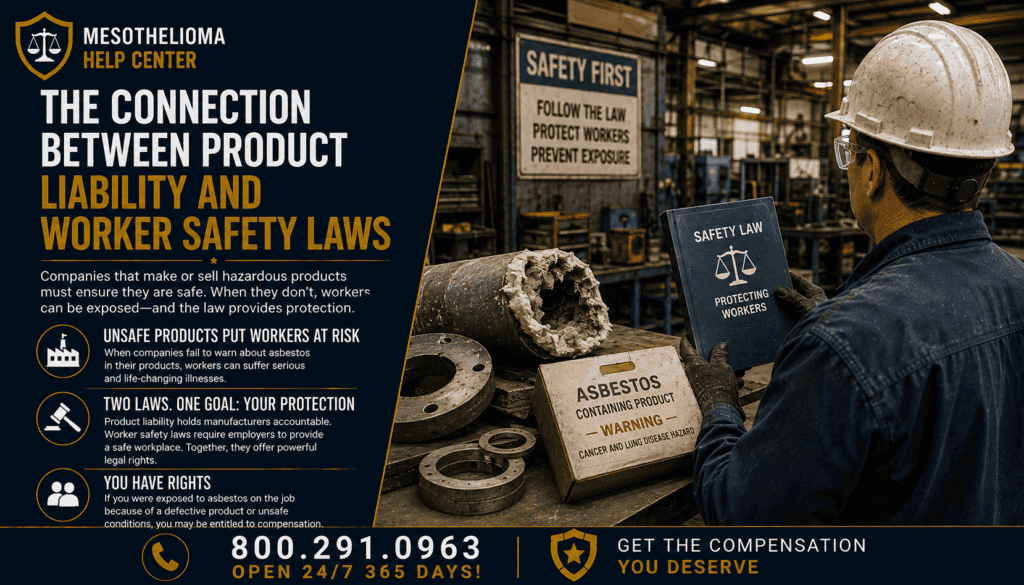
The Connection Between Product Liability and Worker Safety Laws
Asbestos product liability and workplace safety law can involve the same job, material and exposure history, but they address different legal questions. OSHA asbestos standards primarily impose workplace duties on covered employers and building or facility owners, while a product liability claim generally requires separate proof concerning a product, a legally responsible party, exposure, causation and the law that applies to the claim.
An OSHA record, safety violation or evidence that asbestos was present can be important occupational evidence, but it does not automatically establish product liability. Likewise, identifying an asbestos-containing product does not by itself prove that an employer violated OSHA requirements. The strongest reconstruction keeps product evidence, workplace-safety evidence, medical evidence and legal conclusions separate.
Product Liability and Worker Safety Laws
Occupational asbestos cases can involve several overlapping bodies of law. OSHA regulates workplace health and safety under federal occupational standards. Separate state-law rules may govern claims involving manufacturers, suppliers, premises owners or other parties. Workers’ compensation, bankruptcy trust procedures and other legal systems can also apply depending on the facts.
OSHA’s general-industry asbestos standard requires covered employers to control workplace exposure and imposes specific duties involving monitoring, regulated areas, engineering controls, work practices, respiratory protection, medical surveillance, communication and records. It also places duties on building and facility owners concerning information about asbestos-containing material and presumed asbestos-containing material.
Those regulatory duties can create valuable historical evidence. They should not, however, be described as a substitute for the elements required by a product liability claim under applicable law.
Related resources include worker safety, documentation and occupational resources, the role of OSHA in worker protection and identifying where and when occupational exposure occurred.
How Product Liability and OSHA Rules Differ
OSHA standards focus on protecting employees from workplace hazards. They define duties for covered employers and, in some provisions, building or facility owners. OSHA’s asbestos rules differ by industry, with separate standards for general industry, construction and shipyard employment.
Product liability is not one nationwide asbestos rule administered by OSHA. Product-related claims are generally governed by the applicable law and facts of the case. Requirements can vary by jurisdiction and theory of liability.
Questions OSHA Evidence Can Address
- Was workplace asbestos exposure monitored?
- What operation was being sampled?
- Were employees represented by the measurements identified?
- Were regulated areas or protective controls required?
- What asbestos information did an employer or building owner possess?
- Were training, medical-surveillance or exposure records maintained?
Separate Product-Liability Questions May Include
- Which product or material allegedly contained asbestos?
- Who manufactured, supplied or was otherwise legally responsible for it?
- Was the worker exposed to fibers from that product?
- What warnings or instructions accompanied the product?
- What evidence connects the product to the worker’s disease?
- Which jurisdiction’s law and filing deadlines apply?
The answers can overlap factually without being legally interchangeable.
Product Identification and Exposure Evidence
Product identification is often one of the most important factual steps in reconstructing an occupational asbestos history. A worker may remember insulation, gaskets, packing, brake components, construction materials or equipment but not know whether the material contained asbestos or who made it.
Records That May Help Identify Products
- Purchase orders and invoices
- Product catalogs and specifications
- Equipment manuals and parts lists
- Construction drawings and job specifications
- Asbestos surveys and laboratory analyses
- Maintenance and repair records
- Shipping and warehouse records
- Historical photographs and coworker testimony
OSHA’s asbestos standards themselves recognize the importance of product-specific evidence. When an employer relies on objective data to show that a product or activity is not capable of releasing asbestos at or above specified limits under expected conditions, OSHA requires records identifying the product, source of the data, testing or analysis, the operation involved and supporting information.
That regulatory recordkeeping requirement does not decide product liability, but it illustrates why precise identification of the product and how it was used can matter.
Occupation-specific research may also help narrow likely products and tasks. Examples include pipefitters asbestos exposure, boilermakers asbestos exposure, auto mechanics brake and clutch dust exposure and insulators asbestos exposure.
OSHA Safety Duties and Exposure Records
OSHA’s general-industry asbestos standard requires covered employers to maintain accurate records of asbestos exposure measurements. Required information includes the date, operation involving exposure, sampling and analytical methods, sample duration and results, respiratory protection and employees represented by the measurements.
Those exposure-measurement records must be maintained for at least 30 years. Covered asbestos medical-surveillance records are maintained for the duration of employment plus 30 years.
OSHA Records That May Help Reconstruct Conditions
- Personal and area exposure-monitoring results
- Objective data concerning asbestos-containing products or activities
- Medical-surveillance records when applicable
- Employee asbestos training records
- Records identifying ACM or presumed ACM in facilities
- Notifications concerning the location and quantity of ACM or presumed ACM
OSHA also requires general-industry building and facility owners to determine the presence, location and quantity of ACM and presumed ACM at covered worksites and maintain required information concerning those materials for the duration of ownership, transferring the records to successive owners.
Employees, former employees and designated representatives have access rights to qualifying exposure records under OSHA’s employee-record-access rule. Those records can help establish what a worker may have encountered and when.
Need help now? Call 800.291.0963
Live chat available 24/7, 365 days a year.
Submit Your Case
Where Product and Workplace Evidence Overlap
The same document can sometimes contribute to both occupational exposure reconstruction and product identification. A maintenance invoice, for example, may identify a manufacturer and replacement component while also showing when and where the work occurred.
Evidence With Potential Overlap
- Product invoices tied to a particular facility
- Equipment records identifying replacement parts
- Asbestos surveys naming specific materials
- Exposure monitoring linked to a particular operation
- Work orders describing removal or repair
- Building-owner asbestos notifications
- Shipping records identifying asbestos-containing inventory
- Coworker testimony connecting a product to a task and time period
OSHA’s employee-record-access standard explains that exposure records can include monitoring data and, in some circumstances, records that reveal the identity of a toxic substance or harmful physical agent and where and when it was used.
That information may help answer the occupational questions of what, where and when. Separate legal analysis is still required to determine whether the evidence satisfies the elements of a product liability or other claim.
The related union asbestos work-condition documentation resource explains how collective bargaining records, representatives, coworkers and NIOSH evaluations may contribute additional historical evidence.
Claims, Defenses and Important Limits
Asbestos litigation can involve product liability, premises liability, employer-related issues, bankruptcy trust claims or other legal theories. Which options are available depends on jurisdiction, employment history, defendant or trust requirements, medical evidence and applicable filing deadlines.
Important Distinctions
- An OSHA violation does not automatically establish product liability.
- OSHA compliance does not automatically resolve every potential civil-liability question.
- A product name alone does not establish that the product contained asbestos during the relevant period.
- Presence of asbestos at a facility does not prove that every worker was exposed.
- Exposure evidence does not by itself establish medical causation.
- Eligibility for an asbestos bankruptcy trust depends on that trust’s requirements.
OSHA’s role is workplace safety and enforcement. A civil court, bankruptcy trust or other claims system applies its own legal and evidentiary rules. Workers should avoid assuming that a safety regulation produces an automatic right to compensation.
Likewise, historical OSHA records can remain valuable even when they do not establish liability by themselves. They may corroborate work locations, asbestos materials, monitored operations, exposure levels, employee groups or employer knowledge.
Documenting Product and Occupational Exposure
A useful asbestos history keeps evidence organized by employer, location and time period. Product evidence should be connected to the specific worksite and task rather than presented as an unrelated list of asbestos brands or materials.
Suggested Evidence Checklist
- Employment: employer, job title, department and dates
- Location: plant, ship, building, project or facility
- Task: work performed by the individual or nearby trades
- Product: manufacturer, brand, material or component when supported
- Asbestos content: reliable evidence that the product contained asbestos in the relevant period
- Exposure pathway: how fibers could have been released and reached the worker
- Workplace records: monitoring, training, surveys, notifications and work orders
- Corroboration: invoices, specifications, photographs, coworkers and other records
The occupational exposure identification resource provides a framework for reconstructing dates and jobsites. The hidden occupational risks resource covers maintenance, renovation, housekeeping and bystander pathways.
Medical Evidence Is a Separate Part of the Record
Product and occupational records address exposure history. Medical records address diagnosis, clinical history and causation questions. The preventive health screenings for at-risk workers resource explains occupational medical surveillance and important screening limitations.
Neither OSHA records nor product records automatically establish disease causation, liability, claim eligibility or compensation. Compensation is not guaranteed.
Related Worker Safety Resources
OSHA protections: The Role of OSHA in Worker Protection
Exposure records: Worker Safety, Documentation & Occupational Resources
Work history: Occupational Exposure: Identifying Where & When You Were Exposed
Authoritative Sources
This page uses OSHA’s primary federal asbestos standards and employee-record-access rule. These sources establish workplace asbestos duties and documentation requirements; they are not presented as a statement of the elements of a product liability claim under any particular state’s law.
- OSHA — Asbestos, General Industry, 29 CFR 1910.1001
- OSHA — Asbestos in Construction, 29 CFR 1926.1101
- OSHA — Asbestos in Shipyard Employment, 29 CFR 1915.1001
- OSHA — Access to Employee Exposure and Medical Records, 29 CFR 1910.1020
- OSHA — Asbestos Safety and Health Topics
- OSHA — Substance Technical Information for Asbestos, Appendix G
Product Liability and Worker Safety FAQ
Are OSHA asbestos rules the same as product liability law?
No. OSHA standards establish workplace safety duties for covered employers and certain owners. Product liability claims involve separate legal requirements determined by applicable law.
Can OSHA records help identify an asbestos product?
Sometimes. Exposure records, objective data, asbestos notifications and related workplace documents may identify materials, operations or products associated with a worksite.
Does an OSHA asbestos violation automatically prove product liability?
No. An OSHA violation may be relevant evidence in some circumstances, but product identification, exposure, causation and the other requirements of the applicable claim must still be established.
Does OSHA compliance automatically defeat an asbestos product claim?
Not necessarily. OSHA compliance addresses occupational regulatory duties. The legal effect of compliance in a civil product claim depends on applicable law and case-specific evidence.
How long are OSHA asbestos exposure-monitoring records kept?
OSHA’s general-industry, construction and shipyard asbestos standards require covered exposure-measurement records to be maintained for at least 30 years.
Can building-owner asbestos records help document exposure?
Potentially. OSHA’s general-industry standard requires covered building and facility owners to maintain certain information about the presence, location and quantity of ACM and presumed ACM for the duration of ownership and transfer those records to successive owners.
What evidence can connect a product to a worker?
Invoices, specifications, equipment records, asbestos surveys, work orders, photographs and coworker testimony may help connect a product to a particular workplace, task and time period.
Does identifying an asbestos product guarantee compensation?
No. Exposure, medical causation, liability, filing requirements and other claim-specific elements must still be established. Compensation is not guaranteed.
Get Help Reviewing Occupational Asbestos Exposure
Call 800.291.0963
Live chat is available 24/7, 365 days a year.
An OSHA record, workplace violation, asbestos-containing product or historical jobsite does not automatically prove asbestos exposure, disease causation, product liability, other legal liability, claim eligibility or compensation. Each situation depends on the product, employer, jobsite, dates, exposure pathway, medical evidence and applicable law. Compensation is not guaranteed.
⚕️ Legal & Medical Information Disclaimer
This page provides general educational information and is not medical or legal advice. The information does not establish asbestos exposure, diagnosis, causation, liability, claim eligibility or compensation. Medical concerns should be discussed with a qualified healthcare professional, and legal questions should be reviewed with a qualified attorney.