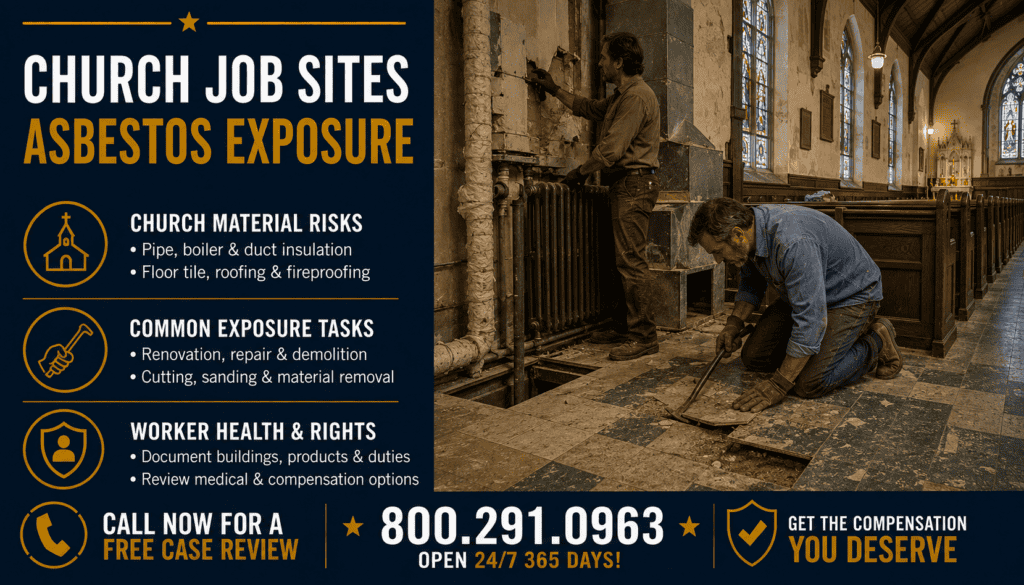
⛪ Church Job Sites Asbestos Exposure
People who worked on church construction and renovation projects may have encountered asbestos-containing materials during specific historical tasks. This guide explains where exposure could occur and what evidence matters after a mesothelioma or asbestos-related lung cancer diagnosis.
Worksite history, building or vessel records, product identification and medical documentation can help clarify possible exposure and legal options. The presence of an older workplace alone does not establish asbestos exposure.
🏭 Where Asbestos Exposure Could Occur
Boiler Houses and Steam Lines
Turbine Halls
Pumps and Valve Galleries
Electrical Rooms and Switchgear
Cooling and Auxiliary Systems
Church construction and renovation projects frequently combined worship spaces, fellowship halls, classrooms, kitchens, offices, bell towers and mechanical rooms. In older properties, possible asbestos-containing materials included pipe insulation, boiler coverings, ceiling textures, floor tiles, adhesives, fireproofing and certain roofing materials. A congregation’s age alone cannot establish whether any particular product contained asbestos; renovation surveys, specifications and laboratory records are more informative.
Building campaigns often took place in stages. A church might add a sanctuary, renovate a basement kitchen, replace a steam boiler or convert schoolrooms into community facilities decades after the original construction. Each phase introduced different contractors and materials. A person’s work history should identify the specific building, room, project, employer and period rather than treating the entire property as one uniform exposure setting.
Mechanical spaces deserve attention because older heating equipment and insulated pipes could be repaired while other activities continued nearby. Maintenance staff might enter boiler rooms, crawl spaces, attics or utility chases, while renovation workers opened walls and ceilings to replace services. These are potential disturbance pathways, not proof that every church building contained asbestos or that every worker was exposed.
Church-affiliated schools and daycare facilities may have additional recordkeeping requirements depending on their legal status. The EPA explains that public and nonprofit private schools, including some religiously affiliated schools, are subject to federal school asbestos management requirements. A standalone sanctuary should not automatically be treated as a regulated school; identify the actual use and ownership of each building.
Related worksite records and exposure patterns are also discussed in Construction Sites. Compare those settings only when they match the actual work, dates and materials involved.
Related worksite records and exposure patterns are also discussed in Historic Building Renovation Job Sites. Compare those settings only when they match the actual work, dates and materials involved.
👷 Workers and Daily Jobs
Boilermakers
Pipefitters
Turbine Mechanics
Electricians
Millwrights
Construction carpenters, drywall installers, roofers, floor layers, painters, plumbers, electricians, heating technicians, insulators and demolition crews worked on different phases of church projects. Custodians and facilities employees sometimes assisted with repairs, moved stored materials or cleaned up after contractors. The central question is whether a particular task disturbed asbestos-containing material and whether the person breathed airborne fibers.
Volunteer labor was common in some church building programs. Volunteers may have removed old flooring, cleared debris, repaired ceilings or helped with renovations without knowing what materials were present. Volunteer status does not establish exposure, and legal options can differ from those of paid workers. A timeline should distinguish employment, independent contracting and volunteer activity.
Workers who only attended services or performed administrative duties generally had different potential exposure pathways from tradespeople cutting or removing older materials. However, an occupied building undergoing poorly controlled renovations could expose bystanders. Consider where the work was conducted, whether barriers and ventilation were used, and whether the person was present during dusty tasks.
Records from general contractors, local building departments, church property committees and mechanical service firms may identify the people and products involved. Historic photographs can also show additions, roof replacement or equipment changes. These details are more useful than assuming that every construction phase used identical products.
Related worksite records and exposure patterns are also discussed in Demolition Site Job Sites. Compare those settings only when they match the actual work, dates and materials involved.
Related worksite records and exposure patterns are also discussed in Public Housing Job Sites. Compare those settings only when they match the actual work, dates and materials involved.
🧱 Asbestos-Containing Products and Equipment
Boiler Lagging
Turbine Insulation
Valve Packing
Flange Gaskets
Insulated Steam Piping
Potential materials in older church projects included resilient floor tiles and mastics, sprayed-on acoustical finishes, thermal insulation, cement siding, roofing felts, gaskets and boiler components. Some products of these general types were manufactured without asbestos, so identification requires product evidence. Original architectural schedules, invoices, packaging photographs and abatement surveys may narrow the question.
Sanctuaries often had large ceiling surfaces and unusual acoustic requirements. Renovations involving textured finishes, suspended ceilings or fireproofing could disturb suspect materials. In attached kitchens and fellowship halls, pipe insulation, mechanical equipment and floor coverings may be more relevant. Different rooms and systems should be documented separately.
An older church may have a combination of original equipment and newer replacements. The year a boiler was removed, a heating loop was re-piped or a roof was resurfaced can help identify which trades were nearby. Do not assume that a modern replacement contained asbestos merely because the equipment it replaced was old.
Photographs of equipment nameplates, building plans and contractor proposals may be valuable when physical samples are unavailable. Do not collect, scrape or disturb suspect material yourself to support a claim; qualified professionals can assess buildings and follow applicable rules.
Related worksite records and exposure patterns are also discussed in Renovation Job Sites. Compare those settings only when they match the actual work, dates and materials involved.
Related worksite records and exposure patterns are also discussed in Fire Stations. Compare those settings only when they match the actual work, dates and materials involved.
🌫️ How Exposure Happened
Airborne exposure can occur when workers saw, sand, drill, scrape, remove or demolish asbestos-containing materials. For example, lifting old floor tiles may disturb adhesive, opening pipe chases may damage insulation, and cutting ceiling assemblies may release accumulated debris. Whether fibers were released depends on the actual material and the method of work.
Church projects may have been scheduled around worship services, weddings, funerals and community programs. A construction schedule can establish whether the building was occupied while dusty work occurred. Look for photographs, service bulletins, project announcements and contractor schedules to reconstruct when renovations took place.
Cleaning methods matter. Dry sweeping, unfiltered vacuuming and carrying debris through occupied corridors can spread dust; properly planned asbestos work uses containment and other controls appropriate to the task. A worker should not infer an exposure level from memory alone, but can describe visible dust, duration and the specific operation.
Workers sometimes moved between multiple congregational properties. A maintenance employee could service the sanctuary, parsonage, school and community hall in the same week. Recording each location separately helps connect exposure scenarios to the correct building and owner.
Related worksite records and exposure patterns are also discussed in Schools. Compare those settings only when they match the actual work, dates and materials involved.
Related worksite records and exposure patterns are also discussed in Nursing Homes. Compare those settings only when they match the actual work, dates and materials involved.
🩺 Mesothelioma After Workplace Exposure
Mesothelioma is a cancer strongly linked to asbestos exposure and may be diagnosed decades after a person worked with or near asbestos-containing products. Earlier jobs can be important even when a facility has changed owners or closed. Record the employers, work areas, years, products and coworkers you remember.
If you have received a mesothelioma diagnosis, request copies of pathology reports, imaging results and treatment summaries. Ask your medical team about specialist care and treatment options. Gathering old work records should not delay medical appointments or recommended treatment.
Exposure may have occurred at more than one job, including earlier construction, maintenance or military service. A complete chronological work history can help distinguish different possible sources instead of attributing everything to one workplace.
For a related exposure comparison, review Power Plant Mesothelioma Lawsuit. Compare the actual products and work performed rather than treating another workplace as proof of exposure here.
🫁 Asbestos-Related Lung Cancer
Asbestos is an established cause of lung cancer. Smoking also causes lung cancer, and combined smoking and asbestos exposure increases risk substantially. A history of smoking does not erase a genuine occupational exposure history. The cause of an individual cancer requires professional assessment.
Tell your physicians about the years and duties involving older insulation, gaskets, friction materials or building products. Save diagnostic imaging, pathology reports and treatment dates alongside your employment timeline. Not every lung cancer diagnosis is asbestos-related, and no single job title establishes causation.
Medical care and questions about possible legal options can proceed at the same time. A careful record is more helpful than guessing which product was present or promising that compensation will be available.
📋 Work History and Evidence
Start with a written timeline that lists each employer, location, approximate dates, department, tasks and coworkers. Add photographs, old equipment names and details of major repairs. If you were a contractor, identify both your employer and the facility where the work happened.
| Possible record | Why it matters |
|---|---|
| Pay records and Social Security earnings | Employment dates and employers |
| Union, pension or contractor records | Trade and assignments |
| Maintenance orders and equipment manuals | Products, machinery and repair dates |
| Photographs and coworker recollections | Work areas and dust-producing tasks |
| Pathology and treatment records | Diagnosis and medical chronology |
Keep originals and save copies. If a workplace closed, former coworkers, unions, contractors and pension administrators may still have information. Do not publish sensitive medical records or identifying details on public websites.
Related worksite records and exposure patterns are also discussed in University Building Job Sites. Compare those settings only when they match the actual work, dates and materials involved.
Related worksite records and exposure patterns are also discussed in Hospital Job Sites. Compare those settings only when they match the actual work, dates and materials involved.
⚖️ Compensation and Legal Options
Some people diagnosed with mesothelioma or asbestos-related lung cancer after occupational exposure may qualify to pursue claims involving asbestos-product manufacturers, bankruptcy trust funds or other benefits. Eligibility depends on diagnosis, exposure evidence, applicable law and deadlines.
Different asbestos trusts have different medical and product-exposure criteria. Some families may have wrongful-death options, and qualifying veterans may have separate VA benefit questions. No payment is automatic. Seek timely, individualized advice because filing deadlines vary.
It is reasonable to ask questions before you have located every old document. Start with the work you actually performed and the diagnosis you received. The goal is an accurate account, not an assumption that every material at a site contained asbestos.
Related worksite records and exposure patterns are also discussed in Government Building Job Sites. Compare those settings only when they match the actual work, dates and materials involved.
Related worksite records and exposure patterns are also discussed in Hotels. Compare those settings only when they match the actual work, dates and materials involved.
📚 Confirmed Sources
OSHA — Asbestos Construction Standard
EPA — Asbestos and School Buildings
❓ Frequently Asked Questions
Did everyone at this workplace encounter asbestos?
No. Products, construction dates, work areas and job duties varied. Exposure depends on the material and the task.
What if I worked near repairs but did not perform them?
Describe your proximity, ventilation, frequency of work and cleanup. Nearby workers sometimes shared the same air.
Can an old job still matter?
Yes. Mesothelioma can develop decades after asbestos exposure. Work performed long before retirement may remain relevant.
What if I cannot remember a product brand?
Begin with the equipment, repair, location, coworkers and years. Manuals or records may help identify the product later.
What if the workplace has closed?
Pay records, unions, contractors, former coworkers and pension records may still help document the work.
Does smoking prevent an asbestos-related lung cancer claim?
No. Smoking and asbestos are separate risk factors. Eligibility and causation require individualized review.
Are asbestos trust payments guaranteed?
No. Trusts have specific eligibility and documentation requirements.
Can a family member ask about a claim?
Potentially. Survivor and wrongful-death options depend on applicable law and deadlines.
What should I do after a diagnosis?
Continue medical care, save medical documents, write your employment history and ask promptly about legal deadlines.
Is coal dust the same as asbestos?
No. Coal mine dust causes coal workers’ pneumoconiosis, while asbestos fibers can cause mesothelioma and asbestos-related lung cancer. Mine workers may encounter multiple hazards, and the substances should not be conflated. NIOSH discusses coal dust, silica, diesel particulate and other mineral particles as separate mining hazards.
What records are most useful for church renovation projects?
Begin with the exact location, employer and dates, then collect work orders, renovation or abatement records, equipment specifications and coworker names. Medical documentation is also important after diagnosis.
GET THE COMPENSATION YOU DESERVE
If you have been diagnosed with mesothelioma or asbestos-related lung cancer after working around asbestos, you deserve clear information about possible compensation and trust fund options. Tell us where you worked and when you were diagnosed.
Helping people for more than 25 years · Open 24/7, 365 days!
Call to discuss your work history:
800.291.0963Or send your information online:
Mesothelioma Help Center is not a law firm or medical provider and does not determine legal or VA eligibility. This information is not individualized medical or legal advice.