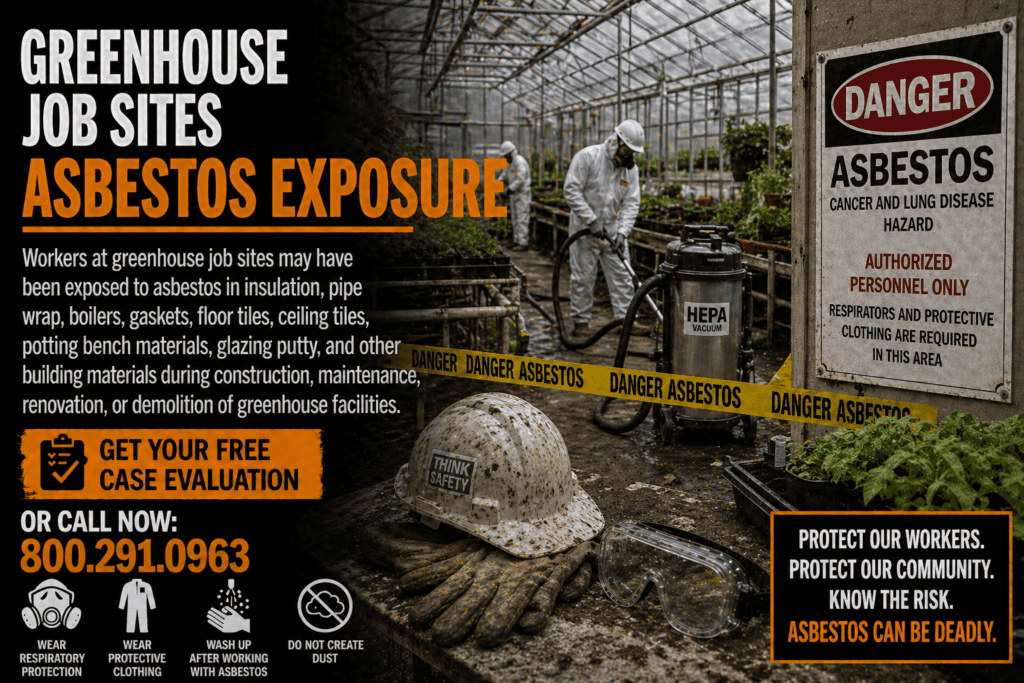
🌱 Greenhouses Asbestos Exposure
If you worked in greenhouses, commercial nurseries and horticultural growing facilities and have been diagnosed with mesothelioma or asbestos-related lung cancer, the places you worked and the repairs you witnessed matter. Asbestos-containing insulation, gaskets, building products and certain equipment parts were used in older facilities; disturbing them released fibers into the air.
This page explains exposure involving heating systems, boilers, insulated pipes and maintenance. You can begin by listing employers, years, equipment, tasks and coworkers, even if you do not remember the name of every product.
🏭 Where Asbestos Was Found
Exposure conditions differed across greenhouses, commercial nurseries and horticultural growing facilities. The relevant questions are whether a specific product contained asbestos, whether workers disturbed it and who was nearby. The following work areas illustrate where those questions arise.
Boiler Houses and Heating Loops
Steam and hot-water boilers kept growing houses warm during cold seasons. Older asbestos insulation on boilers, headers, elbows and valves was disturbed during maintenance, especially before winter startup. For related workplace details, see Mechanics Electricians Asbestos Exposure and compare the tasks with your own employment history.
For boiler houses and heating loops, record the dates, repair or renovation project, contractor names and any dust-producing cleanup. Equipment manuals, photographs or coworker recollections may help identify the materials used in that part of the property.
Greenhouse Pipe Runs
Heating pipes ran beneath benches and along growing aisles. Workers repairing leaks or replacing insulated lines sometimes handled deteriorated insulation and debris. For related workplace details, see Manufacturing Electricians Mechanics Asbestos Exposure and compare the tasks with your own employment history.
For greenhouse pipe runs, record the dates, repair or renovation project, contractor names and any dust-producing cleanup. Equipment manuals, photographs or coworker recollections may help identify the materials used in that part of the property.
Potting and Service Buildings
Older service buildings housed electrical panels, pumps and flooring. Renovation contractors encountered asbestos-containing construction products in some buildings. For related workplace details, see Cement Plant Electricians Mechanics Asbestos Exposure and compare the tasks with your own employment history.
For potting and service buildings, record the dates, repair or renovation project, contractor names and any dust-producing cleanup. Equipment manuals, photographs or coworker recollections may help identify the materials used in that part of the property.
Maintenance and Pump Rooms
Mechanics changed pump packing and flange gaskets, and repaired older motors. These jobs mattered when installed parts actually contained asbestos. For related workplace details, see Water Treatment Plant Maintenance Repair Workers Asbestos Exposure and compare the tasks with your own employment history.
For maintenance and pump rooms, record the dates, repair or renovation project, contractor names and any dust-producing cleanup. Equipment manuals, photographs or coworker recollections may help identify the materials used in that part of the property.
Heating System Renovations
Major greenhouse expansions involved cutting out older piping and replacing boilers. Seasonal employees sometimes worked near contractors during demolition. For related workplace details, see Pump Stations Mechanical Rooms Asbestos Exposure and compare the tasks with your own employment history.
For heating system renovations, record the dates, repair or renovation project, contractor names and any dust-producing cleanup. Equipment manuals, photographs or coworker recollections may help identify the materials used in that part of the property.
👷 Workers and Daily Jobs
Workers at greenhouses, commercial nurseries and horticultural growing facilities had different duties. People who removed old components faced different circumstances from people who worked in adjacent areas. Write down what happened during an ordinary shift and during major repairs, not just the title printed on a pay stub.
| Occupation | Details to record |
|---|---|
| Greenhouse Heating Technicians | Years and work areas; machines or materials handled; nearby contractors; maintenance, removal and cleanup tasks; names of coworkers. |
| Boiler Operators | Years and work areas; machines or materials handled; nearby contractors; maintenance, removal and cleanup tasks; names of coworkers. |
| Maintenance Mechanics | Years and work areas; machines or materials handled; nearby contractors; maintenance, removal and cleanup tasks; names of coworkers. |
| Irrigation Technicians | Years and work areas; machines or materials handled; nearby contractors; maintenance, removal and cleanup tasks; names of coworkers. |
| Nursery Laborers | Years and work areas; machines or materials handled; nearby contractors; maintenance, removal and cleanup tasks; names of coworkers. |
| Renovation Contractors | Years and work areas; machines or materials handled; nearby contractors; maintenance, removal and cleanup tasks; names of coworkers. |
A maintenance crew might remove insulation while another employee operated nearby equipment. Shared air during removal, sweeping or debris handling is worth describing. A job title by itself does not prove exposure. For related workplace details, see Boilers Heaters Steam Systems Asbestos Exposure and compare the tasks with your own employment history.
Also identify subcontractors and temporary jobs. A person who moved between several properties may have encountered different products, and the dates can help distinguish older asbestos-containing equipment from later replacements.
⚙️ Products and Equipment
The following materials are relevant to investigations of older greenhouses, commercial nurseries and horticultural growing facilities. They are not a claim that every location used asbestos. Manufacturers changed formulations, and many newer versions do not contain asbestos.
| Product or system | Relevant activity |
|---|---|
| Boiler Insulation | Cutting, scraping, stripping, replacing or cleaning up an asbestos-containing version of boiler insulation could release fibers; identify the product and approximate installation date. |
| Insulated Heating Pipes | Cutting, scraping, stripping, replacing or cleaning up an asbestos-containing version of insulated heating pipes could release fibers; identify the product and approximate installation date. |
| Pump Packing | Cutting, scraping, stripping, replacing or cleaning up an asbestos-containing version of pump packing could release fibers; identify the product and approximate installation date. |
| Flange Gaskets | Cutting, scraping, stripping, replacing or cleaning up an asbestos-containing version of flange gaskets could release fibers; identify the product and approximate installation date. |
| Older Floor Tiles | Cutting, scraping, stripping, replacing or cleaning up an asbestos-containing version of older floor tiles could release fibers; identify the product and approximate installation date. |
Old work orders, purchase invoices, product labels and drawings can identify a specific gasket, insulation product or building component. This is more reliable than assuming every dusty surface contained asbestos. For related workplace details, see School Boiler Rooms Mechanical Systems Asbestos Exposure and compare the tasks with your own employment history.
If you remember the color, location or texture of a material, write that down without trying to identify it by sight. Only appropriate testing or reliable historical records can establish its composition.
🌬️ How Exposure Occurred
In greenhouses, commercial nurseries and horticultural growing facilities, workers disturbed older asbestos-containing materials during servicing, renovation and demolition. Cutting lagging, scraping gaskets, removing flooring and cleaning repair debris could release airborne fibers. Dry sweeping and compressed air could redistribute settled dust. For related workplace details, see Hotel Boiler Rooms Mechanical Systems Asbestos Exposure and compare the tasks with your own employment history.
The most useful account describes one recognizable job: what was opened, which material was removed, whether debris fell onto the floor, how long the work lasted and whether other employees were in the room. Repeat repairs across many years can be important even when each job was short.
Not every repair involved asbestos. Building age, equipment type, product specifications, ventilation and protective controls all affect the interpretation. Avoid guessing that dust from soil, cement or ordinary cleaning products was asbestos.
Dust carried on work clothes and tools sometimes reached homes. Family members who regularly handled contaminated clothing should document that activity separately. Workplace and household histories may involve different dates and sources. For related workplace details, see Cement Plant Powerhouses Boiler Rooms Asbestos Exposure and compare the tasks with your own employment history.
🩺 Mesothelioma After Workplace Exposure
Mesothelioma is a cancer strongly associated with asbestos exposure and often develops decades after fibers were inhaled. Work from many years ago can remain relevant when someone receives a diagnosis after retirement. Your medical team can explain the type of mesothelioma, staging and treatment choices.
After a diagnosis, write a chronological history of jobs at greenhouses, commercial nurseries and horticultural growing facilities, including specific rooms, equipment, repairs and coworkers. Add other jobs and any military service because exposure may have occurred at several places during a career. For related workplace details, see Cement Plant Maintenance Repair Workers Asbestos Exposure and compare the tasks with your own employment history.
Request copies of pathology reports, imaging, treatment summaries and diagnosis dates. Ask whether referral to a mesothelioma specialist is appropriate. Gathering employment records should not delay appointments or recommended care.
Families can help organize old photographs, address books, union information and names of coworkers. Keep firsthand memories separate from facts found in records; both can be useful but should not be confused.
🫁 Asbestos-Related Lung Cancer
Asbestos exposure is an established cause of lung cancer. Smoking is another important risk factor, and combined exposure substantially increases risk. A smoking history does not erase a genuine occupational asbestos exposure history.
If you have lung cancer, tell your treating clinicians about work in greenhouses, commercial nurseries and horticultural growing facilities, especially projects involving insulation, gaskets or demolition. Diagnosis alone cannot establish the cause of an individual cancer; medical and occupational evidence should be considered together. For related workplace details, see Cement Manufacturing Plants Asbestos Exposure and compare the tasks with your own employment history.
Preserve imaging, pathology and treatment records and make a separate timeline of workplace tasks. Explain whether you personally removed materials, worked nearby or cleaned up afterward. Accurate details matter more than broad claims that an entire property was hazardous.
Continue medical care and discuss treatment questions with qualified clinicians. Seeking information about possible compensation is separate from medical diagnosis and should not substitute for it.
📋 Work History and Evidence
Start with employer name, site address, approximate dates, job title, shift, department and the names of supervisors or coworkers. Then record each memorable repair, renovation, demolition or equipment replacement.
| Possible record | What it may show |
|---|---|
| Pay stubs and earnings statements | Employers and years worked |
| Union and pension records | Trades, contractors and assignments |
| Equipment manuals and invoices | Products, suppliers and repair dates |
| Photographs and building plans | Rooms, systems and equipment locations |
| Coworker statements | Tasks, proximity and work practices |
| Medical records | Diagnosis and treatment timeline |
If a business closed, former contractors, union locals, pension administrators and coworkers may still have useful records. Keep originals and copies in a safe place and avoid publicly sharing medical or identity documents. For related workplace details, see Aircraft Mechanics Jet Engine Technicians Asbestos Exposure and compare the tasks with your own employment history.
Do not invent precise dates if you are uncertain. Mark an estimate as approximate and update it when better documentation appears. An accurate timeline is more useful than a polished but unreliable account.
⚖️ Compensation and Legal Options
People diagnosed with mesothelioma or asbestos-related lung cancer after occupational asbestos exposure may have legal or asbestos bankruptcy trust options. Some claims involve manufacturers or suppliers of asbestos-containing products rather than the owner of the property where the work occurred.
Trust funds have separate medical and exposure requirements, and filing deadlines vary by state and claim type. Family members may have wrongful-death options in some circumstances. Compensation is not automatic and no outcome can be promised. For related workplace details, see Aircraft Maintenance Repair Workers Asbestos Exposure and compare the tasks with your own employment history.
If you worked in more than one trade or building, describe each job separately. A clear timeline can help identify which products, employers and manufacturers warrant closer review. Seek timely advice about deadlines after a diagnosis. For related workplace details, see Aircraft Electrical Systems Asbestos Exposure and compare the tasks with your own employment history.
📚 Confirmed Sources
❓ Frequently Asked Questions
Did every location contain asbestos?
No. Installed materials and product dates varied. The specific building, equipment and tasks matter.
What if I never handled insulation myself?
Nearby work during removal or cleanup can be relevant. Describe what you saw and where you stood.
Can decades-old work still matter?
Yes. Mesothelioma commonly appears many years after exposure.
What if the facility closed?
Earnings, union, contractor and former coworker records may still be available.
Do I need the product manufacturer first?
No. Begin with dates, work areas, repairs and coworkers; identification can follow from records.
Does smoking rule out an asbestos-related lung cancer history?
No. Both exposures are relevant to medical risk; individual causation requires professional assessment.
Are trust fund payments guaranteed?
No. Each trust has its own eligibility criteria and documentation rules.
Can families ask about claims?
Depending on applicable law, surviving relatives may have options subject to deadlines.
What is a useful first step?
Continue medical care, save diagnosis records, document your work history and ask about deadlines.
GET THE COMPENSATION YOU DESERVE
If you were diagnosed with mesothelioma or asbestos-related lung cancer after working around asbestos, you deserve clear information about possible claims and trust funds. Share the places you worked and the repairs you remember.
Helping people for more than 25 years · Open 24/7, 365 days!
Call to discuss your work history:
800.291.0963Or send your information online:
Mesothelioma Help Center is not a law firm or medical provider and does not determine legal or VA eligibility. This information is not individualized medical or legal advice.