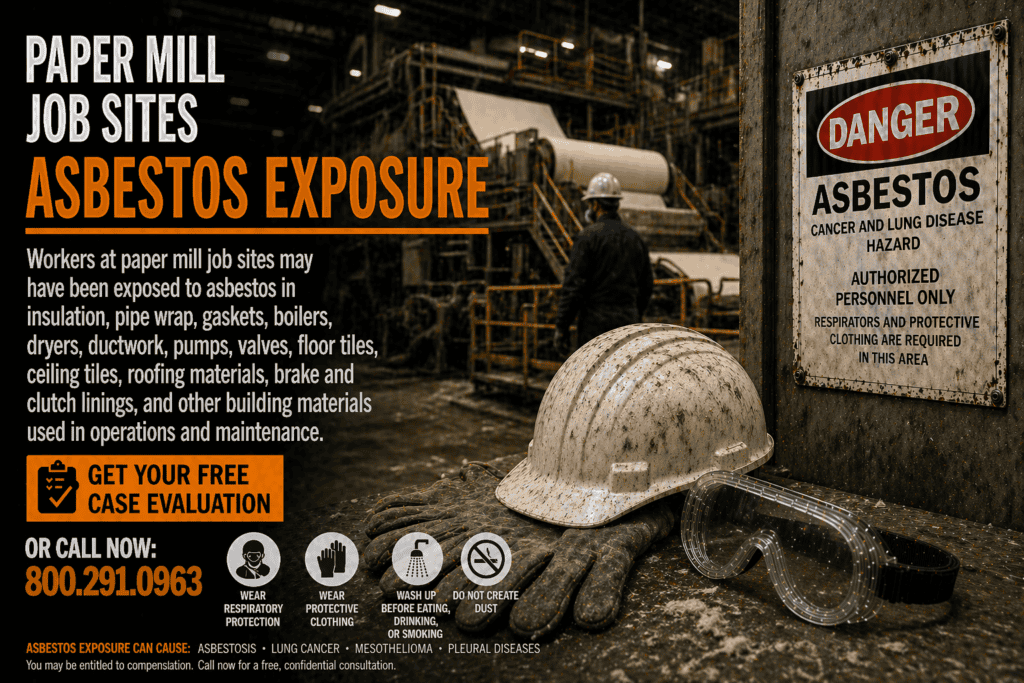
⚓ Paper Mills Asbestos Exposure
Workers involved with paper mills may have encountered asbestos-containing insulation, gaskets, packing or other legacy products during equipment repair, maintenance and renovation. A diagnosis of mesothelioma or asbestos-related lung cancer can make old work histories and material records especially important.
This guide explains exposure settings, occupations, equipment, evidence and possible compensation pathways. Asbestos use varied by manufacturer, vessel or facility, equipment age and renovation history; neither a job title nor a building or vessel name alone establishes exposure.
⚓ Where Asbestos Was Found
Exposure opportunities in paper mills depended on the era, the specific process and the condition of materials being handled. In older installations, heat management and mechanical sealing often determined where asbestos-containing products were used. The following areas are historically plausible points to investigate, not proof that every site contained asbestos.
Paper-machine dryer sections
Steam-heated dryer cylinders, steam joints and hot piping required insulation and routine service. The risk of inhaling fibers was most relevant when a material was cut, scraped, removed, abraded or otherwise disturbed. Intact materials were not equivalent to dusty removal work, and contemporaneous product records are more reliable than assumptions based on appearance.
For paper mills, investigators can compare installation dates with service schedules and vendor documentation. A replacement gasket or insulation wrap may have come from a different supplier than the original equipment. Identifying the exact component, the person who performed the task and whether dust entered occupied work areas helps distinguish potential direct and bystander exposure.
Digesters and recovery boilers
Pulping and chemical-recovery equipment operated at elevated temperatures and sometimes used older insulation. The risk of inhaling fibers was most relevant when a material was cut, scraped, removed, abraded or otherwise disturbed. Intact materials were not equivalent to dusty removal work, and contemporaneous product records are more reliable than assumptions based on appearance.
For paper mills, investigators can compare installation dates with service schedules and vendor documentation. A replacement gasket or insulation wrap may have come from a different supplier than the original equipment. Identifying the exact component, the person who performed the task and whether dust entered occupied work areas helps distinguish potential direct and bystander exposure.
Pumps, valves and packing
Chemical-handling pumps and process valves could contain asbestos packing and flange gaskets. The risk of inhaling fibers was most relevant when a material was cut, scraped, removed, abraded or otherwise disturbed. Intact materials were not equivalent to dusty removal work, and contemporaneous product records are more reliable than assumptions based on appearance.
For paper mills, investigators can compare installation dates with service schedules and vendor documentation. A replacement gasket or insulation wrap may have come from a different supplier than the original equipment. Identifying the exact component, the person who performed the task and whether dust entered occupied work areas helps distinguish potential direct and bystander exposure.
Turbines and power houses
Integrated mills frequently operated steam turbines and onsite boilers with insulated components. The risk of inhaling fibers was most relevant when a material was cut, scraped, removed, abraded or otherwise disturbed. Intact materials were not equivalent to dusty removal work, and contemporaneous product records are more reliable than assumptions based on appearance.
For paper mills, investigators can compare installation dates with service schedules and vendor documentation. A replacement gasket or insulation wrap may have come from a different supplier than the original equipment. Identifying the exact component, the person who performed the task and whether dust entered occupied work areas helps distinguish potential direct and bystander exposure.
Maintenance shutdowns
Rebuilding paper machines and stripping deteriorated insulation could expose mechanics and adjacent workers. The risk of inhaling fibers was most relevant when a material was cut, scraped, removed, abraded or otherwise disturbed. Intact materials were not equivalent to dusty removal work, and contemporaneous product records are more reliable than assumptions based on appearance.
For paper mills, investigators can compare installation dates with service schedules and vendor documentation. A replacement gasket or insulation wrap may have come from a different supplier than the original equipment. Identifying the exact component, the person who performed the task and whether dust entered occupied work areas helps distinguish potential direct and bystander exposure.
👷 Workers and Occupations
The most relevant occupations are those whose duties placed them near legacy insulation, high-temperature machinery, or friction and sealing components. Work assignments changed over time, so job descriptions and dates matter more than titles alone.
Paper-Machine Tenders
Paper-Machine Tenders may have encountered dust while repairing machinery, opening access panels, handling old seals or working alongside insulation removal. Actual exposure depends on the task performed, proximity, ventilation, frequency and whether the material contained asbestos. Former coworkers, work orders and safety records can help reconstruct these conditions.
Millwrights
Millwrights may have encountered dust while repairing machinery, opening access panels, handling old seals or working alongside insulation removal. Actual exposure depends on the task performed, proximity, ventilation, frequency and whether the material contained asbestos. Former coworkers, work orders and safety records can help reconstruct these conditions.
Boiler Operators
Boiler Operators may have encountered dust while repairing machinery, opening access panels, handling old seals or working alongside insulation removal. Actual exposure depends on the task performed, proximity, ventilation, frequency and whether the material contained asbestos. Former coworkers, work orders and safety records can help reconstruct these conditions.
Pipefitters
Pipefitters may have encountered dust while repairing machinery, opening access panels, handling old seals or working alongside insulation removal. Actual exposure depends on the task performed, proximity, ventilation, frequency and whether the material contained asbestos. Former coworkers, work orders and safety records can help reconstruct these conditions.
Electrical And Maintenance Crews
Electrical And Maintenance Crews may have encountered dust while repairing machinery, opening access panels, handling old seals or working alongside insulation removal. Actual exposure depends on the task performed, proximity, ventilation, frequency and whether the material contained asbestos. Former coworkers, work orders and safety records can help reconstruct these conditions.
Supervisors, cleaners, contractors and other workers sometimes occupied the same spaces during overhauls. Their exposure histories should be evaluated separately rather than assumed to match those of hands-on trades. Family members also may have encountered contaminated clothing in historical settings, although the circumstances require individual review.
🧱 Materials and Equipment
| Historical product or system | Why it matters | Evidence to seek |
|---|---|---|
| Pipe and equipment lagging | Removal or deterioration could release fibers if the insulation contained asbestos | Insulation specifications and repair logs |
| Flange gaskets and valve packing | Cutting, scraping or replacing legacy sealing materials could produce dust | Equipment manuals and replacement invoices |
| Heat-resistant sheets and panels | Some older protective barriers contained asbestos | Supplier catalogues and product labels |
| Brakes, clutches and friction parts | Certain older mechanical systems used asbestos-containing friction products | Part numbers and service documentation |
| Boiler and exhaust insulation | Thermal barriers were common around hot machinery | Original construction drawings and overhaul dates |
Not all products in these categories contained asbestos. Fiberglass, mineral wool, ceramic fibers and other substitutes also were used. Product identification should rely on reliable specifications, testing where appropriate, and historical records rather than color or texture. Do not disturb suspected material to investigate it personally.
🌫️ How Exposure Occurred
Hands-on replacement
Workers cutting insulation, scraping gaskets or removing old packing may have generated airborne dust when materials contained asbestos. Duration, ventilation, distance, protective controls and the specific product all influence the assessment. A credible exposure history should identify actual work practices and dates, not simply the existence of older equipment.
Adjacent trades
People working in enclosed rooms or nearby repair bays could have shared the air during demolition or equipment rebuilding. Duration, ventilation, distance, protective controls and the specific product all influence the assessment. A credible exposure history should identify actual work practices and dates, not simply the existence of older equipment.
Major overhauls
Shutdowns and retrofits sometimes brought multiple contractors into the same work areas, making timing and work orders important. Duration, ventilation, distance, protective controls and the specific product all influence the assessment. A credible exposure history should identify actual work practices and dates, not simply the existence of older equipment.
Cleanup and work clothing
Dry sweeping, compressed-air cleaning and contaminated clothing could have redistributed settled fibers in historical workplaces. Duration, ventilation, distance, protective controls and the specific product all influence the assessment. A credible exposure history should identify actual work practices and dates, not simply the existence of older equipment.
The OSHA asbestos rules distinguish among industries and tasks. Shipyard operations and general manufacturing workplaces are subject to different applicable provisions. Current safety procedures should be directed by qualified professionals and applicable law; this article describes historical exposure questions, not a do-it-yourself abatement method.
🩺 Mesothelioma After Occupational Exposure
Mesothelioma is a cancer of the lining around the lungs or, less commonly, the abdomen and other organs. Asbestos exposure is a major established cause. Symptoms may emerge decades after the work occurred, making a chronological employment history particularly useful. A medical diagnosis does not, by itself, identify a specific employer or product responsible for exposure.
People diagnosed with mesothelioma can ask their care team about specialist review, pathology confirmation, imaging, treatment options and supportive care. Records from prior employers, worksites, service vendors and insurers may help legal professionals evaluate whether a documented asbestos exposure occurred. Families should keep copies of the diagnosis and relevant medical and occupational records.
Even when a former workplace has closed, union archives, historical directories, vessel registries, plant ownership records or former coworkers may help reconstruct a work history. The relevant question is whether exposure to asbestos fibers occurred, how it occurred and what evidence connects that exposure to a particular product or responsible entity.
🫁 Asbestos-Related Lung Cancer
Asbestos exposure is an established cause of lung cancer. Smoking also increases lung-cancer risk, and combined exposure can raise risk substantially. A smoking history does not automatically rule out an asbestos contribution; a medical professional must evaluate the complete clinical and exposure history.
A lung-cancer diagnosis requires appropriate medical assessment, including imaging, pathology when indicated and a review of other risk factors. Workers should share occupational histories with clinicians, including the period of employment, machinery or materials handled, major renovation projects and any documented airborne-dust incidents.
For potential claims, a lung-cancer case may involve different evidence and eligibility standards than a mesothelioma case. The availability of compensation varies with diagnosis, exposure proof, state law, defendant identity and trust-specific requirements. No outcome is guaranteed, and medical advice should come from licensed clinicians.
📋 Work History and Evidence
A useful timeline identifies where work occurred, the dates, tasks, products, supervisors, contractors and maintenance events. Reconstructing old jobs often takes more than a single employment record. Preserve original documents and make readable copies; do not alter photographs, invoices or medical records.
Mill Location And Historical Ownership
Mill location and historical ownership can help establish dates, equipment identity, supplier information or the presence of particular workers. Compare them with maintenance logs, contemporaneous correspondence and witness recollections. A document showing a material was purchased does not necessarily prove it was installed or disturbed where an individual worked.
Paper-Machine And Boiler Identifiers
Paper-machine and boiler identifiers can help establish dates, equipment identity, supplier information or the presence of particular workers. Compare them with maintenance logs, contemporaneous correspondence and witness recollections. A document showing a material was purchased does not necessarily prove it was installed or disturbed where an individual worked.
Shutdown Work Orders
Shutdown work orders can help establish dates, equipment identity, supplier information or the presence of particular workers. Compare them with maintenance logs, contemporaneous correspondence and witness recollections. A document showing a material was purchased does not necessarily prove it was installed or disturbed where an individual worked.
Equipment Vendor Manuals
Equipment vendor manuals can help establish dates, equipment identity, supplier information or the presence of particular workers. Compare them with maintenance logs, contemporaneous correspondence and witness recollections. A document showing a material was purchased does not necessarily prove it was installed or disturbed where an individual worked.
Union, Payroll And Contractor Records
Union, payroll and contractor records can help establish dates, equipment identity, supplier information or the presence of particular workers. Compare them with maintenance logs, contemporaneous correspondence and witness recollections. A document showing a material was purchased does not necessarily prove it was installed or disturbed where an individual worked.
A practical evidence checklist includes employers and worksites, years of service, job duties, products remembered, witness names, pathology and diagnosis records, and any available photographs. Veterans or merchant mariners may have additional service and vessel documentation. An attorney familiar with asbestos cases can assess which records are relevant under applicable law.
⚖️ Compensation and Legal Options
Depending on the facts, a person diagnosed with an asbestos-related cancer may wish to explore civil claims, bankruptcy trust funds, workers’ compensation, veterans’ benefits or other applicable resources. These options have different eligibility requirements, filing deadlines and interactions; a particular job history does not guarantee eligibility.
Some asbestos defendants established bankruptcy trusts with specific product-identification and medical criteria. Lawsuit deadlines depend on jurisdiction and circumstances, and claims involving maritime employment may raise additional legal questions. Timely review is important, especially when exposure happened decades earlier or several employers and suppliers were involved.
Compensation decisions should be based on verified work and medical records. A neutral intake discussion can help identify documents to gather and questions to raise with a qualified attorney. Avoid assuming a particular manufacturer was responsible without evidence that its product was used in the relevant location and period.
Related Job Sites and Exposure Histories
Related exposure histories may also involve Shipyard Asbestos Exposure. Comparing these records with paper mills can help distinguish where equipment was installed, who maintained it, and whether a worker moved between locations or trades. This is a topical resource, not evidence that any particular workplace used asbestos.
Related exposure histories may also involve Plastic Manufacturing Plants Asbestos Exposure. Comparing these records with paper mills can help distinguish where equipment was installed, who maintained it, and whether a worker moved between locations or trades. This is a topical resource, not evidence that any particular workplace used asbestos.
Related exposure histories may also involve Paper Mills Asbestos Exposure. Comparing these records with paper mills can help distinguish where equipment was installed, who maintained it, and whether a worker moved between locations or trades. This is a topical resource, not evidence that any particular workplace used asbestos.
Related exposure histories may also involve Power Plants Asbestos Exposure. Comparing these records with paper mills can help distinguish where equipment was installed, who maintained it, and whether a worker moved between locations or trades. This is a topical resource, not evidence that any particular workplace used asbestos.
Related exposure histories may also involve Rubber Plant Job Sites Asbestos Exposure. Comparing these records with paper mills can help distinguish where equipment was installed, who maintained it, and whether a worker moved between locations or trades. This is a topical resource, not evidence that any particular workplace used asbestos.
Related exposure histories may also involve Glass Manufacturing Job Sites Asbestos Exposure. Comparing these records with paper mills can help distinguish where equipment was installed, who maintained it, and whether a worker moved between locations or trades. This is a topical resource, not evidence that any particular workplace used asbestos.
Related exposure histories may also involve Tile Manufacturing Job Sites Asbestos Exposure. Comparing these records with paper mills can help distinguish where equipment was installed, who maintained it, and whether a worker moved between locations or trades. This is a topical resource, not evidence that any particular workplace used asbestos.
Related exposure histories may also involve Drywall Plant Job Sites Asbestos Exposure. Comparing these records with paper mills can help distinguish where equipment was installed, who maintained it, and whether a worker moved between locations or trades. This is a topical resource, not evidence that any particular workplace used asbestos.
Related exposure histories may also involve Construction Sites Asbestos Exposure. Comparing these records with paper mills can help distinguish where equipment was installed, who maintained it, and whether a worker moved between locations or trades. This is a topical resource, not evidence that any particular workplace used asbestos.
Related exposure histories may also involve Factory Asbestos Exposure. Comparing these records with paper mills can help distinguish where equipment was installed, who maintained it, and whether a worker moved between locations or trades. This is a topical resource, not evidence that any particular workplace used asbestos.
Related exposure histories may also involve Steel Mill Asbestos Exposure. Comparing these records with paper mills can help distinguish where equipment was installed, who maintained it, and whether a worker moved between locations or trades. This is a topical resource, not evidence that any particular workplace used asbestos.
Related exposure histories may also involve Textile Mill Asbestos Exposure. Comparing these records with paper mills can help distinguish where equipment was installed, who maintained it, and whether a worker moved between locations or trades. This is a topical resource, not evidence that any particular workplace used asbestos.
Related exposure histories may also involve Foundries Asbestos Exposure. Comparing these records with paper mills can help distinguish where equipment was installed, who maintained it, and whether a worker moved between locations or trades. This is a topical resource, not evidence that any particular workplace used asbestos.
📚 Confirmed Sources
- OSHA — Asbestos in Shipyard Employment, 29 CFR 1915.1001 (shipyard and vessel maintenance context).
- OSHA — Asbestos Standards (industry-specific standards).
- National Cancer Institute — Asbestos Exposure and Cancer Risk (disease and latency information).
- OSHA — Shipyard Employment eTool (maritime work context).
❓ Frequently Asked Questions
Did every paper mills location contain asbestos?
No. Use of asbestos-containing products varied by age, design, manufacturer and maintenance history. The specific material must be identified.
Can someone exposed nearby be affected?
Potentially. Disturbing asbestos-containing materials can release fibers into shared air, but exposure depends on distance, ventilation, time and task.
Can illness appear long after the job ended?
Yes. Asbestos-related cancers can have long latency periods, often extending decades after exposure.
Does a smoking history exclude an asbestos-related lung cancer?
No. Smoking and asbestos are separate lung-cancer risk factors, and both should be evaluated medically.
What records should be gathered first?
Start with diagnosis documents, employment dates, facility or vessel identifiers, tasks, product information, maintenance records and possible witnesses.
Is compensation guaranteed?
No. Legal and trust outcomes depend on diagnosis, proof of exposure, jurisdiction, deadlines and the rules of each program.
Summary
Historical exposure associated with paper mills is a question of specific products, tasks, dates and work environments. People dealing with mesothelioma or asbestos-related lung cancer may benefit from gathering detailed records and discussing medical and legal options with qualified professionals. The goal is to identify verifiable facts, not to presume that every older vessel or factory contained asbestos.
GET THE COMPENSATION YOU DESERVE
Find out if you may qualify for asbestos compensation today.
Call 800.291.0963 or Submit Your Case Here.
Helping people for more than 25 years. Open 24/7, 365 days!
Disclaimer: Mesothelioma Help Center is not a law firm or medical provider and does not determine legal or VA eligibility. This information is not individualized medical or legal advice.