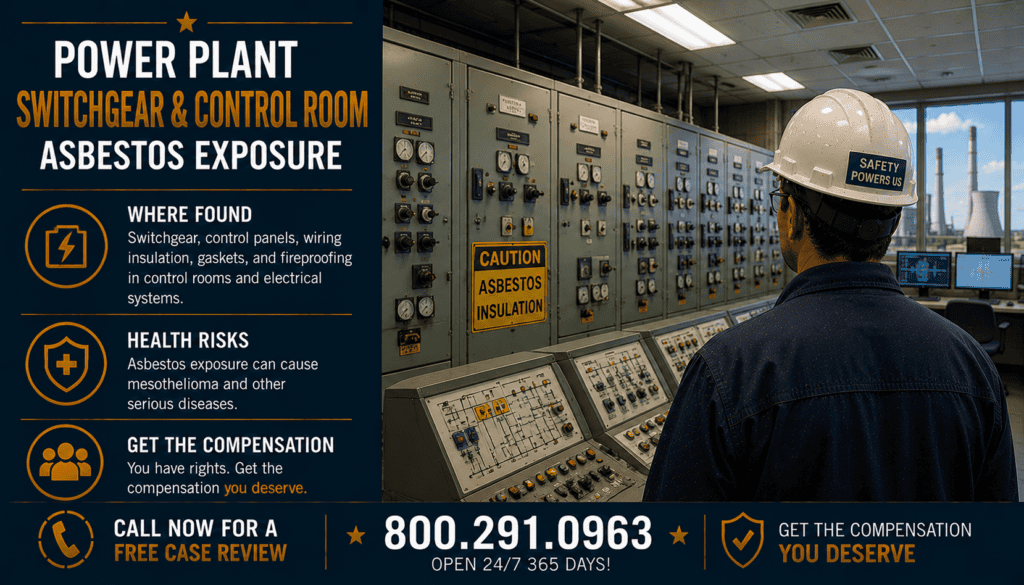
⚡ Power Plant Switchgear & Control Room Asbestos Exposure
Power plant switchgear rooms and control rooms contained electrical equipment used to monitor, regulate, protect, and distribute electrical power. Depending on the facility, these areas could include switchgear cabinets, circuit breakers, control panels, relays, instrumentation, cable systems, electrical barriers, and fire-resistant building materials.
In plants built or operated during periods of widespread asbestos use, some electrical and fire-protection products could contain asbestos. Potential exposure generally became more significant when older materials were opened, removed, repaired, replaced, cut, or otherwise disturbed during electrical maintenance, modernization, equipment replacement, or renovation.
The specific exposure history depended on the plant, equipment, product, occupation, work activity, and time period. A switchgear cabinet, control panel, cable tray, or control room should not automatically be described as asbestos-containing simply because it was installed in an older power plant.
This page is part of the Power Plant Equipment & Systems Asbestos Exposure hub within the broader Power Plants Asbestos Exposure resource.
🔥 Why Asbestos Was Used in Some Electrical Systems
Historical power plant electrical equipment required materials capable of tolerating heat, electrical loads, arcing, and fire risk.
Some asbestos-containing products were used because asbestos offered:
- Heat resistance
- Fire resistance
- Electrical insulation
- Durability
- Ability to reinforce insulating boards
- Suitability for some arc-resistant and heat-resistant barriers
Potential applications could involve electrical panels, switchgear components, insulating boards, fire barriers, or nearby structural materials.
However, materials varied by manufacturer, equipment design, installation period, and later upgrades.
⚡ What Is Power Plant Switchgear?
Switchgear is equipment used to control, protect, and isolate electrical circuits.
Power plant switchgear systems could include:
- Circuit breakers
- Disconnect switches
- Bus systems
- Protective relays
- Control devices
- Electrical cabinets
- Insulating barriers
- Monitoring equipment
These systems helped operators safely manage electricity generated and distributed throughout the facility.
Older switchgear could contain heat-resistant or fire-resistant components that require product-specific investigation.
🎛️ What Is a Power Plant Control Room?
Control rooms allowed operators and engineers to monitor and manage generating equipment.
Depending on the plant, control areas could include:
- Instrument panels
- Gauges
- Relays
- Alarm systems
- Electrical controls
- Switchboards
- Communication equipment
- Monitoring systems
Potential asbestos exposure in a control room could come from the control equipment itself, nearby electrical systems, or older building materials.
This is more accurate than assuming the room itself routinely contained airborne asbestos.
🔧 Switchgear Cabinets & Electrical Enclosures
Historical switchgear cabinets could contain insulating or heat-resistant components.
Potential materials might include:
- Insulating boards
- Arc-resistant barriers
- Heat shields
- Electrical insulation
- Fire-resistant components
Electrical maintenance could involve opening cabinets, replacing breakers, removing insulating components, or modifying internal systems.
If a historical component contained asbestos, direct disturbance could create an exposure opportunity.
🔌 Circuit Breakers and Arc-Resistant Components
Circuit breakers interrupt electrical current when faults occur.
Older electrical equipment sometimes used heat-resistant materials around areas exposed to electrical arcing.
Potential historical products could include:
- Arc barriers
- Insulating panels
- Electrical insulating boards
- Heat-resistant shields
Not every breaker or arc component contained asbestos.
Manufacturer, model, installation date, and replacement history can help determine what materials were present.
🧱 Insulating Boards & Electrical Barriers
Electrical equipment often required nonconductive barriers between energized components.
Historical insulating products could include rigid boards, panels, or heat-resistant materials installed:
- Inside electrical cabinets
- Behind switchboards
- Around control equipment
- Near high-temperature electrical components
Some historical products incorporated asbestos, while others did not.
Removal or cutting during upgrades could potentially disturb fibers if asbestos was present.
🧰 Control Panels & Instrumentation Boards
Power plant control areas could contain extensive panel systems.
Maintenance might involve:
- Removing gauges
- Replacing relays
- Rewiring circuits
- Removing panel backing
- Installing new instrumentation
- Modernizing control systems
If historical panel backing or insulating materials contained asbestos, these projects could create exposure opportunities.
The equipment manufacturer and panel construction can be important when researching older control systems.
⚡ Wiring, Cable Systems & Cable Trays
Electrical cables and wiring extended throughout generating facilities.
Historical systems could involve:
- Wire insulation
- Cable coverings
- Fire-resistant cable barriers
- Cable tray fireproofing
- Conduit systems
Some older electrical products contained asbestos-containing materials for fire or heat resistance.
However, it is too broad to say that wiring or cable trays generally contained asbestos.
Product identification matters.
🧱 Fireproofing Around Electrical Areas
Fire protection was especially important around electrical and control systems.
Older electrical rooms and control areas could contain asbestos-containing:
- Sprayed fireproofing
- Wall panels
- Ceiling materials
- Fire barriers
- Insulating boards
- Floor materials
Renovation or demolition could disturb these materials even when the electrical equipment itself was not being repaired.
See Power Plant Refractory & Fireproofing Asbestos Exposure for broader fire-resistant material coverage.
🛠️ Electrical Maintenance & Repairs
Potential exposure could occur when older asbestos-containing electrical or building materials were disturbed during maintenance.
Tasks might include:
- Opening switchgear cabinets
- Replacing breakers
- Removing insulating boards
- Rewiring control panels
- Repairing relays
- Replacing electrical barriers
- Removing nearby fireproofing
- Modifying cable systems
Routine electrical work did not automatically create asbestos exposure.
The specific product and disturbance are what matter.
🔄 Switchgear Modernization
Power plants often operated electrical systems for many years before modernization.
Upgrade projects could involve:
- Replacing switchgear
- Installing modern circuit breakers
- Replacing relays
- Rebuilding control panels
- Replacing cable systems
- Upgrading protection systems
- Removing older fire-resistant barriers
These projects could disturb legacy materials installed during earlier decades.
Electrical modernization records may therefore help identify potentially important exposure periods.
🎛️ Control Room Modernization
Control rooms were frequently upgraded as generating technology changed.
Projects could involve replacing:
- Analog controls
- Instrument panels
- Relay systems
- Monitoring equipment
- Switchboards
- Wiring
- Wall or ceiling systems
Older backing boards, fire barriers, or nearby building materials could potentially be disturbed during these renovations.
🚨 Emergency Repairs & Outages
Unplanned equipment failures could require urgent electrical work.
Workers might need to:
- Open cabinets
- Remove damaged components
- Replace breakers
- Repair cable systems
- Troubleshoot controls
The emergency nature of the work does not itself establish asbestos exposure.
Potential exposure would depend on whether asbestos-containing materials were present and disturbed during the repair.
Scheduled outages could similarly involve extensive electrical modernization while mechanical work occurred nearby.
👷 Workers Who Could Encounter Switchgear & Control Room Materials
Several occupations could work directly in or around electrical and control areas.
⚡ Power Plant Electricians
Electricians could service switchgear, breakers, generators, control panels, motors, and cable systems.
See Power Plant Electricians Asbestos Exposure.
🧑💼 Power Plant Engineers
Engineers could enter control rooms and electrical spaces during troubleshooting, inspections, upgrades, and outages.
See Power Plant Engineers Asbestos Exposure.
🛠️ Power Plant Maintenance Workers
Maintenance employees could assist with electrical-area renovation, equipment removal, and general plant repairs.
See Power Plant Maintenance Workers Asbestos Exposure.
👷♂️ Power Plant Supervisors
Supervisors could oversee electrical upgrades, shutdown work, or other projects where older materials were disturbed.
See Power Plant Supervisors Asbestos Exposure.
💨 Direct and Nearby Exposure
Exposure circumstances could vary substantially.
Direct Exposure
Potential direct exposure could occur while:
- Removing insulating boards
- Replacing asbestos-containing electrical barriers
- Cutting fire-resistant panels
- Removing older panel backing
- Disturbing fireproofing
Nearby Exposure
Another employee could potentially work in the same area while those tasks occurred.
For example, an operator or engineer could be present during an electrical upgrade performed by electricians or contractors.
This is more precise than assuming airborne fibers routinely circulated throughout every control room.
🌬️ HVAC & Ventilation Around Control Areas
Power plant control rooms were often conditioned spaces served by HVAC systems.
Older HVAC systems could also contain historical:
- Duct insulation
- Mechanical insulation
- Gaskets
- Fire-resistant materials
Ventilation can matter when investigating how dust moved through a particular facility, but it should not be assumed that ventilation automatically distributed asbestos fibers.
See Power Plant HVAC & Ductwork Asbestos Exposure.
⚡ Other Electrical Equipment in Power Plants
Switchgear was only one part of the electrical infrastructure.
Generating facilities could also contain:
- Generators
- Motors
- Transformers
- Electrical panels
- Cable systems
- Motor-control centers
- Distribution equipment
Readers researching the broader electrical environment can use Power Plant Electrical Equipment Asbestos Exposure.
This keeps this page focused specifically on switchgear and control-room systems rather than duplicating the entire electrical-equipment topic.
🏭 Switchgear Exposure by Power Plant Type
Electrical control equipment existed across many generating technologies.
🔥 Coal-Fired Power Plants
Coal-fired generating stations used extensive electrical distribution and control systems supporting boilers, turbines, and generators.
See Coal-Fired Power Plant Asbestos Exposure.
☢️ Nuclear Power Plants
Nuclear facilities contained extensive electrical and instrumentation systems, including control rooms and auxiliary electrical areas.
See Nuclear Power Plant Asbestos Exposure.
🔥 Gas Turbine Power Plants
Gas turbine facilities used generator, protection, control, and electrical-distribution systems associated with combustion turbines.
See Gas Turbine Power Plant Asbestos Exposure.
🏙️ Municipal & Industrial Power Plants
Municipal and industrial powerhouses could contain smaller switchgear rooms and electrical control systems serving boilers, turbines, or plant distribution networks.
See Municipal & Industrial Power Plant Asbestos Exposure.
💧 Hydroelectric Powerhouses
Electrical systems were particularly important in hydroelectric plants, which relied on turbines, generators, switchgear, and control equipment.
See Hydroelectric Dam Job Sites Asbestos Exposure.
⏱️ When Switchgear & Control Room Exposure Could Have Occurred
Potential exposure periods included:
- Original construction
- Switchgear installation
- Routine electrical maintenance
- Breaker replacement
- Control-panel upgrades
- Plant modernization
- Cable replacement
- Fireproofing removal
- Building renovation
- Demolition
A system’s age can provide a clue, but equipment history is more useful than assuming exposure solely because switchgear was installed before a particular year.
🫁 Asbestos-Related Diseases
Asbestos exposure is associated with diseases that can develop many years after exposure.
These include:
- Mesothelioma
- Asbestos-related lung cancer
- Asbestosis
- Other asbestos-related conditions
The original page described occupational asbestos exposure as the “only known cause” of mesothelioma. That language is too absolute. Mesothelioma is strongly associated with asbestos exposure, but a worker’s exposure history should still be established individually.
🔎 Documenting Switchgear & Control Room Exposure
Former workers and families can begin by recording:
- Power plant name
- City and state
- Utility or owner
- Employment dates
- Employer or contractor
- Occupation
- Control room or electrical building
- Switchgear manufacturer
- Breaker manufacturer
- Panel manufacturer
- Modernization projects
- Electrical outages
- Fireproofing removal
- Coworkers
Even partial information can help identify historical records.
📁 Records That May Help
Potential historical sources include:
- Employment records
- Electrical maintenance logs
- Switchgear manuals
- Circuit-breaker records
- Engineering drawings
- Control-room plans
- Upgrade records
- Work orders
- Procurement documents
- Contractor records
- Historical photographs
- Coworker statements
These records can help connect an individual to particular equipment and periods of maintenance.
🏷️ Equipment & Manufacturer Identification
Workers may remember switchgear or electrical manufacturers even when they cannot identify a specific asbestos-containing component.
Potentially useful information includes:
- Switchgear manufacturer
- Breaker manufacturer
- Control-panel manufacturer
- Generator manufacturer
- Equipment model
- Installation date
- Upgrade contractor
- Panel or insulation supplier
The presence of a manufacturer’s electrical equipment does not automatically establish asbestos exposure or legal responsibility.
Replacement materials could also come from separate manufacturers.
⚖️ Switchgear & Control Room Mesothelioma Claims
A former power plant worker diagnosed with mesothelioma may investigate whether historical exposure in switchgear, control-room, or electrical areas contributed to the disease.
An investigation could consider:
- Employment history
- Facility
- Occupation
- Electrical equipment
- Insulating materials
- Fireproofing
- Contractors
- Coworkers
- Modernization projects
- Medical documentation
- Applicable law
The relevant question is not simply whether old switchgear was present.
A stronger historical investigation attempts to determine which asbestos-containing materials were involved, how those materials were disturbed, and how the individual may have encountered them.
MesotheliomaHelp.Center provides legal and medical information to help individuals and families understand asbestos exposure, mesothelioma, and potential next steps. We are not a law firm and do not file lawsuits.
💰 Asbestos Trust Fund Claims
Some companies associated with historical asbestos-containing products later entered bankruptcy and established asbestos trusts.
Eligibility depends on each trust’s disease and exposure requirements.
For broader information, see Power Plant Asbestos Trust Fund Claims.
A trust claim is different from a civil lawsuit, and compensation should never be described as automatic.
👨👩👧 Wrongful Death Claims
When a former power plant electrical worker dies from mesothelioma or another asbestos-related disease, qualifying family members or representatives may potentially investigate wrongful death options.
Historical exposure can sometimes be reconstructed through:
- Employment records
- Electrical-system records
- Plant documentation
- Coworker statements
- Contractor records
- Medical records
See Power Plant Wrongful Death Asbestos Lawsuits.
⏱️ Filing Deadlines
Asbestos-related lawsuits are subject to statutes of limitations.
The applicable filing deadline can depend on:
- State law
- Date of diagnosis
- Date of death
- Claim type
- Exposure locations
- Jurisdiction
Workers and families should not assume the deadline began when the electrical work occurred.
See Power Plant Statute of Limitations.
🏛️ Settlement & Verdict History
Historical power plant electrical cases can provide litigation context, but prior settlements and verdicts do not predict another person’s result.
Case outcomes depend on:
- Disease
- Exposure evidence
- Products
- Defendants
- Jurisdiction
- Applicable law
See Power Plant Asbestos Settlement & Verdict History.
❓ Frequently Asked Questions About Switchgear & Control Room Asbestos Exposure
Did every switchgear cabinet contain asbestos?
No. Some historical electrical components used asbestos-containing insulation or barriers, but materials varied by manufacturer, model, and time period.
Were control rooms automatically contaminated with asbestos?
No. Potential exposure depended on the materials present, their condition, and whether they were disturbed.
Could electrical modernization create exposure?
Potentially. Removing old switchgear, panels, insulating boards, or fire-resistant materials could disturb asbestos-containing products if they were present.
Could operators or engineers be exposed without performing electrical work?
Potentially. They could be nearby when asbestos-containing materials were disturbed, but the actual circumstances need to be investigated.
Can old electrical exposure be documented decades later?
Yes. Equipment manuals, engineering drawings, maintenance records, work orders, contractors, and coworker information can sometimes help reconstruct historical conditions.
🔗 Explore Related Power Plant Equipment & Systems
⚙️ Power Plant Equipment & Systems Asbestos Exposure
Power Plant Equipment & Systems Asbestos Exposure
This is the parent Equipment & Systems hub for this page.
⚡ Power Plant Electrical Equipment Asbestos Exposure
Power Plant Electrical Equipment Asbestos Exposure
Research generators, electrical panels, motors, cable systems, and other electrical equipment.
🔄 Power Plant Turbine & Generator Asbestos Exposure
Power Plant Turbine & Generator Asbestos Exposure
Research turbine insulation, generators, electrical components, and overhaul work.
🌬️ Power Plant HVAC & Ductwork Asbestos Exposure
Power Plant HVAC & Ductwork Asbestos Exposure
Research HVAC systems, duct insulation, and mechanical materials around occupied plant areas.
👷 Power Plant Workers & Occupations Asbestos Exposure
Power Plant Workers & Occupations Asbestos Exposure
Research electricians, engineers, maintenance workers, supervisors, and other occupations.
⚡ Power Plant Switchgear & Control Room Asbestos Exposure
You are here.
This page concentrates specifically on historical switchgear, electrical enclosures, control panels, insulating barriers, fireproofing, and modernization work.
The hierarchy is:
Power Plants Asbestos Exposure → Power Plant Equipment & Systems Asbestos Exposure → Power Plant Switchgear & Control Room Asbestos Exposure
☎️ Call 800.291.0963 — Open 24/7, 365 Days
If you or a family member worked in power plant switchgear rooms, control rooms, or other electrical areas and later developed mesothelioma or another asbestos-related disease, documenting the facility, employment dates, equipment, occupation, and modernization work can be an important step in researching historical exposure.
MesotheliomaHelp.Center provides legal and medical information to help individuals and families understand asbestos exposure, mesothelioma, and potential next steps.