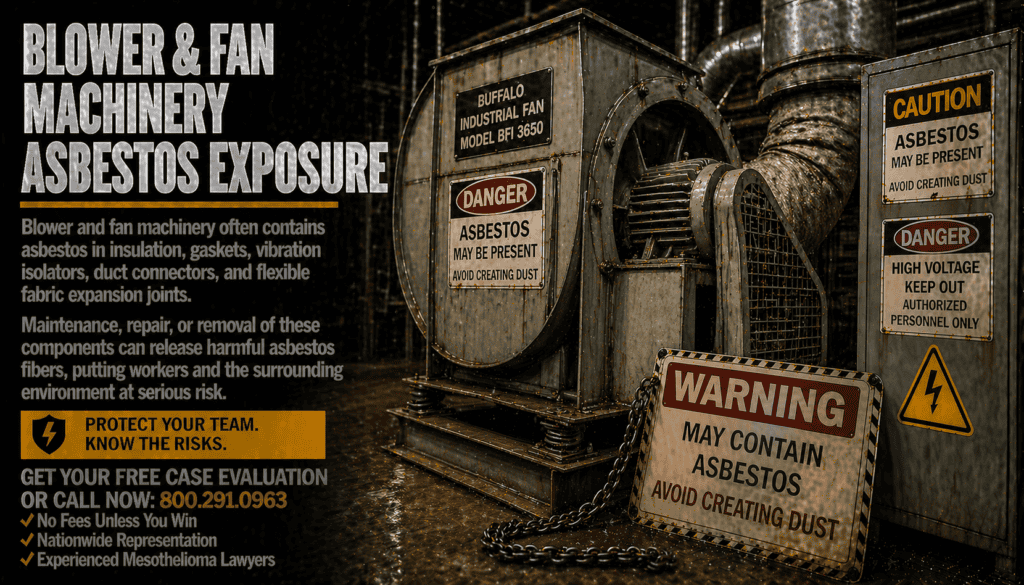
⚙️ Blower & Fan Machinery Asbestos Exposure
Older blower and fan systems were used to move air through factories, utility plants, commercial buildings, and other facilities. Historical asbestos exposure concerns generally involve specific insulation, gaskets, seals, or nearby construction materials—not the movement of air itself.
Workers who repaired or replaced this equipment may need to reconstruct the materials present, the work performed, and whether asbestos-containing products were disturbed. These details can matter for medical discussions and potential compensation claims.
⚙️ How Blowers and Fans Were Used
Industrial blowers and fans move air through ventilation systems, process equipment, cooling arrangements, and manufacturing buildings. Axial fans generally move air along the direction of a rotating shaft, while centrifugal blowers redirect flow through a housing. These differences affect maintenance access and the kinds of nearby materials workers encountered.
An older fan did not necessarily contain asbestos. Historical exposure concerns more often involve asbestos-containing insulation, fire-resistant panels, gaskets, packing, or building materials disturbed while equipment was installed, serviced, or removed. The specific installation date and material formulation matter more than the machinery name.
In large facilities, blowers could serve equipment rooms, industrial ovens, and general plant ventilation. The related air-handling unit machinery page addresses larger assemblies where filters, housings, and adjacent insulation could require service. Identifying the actual work area helps distinguish fan repairs from nearby building renovation.
Workers should document whether a fan was mounted in a mechanical room, on a roof, or beside heat-producing equipment. The location can determine whether older thermal insulation or other suspect materials were present during maintenance.
🧱 Historical Materials and Exposure Pathways
Potential asbestos-containing materials associated with some older installations included thermal insulation around adjacent piping, heat-resistant gasketing, fireproofing, and certain construction products. Their presence cannot be inferred from the existence of a fan alone. Some systems contained no asbestos-bearing components at all.
When a technician removed a housing or duct connection, the relevant question is whether the particular gasket or adjacent insulation actually contained asbestos. Mechanical disturbance of asbestos-containing material can release fibers, especially during scraping, cutting, or uncontrolled removal. Ordinary dust from belts or filters is not proof of asbestos.
Connections between fans and duct runs may have included flexible joints, seals, or other components with changing formulations. The ventilation ductwork article explores how duct repairs and building alterations could disturb materials beyond the fan itself.
Asbestos-related exposure also depended on proximity. A worker might service a fan while another crew removed old insulation in the same mechanical room. Witness accounts, schedules, and ventilation conditions help evaluate whether the worker was near the disturbance.
🔧 Maintenance, Repair, and Replacement
Fan maintenance could involve replacing belts, bearings, motors, impellers, seals, and housings. Most of these activities do not automatically involve asbestos. The concern arises when the task disturbs verified asbestos-containing insulation, gaskets, or nearby building materials.
Maintenance personnel sometimes worked on systems that had been altered many times. A replacement seal purchased in one decade may have differed from the original component. Historical purchase orders and parts lists can help identify which materials were used at the time of a worker’s assignment.
At industrial sites, a fan may have operated beside compressed-air systems. The air compressor machinery article distinguishes compressor equipment from insulation and sealing materials used in surrounding systems. Such distinctions prevent an unsupported assumption that every component of a mechanical room had asbestos.
Workers and families should avoid removing old gaskets or insulation to collect evidence. Suspect materials should be assessed by appropriately trained professionals, while work histories and surviving records can be preserved without disturbing equipment.
🏭 Industries and Work Areas
Blowers and fans appeared in power plants, factories, shipyards, commercial buildings, and maintenance shops. A common job title does not establish the same exposure at every facility. Equipment location, age, modifications, and the presence of other maintenance crews can change the analysis.
Cooling installations may have used large fans to move air through heat-exchange equipment. The cooling tower machinery page covers a different operating environment where workers may have encountered distinct piping, seals, or adjacent insulation during repairs.
In refrigeration plants, ventilation and cooling equipment could operate near chillers and compressors. The chiller machinery article addresses service conditions around large cooling machines rather than treating every HVAC system as identical.
Work in a hospital mechanical room differs from work in a foundry exhaust area. In one setting, older pipe insulation may be the primary concern; in another, high-temperature process insulation may be relevant. Specific materials must be identified before attributing exposure.
👷 Workers and Occupational Exposure
Potentially affected occupations included HVAC technicians, industrial mechanics, millwrights, maintenance electricians, pipefitters, insulation workers, and demolition crews. Actual exposure depends on tasks performed, whether asbestos-containing material was disturbed, and whether the worker was close enough to inhale released fibers.
An electrician changing a fan motor might not touch asbestos-containing material. However, if the task required disturbing older insulation or working beside removal operations, a different exposure history could emerge. The account should describe exactly what happened rather than assume exposure from the occupation alone.
Compressor stations also employed mechanics who serviced rotating machinery and associated piping. The compressor station machinery page provides related context, although a station’s materials and maintenance practices cannot be presumed from its industry.
Supervisors, contractors, and workers from adjacent trades may remember different parts of the same job. Combining firsthand recollections with work orders and site maps can establish the timing and location of potentially relevant tasks.
📍 Where Exposure May Have Occurred
Possible exposure settings include equipment replacement, duct renovation, mechanical-room demolition, and maintenance near older insulated systems. The presence of asbestos must be established for the material involved; a building’s age or the presence of dust alone is insufficient.
In large cooling plants, refrigeration equipment may share rooms with blowers and ventilation fans. The refrigeration unit machinery page addresses another equipment category that can help identify which repair tasks and materials belonged to which system.
Workers should record the precise building, floor, mechanical room, approximate dates, and nearby trades. These details can distinguish an encounter with a particular product from general employment at a site.
| Work Area or Activity | Potential Historical Exposure Circumstance |
|---|---|
| Mechanical-room renovations | Removal of verified asbestos-containing insulation near fan equipment |
| Duct connections | Disturbance of older asbestos-containing sealing or joint materials, where present |
| Industrial process ventilation | Repairs performed beside removal of high-temperature insulation |
| Equipment replacement | Scraping or demolition of identified asbestos-containing materials |
| Shared maintenance spaces | Nearby disturbance by other trades during the same work period |
📁 Records and Evidence
Employment records, maintenance orders, equipment manuals, supplier invoices, and photographs can help reconstruct older blower and fan installations. Each record answers a different question: an employment record shows when someone worked; an invoice may identify a product; a work order may show which task occurred.
Product specifications and replacement-part catalogs should be matched to the relevant years. A modern description of a fan or gasket may not describe the same material used decades earlier. Equipment labels also do not automatically identify the manufacturer of later replacement parts.
Testimony from coworkers can establish firsthand observations about removal activities, product markings, and work proximity. Accounts should distinguish what the witness saw from what they learned afterward. Original documents should be preserved, with dates and sources recorded.
Photographs and building plans may help place a fan near insulated piping or a demolition area, but visual resemblance does not prove asbestos content. Qualified professionals can evaluate material evidence when appropriate.
| Record | What It May Help Establish |
|---|---|
| Pay stubs and union records | Employment periods, occupations, and assignments |
| Maintenance work orders | Repair dates, tasks, and equipment locations |
| Product catalogs and invoices | Historical materials, suppliers, and replacement components |
| Building plans and photographs | Equipment placement and surrounding work areas |
| Coworker testimony | Firsthand observations of tasks and materials |
| Medical and pathology records | Diagnosis and relevant medical history, not product identity |
🩺 Mesothelioma and Asbestos-Related Lung Cancer
Mesothelioma is a cancer strongly associated with asbestos exposure. Symptoms and diagnosis can occur decades after exposure. A diagnosis does not, by itself, establish that a particular fan, blower, or employer was responsible. Medical records and exposure documentation serve separate purposes.
Asbestos exposure can also contribute to lung cancer. Other factors, including smoking, may be relevant to an individual’s medical history. Clinicians assess diagnosis and treatment, while legal professionals review the evidence needed for a potential claim.
People who worked around old equipment and later receive an asbestos-related diagnosis should discuss their occupational history with their medical team. A detailed account can include maintenance tasks, materials handled, protective practices, and nearby work that generated dust.
The parent HVAC, refrigeration, and air-handling machinery article provides a broader overview of the related systems and potential historical exposure conditions.
⚖️ Compensation, Claims, and Next Steps
People diagnosed with mesothelioma or asbestos-related lung cancer may wish to ask a qualified attorney about potential lawsuits, asbestos bankruptcy trust claims, or other applicable benefits. Eligibility depends on the diagnosis, evidence, responsible entities, jurisdiction, and deadlines.
An attorney may compare employment dates with product records, identify possible witnesses, and assess whether an asbestos-containing material can be connected to a responsible company. A manufacturer’s name on a fan does not automatically establish responsibility for every gasket or insulation product installed nearby.
Compensation amounts and filing deadlines vary. No particular settlement, trust payment, or outcome can be promised. Families should keep copies of pathology records, employment history, worksite details, and correspondence, and seek timely advice about applicable limitation periods.
For a useful starting point, write down what work was performed, where the equipment was located, and whether any old insulation or seals were disturbed. Separate confirmed details from estimates so the exposure history remains accurate.
❓ Frequently Asked Questions
Did All Older Blowers and Fans Contain Asbestos?
No. Some older installations used asbestos-containing materials in nearby insulation or sealing components, but the presence of asbestos must be established for the specific product and period.
Can Changing a Fan Belt Cause Asbestos Exposure?
Changing a belt alone does not establish asbestos exposure. Risk depends on whether the work disturbed asbestos-containing materials or occurred near such disturbance.
What Records Help Identify Historical Exposure?
Maintenance logs, employment records, invoices, product specifications, photographs, and firsthand witness accounts may help reconstruct the conditions.
Can a Family Seek Compensation After a Diagnosis?
Possibly. Available claims depend on the medical diagnosis, evidence, applicable law, and filing deadlines. A qualified attorney can review the facts.
Should Workers Sample Old Fan Insulation Themselves?
No. Do not disturb suspect material to gather evidence. Use qualified asbestos professionals when testing or removal is necessary.
📝 Summary
Historical blower and fan exposure concerns are tied to the actual asbestos-containing materials disturbed during installation, maintenance, renovation, or nearby work. Worksite records and product identification are essential to distinguish a plausible exposure history from assumptions based on equipment age alone.
📚 Confirmed Sources
The Occupational Safety and Health Administration describes workplace asbestos hazards and protections. The U.S. Environmental Protection Agency explains how asbestos-containing materials should be managed, while the National Cancer Institute summarizes asbestos-related cancer risks. These are general references, not proof that a particular fan or worksite contained asbestos.
Find out if you may qualify for asbestos compensation today.
Call 800.291.0963 — Help is available 24/7/365. 25+ years of experience.
This information is educational, not medical or legal advice. Mesothelioma Help Center is not a law firm or medical provider and does not determine legal or VA eligibility.