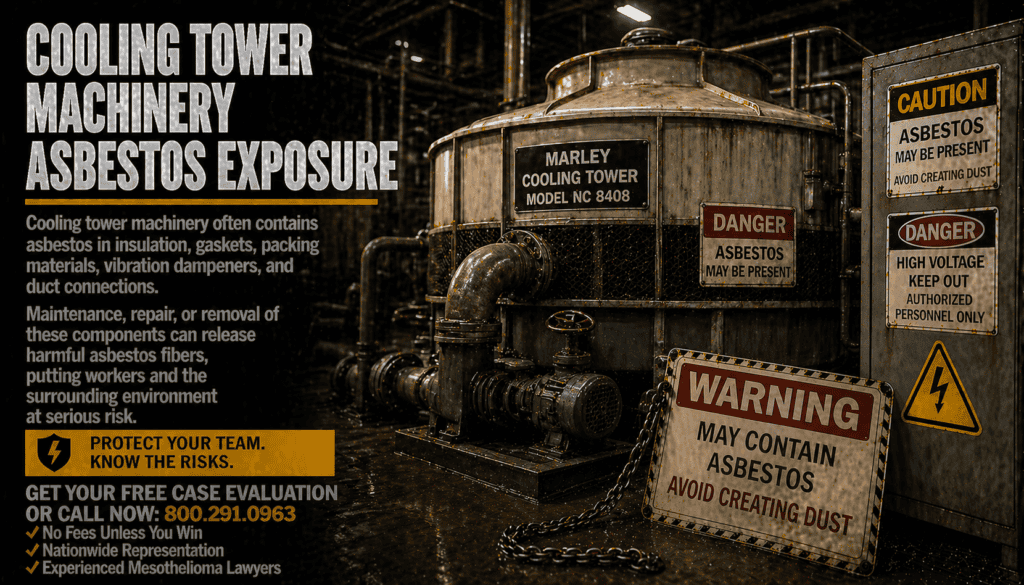
🏭 Cooling Tower Machinery Asbestos Exposure
Cooling towers serve important roles in industrial plants and large HVAC systems, but their presence alone does not establish asbestos exposure. Historical risks depended on specific asbestos-containing materials, maintenance tasks, and the period when workers were present.
This article explains where exposure may have occurred around older cooling-tower installations, which records can help identify products and workers, and what a diagnosis may mean for medical and legal follow-up.
🏭 How Cooling Towers Fit Industrial Systems
Cooling towers remove heat from circulating water in factories, power stations, institutional buildings, and commercial HVAC installations. Water passes through a tower while air movement supports evaporative cooling. Associated systems can include pumps, motors, piping, controls, heat exchangers, and water treatment equipment. These parts have different functions and should not be treated as a single asbestos-containing product.
Historically, asbestos exposure concerns around a cooling-tower installation could arise from certain surrounding insulation, gaskets, packing, cementitious panels, or nearby mechanical work, depending on the specific materials and era. The tower itself did not necessarily contain asbestos. Documentation should identify the component and material rather than infer exposure from the presence of a tower.
Cooling towers frequently serve central cooling plants, so maintenance histories may overlap with chiller machinery. A worker repairing a chiller connection could have a different exposure history from someone cleaning tower fill or testing circulating water.
Facility records can clarify whether a cooling tower was installed during original construction, expanded during a later modernization, or replaced with a newer system. That chronology matters because material specifications and contractor assignments can change across decades.
🧱 Historical Materials and Possible Asbestos Sources
Older thermal systems sometimes used asbestos-containing insulation on adjacent steam or hot-water lines, boilers, or heat-transfer equipment. Cooling-water lines ordinarily operate at different temperatures, so it would be inaccurate to assume they carried the same insulation. Investigators should determine exactly which lines and components were involved.
Certain historical gaskets, packing materials, and sealing products in pumps or valves may have contained asbestos. Their composition depended on the manufacturer, model, replacement history, and time period. The air compressor machinery used elsewhere at a facility could involve its own sealing or thermal components, but proximity alone does not connect it to tower work.
An older building may also have asbestos-containing insulation or fireproofing near the tower equipment room. This creates a separate possible exposure pathway during renovations or equipment removal. Ventilation Ductwork Machinery Asbestos Exposure discusses how adjacent air-handling installations can have distinct material histories.
Not all cooling-tower fill, drift eliminators, structural panels, coatings, or piping contained asbestos. Product-specific evidence is necessary. Workers should avoid assuming that mineral deposits, ordinary concrete dust, or visible corrosion are asbestos fibers.
🔧 Maintenance, Repair, and Replacement Activities
Tasks that may have disturbed historically asbestos-containing materials include removing old gaskets from flanges, repacking pumps, dismantling connected equipment, stripping nearby insulation, or renovating mechanical rooms. The potential for airborne exposure depends on whether the actual material contained asbestos and how the task was performed.
Cooling-tower mechanics often worked alongside pipefitters, electricians, millwrights, insulation workers, and outside contractors. A technician may have remained nearby while another crew opened a pump casing or removed pipe covering. Work orders and crew schedules help distinguish direct handling from bystander exposure.
Fans and motors drive airflow through many tower designs. The related blower and fan machinery page addresses equipment maintenance, but a fan replacement does not automatically imply asbestos exposure. The relevant question is whether asbestos-containing materials were disturbed in the work area.
Large plant shutdowns sometimes brought several trades into the same mechanical space. A timeline should identify the year, equipment number, repair activity, materials removed, and whether dust-producing tasks occurred near the claimant. This is more useful than a general statement that cooling towers were dusty.
👷 Workers and Occupational Exposure Patterns
Cooling-tower technicians, maintenance mechanics, pump repair workers, contractors, and plant utility staff may have worked in areas where historical asbestos-containing materials were present. Their exposure histories can differ substantially according to tasks and proximity.
Electrical technicians servicing motor controls might not have handled insulation or gaskets. By contrast, a pipefitter replacing an old valve could have disturbed packing or nearby pipe insulation if those products contained asbestos. Occupational labels alone do not establish the relevant exposure.
Airflow systems serving the same facility may be documented in air-handling unit machinery maintenance records. Those records may help establish who worked in adjoining mechanical spaces, although they do not prove exposure by themselves.
Workers should record employers, subcontractors, unions, departments, dates, specific tower locations, and coworkers who witnessed repairs. Even approximate recollections can guide a search for records when clearly marked as estimates.
🏗️ Renovations and Equipment Removal
Older cooling towers may have been demolished, rebuilt, or replaced during facility upgrades. Renovation crews sometimes worked around legacy mechanical insulation, wall materials, and equipment seals. Disturbance of confirmed asbestos-containing materials can create a risk, particularly without appropriate controls.
A project replacing tower pumps could overlap with work on compressor station machinery or other plant utilities. Shared project dates can be informative, but records should identify which contractor and trade handled each material.
Before disturbing suspect materials, building owners and contractors should arrange appropriate inspection and follow applicable asbestos regulations. Workers should not collect suspected asbestos samples themselves or use ordinary household vacuums for cleanup.
The condition of a tower can also create non-asbestos hazards, including falls, electrical hazards, chemical treatment exposures, and waterborne pathogens. These should be evaluated separately; none establishes that asbestos was present.
📍 Where Exposure May Have Occurred
Exposure histories become clearer when they identify the precise location of work. A rooftop tower, a ground-level industrial cooling structure, and an indoor pump room may have very different material inventories and maintenance practices.
Adjacent refrigeration units can share a plant room or maintenance contractor with a cooling tower. A shared location may help locate records, but product identification must still be established independently.
An accurate site description should include the tower designation, mechanical-room floor, piping circuit, contractor, and approximate work dates. This helps distinguish the actual exposure setting from broad descriptions of an entire plant.
| Work Area | Potential Exposure Scenario to Verify |
|---|---|
| Cooling-tower pump station | Historical pump packing, flange gaskets, or adjacent insulation disturbed during repairs |
| Mechanical equipment room | Insulation removal near connected heat-transfer equipment |
| Rooftop tower connections | Older seals or surrounding building materials disturbed during replacement |
| Industrial utility corridor | Contractor removal of documented asbestos-containing pipe covering |
| Demolition or modernization site | Removal of confirmed asbestos-containing legacy materials |
📁 Records and Evidence
Important records may include original specifications, construction plans, vendor invoices, maintenance logs, insulation surveys, work permits, equipment manuals, and photographs. No single document necessarily establishes asbestos content, worker contact, and manufacturer identity.
Workers can preserve job assignments, union records, payroll records, and witness names. Family members may help collect records after a diagnosis, but should not disturb old materials to produce a physical sample.
For projects involving HVAC, refrigeration, and air-handling machinery, the parent equipment inventory may help distinguish cooling towers from chillers, air handlers, and compressors. Each relevant product should be evaluated on its own evidence.
Original files should be preserved, with notes recording who supplied each record and when. Sensitive medical information should be shared through a verified secure channel.
| Record | What It May Help Establish |
|---|---|
| Equipment specifications | Original model, installation date, and specified components |
| Maintenance work orders | Repair dates, tasks, crews, and replaced materials |
| Material surveys and laboratory reports | Whether identified sampled materials contained asbestos |
| Purchase orders and supplier invoices | Possible manufacturers and deliveries during relevant periods |
| Payroll and union records | Employment, assignments, and worksite dates |
| Witness accounts and photographs | Observed work conditions and locations, subject to verification |
🩺 Mesothelioma and Asbestos-Related Lung Cancer
Mesothelioma is a cancer associated with asbestos exposure. Symptoms can develop long after the exposure period, and diagnosis requires evaluation by qualified medical professionals. A person who worked near a cooling tower should not assume that the tower caused a diagnosis without a supported exposure history.
Asbestos-related lung cancer can also occur following asbestos exposure, but lung cancer has multiple possible causes. Medical evaluation considers clinical findings and relevant risk factors. Worksite records help investigate exposure; they cannot replace pathology or a medical diagnosis.
Workers who are concerned about possible historical exposure should discuss their history with a healthcare professional. The appropriate follow-up depends on symptoms, risk factors, and medical judgment rather than a general equipment label.
When a person is diagnosed, organizing records promptly can preserve information about past contractors, suppliers, and maintenance projects that might otherwise be lost.
⚖️ Compensation, Questions, and Next Steps
People diagnosed with mesothelioma or asbestos-related lung cancer may wish to discuss potential legal options with a qualified attorney. Depending on the evidence, possible avenues can include a lawsuit, an asbestos bankruptcy trust claim, or applicable veterans benefits. Eligibility and deadlines differ.
Legal review generally examines diagnosis, work history, products, potential defendants, and the governing jurisdiction. Working near a cooling tower does not guarantee a claim, and no compensation amount should be assumed.
An attorney may investigate whether a manufacturer supplied an asbestos-containing gasket, whether a contractor installed insulation, or whether a different product was responsible. Distinguishing these entities is essential to an accurate case assessment.
Promptly preserve available records and ask about applicable filing deadlines. A preliminary online inquiry is not necessarily a formal legal filing, and families should request written confirmation when a claim has actually been submitted.
❓ Frequently Asked Questions
Did all older cooling towers contain asbestos?
No. Composition varied by design, manufacturer, materials, and year. Asbestos exposure cannot be inferred from the age of a cooling tower alone.
Could pump maintenance have involved asbestos?
Some historical gaskets or packing products used in industrial systems contained asbestos. The actual component, replacement history, and work method must be verified.
Was ordinary cooling-tower water scale asbestos?
Not necessarily. Mineral deposits and water-treatment residues are not evidence of asbestos. Suspect materials require qualified evaluation.
Can a nearby contractor’s work matter?
Possibly, if supported evidence shows asbestos-containing material was disturbed near the worker during the relevant period. Proximity alone is not proof.
What should a worker do after a diagnosis?
Seek appropriate medical care, preserve work and exposure records, and consider legal advice about deadlines and available claim routes.
For a practical first review, write down the exact name used for the cooling-tower installation, its building or plant location, and any equipment identification numbers. Identify the crew that performed maintenance and the tasks witnessed firsthand. A useful description distinguishes replacing a motor from removing insulation or scraping a gasket. Include dates of shutdowns and whether the worker was inside a confined mechanical area or outdoors near the tower. These details help locate contracts, service reports, and possible witnesses without assuming the materials contained asbestos.
When equipment has been replaced, newer components may not represent the historical installation. A current photograph can establish where a tower stands today but may not reveal what products were used decades earlier. Archived drawings, procurement records, and old maintenance photographs may better establish the relevant period. Even when a company manufactured the tower, another supplier might have furnished a replacement gasket or insulation product. Each connection should be checked separately. Where records conflict, keep both versions and note the uncertainty rather than selecting the account that appears most favorable to a potential claim.
📝 Summary
Cooling-tower asbestos exposure investigations should focus on identified materials, documented maintenance tasks, and worker proximity. A cooling tower is not automatically an asbestos product. Equipment records, contractor files, and medical evidence can help distinguish possible exposure from assumptions.
📚 Confirmed Sources
The U.S. Environmental Protection Agency explains asbestos-related building-material concerns and professional handling. The Occupational Safety and Health Administration provides workplace asbestos standards and guidance. The National Cancer Institute summarizes asbestos-related health risks. These sources provide general guidance, not confirmation that a particular cooling tower contained asbestos.
Find out if you may qualify for asbestos compensation today.
Call 800.291.0963 — Help is available 24/7/365. 25+ years of experience.
This information is educational, not medical or legal advice. Mesothelioma Help Center is not a law firm or medical provider and does not determine legal or VA eligibility.