⚙️ Loom Machinery Asbestos Exposure
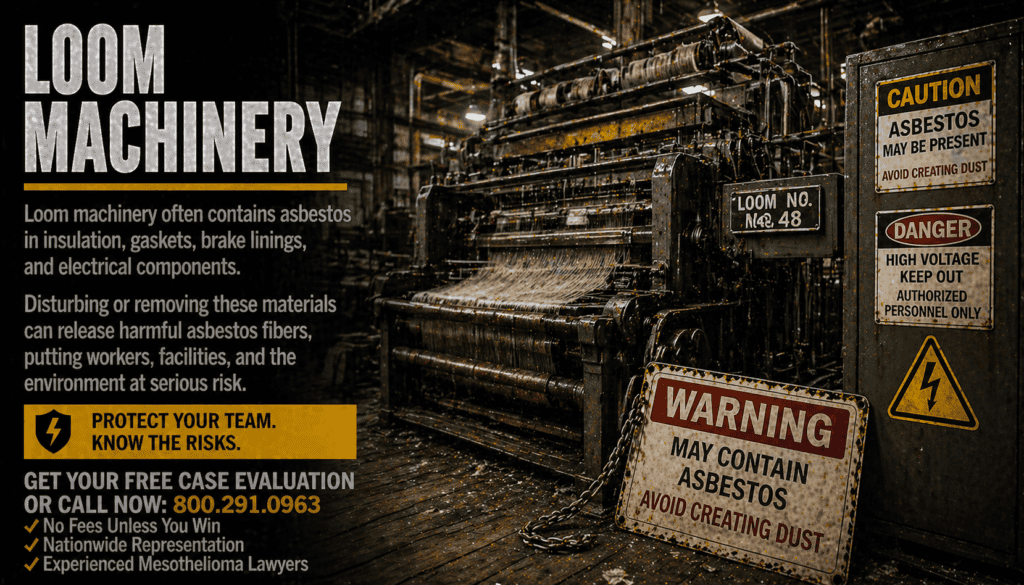
Textile weaving looms were used in industrial settings where certain older friction, heat-resistant, or building materials sometimes contained asbestos. Relevant potential sources include loom drive brakes, clutch assemblies, heat-resistant components, and nearby factory insulation. This does not mean that every machine of this type contained asbestos.
People diagnosed with mesothelioma or asbestos-related lung cancer may need to examine decades-old industrial work. This page explains where contact might have occurred, what records can help, and how compensation options differ. A job title or machine assignment alone cannot establish asbestos exposure, causation, or legal eligibility.
📑 On This Page
- Machinery Exposure Overview
- Where Exposure May Have Occurred
- Workers & Occupations
- Equipment, Components & Work Practices
- Records & Evidence
- Mesothelioma & Asbestos-Related Lung Cancer
- Lawsuits, Trust Funds & Compensation
- Frequently Asked Questions
- Summary & Confirmed Sources
⚙️ Machinery Exposure Overview
Textile weaving looms were used in industrial settings where certain older friction, heat-resistant, or building materials sometimes contained asbestos. Relevant potential sources include loom drive brakes, clutch assemblies, heat-resistant components, and nearby factory insulation. This does not mean that every machine of this type contained asbestos.
For a broader explanation of equipment and materials, see Industrial Equipment Manufacturers. The exposure facts still depend on the individual workplace, product, and dates.
For a broader explanation of equipment and materials, see Machinery Asbestos Exposure. The exposure facts still depend on the individual workplace, product, and dates.
Asbestos was historically used for heat resistance and in certain friction products, insulation, and building materials. Fibers can become airborne when asbestos-containing material is disturbed. Ordinary use of a machine and removal of an asbestos-containing part are different exposure circumstances. The machine’s age, manufacturer, exact components, and maintenance history are essential details.
Some machinery relied on brake or clutch assemblies; others used different mechanisms. The presence of a brake does not establish that its lining contained asbestos. Similarly, the fact that a machine generated ordinary production dust does not mean the dust contained asbestos. Product specifications and workplace evidence must support that connection.
Historical production sites frequently changed equipment, parts, layouts, and maintenance procedures. An older machine might have received non-asbestos replacement components, while a newer component could have a different composition from the original. Records should distinguish the worker’s actual years on the machine from its manufacturing date.
A strong exposure narrative answers who worked on the machinery, what was repaired or removed, where the worker stood, how often work occurred, and whether material was disturbed in a way that released airborne fibers. Unsupported statements that every worker in a trade encountered asbestos should be avoided.
📍 Where Exposure May Have Occurred
Work involving textile weaving looms could take place in production rooms, equipment bays, maintenance shops, utility areas, or during equipment replacement. The table identifies possible evidence sources rather than confirming asbestos in any particular machine.
For a comparable plant work area, consult Manufacturing Plant Piping, Valves & Gaskets. The exposure facts still depend on the individual workplace, product, and dates.
| Work Area or Component | Why It May Matter |
|---|---|
| Machine drive and stopping system | Brake or clutch material may require manufacturer and part-number verification. |
| Maintenance and overhaul bay | Removal or cleaning of old parts can be a distinct exposure event. |
| Nearby utility piping | Historical insulation may have been disturbed during repair or renovation. |
| Electrical or control enclosure | Heat-resistant components or adjacent building materials may warrant review. |
| Factory renovation or demolition area | Work on installed asbestos-containing building materials may create dust. |
The relevant source may be the machinery itself, a neighboring process, or the surrounding building. These must not be conflated. For example, asbestos insulation on nearby steam piping is not evidence that the machine’s drive assembly contained asbestos. Separate the products and locations in the work history.
For related equipment settings, review Elevator Machinery, Cable Pulling Winch Machinery, and Forging Hammer Machinery. Different types of machinery used different stopping mechanisms, power systems, and materials.
👷 Workers & Occupations
Occupations worth evaluating include weavers, loom fixers, mechanics, millwrights, electricians. Actual duties matter more than job titles. An operator who ran a machine without repairing it may have a different exposure history from a mechanic who opened brake housings, replaced friction linings, or removed damaged insulation.
Related occupational evidence is discussed in Textile Mill Workers & Machine Operators. The exposure facts still depend on the individual workplace, product, and dates.
Related occupational evidence is discussed in Factory Workers. The exposure facts still depend on the individual workplace, product, and dates.
Related occupational evidence is discussed in Machine Operators. The exposure facts still depend on the individual workplace, product, and dates.
Maintenance staff may have inspected equipment, cleaned housings, changed components, lubricated machinery, or performed overhauls. Coworkers could have been nearby, but bystander exposure requires evidence about the disturbed material, proximity, duration, ventilation, and frequency. Working in the same large building is not sufficient by itself.
Contractors and electricians sometimes entered a factory only during major projects. Their records may identify shutdowns, renovations, and specific machines. Shift schedules, work orders, equipment logs, and interviews can help distinguish regular operations from short-term high-dust activities.
Industrial workers sometimes moved among plants or worked in several trades. Document earlier and later jobs, because a mesothelioma or lung cancer exposure assessment should not automatically attribute the disease to the first machine remembered. A complete timeline helps avoid overlooking other potentially relevant sources.
When discussing factory hazards, distinguish asbestos from silica, metal dust, textile fibers, and other substances. The presence of visible dust does not identify its composition. Evidence of asbestos-containing products and actual disturbance is needed.
🛠️ Equipment, Components & Work Practices
Brake and Clutch Assemblies
Some historical equipment used friction materials for stopping or power transmission. For textile weaving looms, confirm the actual brake or clutch design and the relevant manufacturer. A generic statement about asbestos in automotive brakes cannot establish asbestos in an industrial machine.
For product identification context, review Weaving & Loom Operations. The exposure facts still depend on the individual workplace, product, and dates.
For product identification context, review Asbestos Exposure in Equipment. The exposure facts still depend on the individual workplace, product, and dates.
Thermal Insulation and Heat Protection
Heat-resistant insulation, pipe covering, and fireproofing sometimes contained asbestos. The specific installation, product, condition, and disturbance are more important than proximity to a warm or noisy machine.
Maintenance, Cleaning, and Replacement
Disassembly, scraping, sanding, compressed-air cleaning, and replacement work can affect potential dust release if the material actually contains asbestos. Do not infer exposure from maintenance alone without identifying the material.
Machine Models, Dates, and Replacement Parts
Equipment catalogs, parts lists, and repair invoices can distinguish original materials from later substitutes. A machine model might have been produced for many years and modified by several owners.
Nearby Trades and Facility Renovations
Pipefitters, insulators, electricians, demolition crews, and contractors sometimes worked near production machinery. If an exposure claim concerns their work, document it as a separate pathway rather than attributing it to the machine itself.
Related machine types include Grinding Machine Machinery, Loom Machinery, and Elevator Machinery. The relevant asbestos pathways may differ considerably among these systems.
📁 Records & Evidence
Start by building a dated record of employers, factories, departments, machine models, shifts, and maintenance tasks. Record the source of every fact and preserve copies of original documents. Product identification often requires combining several types of evidence rather than relying on a single general industry reference.
Additional jobsite records are discussed in Job Sites Asbestos Exposure. The exposure facts still depend on the individual workplace, product, and dates.
| Record | What It Can Establish |
|---|---|
| Employment and union records | Employer, occupation, dates, and department |
| Machine manuals and manufacturer catalogs | Model, equipment layout, and possible part specifications |
| Maintenance logs and repair orders | Component replacement dates and tasks performed |
| Purchase orders and supplier invoices | Product identity and timing of procurement |
| Factory drawings and renovation permits | Location of utilities and building alterations |
| Coworker statements and photographs | Work practices, proximity, and corroborating details |
| Pathology and treatment records | Diagnosis and medical chronology |
A part number may help establish that a friction or insulation product was ordered, but it does not by itself prove a particular worker handled it. Likewise, a person may remember a repair but not the material composition. Claims often depend on carefully connecting the work history with the product and the medical evidence.
If the company closed, former employees may still have personal records, photographs, tax or employment files, union documents, and correspondence. Equipment manufacturers and historical catalogs may provide context, but any uncertainty should be explained rather than treated as proof.
🫁 Mesothelioma & Asbestos-Related Lung Cancer
Mesothelioma
Mesothelioma is a cancer of the mesothelium, most commonly involving the lining around the lungs. Asbestos exposure is its principal established cause, and symptoms may arise decades after exposure. Diagnosis requires appropriate medical evaluation and may involve imaging, biopsy, and pathology. The diagnosis does not automatically identify which workplace or product caused the exposure.
Asbestos-Related Lung Cancer
Asbestos exposure increases lung cancer risk. Smoking and asbestos can have combined effects, but smoking history does not eliminate the need to consider occupational exposures. Not every lung cancer in a machinery worker is asbestos-related. Clinicians must evaluate the diagnosis and risk factors, and legal claims require case-specific evidence.
Preserve pathology reports, imaging, physician summaries, and a complete occupational history. These documents help separate confirmed medical facts from the separate question of identifying an actionable asbestos exposure.
⚖️ Lawsuits, Trust Funds & Compensation
Civil Asbestos Claims
Depending on the facts and applicable law, a person diagnosed with an asbestos-related disease may have a claim against a responsible manufacturer, supplier, or other party. A lawsuit generally requires evidence of injury, actionable exposure, and legal responsibility. State deadlines and legal standards vary, so prompt individualized advice is important.
For comparison with equipment-based exposures, see Machinery-Related Products. The exposure facts still depend on the individual workplace, product, and dates.
Asbestos Bankruptcy Trust Funds
Some former asbestos companies established bankruptcy trusts. Each trust has its own medical, exposure, and submission requirements. A worker’s machine assignment does not establish eligibility for a particular trust, and a trust filing should not be assumed to preserve a separate civil lawsuit deadline.
Families and Wrongful-Death Claims
Surviving family members may have distinct legal options under applicable law. Who may file, which records are needed, and the filing period vary. A death certificate, medical records, and evidence of the person’s employment and exposures may be important.
No article can determine legal eligibility from an occupational title alone. Workers and families should ask qualified counsel to assess the relevant jurisdiction, exposure evidence, potential defendants, and deadlines before relying on general compensation information.
❓ Frequently Asked Questions
Did all textile weaving looms contain asbestos?
No. Materials varied by manufacturer, model, production date, and repairs. Confirm the actual component and relevant period.
Which parts of textile weaving looms might have involved asbestos?
Potential sources depend on the design and may include particular friction, thermal, or surrounding building materials. Each requires product-specific verification.
Could operators be exposed without repairing machinery?
Possibly, if asbestos-containing material was disturbed nearby. Frequency, duration, distance, and ventilation matter.
Can ordinary production dust be assumed to contain asbestos?
No. Dust may contain many substances, and its composition requires evidence rather than visual assumptions.
How do replacement parts affect an asbestos claim?
Later components may differ from original parts. Repair orders and dated specifications help establish what was installed during the worker’s assignment.
What records help prove machinery-related exposure?
Employment files, manuals, parts lists, repair records, invoices, photographs, and credible coworker statements may help.
Can former machinery workers seek asbestos compensation?
Potentially, depending on diagnosis, exposure evidence, responsible parties or trust criteria, and applicable filing deadlines.
Does a mesothelioma diagnosis automatically prove machine exposure?
No. The medical diagnosis and identification of a specific exposure pathway are distinct questions requiring separate evidence.
📌 Summary & Confirmed Sources
Loom Machinery Asbestos Exposure should be assessed using actual machine specifications, maintenance records, work practices, and medical evidence. Historical asbestos use in some industrial products does not establish exposure for every operator or repair worker. Preserve records and obtain qualified medical or legal guidance where appropriate.
For further background, see Industrial Kiln Products. The exposure facts still depend on the individual workplace, product, and dates.
Other machinery pages in this group include Cable Pulling Winch Machinery, Forging Hammer Machinery, and Grinding Machine Machinery.
Confirmed Sources
OSHA — Asbestos in General Industry
OSHA — Scope of Brake and Clutch Repair Rules
National Cancer Institute — Asbestos Exposure and Cancer Risk
Find Out If You May Qualify for Asbestos Compensation Today
Call 800.291.0963 — help is available 24/7/365. 25+ years of experience.
Disclaimer: Mesothelioma Help Center is not a law firm or medical provider and does not determine legal or VA eligibility. This page provides general information and is not legal or medical advice.