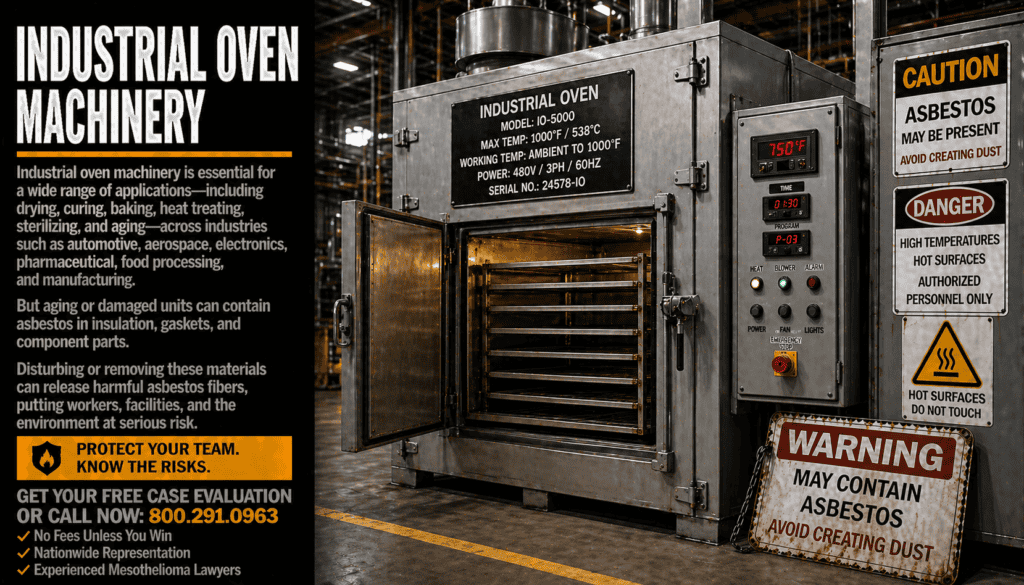
🔥 Industrial Oven Machinery Asbestos Exposure
Industrial Oven Machinery Asbestos Exposure examines historical asbestos exposure associated with industrial process ovens. Potentially relevant products include high-temperature door gaskets, thermal insulation, burner systems, and older refractory or panel materials. Their presence must be established for the specific equipment, facility, and years involved; not every machine used asbestos-containing materials.
People diagnosed with mesothelioma or asbestos-related lung cancer may need to reconstruct older work assignments, equipment repairs, and product histories. This article explains exposure locations, worker duties, evidence, and legal options without assuming that a job title alone proves asbestos exposure.
📑 On This Page
- Exposure Overview
- Where Exposure May Have Occurred
- Workers & Occupations
- Equipment & Exposure Pathways
- Records & Evidence
- Mesothelioma & Asbestos-Related Lung Cancer
- Compensation & Legal Options
- Frequently Asked Questions
- Summary & Confirmed Sources
⚙️ Exposure Overview
For industrial process ovens, the principal question is whether asbestos-containing products were installed or maintained during a particular worker’s assignment. Historically, some industrial heat-resistant, electrical-insulating, and fire-resistant materials contained asbestos. Product composition varied by manufacturer, model, installation date, and replacement history.
When asbestos-containing materials are cut, scraped, drilled, removed, or otherwise disturbed, airborne fibers may be released. Routine operation without disturbance is not equivalent to removal of an old gasket, insulating board, or thermal barrier. An accurate description distinguishes the task, material, and proximity.
An occupational history should identify employer, facility, department, equipment model, service dates, maintenance tasks, contractors, ventilation, and other potential exposure sources. It should also record what remains unknown instead of filling gaps with unsupported assumptions.
The broader Asbestos Exposure in Machinery page provides context for machinery-related exposure. The parent section Ovens, Kilns & Curing Machinery helps explain how this article fits into the equipment hierarchy.
📍 Where Exposure May Have Occurred
The following work areas can guide an evidence review. A listed location is not proof of asbestos, and a historical material specification may not apply to every machine or later repair.
| Work Area or Component | Why It May Matter |
|---|---|
| Oven doors and gaskets | Equipment drawings and dated component specifications may identify materials. |
| Heating chambers and panels | Maintenance reports can show when heat-resistant or insulating parts were disturbed. |
| Burners and combustion systems | Repair invoices may establish replacement products and work methods. |
| Exhaust ducts and utility connections | Facility plans and contractor records may distinguish nearby utilities from the machine. |
| Relining and renovation work areas | Witness accounts and schedules may identify who was present during shutdown work. |
For a worker near the equipment, identify the exact operation or repair that could have released fibers. Duration, frequency, distance, and ventilation matter. A worker in another room during the same shift does not necessarily share the exposure history of the person removing the material.
Building insulation, steam piping, or electrical-room fireproofing can be a distinct exposure source. Those materials should be described separately from the machine’s own components. This distinction matters when identifying a manufacturer, contractor, or other potentially responsible entity.
Relevant industrial context is available through Power Plant Electrical Equipment, Power Plants Asbestos Exposure, and Power Plant Turbine & Generator. These pages cover related facility systems, but the facts must still be tied to the individual workplace.
👷 Workers & Occupations
Workers whose duties may warrant review include oven operators, plant engineers, industrial mechanics, insulators, and maintenance contractors. An operator may have monitored a production process, while a mechanic removed insulation or replaced a component. The same job title can cover substantially different tasks across employers and years.
A bystander exposure history should identify the dust-generating work, the asbestos-containing product, the worker’s proximity, and the length and frequency of contact. Mere employment at a bakery, factory, electrical facility, or power station does not establish an actionable exposure.
Shutdowns and major rebuilds can bring contractors and several trades into the same area. Work permits, shift schedules, invoices, and maintenance logs may clarify who performed the work and who was nearby. Statements from former coworkers are most helpful when they identify specific equipment and repair methods.
Workers sometimes changed departments, employers, or industries. A complete occupational timeline should include earlier and later jobs and should distinguish asbestos from other workplace hazards such as flour dust, welding fumes, heat, or electrical injury.
Occupation and facility context can be explored through Bakery Workers, Power Plant Electricians, and Power Plant Workers & Occupations. Each link addresses a different aspect of industrial employment and should not substitute for a documented exposure history.
🛠️ Equipment & Exposure Pathways
Historical Materials and Specifications
Potential materials include high-temperature door gaskets, thermal insulation, burner systems, and older refractory or panel materials. Some historical products used asbestos for thermal resistance or electrical protection, while others used different materials. Identification requires model-specific records.
Useful documentation includes technical manuals, supplier invoices, engineering drawings, dated repair orders, and accounts from people who witnessed the task. A manual can identify a product design but not prove that a particular employee encountered it; witness recollections may establish the work but not the material composition.
For a reliable reconstruction, note the repair date, component name, tools, dust conditions, location, workers present, and whether debris was handled. Where records are incomplete, identify the uncertainty. Avoid inventing exposure measurements, product brands, or a confirmed asbestos content for a particular facility.
Routine Operation Versus Maintenance
The machine may have operated for years without disturbing a sealed component. Removal, scraping, replacement, or demolition of confirmed asbestos-containing materials presents a different exposure question.
Useful documentation includes technical manuals, supplier invoices, engineering drawings, dated repair orders, and accounts from people who witnessed the task. A manual can identify a product design but not prove that a particular employee encountered it; witness recollections may establish the work but not the material composition.
For a reliable reconstruction, note the repair date, component name, tools, dust conditions, location, workers present, and whether debris was handled. Where records are incomplete, identify the uncertainty. Avoid inventing exposure measurements, product brands, or a confirmed asbestos content for a particular facility.
Component Replacement and Modernization
Original parts and later substitutes may have different compositions. Equipment age alone does not establish the content of the part present during an employee’s assignment.
Useful documentation includes technical manuals, supplier invoices, engineering drawings, dated repair orders, and accounts from people who witnessed the task. A manual can identify a product design but not prove that a particular employee encountered it; witness recollections may establish the work but not the material composition.
For a reliable reconstruction, note the repair date, component name, tools, dust conditions, location, workers present, and whether debris was handled. Where records are incomplete, identify the uncertainty. Avoid inventing exposure measurements, product brands, or a confirmed asbestos content for a particular facility.
Nearby Utilities and Building Materials
Pipes, boilers, electrical enclosures, and building fireproofing may be separate historical sources. Do not attribute asbestos from the surrounding facility to a machine without evidence.
Useful documentation includes technical manuals, supplier invoices, engineering drawings, dated repair orders, and accounts from people who witnessed the task. A manual can identify a product design but not prove that a particular employee encountered it; witness recollections may establish the work but not the material composition.
For a reliable reconstruction, note the repair date, component name, tools, dust conditions, location, workers present, and whether debris was handled. Where records are incomplete, identify the uncertainty. Avoid inventing exposure measurements, product brands, or a confirmed asbestos content for a particular facility.
Bystander Work, Cleanup, and Ventilation
Nearby workers may require assessment when a known asbestos-containing product was disturbed. Dust controls, cleaning methods, ventilation, and physical separation affect the circumstances.
Useful documentation includes technical manuals, supplier invoices, engineering drawings, dated repair orders, and accounts from people who witnessed the task. A manual can identify a product design but not prove that a particular employee encountered it; witness recollections may establish the work but not the material composition.
For a reliable reconstruction, note the repair date, component name, tools, dust conditions, location, workers present, and whether debris was handled. Where records are incomplete, identify the uncertainty. Avoid inventing exposure measurements, product brands, or a confirmed asbestos content for a particular facility.
Compare the different equipment pathways discussed in Industrial Equipment Manufacturers, Power Plant Switchgear & Control Room, Electrical Equipment, and Oven Equipment. These resources cover manufacturers, heat-processing equipment, electrical systems, and oven equipment without implying identical components.
Related machinery articles include Bakery Oven Machinery Asbestos Exposure, Curing Oven Conveyor Machinery Asbestos Exposure, Power Generation & Electrical Machinery Asbestos Exposure, Circuit Breaker Machinery Asbestos Exposure. They describe distinct operating environments and can help readers distinguish heat-related machinery from electrical protection systems.
📁 Records & Evidence
Create a dated timeline of employers, departments, machines, repair events, and medical records. Preserve original files, identify where each document came from, and distinguish confirmed facts from recollections or general industry information.
| Record | What It Can Establish |
|---|---|
| Employment and payroll files | Employer, location, department, job title, and dates |
| Manufacturer manuals and parts lists | Machine model and potential component specifications |
| Repair orders and maintenance logs | Work performed, timing, and replacement parts |
| Purchase orders and supplier invoices | Possible product and manufacturer identity |
| Facility drawings and renovation files | Nearby utilities, barriers, and contractor activity |
| Coworker statements and photographs | Task details, work proximity, and corroboration |
| Pathology and treatment records | Medical diagnosis and clinical chronology |
Records showing asbestos somewhere in an industry are not the same as evidence of contact by a particular worker. The strongest account connects the person, product, place, and relevant period. If a company closed, union records, former coworkers, catalogs, and archived plans may still offer leads.
For wider equipment context, see Asbestos Exposure in Equipment. Its categories may help locate another relevant machine or material, but a broad category should not be treated as proof of exposure.
🫁 Mesothelioma & Asbestos-Related Lung Cancer
Mesothelioma
Mesothelioma is a cancer of the mesothelium, commonly affecting the lining around the lungs. Asbestos is its principal established cause. Symptoms may arise many years after exposure, so medical professionals often need a detailed historical occupational history. A confirmed diagnosis does not, by itself, identify a responsible machine or product.
Asbestos-Related Lung Cancer
Asbestos exposure increases lung cancer risk, and smoking can further increase risk. Not every lung cancer in an industrial worker is attributable to asbestos. Clinicians assess diagnosis and risk factors, while a legal claim separately requires evidence concerning exposure and responsibility.
Keep pathology reports, imaging, physician summaries, and a full employment history. Medical diagnosis and product identification are related but separate questions. No online article can establish medical causation for an individual.
⚖️ Compensation & Legal Options
Civil Asbestos Lawsuits
Some diagnosed workers or eligible families may have claims against responsible companies. Applicable law, filing deadlines, exposure evidence, product identification, and legal responsibility vary by jurisdiction. Neither a diagnosis nor a machine assignment guarantees a recovery.
Asbestos Bankruptcy Trusts
Certain former asbestos companies established bankruptcy trusts with their own medical and exposure criteria. A trust submission is separate from a civil lawsuit, and deadlines should be evaluated independently. Eligibility cannot be assumed from a general equipment category.
Family and Wrongful-Death Claims
After a worker’s death, eligible relatives or estate representatives may have distinct claims depending on the governing law. Death certificates, medical records, work histories, and evidence of exposure can be relevant. Seek individualized advice promptly because deadlines vary.
❓ Frequently Asked Questions
Did all industrial process ovens contain asbestos?
No. Materials varied by model, manufacturer, installation date, and maintenance history.
Which parts of industrial process ovens could be relevant?
Potential sources include specific historical insulation, seals, barriers, or surrounding facility products; each needs verification.
Can an operator be exposed without doing repairs?
Possibly, if asbestos-containing material was disturbed nearby and contact is supported by evidence of proximity and duration.
Does visible workplace dust prove asbestos exposure?
No. Dust can contain many substances. Product identification and actual disturbance are essential.
Why do replacement parts and dates matter?
Original components and later substitutes may differ, so dated manuals and repair records matter.
What records help document machinery-related exposure?
Employment files, manuals, work orders, invoices, photographs, and corroborated coworker accounts may help.
Can workers or families pursue compensation?
Potentially, subject to diagnosis, applicable law, exposure evidence, trust rules, and filing deadlines.
Does a mesothelioma diagnosis prove which machine caused exposure?
No. Diagnosis and proof of a particular exposure pathway require separate evidence.
📌 Summary & Confirmed Sources
Industrial Oven Machinery Asbestos Exposure requires careful evaluation of equipment materials, maintenance history, worker duties, and medical evidence. Historical asbestos use in some industrial products does not mean every machine contained asbestos. Preserve records and seek qualified medical or legal guidance where appropriate.
Confirmed Sources
OSHA — Asbestos in General Industry
National Cancer Institute — Asbestos Exposure and Cancer Risk
Find Out If You May Qualify for Asbestos Compensation Today
Call 800.291.0963 — help is available 24/7/365. 25+ years of experience.
Disclaimer: Mesothelioma Help Center is not a law firm or medical provider and does not determine legal or VA eligibility. This page provides general information and is not legal or medical advice.
Related facility maintenance context: Industrial Ovens & Furnaces.