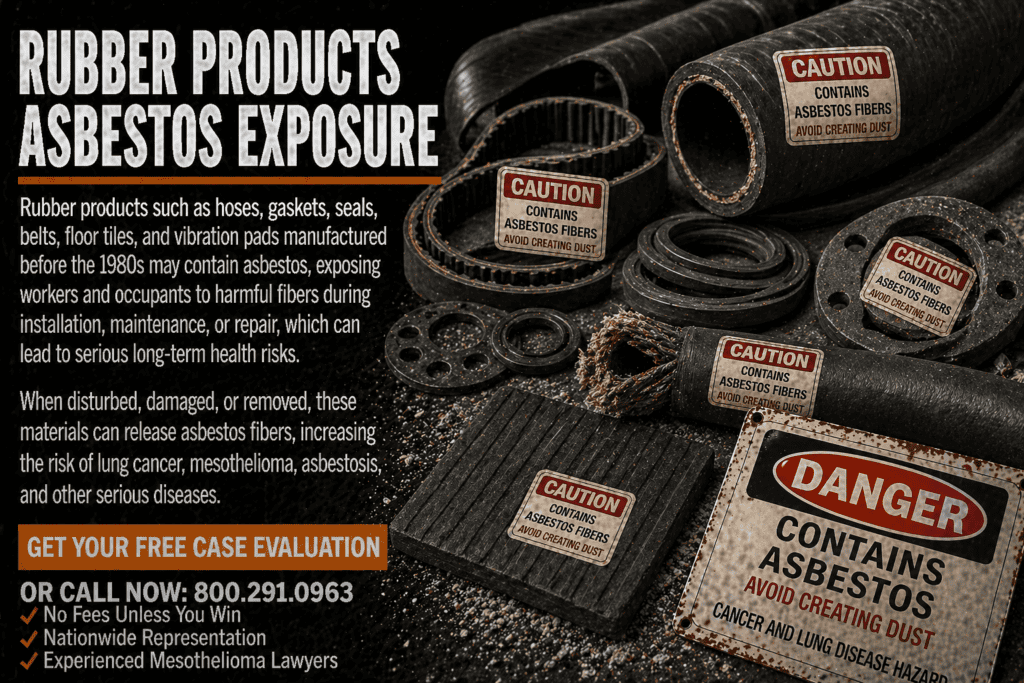
Rubber Products Asbestos Exposure
Certain historical industrial rubber and rubber-like products incorporated asbestos fibers for heat resistance, strength or sealing performance. Potential exposure depended on the particular formulation and on work that disturbed the asbestos-containing material.
Rubber products were not universally made with asbestos. Identifying the precise item, manufacturer, service period and maintenance activity is essential when reviewing a possible connection to mesothelioma.
Industrial Seals, Sheets and Composite Materials
Some compressed sheets, sealing compounds and reinforced composites were designed for high-temperature or chemically demanding service. Asbestos fibers could provide reinforcement while a rubber or resin binder contributed flexibility and sealing characteristics. Exact formulations depended on product specifications and time.
When evaluating an old sheet or seal, look for manufacturer markings, purchase descriptions, equipment manuals and surviving catalogs. A visual resemblance to rubber is not enough to determine whether asbestos was present.
Industrial seals may have been supplied as finished rings, rolls of sheet stock or precut pieces. Those formats created different opportunities for handling and disturbance, especially when workers fabricated their own replacements.
A useful interview asks what the worker actually did on an ordinary day: which surfaces were opened, which tools were used, where waste went and whether coworkers performed dusty work nearby. The answers can vary greatly even within one occupation. Avoid assuming that every task involved asbestos. The relevant question is whether a particular asbestos-containing material was disturbed under conditions that could produce inhalable dust.
Work Activities That Could Release Fibers
Workers could disturb asbestos-containing composite material while cutting sheets to shape, punching openings, scraping old seals, grinding residue or removing deteriorated components. Potential exposure depends on fiber content, condition, tools, housekeeping, ventilation and frequency of work.
Handling a sealed, intact component is different from sanding or mechanically abrading one. A careful work history should identify the actual task rather than treating all contact with rubber products as equivalent.
The condition of a used seal matters. A brittle, adhered or deteriorated part may require more aggressive removal than a flexible component that comes away intact. The task and material composition both deserve attention.
Records from several sources can sometimes corroborate one another. A job title establishes employment, a service ticket may identify a repair, and a catalog may describe the composition of a part sold during that period. None of these records necessarily proves every remaining element alone. Keep originals or clear copies, note where they came from and avoid changing old documents to make the timeline appear more certain.
Workplaces and Occupations
Potentially relevant settings included chemical plants, power stations, refineries, manufacturing facilities, equipment repair shops and marine maintenance areas. Maintenance mechanics, gasket cutters, pipefitters and machine operators could perform different tasks involving specialized sealing materials.
A worker might encounter dust from a neighboring bench where composite sheets were cut. Record proximity, shared ventilation and whether cleanup involved sweeping or compressed air. Do not assume the facility or trade alone establishes asbestos exposure.
Maintenance crews may share benches, grinders and cleanup equipment. Identifying who performed cutting or scraping and where other employees stood helps describe potential bystander exposure without assuming it occurred.
For someone who is currently concerned about material in a workplace or building, do not attempt to identify asbestos by sight or disturb a suspected component. Appropriate inspection, sampling and controls belong with qualified professionals following applicable rules. This safety question is different from the retrospective legal question of whether a person encountered a specific product decades earlier. Both deserve careful handling.
Product Identification and Records
Material safety documents, technical datasheets, invoices, warehouse labels, equipment specifications and maintenance orders can help distinguish asbestos-containing products from substitutes. Product descriptions may change over time, even when a brand remains familiar.
A family member may remember the employer but not the supplier. Former colleagues, union records or historical catalogs can sometimes fill gaps. Preserve uncertainty explicitly, including conflicting recollections or incomplete records.
Manufacturers sometimes sold asbestos and non-asbestos grades within the same product family. A catalog name alone may be insufficient; part numbers, dates and composition statements are especially useful.
Manufacturers may have offered several versions of a product over time. A modern online listing, an old advertisement and a current company name may refer to different materials or corporate entities. Look for the part number, installation date and supplier where possible. If records are missing, a responsible article should acknowledge uncertainty rather than turn a general industry practice into a definite claim about an individual.
Health Considerations and Latency
Asbestos exposure can cause mesothelioma and other serious illnesses, often after a long latency period. The diagnosis must be made by clinicians using appropriate tests; neither the presence of an old rubber product nor a history of maintenance work establishes disease causation by itself.
Patients should discuss symptoms and treatment with their medical team. An accurate history of jobs, materials and possible dust-generating work may also be useful for a separate legal review.
Exposure information and diagnosis should remain separate records. A treating physician evaluates the disease, while an occupational history documents potential sources that may be reviewed under applicable law.
Mesothelioma symptoms and treatment choices should be discussed with a medical professional. Work-history details may be relevant to understanding potential exposures, but they cannot substitute for pathology or other clinical evidence. Families may find it useful to maintain separate medical, employment and legal folders so that each professional receives the records relevant to their role without mixing assumptions into established facts.
Legal Claims and Potential Compensation
A possible asbestos-related claim generally requires more than proof that a rubber-like product was present. Evidence may need to address its asbestos content, how fibers were released, the person’s exposure and the relevant legal standard. Civil claims and bankruptcy trust claims have different requirements.
Not every manufacturer has a trust and not every historical product creates a viable lawsuit. State deadlines and defendant-specific facts matter. An attorney can explain how product identification and medical records fit together.
A trust’s existence does not mean every rubber or sealing product from a related company qualifies. Trust distribution procedures and evidence requirements must be checked for the specific claimant.
Different compensation routes can have different documentation rules, deadlines and disclosure obligations. A trust claim is not necessarily the same as a lawsuit against an operating company. Nor does identifying a historical asbestos product guarantee that a particular person qualifies for compensation. A case review should clarify the legal theory, the evidence still needed, who would handle the matter and what costs or fees could apply.
Organizing an Exposure Timeline
Create a timeline of employers, facilities, equipment and products. For each job, record whether sheets were cut, gaskets replaced, residue scraped or parts ground. Include approximate dates, job titles, nearby coworkers and any labels remembered.
Keep copies of medical records and employment evidence in separate folders. A factual timeline is more useful than an exhaustive list of products that might have been used somewhere in the industry.
A useful chronology includes changes in materials and maintenance practices over time. Note when suppliers changed, whether precut seals replaced sheet stock and whether dust controls were introduced.
Families can prepare a brief summary before speaking with an attorney: diagnosis and date, principal jobs, relevant tasks, approximate exposure years, product names remembered and documents available. It is appropriate to say “unknown” when a detail cannot be recalled. Ask how time limits may apply, which records are most useful and how medical priorities can be respected during any review.
In reviewing specialized sealing products, distinguish the manufacturing stage from field maintenance. One person may have fabricated sheets into finished parts, while another only removed worn components during equipment service. Those roles can involve different products, tools and opportunities for dust. It is also important to record whether an item was described as rubber, fiber, compressed sheet or a proprietary composite. These terms may overlap in ordinary conversation without proving the same formulation. If a remembered brand is uncertain, preserve the approximate spelling and any packaging details instead of choosing a manufacturer from a modern catalog. A complete review can consider both the person who performed the task and coworkers nearby, but each account should describe observed conditions rather than speculate about an unseen exposure.
❓ Frequently Asked Questions
Did all rubber products contain asbestos?
No. Only some specialized historical formulations did; product-specific evidence is needed.
Can cutting composite rubber sheets release fibers?
It can if the material contains asbestos and the cutting disturbs fibers.
Are modern rubber products the same as historical composites?
No. Modern materials and formulations vary; do not assume asbestos content.
What evidence helps identify a seal?
Specifications, labels, invoices, manuals and coworker testimony may be relevant.
Can nearby workers have exposure?
Yes, depending on airborne dust, proximity and conditions.
Does every manufacturer have a trust fund?
No. Trust availability and eligibility depend on specific entities and rules.
Sources and References
Authoritative background: EPA — Learn About Asbestos; OSHA — Asbestos Overview; EPA — Historical Product Uses; EPA — Chrysotile Asbestos Risk Management. Product-specific claims require independent supporting evidence.
📞 Get the Mesothelioma Help & Compensation You Deserve — Contact Us Today!
After a mesothelioma diagnosis, we can help you organize asbestos exposure information and understand potential compensation options. Eligibility and outcomes depend on individual facts and applicable rules.
For 25+ years, we have helped veterans, workers, and families find information and explore their next steps.
📲 Contact Us Today — Three Easy Ways!
CALL: 800.291.0963 for a free case review.
LIVE CHAT: Available 24/7/365 through the website.
CONTACT FORM: Use the form below.
Disclaimer: This information is not be considered as legal or medical advice. Mesothelioma Help Center is not a law firm or medical provider and does not determine legal or VA eligibility.