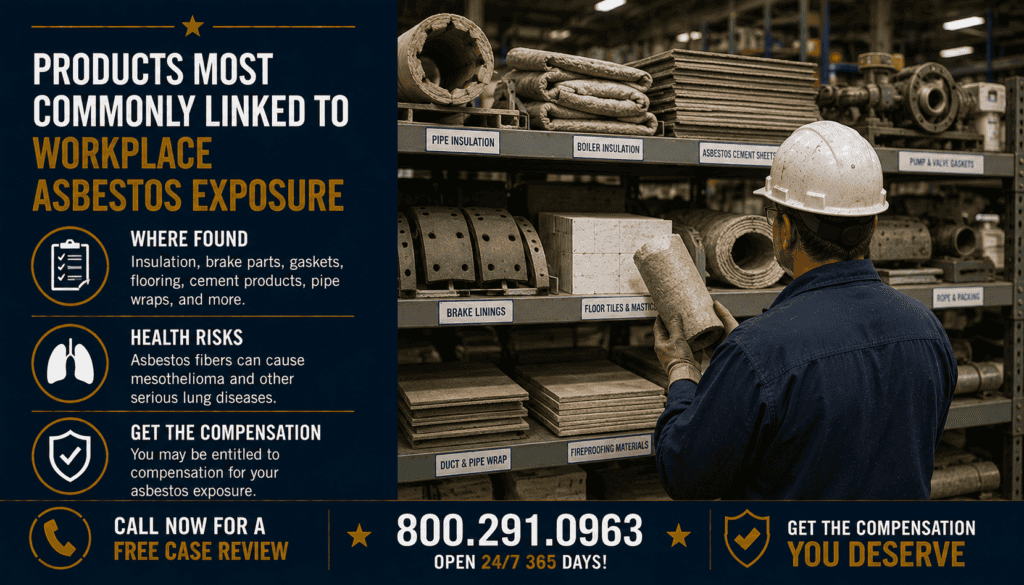
Products Most Commonly Linked to Workplace Asbestos Exposure
Historical workplace asbestos exposure is often associated with specific categories of industrial, construction, mechanical and heat-resistant products. Commonly investigated categories include insulation, gaskets, packing, boilers, pumps, valves, friction products, flooring, cement products, electrical materials and industrial textiles.
These categories should not be treated as proof that every older product contained asbestos. Product formulation varied by manufacturer, model, application and year, and exposure depends on whether an asbestos-containing material was actually present and disturbed.
Workplace Products Commonly Associated with Asbestos
Asbestos was historically valued for heat resistance, durability, insulation and friction performance. Those properties led to its use in selected products found in factories, shipyards, power plants, refineries, construction sites, transportation maintenance facilities and other workplaces.
Frequently investigated product categories include:
- thermal insulation and fireproofing;
- boiler and high-temperature equipment components;
- gaskets and valve or pump packing;
- brakes, clutches and other friction materials;
- cement board, siding and other cement products;
- floor tile, backing and mastics;
- electrical insulation and arc-resistant materials; and
- heat-resistant cloth, blankets, rope and tape.
Historical product identification is strongest when the exact manufacturer, product name, worksite and time period can be established.
Insulation, Boilers and High-Heat Products
Thermal insulation is one of the best-known historical workplace asbestos product categories. Some older pipe covering, block insulation, boiler insulation, blankets, cement and related heat-protection materials contained asbestos.
Potentially relevant work included installing, cutting, removing or repairing insulation around steam lines, boilers, turbines, furnaces and other hot equipment.
See Insulation Products Asbestos Exposure and Boiler Products Asbestos Exposure.
Gaskets, Packing, Pumps and Valves
Asbestos-containing gaskets and packing were historically used in many industrial systems because they could tolerate heat, pressure, steam and chemical service conditions.
Potential exposure could occur when workers scraped flange gaskets, cut replacement gasket sheet, pulled packing from pumps or valves, or cleaned residue from equipment surfaces.
See Gasket Products Asbestos Exposure, Packing Products Asbestos Exposure, Pump Products Asbestos Exposure, and Valve Products Asbestos Exposure.
Brakes and Other Friction Products
Some historical brake linings, brake blocks and other friction products contained asbestos. These products were used in automotive, railroad, industrial and heavy-equipment applications.
Potential exposure could occur during brake removal, replacement, grinding, sanding, blowing or cleanup when asbestos-containing friction material was present.
Flooring, Cement and Building Materials
Construction and maintenance workers may have encountered asbestos in some historical floor tile, backing, mastics, cement board, siding and other building products.
Exposure opportunities could occur when older materials were cut, drilled, sanded, scraped, demolished or removed during renovation.
See Flooring Products Asbestos Exposure and Cement Products Asbestos Exposure.
Electrical Materials and Industrial Textiles
Some historical electrical and heat-protection products used asbestos for insulation or fire resistance. These could include selected electrical components, heat-resistant boards, cloth, blankets, rope, tape and other industrial textiles.
Potential exposure could occur when workers cut, drilled, frayed, removed or replaced asbestos-containing electrical or textile materials.
See Electrical & Communications Products Asbestos Exposure and Textile Products Asbestos Exposure.
How Workplace Product Exposure Could Occur
Exposure is more plausible when asbestos-containing material is physically disturbed. Relevant work may include:
- cutting or removing insulation;
- scraping old gaskets;
- pulling valve or pump packing;
- grinding or sanding friction materials;
- drilling or sawing cement products;
- removing flooring or mastics;
- cutting or handling heat-resistant cloth or rope;
- opening equipment that contains aged insulation; and
- cleaning dusty maintenance or demolition debris.
Actual exposure depends on asbestos content, condition, work method, frequency, duration, proximity, ventilation and cleanup practices.
Trying to identify an old workplace product? Call 800.291.0963. Live chat available 24/7, 365 days a year. Submit Your Case.
Evidence That May Identify a Workplace Product
Product identification often requires several types of evidence rather than a single memory or document.
- product labels and packaging;
- manufacturer catalogs and technical bulletins;
- equipment manuals and parts lists;
- purchase orders and invoices;
- maintenance and repair records;
- facility engineering documents;
- asbestos surveys and abatement records;
- historical photographs;
- employment, union or military records;
- coworker or supervisor statements; and
- laboratory analysis of surviving material where appropriate.
Working around a product category commonly associated with asbestos does not establish that a particular product contained asbestos or that an individual was exposed.
For deeper research methods, see How Law Firms Research Asbestos Product History and Identifying Asbestos Product Manufacturers from Service Records.
Workplace Asbestos Product FAQs
Which workplace products are most commonly associated with asbestos?
Historical investigations often focus on insulation, gaskets, packing, boilers, pumps, valves, brakes, flooring, cement products, electrical materials and industrial textiles.
Did every older insulation product contain asbestos?
No. Asbestos content depended on manufacturer, product formulation and year.
Were asbestos gaskets common in industrial equipment?
Some historical industrial systems used asbestos-containing gaskets, especially in heat, steam and pressure applications.
Could pump and valve maintenance create asbestos exposure?
Potentially, if asbestos-containing gaskets or packing were scraped, cut, pulled or otherwise disturbed.
Were asbestos brakes used only in automobiles?
No. Historical asbestos friction materials were also used in some railroad, industrial and heavy-equipment applications.
Could old flooring contain asbestos?
Some historical floor tile, backing and mastics contained asbestos. Product-specific evidence is needed.
How can a worker identify an old asbestos product?
Labels, catalogs, invoices, manuals, photographs, maintenance records, asbestos surveys and coworker testimony may help.
Does working with a commonly associated product automatically qualify someone for compensation?
No. Eligibility depends on product identity, actual exposure, medical evidence, jurisdiction and other case-specific facts. Compensation is not guaranteed.
For broader research guidance, see Product Research, Identification & Legal Resources for Asbestos Exposure, How Law Firms Research Asbestos Product History, Identifying Asbestos Product Manufacturers from Service Records, and the main Asbestos Exposure in Products guide.
Get Help Identifying Workplace Asbestos Products
If you or a family member has been diagnosed with mesothelioma, asbestos-related lung cancer or another asbestos-related disease and you are trying to identify historical workplace products, manufacturers or equipment, we can help organize the information that may be relevant.
Call 800.291.0963 to discuss what you remember about the workplace, product, equipment, manufacturer, work duties and years of possible exposure. Live chat is available 24/7, 365 days a year. Submit Your Case using the form below.
Prior exposure does not automatically establish a legal claim. Eligibility depends on the evidence, diagnosis, jurisdiction and other circumstances, and compensation is not guaranteed.
⚕️ Legal & Medical Information Disclaimer
This page provides general educational information and is not medical or legal advice. The information does not establish asbestos exposure, diagnosis, causation, liability, claim eligibility or compensation. Medical concerns should be discussed with a qualified healthcare professional, and legal questions should be reviewed with a qualified attorney.