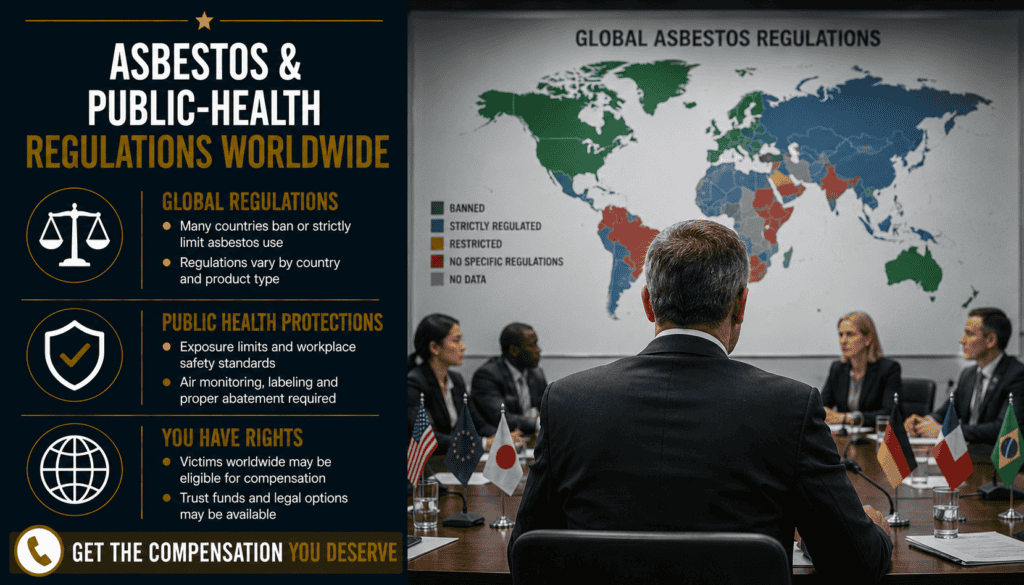
Asbestos Public Health Regulations Worldwide
Asbestos regulation is not uniform worldwide. Some countries prohibit essentially all new asbestos use, others impose partial restrictions, and some continue to permit uses under national rules. Even where new use has ended, governments still face a long-term public-health problem: asbestos installed decades ago remains in buildings, infrastructure and equipment and can be disturbed during maintenance, renovation, demolition and disaster cleanup.
Understanding international regulation therefore requires more than asking whether a country has an “asbestos ban.” Worker exposure limits, building-management duties, licensing, removal procedures, waste rules, environmental controls and disease surveillance can all differ. Historical rules also matter because today’s standards should not automatically be applied to an exposure that occurred decades ago.
🌍 Why Asbestos Regulation Differs Worldwide
Countries developed asbestos industries, construction practices and occupational-safety systems at different times. They also differ in regulatory capacity, building stock, economic resources, waste infrastructure and the extent to which asbestos remains in active commerce.
WHO’s August 2026 fact sheet states that asbestos use has been prohibited in more than 50 WHO Member States. That leaves a mixed global landscape rather than one universal legal standard.
For the broader exposure framework, visit the Asbestos Exposure Lawsuit child hub.
🩺 WHO’s Public-Health Position
The World Health Organization states that all forms of asbestos, including chrysotile, are carcinogenic to humans. WHO recommends stopping the use of all types of asbestos as the most efficient way to eliminate asbestos-related diseases, replacing asbestos with safer substitutes, preventing exposure to asbestos already in place and during removal, and improving diagnosis, rehabilitation and exposure registries.
WHO estimates that occupational asbestos exposure causes more than 200,000 deaths globally each year. It also emphasizes that disease will continue for many years after bans because of the long latency between exposure and illness.
⚖️ International Labour Standards
The International Labour Organization’s Asbestos Convention, 1986 (No. 162) establishes an international framework for protecting workers from asbestos hazards. It addresses national laws or regulations, exposure prevention and control, protective measures and employer responsibilities.
ILO conventions do not automatically operate as identical domestic statutes everywhere. Ratification and national implementation matter. Country-specific workplace rules should therefore be checked rather than assuming that an international instrument supplies the exact local requirement.
🚫 Total Bans, Partial Restrictions and Ongoing Use
| Regulatory model | General meaning | Important limitation |
|---|---|---|
| Comprehensive prohibition | New manufacture, import, sale or use is broadly prohibited | Legacy asbestos can remain in older structures |
| Partial restriction | Specified fiber types, products or uses are prohibited | Other uses may remain lawful |
| Controlled ongoing use | Use continues subject to occupational or product controls | Rules and enforcement vary |
| Legacy-management regime | Focuses on asbestos already installed | Does not mean every old material contains asbestos |
A country’s status should always be tied to a date. Regulations can change, transition periods can apply and older products may remain in service long after new use ends.
🇪🇺 European Union
EU law has prohibited the placing on the market and use of asbestos fibers and articles containing intentionally added asbestos, subject to the applicable regulatory framework. Worker protection is separately addressed by Directive 2009/148/EC, as amended by Directive (EU) 2023/2668.
The 2023 amendment lowered the occupational exposure limit to 0.01 fibres/cm³ as an eight-hour time-weighted average and establishes additional requirements from December 21, 2029, including alternative limit/counting approaches and more sensitive measurement requirements.
EU directives are implemented through Member State law, so national rules remain important for licensing, notification, training, removal and enforcement.
🇬🇧 United Kingdom
The United Kingdom prohibits new asbestos use and regulates asbestos already present through occupational and building-management requirements. The Control of Asbestos Regulations 2012 include duties to manage asbestos in non-domestic premises, assess risks, prevent or reduce exposure and use appropriately trained workers.
Some higher-risk work requires a licensed contractor. Whether a particular activity is licensable depends on the material and work, so a general statement that all asbestos work requires the same license would be inaccurate.
🇨🇦 Canada
Canada’s Prohibition of Asbestos and Products Containing Asbestos Regulations came into force in 2018 and broadly prohibit the import, sale and use of asbestos and products containing asbestos, subject to specified exclusions and transitional provisions.
Occupational health and safety is also regulated through federal, provincial and territorial systems. A national product prohibition therefore should not be treated as the complete set of workplace requirements.
🇦🇺 Australia
Australia has prohibited asbestos and asbestos-containing materials from being imported or used since the end of 2003, subject to limited exceptions. Legacy asbestos remains widespread in older buildings and is addressed through work health and safety, removal, licensing and environmental rules administered across federal, state and territory systems.
Because requirements differ by jurisdiction, property owners and workers should consult the rules applying where the work is actually performed.
🇯🇵 Japan
Japan progressively restricted asbestos products and ultimately prohibited manufacture and use subject to its national regulatory framework. Like other countries with historical asbestos use, Japan continues to face legacy-building, worker-protection, demolition and disease-compensation issues.
Historical exposure investigations should identify the rule in force during the actual employment period rather than using today’s prohibition as proof of what was required decades earlier.
🇺🇸 United States
The United States uses several overlapping federal asbestos laws rather than a single historical nationwide ban covering every legacy material. OSHA regulates workplace exposure; EPA regulates asbestos through statutes including the Toxic Substances Control Act and Clean Air Act asbestos NESHAP requirements; other federal, state and local rules can also apply.
EPA finalized a TSCA rule in March 2024 prohibiting ongoing uses of chrysotile asbestos under use-specific transition schedules. EPA separately completed its Part 2 risk evaluation in November 2024 for legacy uses and associated disposal, other asbestos fiber types and asbestos-containing talc. In 2026, EPA continued gathering information for development of risk-management regulation addressing those legacy conditions.
Accordingly, the statement “all asbestos is completely banned in the United States” is not an accurate description of the current regulatory structure.
🗺️ Countries Without Comprehensive Bans
WHO notes that some countries continue to use asbestos for various reasons. In those jurisdictions, prevention may depend on partial product restrictions, occupational exposure controls, labeling, licensing, engineering controls and other national requirements rather than a comprehensive prohibition.
International comparisons should avoid assuming that the absence of a comprehensive ban means the absence of all regulation. The actual national statutes and regulations must be reviewed.
👷 Workplace Exposure Rules
Occupational rules commonly address exposure assessment, permissible or binding limits, engineering controls, regulated work areas, respiratory protection, protective clothing, hygiene, training, medical surveillance and recordkeeping. The details vary substantially.
An occupational limit is a regulatory benchmark, not a guarantee that exposures below it cannot contribute to disease. See Airborne Asbestos Fiber Levels: What’s Considered Safe?.
🏚️ Legacy Asbestos in Existing Buildings
Legacy asbestos has become a major regulatory focus in countries that stopped new use years ago. Building rules may require owners or employers to identify asbestos, maintain registers, assess condition, inform workers and plan before disturbing materials.
EPA’s 2024 Part 2 risk evaluation illustrates the U.S. legacy issue: it evaluated asbestos remaining in products such as floor and ceiling tiles, pipe wraps, insulation and heat-protective textiles after manufacture, processing or distribution for those uses had ended.
🛠️ Renovation, Demolition and Abatement
Regulations frequently become more stringent when asbestos-containing material will be disturbed. Requirements may include surveys, notification, licensed or trained contractors, containment, wet methods, negative-pressure controls, respiratory protection, decontamination, air monitoring and clearance procedures.
Do not assume that a rule from one country applies to work in another. Even within federal systems, states, provinces or territories may impose additional requirements.
🚛 Transport and Waste Disposal
Asbestos regulation does not end when material leaves a building. Many jurisdictions regulate packaging, labeling, transport, approved disposal facilities and waste documentation. Illegal dumping or ordinary disposal can create environmental and worker exposure risks.
Disaster debris presents an additional challenge because damaged asbestos-containing materials can become mixed with other building waste. See Environmental Asbestos Exposure After Natural Disasters.
🏘️ Environmental and Public Exposure
Public-health regulation can extend beyond workers. Environmental controls may address emissions from demolition and renovation, mines and industrial facilities, waste sites, contaminated land, schools and public buildings.
WHO notes that exposure can occur in ambient air near point sources and indoor air where friable asbestos-containing material is present. Environmental regulation therefore complements occupational rules rather than replacing them.
📊 Disease Surveillance and National Programs
WHO and ILO have encouraged national programs for eliminating asbestos-related diseases. Key public-health tools include national asbestos profiles, disease surveillance, exposure registries, awareness programs, safer substitution, worker protection and plans for managing existing asbestos.
These programs help countries move beyond a simple ban/no-ban framework toward long-term management of historical exposure and disease burden.
📋 What to Compare Between Countries
| Question | Why it matters |
|---|---|
| Is new asbestos use prohibited? | Shows whether new products can legally enter use |
| Which fibers/products are covered? | Partial bans can differ from comprehensive prohibitions |
| What is the occupational limit? | Worker-control benchmarks vary |
| How are fibers measured? | Analytical methods can affect reported concentrations |
| Is an asbestos survey/register required? | Important for legacy-building management |
| Who may remove asbestos? | Licensing and competency rules differ |
| How is waste regulated? | Prevents exposure during transport and disposal |
| Are exposure/disease registries used? | Supports surveillance and prevention |
| What rule applied historically? | Today’s law may differ from the exposure-era rule |
📁 Why Historical Regulations Matter in Exposure Investigations
For a person who worked with asbestos in more than one country, regulations can provide historical context about known hazards, workplace controls, product restrictions and employer duties. They may also help identify records that should exist, such as monitoring, training, medical surveillance or abatement documents.
But regulations are only one part of an exposure investigation. Preserve the country, employer, facility, dates, occupation, tasks, products, coworkers and any monitoring records. See How to Document Your Asbestos Exposure History and Global Trends in Asbestos Exposure and Prevention.
🚫 What a Regulation Does Not Automatically Prove
- A national ban does not prove that all asbestos was removed from existing buildings.
- A current exposure limit does not prove what legal standard applied decades ago.
- A regulatory violation does not automatically establish every element of a civil lawsuit.
- Compliance with a numerical limit does not automatically resolve medical causation.
- The existence of asbestos at a workplace does not prove a particular worker encountered it.
- A rule in one country does not establish the legal duty in another country.
- An international recommendation is not necessarily identical to binding domestic law.
❓ Frequently Asked Questions
Is asbestos banned worldwide?
No. WHO reported in August 2026 that asbestos use was prohibited in more than 50 Member States, meaning regulation remains uneven globally.
Does WHO consider chrysotile asbestos carcinogenic?
Yes. WHO states that all forms of asbestos, including chrysotile, are carcinogenic to humans.
Does an asbestos ban remove asbestos from old buildings?
No. Legacy asbestos may remain for decades and must be managed under applicable building, occupational and environmental rules.
Does the European Union regulate worker exposure separately from product restrictions?
Yes. EU worker protection is addressed through the asbestos-at-work directive, including the 2023 amendment lowering occupational exposure limits and updating measurement requirements.
Is all asbestos completely banned in the United States?
No. EPA’s 2024 TSCA rule prohibits ongoing chrysotile uses under specified transition schedules, while legacy asbestos and associated disposal are addressed through a separate risk-management process and other existing laws.
Are asbestos exposure limits the same in every country?
No. Numerical limits, averaging periods, fiber-counting methods and enforcement systems can differ.
Why are demolition rules important after an asbestos ban?
Because asbestos installed before the ban may still be present and can be disturbed during renovation or demolition.
Do international WHO recommendations create legal duties?
WHO guidance is authoritative public-health guidance but is not itself a substitute for the binding law of a particular country.
What does the ILO Asbestos Convention do?
Convention No. 162 establishes an international occupational-safety framework for preventing and controlling workplace asbestos exposure. Domestic effect depends on ratification and national implementation.
Can current regulations prove that my historical employer was negligent?
No. The rules and evidence from the relevant time and jurisdiction must be evaluated, along with the facts required by applicable law.
What if I worked with asbestos in several countries?
Document each country, employer, site, time period and task separately. Regulatory and legal analysis may differ for each location.
Where should I start researching a country’s asbestos rules?
Begin with the country’s official occupational-safety, environmental and public-health authorities, then verify the version of the law that applied during the relevant period.
📞 Request a Case Evaluation
If you or a family member has been diagnosed with mesothelioma after working with or around asbestos in the United States or another country, preserve the countries, employers, job sites, years, occupations, products, tasks and coworkers connected to the exposure history.
Call 800.291.0963 for a no-obligation case evaluation. Talk to a real person 24/7, 365 days a year. There are no out-of-pocket legal fees for a contingency-fee claim unless compensation is recovered. Submit your case here.
📝 Summary
Asbestos public-health regulation varies widely around the world. More than 50 WHO Member States prohibit asbestos use, while other countries use partial restrictions or continue to permit some uses. Even countries with longstanding prohibitions face substantial legacy-asbestos challenges in buildings and infrastructure. Effective regulation therefore extends beyond product bans to worker exposure limits, building management, renovation and demolition controls, trained abatement, waste disposal, environmental protection and disease surveillance. For historical exposure questions, always distinguish today’s rules from those that applied at the time and place of the actual work.
🔗 Confirmed Sources
- World Health Organization — Asbestos Fact Sheet, August 2026
- World Health Organization — Asbestos: Chemical Safety and Health
- International Labour Organization — Asbestos Convention, 1986 (No. 162)
- EUR-Lex — Directive (EU) 2023/2668
- U.S. EPA — Asbestos Part 1: Chrysotile Asbestos
- U.S. EPA — Final Asbestos Part 2 Risk Evaluation
Disclaimer: General information only—not legal or medical advice. This website is not a law firm. Asbestos prohibitions, occupational limits, licensing, building-management rules, environmental requirements and legal remedies vary by country and can change. Verify current and historical requirements with the appropriate official authority. No prior result guarantees a future outcome.