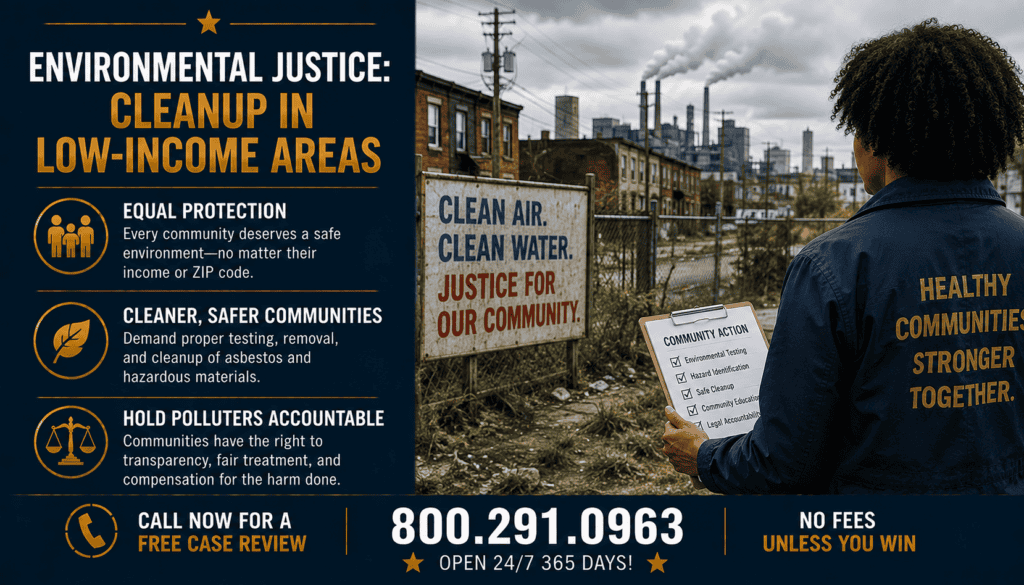
Environmental Justice and Asbestos Cleanup in Low-Income Areas
Asbestos cleanup can become an environmental justice concern when communities already facing economic or environmental burdens are located near aging housing, abandoned industrial properties, demolition projects, waste sites or disaster debris. The central public-health question is not simply whether a neighborhood is low-income. It is whether asbestos-containing material is present, how it is disturbed, who may be exposed, whether required controls are followed, and whether residents and workers have meaningful access to information and protection.
Environmental justice analysis should not assume that every low-income neighborhood has greater asbestos exposure or that income alone proves a legal claim. Site-specific evidence matters. Building age, historical industry, demolition practices, air and material testing, cleanup records, waste handling, proximity and individual exposure history can all be relevant.
🏘️ Why Asbestos Cleanup Can Become an Environmental Justice Issue
Communities may encounter asbestos during demolition of deteriorated buildings, redevelopment of former industrial land, cleanup of abandoned facilities, removal of illegal dumping, infrastructure work or recovery after fires and natural disasters. When these activities occur near homes, schools or businesses, dust control and communication can become community-wide concerns.
EPA’s asbestos demolition guidance explains that federal asbestos requirements apply to many municipal demolition projects and that state or local requirements may also apply. For covered demolitions, a thorough asbestos inspection is required before work begins.
For the broader legal hub, visit Secondhand, Family & Environmental Asbestos Lawsuits.
⚖️ What Environmental Justice Means in Cleanup Decisions
Environmental justice focuses on how environmental burdens and protections are experienced across communities and whether people can participate meaningfully in decisions affecting their environment and health. In an asbestos cleanup, practical issues can include access to project information, notice of demolition schedules, understandable risk communication, opportunities to raise concerns, worker protection and consistent enforcement of cleanup requirements.
Environmental justice is a policy and public-health framework; it does not by itself establish negligence, causation or entitlement to compensation in an individual lawsuit.
🏭 Where Community Asbestos Contamination Can Come From
- Demolition or renovation of older buildings
- Former factories and asbestos-product facilities
- Improper disposal or illegal dumping
- Abandoned industrial equipment and insulation
- Contaminated soil from historical operations
- Old housing, schools and public buildings
- Fire, flood, tornado or other disaster debris
- Waste transport and disposal activities
EPA notes that asbestos at Superfund sites may result from past industrial operations or improper waste disposal. Site-specific investigation is needed to determine whether asbestos is actually present and whether it poses an unacceptable risk.
🏚️ Aging Housing and Legacy Building Materials
Older residential and commercial structures can contain asbestos in products such as pipe insulation, floor tile, roofing, siding, cement products and other building materials. Age alone does not prove asbestos content, and not every older building contains the same materials.
The exposure concern generally increases when asbestos-containing material is damaged or disturbed. Renovation, demolition and uncontrolled debris handling can change an intact building material into a dust-producing situation.
🚧 Demolition, Urban Renewal and Asbestos Controls
Large-scale demolition programs may involve vacant or deteriorated housing concentrated in particular neighborhoods. EPA states that the asbestos NESHAP applies to most demolition projects conducted by municipalities, counties and land banks. Residential structures demolished as part of a commercial or public project may be subject to federal requirements even though isolated small residential buildings can be treated differently under the rule.
For demolitions subject to the NESHAP, EPA requires a thorough inspection for asbestos-containing material before demolition. Depending on the material and quantity, notification, removal, wetting, emission-control, waste and recordkeeping requirements can apply.
🧪 Contaminated Industrial and Superfund Sites
EPA’s Superfund program can address asbestos contamination resulting from historical industrial operations or improper waste disposal. EPA may conduct cleanup itself, compel responsible parties to perform cleanup or seek reimbursement under CERCLA where statutory requirements are met.
EPA uses site-specific risk evaluation for asbestos-contaminated Superfund sites. Its guidance notes that asbestos in soil at or below one percent may still present unacceptable risk under some site conditions, so a simple percentage threshold does not resolve every cleanup decision.
🌪️ Disaster Cleanup and Community Exposure
Disasters can damage older structures and mix asbestos-containing building material with other debris. EPA warns that hazards such as asbestos may be overlooked during rapid recovery because they are not immediately life-threatening even though health consequences may appear years later.
Residents should not enter unsafe buildings or collect suspect material as evidence. For detailed guidance, see Environmental Asbestos Exposure After Natural Disasters.
👷 Cleanup Workers and Day Laborers
Demolition and cleanup workers can face direct occupational exposure when asbestos-containing materials are disturbed. Worker protections can include hazard assessment, regulated areas, engineering controls, appropriate respiratory protection, protective clothing, decontamination and training under applicable occupational-safety rules.
Temporary workers, day laborers and subcontractors should not be assumed to have received the same training or records simply because they worked on the same project. An exposure investigation should identify the actual employer, contractor, training, tasks, protective equipment and work dates.
👨👩👧 Residents, Children and Nearby Families
Community exposure questions differ from occupational exposure because residents may not be inside the controlled work area. Relevant facts can include distance from the project, visible dust migration, duration, building openings, wind and weather, cleanup practices, environmental sampling and whether asbestos-containing material was actually disturbed.
Living near a demolition project does not automatically establish asbestos exposure. Reliable environmental and project evidence is important before drawing conclusions.
📢 Community Notice, Language Access and Risk Communication
Residents benefit from clear information about the project scope, demolition schedule, asbestos inspection, dust-control measures, complaint contacts and what to do if visible dust or debris leaves the site. Communication should be understandable to the community being served.
For an exposure record, preserve public notices, meeting materials, mailed notices, posted signs, project websites, agency correspondence and translations that were provided. These records can later show what information was available and when.
🔬 Inspection, Sampling and Air Monitoring
For covered demolition and renovation projects, EPA’s asbestos NESHAP requires a thorough inspection. Separate project plans or state and local requirements may also involve material sampling or air monitoring.
A single sample should be interpreted according to where, when and how it was collected. A positive material sample does not automatically prove a resident inhaled fibers, and a short-term air sample does not necessarily reconstruct exposure over an entire project.
💨 Dust Control During Demolition and Removal
EPA’s NESHAP work practices are designed to minimize asbestos emissions during demolition, renovation, waste packaging, transport and disposal. Where regulated asbestos-containing material must be handled, requirements can include removal before demolition, adequate wetting and leak-tight handling.
Visible dust can be an important condition to document, but visible dust alone cannot identify asbestos. Photograph conditions safely and report concerns to the appropriate regulatory authority rather than entering a work zone or collecting debris.
🚛 Waste Transport and Disposal
Asbestos control continues after material leaves the demolition site. Applicable requirements can govern wetting, packaging, labeling, transport, shipment records and disposal at facilities permitted to receive asbestos waste.
EPA compliance guidance states that regulated material removed during covered renovation or demolition must be managed and buried in an approved landfill. Improper dumping or uncovered transport can create additional community concerns.
📁 Records Communities Can Preserve
| Record | What it may help establish |
|---|---|
| Demolition notice/permit | Project dates, owner, contractor and scope |
| Asbestos inspection | Materials identified before work |
| Abatement records | Removal contractor and work performed |
| Photos/video | Site conditions and visible dust at a particular time |
| Air/sample reports | Measured conditions at specified locations and times |
| Waste shipment records | Handling and disposal route |
| Agency complaints | What was reported and when |
| Public notices | Information provided to residents |
| Medical records | Individual medical history; separate from exposure proof |
☎️ Reporting Suspected Unsafe Cleanup
Residents concerned about an active demolition or asbestos project can contact the state or local air-quality or environmental agency responsible for asbestos enforcement. EPA also maintains regional and state asbestos contacts.
When reporting a concern, provide the exact address, date and time, project description and observed conditions without entering the site. Keep a copy of complaint numbers, emails, photographs and agency responses.
⚖️ When Cleanup Exposure May Raise Legal Questions
Potential legal questions can involve property owners, municipalities, demolition contractors, abatement companies, employers, historical industrial operators, product manufacturers or other entities depending on the facts and applicable law.
A legal claim generally requires more than showing that cleanup occurred in a disadvantaged community. Exposure, duty, breach or other liability standards, causation, injury, jurisdiction and filing deadlines must be evaluated under the governing law.
Related pages include Legal Rights After Environmental Asbestos Exposure and Community Lawsuits Holding Polluting Companies Accountable.
🧾 Evidence for an Environmental Exposure Claim
Build the history chronologically. Record where the person lived, worked or attended school; the contaminated or demolition site; dates; distance; activities; observed conditions; known asbestos findings; witnesses; agency involvement; and any occupational or household asbestos exposure that may also be relevant.
Preserve original documents and digital files. Do not alter photographs or guess at asbestos content. Environmental evidence and medical evidence answer different questions and should be kept distinct.
🚫 What Community Conditions Do Not Automatically Prove
- Low household income does not itself prove greater asbestos exposure.
- Living near an old building does not prove the building contained asbestos.
- Visible demolition dust does not establish asbestos content.
- A positive sample from one material does not prove all neighborhood dust contained asbestos.
- A regulatory violation does not automatically establish every element of civil liability.
- Living near a contaminated site does not by itself establish an individual dose.
- A mesothelioma diagnosis does not identify which site or defendant caused an exposure.
These distinctions support a more accurate environmental justice analysis by focusing on documented conditions rather than assumptions.
✅ Community Cleanup Documentation Checklist
- Record the exact project or contaminated-site address.
- Save demolition permits and public notices.
- Request or preserve asbestos inspection records when available.
- Document project owners and contractors.
- Keep original photographs and videos with dates and locations.
- Record visible dust or off-site debris without entering the work zone.
- Save environmental sampling and air-monitoring reports.
- Keep agency complaint numbers and responses.
- Preserve community-meeting materials and correspondence.
- Record waste trucks, disposal information and shipment records when lawfully available.
- Identify firsthand witnesses.
- Document residence, work or school locations and relevant dates.
- Keep medical records separate from exposure documentation.
- Do not collect suspected asbestos debris yourself.
- Review legal filing deadlines promptly if a claim is being considered.
❓ Frequently Asked Questions
What makes asbestos cleanup an environmental justice issue?
It can become an environmental justice concern when environmental burdens, cleanup protections, access to information or opportunities to participate affect communities already facing socioeconomic or environmental stressors. The actual asbestos conditions still require site-specific evidence.
Are low-income neighborhoods automatically more exposed to asbestos?
No. Income alone cannot establish exposure. Building stock, historical land use, industrial sources, demolition activity and cleanup practices must be evaluated.
Does EPA regulate asbestos during demolition?
Yes. The federal asbestos NESHAP applies to covered facilities and many municipal demolition projects and includes inspection, notification and work-practice requirements.
Do asbestos rules apply to every single-family home demolition?
Not necessarily. Federal NESHAP treatment depends on the project and building circumstances, while state and local rules may be broader. Large municipal or redevelopment projects can bring residential structures within federal requirements.
Can asbestos contamination be cleaned up through Superfund?
Yes, in appropriate circumstances. EPA states that asbestos contamination from past industrial operations or improper waste disposal may be addressed under Superfund, subject to CERCLA and site-specific conditions.
Can I collect demolition debris to have it tested?
Do not enter a work zone or disturb suspected asbestos material yourself. Report the concern and use qualified professionals or regulatory authorities for sampling.
Does visible dust prove asbestos exposure?
No. Visible dust can document site conditions but cannot establish asbestos content without additional evidence.
What records should residents save?
Useful records can include permits, asbestos inspections, public notices, photographs, environmental reports, complaint records, contractor information and witness contacts.
What if a demolition project is next to a school?
Document the project and contact the appropriate local or state environmental authority with concerns. School proximity is important context but does not by itself prove asbestos migration or exposure.
Can a community lawsuit be filed over asbestos contamination?
Potential claims depend on the facts, plaintiffs, defendants, exposure and injury evidence, legal theories, jurisdiction and deadlines. Community concern alone does not establish a viable lawsuit.
Does a cleanup violation automatically prove negligence?
No. Regulatory evidence may be relevant, but its legal effect depends on the jurisdiction and the elements of the particular claim.
What should a person diagnosed with mesothelioma preserve?
Preserve residential and work history, dates, contaminated-site or demolition information, environmental reports, photographs, witnesses, medical records and any other occupational or household asbestos history.
📞 Request a Case Evaluation
If you or a family member has been diagnosed with mesothelioma after living or working near an asbestos-contaminated industrial site, demolition project or cleanup area, gather the addresses, dates, project records, environmental reports, photographs, witnesses and any occupational or household exposure history.
Call 800.291.0963 for a no-obligation case evaluation. Talk to a real person 24/7, 365 days a year. There are no out-of-pocket legal fees for a contingency-fee claim unless compensation is recovered. Submit your case here.
📝 Summary
Environmental justice and asbestos cleanup intersect when demolition, contaminated land, industrial legacies, disaster debris or waste handling affect communities that may already face economic and environmental burdens. Effective protection depends on identifying asbestos before disturbance, controlling emissions, protecting workers and residents, communicating clearly, managing waste correctly and enforcing applicable requirements. For a legal or exposure investigation, neighborhood characteristics alone are not enough; preserve site-specific evidence showing what material was present, what work occurred, how exposure may have happened and who was responsible for the relevant activity.
🔗 Confirmed Sources
- U.S. EPA — Asbestos-Containing Materials and Demolition
- U.S. EPA — Asbestos NESHAP
- U.S. EPA — Asbestos at Superfund Sites
- U.S. EPA — Asbestos Demolition and Renovation Compliance Monitoring
- U.S. EPA — Dealing With Debris and Damaged Buildings
Disclaimer: General information only—not legal or medical advice. This website is not a law firm. Environmental, asbestos, demolition, workers’ compensation and civil-liability rules vary by jurisdiction and circumstances and can change. Do not enter unsafe work areas or disturb suspected asbestos material to collect evidence. No prior result guarantees a future outcome.