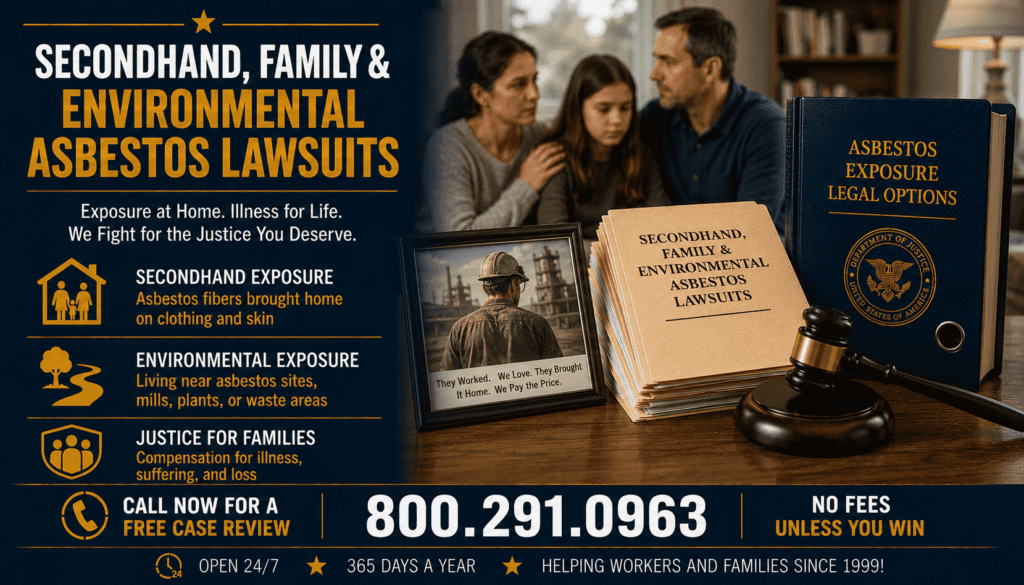
Secondhand, Family & Environmental Asbestos Lawsuits
Asbestos exposure did not always end when a worker left the jobsite. Historically, fibers could be carried home on work clothing, shoes, skin, hair or personal items, exposing spouses, children and other household members. ATSDR recognizes these paraoccupational or take-home exposure pathways, and EPA has evaluated risks to household members who handle or are near asbestos-contaminated work garments.
Other families may have experienced environmental exposure from nearby industrial operations, demolition, renovation, contaminated property or disturbed legacy asbestos materials. A lawsuit based on secondhand or environmental exposure requires case-specific evidence connecting the person, exposure pathway, potentially responsible party and disease under applicable state law.
🏠 Understanding Secondhand & Environmental Asbestos Claims
These cases differ from direct occupational claims because the diagnosed person may never have worked with asbestos. The investigation instead reconstructs how fibers could have traveled from a workplace, industrial source, contaminated property or disturbed material to the person who later developed disease.
The exposure pathway and legal duty must be evaluated separately. Evidence that asbestos was present somewhere does not automatically prove that a particular defendant caused a claimant’s exposure.
👕 What Is Secondhand Asbestos Exposure?
ATSDR describes past paraoccupational exposure in household contacts of asbestos workers through asbestos dust carried on workers’ skin, hair and clothing. Inhalation is the principal exposure route associated with asbestos disease.
Secondhand exposure is also called household, take-home or paraoccupational exposure. The terminology may differ, but the factual inquiry focuses on the source, transport pathway, frequency and duration of contact.
🧺 Take-Home Exposure From Work Clothing
Historically, workers in industries using asbestos could return home wearing dusty work clothes. Household members could then encounter fibers while hugging the worker, handling clothing, cleaning vehicles or living in areas where contaminated items were stored.
EPA’s asbestos risk evaluation recognizes take-home scenarios involving people who handle contaminated occupational garments and bystanders near those garments.
👨👩👧 Family and Household Exposure
A family claim may involve a spouse, child or other household member. Relevant facts include how long the people lived together, the worker’s occupation, work practices, whether clothing was changed at work, transportation routines, where work clothes were stored and who handled them.
Family relationship alone does not prove exposure. The claim should document the actual household contact and exposure pathway.
🧼 Laundry and Clothing Exposure
Laundering contaminated work clothes is a recognized historical exposure scenario. ATSDR specifically identifies laundering as a route through which household contacts could inhale asbestos dust carried home from work.
Important evidence can include who washed the clothes, how often, whether garments were shaken or brushed, where laundry occurred and whether work clothes were mixed with household laundry.
🌎 Environmental Asbestos Exposure
Environmental exposure can occur when asbestos-containing material or naturally occurring asbestos is disturbed and fibers enter the air. ATSDR identifies environmental sources including older asbestos materials, contaminated areas and natural deposits.
For a legal claim, the existence of environmental asbestos is only part of the analysis. Evidence must address the relevant source, pathway, location, time period and responsible entity.
🏘️ Community Exposure Near Industrial Sites
Residents near facilities that handled asbestos-containing materials may allege exposure from airborne emissions, waste, contaminated soil or material transported through the community. Historical operations, wind patterns, disposal records, sampling data and witness testimony can become relevant.
A facility’s proximity to a home does not by itself establish an individual’s exposure level or legal causation.
🚨 Demolition, Disasters and Cleanup
EPA and ATSDR recognize that demolition, renovation, fires and other disturbances can release fibers from legacy asbestos-containing materials. Cleanup workers, nearby residents and other people can potentially encounter disturbed material.
Historical evidence should distinguish the presence of asbestos-containing material from proof that fibers reached a particular claimant at a legally significant level.
🏡 Exposure in Homes and Buildings
EPA explains that intact asbestos-containing material generally should be left undisturbed, while damaged or disturbed material can release fibers. Older homes may contain asbestos in insulation, flooring, roofing, cement products and other building materials.
A residential exposure investigation should document renovations, damaged materials, contractors, product identification and occupancy dates rather than assuming every older building created asbestos exposure.
⚖️ How Liability Is Evaluated
Liability depends on the legal theory and governing state law. Potential issues can include product liability, negligence, premises liability, failure to warn or other recognized theories.
The analysis should separate diagnosis, exposure, defendant identification, legal duty, causation and damages. A mesothelioma diagnosis does not independently establish which company is legally responsible.
📋 Duty and State-Law Differences
Take-home asbestos cases can raise the question of whether a defendant owed a legal duty to a household member who was not present at the workplace. Courts and legislatures can apply different rules to that issue.
Because duty and other elements vary by jurisdiction, a result from one state should not be assumed to control a claim arising elsewhere.
🏢 Potential Defendants
Depending on the evidence, a case may investigate product manufacturers, suppliers, premises owners, contractors, employers or other entities associated with the alleged source. Some former asbestos defendants may instead be associated with bankruptcy trusts.
Each defendant requires its own factual and legal basis. A company should not be included solely because it operated in an asbestos-related industry.
📂 Evidence Used in Secondhand Claims
| Evidence | What it may help establish |
|---|---|
| Employment records | Where and when the worker was employed |
| Job descriptions | Tasks and possible exposure circumstances |
| Product records | Possible asbestos sources at the workplace |
| Family testimony | Laundry, clothing and household routines |
| Residence records | Where the household lived during relevant periods |
| Environmental records | Facility emissions, waste or contaminated locations |
| Medical records | Diagnosis and treatment |
👷 Reconstructing the Worker’s Exposure
Start with the worker’s employers, jobsites, trade, department, tasks and dates. Identify materials or equipment actually encountered and coworkers who can describe conditions firsthand.
Employment at a shipyard, refinery, factory or other site does not prove contact with every asbestos product used there.
🗓️ Reconstructing Household Contact
Build a household timeline showing when the worker and family member lived together, work shifts, transportation, clothing practices, laundry routines and other recurring contact. Mark estimated dates clearly.
This timeline can connect workplace evidence to the alleged household pathway without overstating what individual records prove.
🧪 Environmental Evidence
Environmental investigations can use historical sampling, regulatory records, facility documents, property records, maps and expert analysis. Each type of evidence has limits.
For example, a historical air or soil sample describes conditions associated with that sample; it does not automatically quantify every resident’s past exposure.
🩺 Medical Evidence and Causation
Medical evidence establishes diagnosis and can address relevant clinical issues. Exposure and legal causation require additional factual and, in some cases, expert evidence.
ATSDR recognizes that mesothelioma can occur after paraoccupational exposure, but population-level evidence does not substitute for proving the facts required in an individual legal claim.
🗣️ Family and Coworker Witnesses
Family witnesses may remember work clothing, laundry practices, vehicles and household routines. Coworkers may remember products, tasks and workplace conditions.
Witness statements are strongest when they distinguish firsthand recollection from information learned later. Avoid supplying brand names or dates that a witness does not actually remember.
📑 Employment, Laundry and Residence Records
Useful records can include Social Security earnings histories, personnel files, union records, military records, city directories, leases, deeds, utility records, photographs and contemporaneous correspondence.
Industrial laundry records can be especially important when contaminated work clothing was commercially handled rather than washed at home.
🕊️ Wrongful-Death Claims
If a person exposed secondhand or environmentally dies from mesothelioma, state law may permit qualifying survivors or an authorized representative to pursue wrongful-death claims. Survival claims may also preserve certain rights belonging to the deceased.
Explore Mesothelioma Wrongful Death Lawsuits.
⏳ Filing Deadlines
Statutes of limitations vary by state and claim type. Diagnosis, death, residence, exposure location and jurisdiction can all matter to the analysis.
Do not delay deadline review while searching for every historical record. See Mesothelioma Deadlines & Statute of Limitations.
🔀 Trust Claims and Civil Lawsuits
A worker’s occupational exposure may involve companies that later established asbestos bankruptcy trusts as well as solvent defendants. Trust eligibility and a civil lawsuit are separate claim routes with different procedures.
Household exposure histories should remain consistent with the underlying evidence across trust submissions and litigation.
⚠️ What Individual Evidence Does Not Prove
- A mesothelioma diagnosis does not identify the responsible company.
- Employment at a facility does not establish exposure to every product there.
- An invoice does not prove the worker personally handled the product.
- A dusty uniform does not identify which material produced the dust.
- Living near a facility does not by itself quantify exposure.
- A historical environmental sample does not automatically establish an individual’s past dose.
- A family relationship alone does not prove take-home exposure.
🧭 Explore Family & Environmental Lawsuit Topics
- Secondary Exposure From Industrial Laundry Facilities
- Environmental Justice & Cleanup in Low-Income Areas
- Legal Options After Secondary Household Asbestos Exposure
- Community Lawsuits Holding Polluting Companies Accountable
- Corporate Negligence: How Lawsuits Drive Justice & Research
- Legal Rights After Environmental Asbestos Exposure
- Legal Rights for Environmental and Community Exposure Victims
- Family Member Mesothelioma Claims
- Managing Insurance Claims as a Family
✅ Evidence Checklist
| Area | Information to preserve |
|---|---|
| Worker history | Employers, jobsites, tasks and dates |
| Products | Brands, equipment and supporting records |
| Household contact | Residence dates and daily routines |
| Laundry | Who handled clothes, where and how often |
| Transportation | Vehicles and contaminated-item storage |
| Environmental source | Facility, demolition, waste or property records |
| Witnesses | Family, coworkers and neighbors with firsthand knowledge |
| Medical records | Pathology, diagnosis and treatment |
| Prior claims | Trust claims, lawsuits and exposure statements |
| Deadlines | Diagnosis, death and relevant state contacts |
❓ Frequently Asked Questions
Can family members be exposed to asbestos from a worker’s clothing?
Yes. ATSDR recognizes historical paraoccupational exposure from asbestos dust carried home on workers’ skin, hair and clothing, including exposure during laundering.
What is take-home asbestos exposure?
It describes asbestos transported from an occupational setting into a household on clothing, shoes, skin, hair or other items.
Can a spouse who washed work clothes have a claim?
Potentially, depending on the evidence and state law. The claim must establish the applicable legal elements rather than relying only on the family relationship.
Can children experience secondhand asbestos exposure?
Yes. Household contacts, including children, could historically encounter fibers brought home from work. The facts of the actual household exposure remain important.
Can living near an industrial facility cause asbestos exposure?
Potentially, if asbestos fibers were released and reached surrounding areas. A legal claim requires evidence concerning the source, pathway and claimant-specific exposure.
Does mesothelioma prove secondhand exposure?
No. Diagnosis establishes disease, not the particular source or legally responsible defendant.
What records help prove household exposure?
Worker employment records, product evidence, residence history, family testimony, photographs and laundry or clothing routines can be relevant.
Are environmental and take-home claims the same?
No. Take-home claims generally focus on fibers transported from work, while environmental claims may involve releases from facilities, contaminated property, demolition or other sources.
Can a wrongful-death lawsuit involve secondhand exposure?
Potentially, when the governing state law and evidence support the required elements.
Should families wait until every exposure source is identified?
No. Filing deadlines should be reviewed while historical exposure evidence is still being investigated.
📞 Request a Case Evaluation
If a family member developed mesothelioma after possible household or environmental asbestos exposure, organize the worker’s employment history, jobsites, work clothing and laundry routines, household residences, witnesses, environmental records and medical documentation. Clearly separate verified facts from estimates or later recollections.
Call 800.291.0963 for a no-obligation case evaluation and to talk to a real person 24/7, 365 days a year. Many mesothelioma law firms handle qualifying cases on a contingency-fee basis; confirm the fee agreement and terms directly with the firm you retain. Submit your case here.
📝 Summary
Secondhand, family and environmental asbestos claims can involve fibers carried home from workplaces, contaminated work clothing, industrial emissions, demolition, contaminated property and other pathways. Government health agencies recognize historical take-home and environmental exposure pathways, but an individual lawsuit still requires claimant-specific evidence. Strong case development reconstructs the original asbestos source, transport pathway, household or community contact, potential defendants, medical evidence and applicable state law without assuming that diagnosis, employment or proximity alone proves liability.
🔗 Confirmed Sources
- ATSDR — Asbestos and Your Health
- ATSDR — Taking an Exposure History
- U.S. EPA — Protect Your Family From Exposures to Asbestos
- U.S. EPA — Asbestos Part 2 Risk Evaluation
Disclaimer: General information only—not legal or medical advice. This website is not a law firm. Duty rules, liability standards, causation requirements, filing deadlines and available claims vary by state and case-specific facts. A diagnosis, family relationship, workplace history or residence near an asbestos source does not by itself establish liability or guarantee compensation. Past results do not guarantee future outcomes.