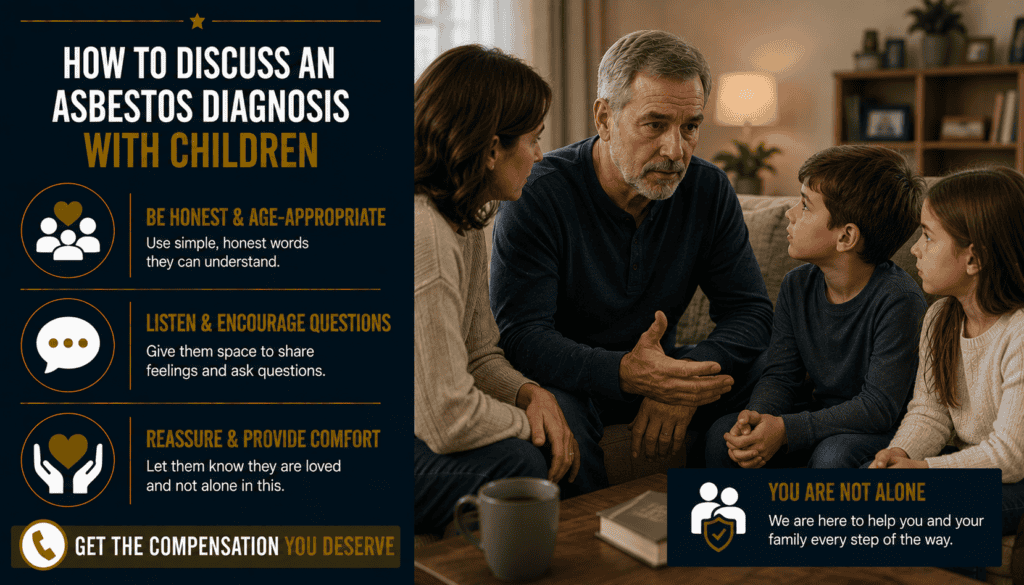
How to Discuss an Asbestos Diagnosis With Children
Clear, age-appropriate conversations about asbestos-related illness, uncertainty, and family safety.
When a parent or another loved one receives an asbestos-related diagnosis, children may hear unfamiliar words, notice medical appointments, or worry that the home is unsafe. A useful first conversation explains what clinicians have actually diagnosed, what is still being investigated, and which adults will keep daily life steady. This guide addresses conversations about an asbestos-related condition; it does not assume every asbestos exposure or abnormal scan means mesothelioma.
Asbestos exposure, an asbestos-related noncancerous condition, lung cancer, and mesothelioma are different findings. Before talking with a child, confirm the exact diagnosis with the medical team. For a broader explanation of the testing process, review mesothelioma diagnosis and how imaging and biopsies fit together.
Clarify What the Diagnosis Actually Means
Begin with precise language. Someone may have a history of asbestos exposure without having cancer. Imaging can identify findings that need investigation, but a mesothelioma diagnosis usually requires examination of an appropriate tissue sample. The words you use with children should reflect the confirmed medical record rather than the most frightening possibility.
| What adults know | What to say to a child | What not to imply |
|---|---|---|
| Exposure history only | “The doctor is checking whether past contact with asbestos affected my health.” | Exposure automatically means cancer. |
| Abnormal imaging, diagnosis pending | “A scan showed something doctors need to investigate.” | The scan proves mesothelioma. |
| Confirmed noncancerous condition | “The doctor found a condition linked to asbestos; we are learning how to manage it.” | Every asbestos-related condition is cancer. |
| Confirmed mesothelioma | “The doctors found a cancer called mesothelioma. We are discussing treatment and support.” | The same outcome applies to everyone. |
If the person has confirmed mesothelioma, explain that it is a cancer affecting a lining around certain organs. Avoid detailed anatomy unless the child wants it. A child needs a trustworthy explanation more than a complete pathology lesson. See pleural mesothelioma for adult background.
Prepare Before Talking With Children
Choose a calm time with enough space for questions. The patient should decide which details may be shared when possible. Adults can agree on a few confirmed facts and practical plans so the child does not hear contradictory explanations. A conversation can be brief and revisited; there is no need to deliver all possible future scenarios at once.
| Preparation | Practical action |
|---|---|
| Check diagnosis | Ask the treating clinician what is confirmed and what remains uncertain. |
| Agree on language | Use the same illness name and simple explanation across caregivers. |
| Identify daily caregivers | Know who handles school pickup, meals, and bedtime during appointments. |
| Choose a quiet moment | Avoid delivering the news in a rushed or public setting. |
| Plan follow-up | Tell the child when you will talk again and whom they may ask questions. |
A possible opening for a confirmed diagnosis is: “I have a condition called mesothelioma. It is a kind of cancer, and the doctors are helping me decide what care I need. You did not cause it. We will tell you what we learn, and we have a plan to take care of you.” Change the words if the diagnosis is not cancer.
Explain the Diagnosis by Age
A child’s developmental level, experience with illness, and personal preferences matter more than an exact birthday. Keep the first explanation short, then ask what they understood. Some children will want to draw or play afterward; that does not mean the conversation failed.
| Age or stage | Helpful approach | Most immediate concern |
|---|---|---|
| Preschool | Name the illness in simple words; explain what changes today. | Who will take care of me? |
| Elementary school | Explain appointments and treatment in concrete steps. | Did I cause it or can I catch it? |
| Teenager | Offer accurate detail, privacy, and choices about when to talk. | How will school, friends, and family responsibilities change? |
| Adult child | Discuss medical facts and desired involvement with patient consent. | How can I help without taking over decisions? |
For younger children, “Grandma is going to the doctor because her lungs are not working as well as usual” may be appropriate when that is the confirmed issue. For teenagers, name mesothelioma or another exact diagnosis and invite questions without expecting an immediate response. Helping children understand a parent’s diagnosis offers a companion discussion of age-appropriate communication.
Answer Questions About Asbestos and Safety
Children may connect the word asbestos with their own safety. Explain two separate issues: cancer itself is not contagious through hugs or everyday contact, while asbestos fibers can be hazardous if asbestos-containing material is disturbed and fibers are inhaled. Do not assure children that a particular building or product is safe without an appropriate assessment. If there is a current suspected asbestos hazard, keep children away from the disturbed material and seek qualified local environmental or building guidance; do not ask children to inspect or clean it.
| Question | Careful answer |
|---|---|
| “Did I make you sick?” | “No. Nothing you said, thought, or did caused this illness.” |
| “Can I catch the cancer?” | “No. Cancer is not spread by hugging or sitting together.” |
| “Is there asbestos in our house?” | “We do not know just from the diagnosis. Adults will check any specific concern with qualified professionals.” |
| “Can I clean dusty material?” | “No. Leave suspicious material alone and tell an adult.” |
| “Will you get better?” | “The doctors are explaining the options. We will tell you what we know without making promises.” |
A historical workplace exposure does not by itself establish that a child is currently being exposed at home. Likewise, family members should not disturb suspected asbestos to find out whether it is present. Discuss possible household exposure with appropriate professionals rather than using a cancer diagnosis as a substitute for an environmental assessment.
Explain Appointments and Changes at Home
Explain visible changes before they happen when possible. A child may interpret a parent’s fatigue, an overnight hospital stay, or an inability to attend a school event as rejection. Use concrete schedules, identify a backup adult, and explain that illness or treatment can affect energy and availability.
| Upcoming change | What a child may need to hear |
|---|---|
| Medical appointment | “Uncle Sam will pick you up; I will tell you when I am back.” |
| Biopsy or scan | “Doctors are doing a test to learn more; they will explain the results to us.” |
| Treatment day | “I may be tired afterward, and another adult will make dinner.” |
| Hospital stay | “You will stay with Aunt Jo and can call me when I am able.” |
| New symptoms | “I will tell my medical team; it is not your job to fix this.” |
Adults can use a medical-records checklist to organize clinical information, but children should not be tasked with interpreting reports. Encourage ordinary school, play, and friendships without guilt.
Support Feelings, School, and Daily Life
Children may feel worried, angry, sad, relieved, or uninterested at different times. Reassure them that all feelings can be discussed, and do not require them to stay cheerful. Check in periodically rather than making every family conversation about the illness. A trusted teacher or school counselor may help if the family agrees to share limited information.
| What you notice | First supportive response | Consider professional support when |
|---|---|---|
| Repeated questions | Give the same truthful answer and invite more questions. | Worry persistently interferes with daily life. |
| Withdrawal | Offer quiet company or another trusted adult. | Isolation is sustained or worsening. |
| School or sleep changes | Restore predictable routines and ask what is hardest. | Problems persist or significantly impair functioning. |
| Excessive caregiving | Return medical and household responsibility to adults. | The child misses school or feels responsible for recovery. |
| Talk of self-harm | Stay with the child and seek urgent help. | Any immediate danger warrants emergency services. |
An oncology social worker, pediatrician, school counselor, or mental-health professional can help. For adults, coping emotionally after diagnosis addresses the parallel need for support. In the United States, call or text 988 for a suicide or mental-health crisis; call emergency services for immediate danger.
Coordinate Medical Guidance and Family Support
The patient’s medical team can clarify the exact diagnosis and what can be shared accurately. An oncology social worker or child-life specialist may help with age-appropriate explanations. If the illness is advanced, avoid euphemisms or false reassurances about prognosis; ask the clinical team for help discussing serious changes truthfully and compassionately.
| Support person | How they can help |
|---|---|
| Treating clinician | Confirm diagnosis, tests, and treatment information. |
| Oncology social worker | Assist with family conversations and support resources. |
| Child-life specialist, where available | Offer developmentally appropriate ways to understand illness. |
| Pediatrician | Assess changes in a child’s functioning and advise on care. |
| School counselor | Provide school-based support with family permission. |
Relevant reading includes talking with family, obtaining a second opinion, and mesothelioma support resources. For primary guidance, consult the National Cancer Institute’s advice on talking to children about cancer, its guidance for families facing advanced cancer, and MedlinePlus on talking with a child about a parent’s terminal illness when relevant. The latter resource applies only when the medical team has confirmed that situation.
Frequently Asked Questions
Is an asbestos diagnosis always mesothelioma?
No. An exposure history, a noncancerous asbestos-related condition, lung cancer, and mesothelioma are distinct. Use the precise confirmed diagnosis.
Should I tell children the word asbestos?
You can use the word when it helps explain a confirmed diagnosis, but pair it with a short explanation and do not overload children with technical details.
Can children catch mesothelioma from a parent?
No. Cancer is not contagious through normal contact, including hugs. A separate concern about asbestos-containing materials requires an appropriate environmental assessment.
Did my child cause the illness?
No. Tell the child directly that nothing they thought, said, or did caused the diagnosis.
What if we are still waiting for biopsy results?
Explain that clinicians found something that needs further testing. Do not present mesothelioma as confirmed until the care team confirms it.
What should I say if a child asks whether I will die?
Acknowledge the fear, share what is actually known, avoid guarantees, and explain who will care for the child. Seek help from a counselor if needed.
Should the school know?
Consider sharing limited information with a trusted teacher or counselor, based on the patient’s privacy wishes and the child’s support needs.
When should a child see a counselor?
Seek advice if distress is persistent, escalating, or disrupting school, sleep, relationships, or safety. Immediate danger requires emergency help.
Get Help and Explore Your Options
If your family is dealing with a confirmed asbestos-related diagnosis, you can ask about general information and possible legal options. Call 800.291.0963. Live chat is available 24/7, 365 days a year. Submit Your Case using the form below. No compensation or case result is guaranteed; eligibility depends on individual circumstances.
⚕️ Legal & Medical Information Disclaimer
This page provides general educational information, not medical, mental-health, environmental, or legal advice. Consult qualified clinicians, environmental professionals, and attorneys as appropriate. Seek urgent help for immediate safety concerns.