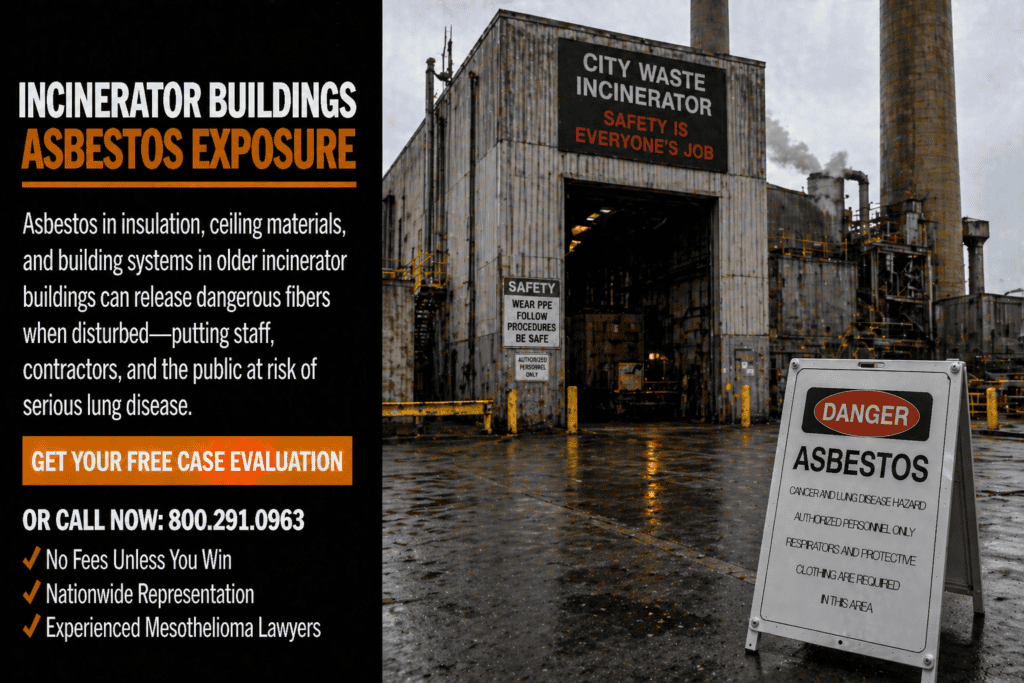
🔥 Incinerator Buildings Asbestos Exposure
Incinerator facilities can include furnace and combustion areas, boiler or heat-recovery sections, pipe and utility corridors, ventilation systems, electrical and control rooms, maintenance shops, ash-handling areas, loading spaces and administrative buildings. Older facilities may have undergone repeated shutdowns, equipment replacements, utility upgrades and major renovations during decades of operation.
Depending on a facility’s age, construction history and installed products, some older incinerator buildings may have contained asbestos-containing materials. Working at or near an older incinerator does not by itself prove asbestos exposure. A stronger investigation connects a person to a specific facility, building area, dates, job or task, material and disturbance event.
See the Industrial, Manufacturing & Utility Buildings Asbestos Exposure hub and the broader Asbestos Exposure in Buildings resource.
🔥 How Asbestos Exposure Could Occur in Incinerator Buildings
Potential building exposure depended on whether asbestos-containing material was actually present and whether maintenance, repair, renovation, removal or demolition disturbed it. Incinerator exposure research should distinguish building materials from furnace refractory, process equipment, gaskets, machinery and other equipment-specific sources unless separate evidence identifies those materials as asbestos-containing.
Projects worth investigating include boiler and heat-recovery repairs; pipe and utility maintenance; ventilation upgrades; electrical and control-system modernization; wall, ceiling and flooring work; maintenance-shop renovation; planned outages; facility expansion; decommissioning; and demolition.
EPA guidance states that renovation, remodeling and replacement of utility systems can increase the potential for disturbing ACM. Before renovation, asbestos inspection and assessment records should be reviewed and suspect or assumed ACM that could be affected should be evaluated.
🏭 Incinerator Building Areas and Systems to Investigate
🔥 Furnace and Combustion Areas
Combustion areas can contain structural surfaces, utility runs, ventilation systems and adjacent building materials. Furnace refractory or process insulation should not automatically be characterized as asbestos-containing; its composition requires separate evidence.
♨️ Boiler and Heat-Recovery Areas
Some incinerator facilities use boilers or heat-recovery systems. Older pipe, boiler, tank or duct insulation may warrant investigation when supported by surveys, records, testing or applicable regulatory presumptions.
🔩 Pipe and Utility Corridors
Utility areas may contain steam, hot-water, process and building-service piping. Repair, valve work and system replacement can disturb nearby insulation or building materials where ACM is present.
🌬️ Ventilation and Air-Handling Areas
Fan, duct and mechanical work may affect ceilings, walls, utility penetrations and insulation.
⚡ Electrical and Control Rooms
Cable installation, panel replacement and conduit work can involve drilling, cutting and access through older walls and ceilings.
🔧 Maintenance Shops
Exposure investigations should distinguish installed building materials from equipment parts handled in the shop.
🗑️ Ash-Handling and Loading Areas
Ash and process dust should not automatically be described as asbestos. Evidence is needed to identify a specific asbestos-containing source and disturbance pathway.
🧱 Asbestos-Containing Materials to Investigate
No incinerator material should be identified as asbestos-containing solely because a facility is old or operated at high temperatures. Historical specifications, asbestos surveys, qualified inspections, sampling records and appropriate laboratory analysis provide stronger evidence.
| Facility Area | Material or System to Investigate | Potential Disturbance |
|---|---|---|
| Boiler/mechanical areas | Pipe, boiler, tank or duct insulation where present | Repair, removal or replacement |
| Walls and ceilings | Certain historical panels, compounds or ceiling materials | Drilling, cutting or demolition |
| Structural surfaces | Certain surfacing or fireproofing materials | Repair, renovation or removal |
| Offices/support spaces | Certain historical flooring and associated mastics | Removal, cutting or renovation |
| Ventilation systems | Certain thermal insulation and associated materials | Maintenance or modernization |
| Roofs/exteriors | Certain historical roofing, siding or cement products | Repair, removal or demolition |
OSHA defines thermal-system insulation as ACM applied to pipes, fittings, boilers, tanks, ducts and other structural components to prevent heat loss or gain. OSHA’s Class II definition includes removal of asbestos-containing wallboard, floor tile and sheeting, roofing and siding shingles, and construction mastics. Class III work includes repair and maintenance where ACM, including TSI and surfacing ACM/PACM, is likely to be disturbed.
👷 Incinerator Workers and Trades Potentially at Risk
Potential building exposure varies by occupation and task. Workers who cut, removed, drilled, repaired or disturbed installed materials may have had different exposure opportunities from employees working around intact finished surfaces.
- Maintenance mechanics — building and utility repairs.
- Boiler workers — boilers, piping and heat-recovery systems.
- Pipefitters and plumbers — steam, water and utility piping.
- HVAC technicians — ducts, fans and ventilation systems.
- Electricians and control technicians — panels, conduit and wiring.
- Insulators — documented thermal-system insulation.
- Construction trades — walls, ceilings and renovations.
- Shutdown crews — concentrated maintenance projects.
- Demolition workers — decommissioning and structural removal.
Operators and ash-handling employees may require investigation if documented ACM was disturbed nearby. Working around incinerator ash or ordinary facility dust alone does not establish asbestos exposure.
🔨 Maintenance, Outages, Renovation and Demolition
Planned outages can concentrate maintenance activity in a short period. Crews may open equipment areas, remove insulation, replace piping, modernize electrical systems, repair ventilation and access spaces that are difficult to reach during normal operations.
OSHA’s asbestos construction standard covers demolition, alteration, repair, maintenance and renovation involving asbestos. Class III asbestos work includes repair and maintenance operations where ACM, including thermal-system insulation, surfacing ACM or PACM, is likely to be disturbed.
- Boiler and heat-recovery repairs.
- Pipe and utility replacement.
- Ventilation-system modernization.
- Electrical and control-system upgrades.
- Building wall and ceiling work.
- Planned outages and overhauls.
- Decommissioning and demolition.
📂 How to Document Incinerator Building Exposure
A stronger investigation moves beyond “I worked at an old incinerator” toward:
Person → Facility → Building/Area → Date → Job/Task → Material → Disturbance
- Identify the facility and historical address.
- Identify the furnace, boiler, utility, control, maintenance or other work area.
- Establish employment and contractor dates.
- Document the occupation, trade and exact tasks.
- Identify outages, repairs, renovations, decommissioning or demolition.
- Search for asbestos surveys and sample results.
- Locate architectural, piping and mechanical drawings.
- Review maintenance logs, work orders, outage schedules, permits, contracts and abatement records.
- Identify owners, operators, municipalities and contractors.
- Locate coworkers and other witnesses.
Incinerator facilities may change owners, operators or names. Municipal records, environmental files, engineering documents, demolition records and contractor files can help reconstruct historical work.
🫁 Health Risks and Potential Legal Options
Asbestos exposure is associated with serious diseases including mesothelioma, asbestos-related lung cancer and asbestosis. These diseases may be diagnosed many years after exposure.
A diagnosis does not establish that a particular incinerator caused the exposure. A complete investigation may need to examine building materials, boilers, piping, equipment components, other employers, industrial sites, construction projects, military service and other possible asbestos sources.
Building exposure should be analyzed separately from furnace refractory, machinery, gaskets and other equipment-specific sources unless evidence links multiple sources to the same work history.
See Mesothelioma Lawsuit and Asbestos Exposure Lawsuit.
Compensation is not guaranteed and depends on diagnosis, exposure evidence, potentially responsible parties, applicable law and filing deadlines.
❓ Incinerator Buildings Asbestos Exposure Questions
Did every older incinerator building contain asbestos?
No. Facility age can justify investigation, but it does not prove that any particular installed material contained asbestos.
Does incinerator ash prove asbestos exposure?
No. Ash and facility dust should not automatically be characterized as asbestos. Evidence must identify a specific asbestos-containing source and disturbance pathway.
Why can boiler and utility areas be important?
Older facilities may contain extensive piping, boilers, tanks and ducts. Where documented ACM was installed, repair or replacement work may have disturbed it.
Which workers may have had more direct exposure opportunities?
Maintenance mechanics, boiler workers, pipefitters, HVAC technicians, electricians, insulators and construction or demolition workers may have directly disturbed installed materials.
Why are planned outages important?
Outages can concentrate repair and replacement work in mechanical, utility and building areas.
Is furnace refractory automatically asbestos-containing?
No. Furnace and refractory materials require product-specific or facility-specific evidence.
What records may help document exposure?
Asbestos surveys, facility plans, maintenance logs, outage schedules, work orders, contracts, abatement files, employment records and witness accounts may help.
Can a demolished incinerator still be investigated?
Potentially. Historical municipal, property, environmental, engineering, asbestos, contractor and employment records may survive.
🚀 Turn an Incinerator Work History Into a Clear Exposure Record
📞 Review the Facility, Work Area, Outages and Evidence
If you or a loved one worked in or maintained an incinerator building and later developed mesothelioma or asbestos-related lung cancer, a focused review can help identify possible exposure sources and surviving records.
- Facility — name, address, owner/operator, area and dates.
- Work — employer, occupation, trade, duties and outages.
- Exposure — documented insulation, floors, ceilings, walls, ventilation and utilities.
- Projects — repairs, outages, modernization, decommissioning and demolition.
- Evidence — surveys, plans, maintenance logs, outage records, contracts, abatement files and witnesses.
Call 800.291.0963 now, use live chat 24/7, 365 days a year, or Submit Your Case for a free, confidential case review.
Compensation is not guaranteed. Potential legal options depend on diagnosis, exposure evidence, potentially responsible parties, applicable law and filing deadlines.
⚕️ Legal & Medical Information Disclaimer
This page provides general educational information and is not legal or medical advice. Working at or near an incinerator does not by itself prove asbestos exposure, disease causation, legal liability or eligibility for compensation.