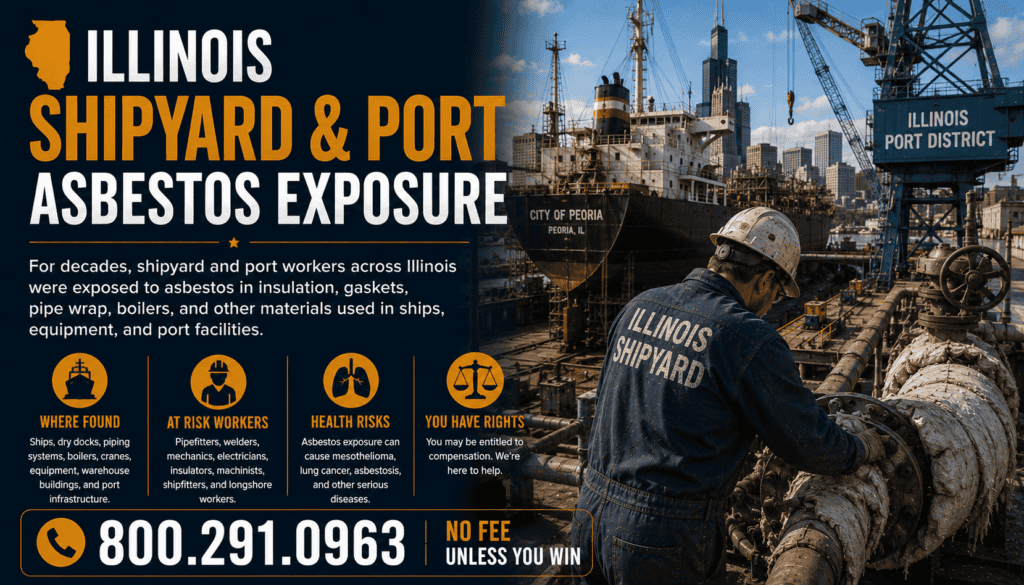
⚓ Illinois Shipyard & Port Asbestos Exposure
Illinois shipyard, port, dry dock, and marine repair workers could encounter asbestos while building, repairing, maintaining, and overhauling commercial vessels, tugboats, barges, ferries, harbor equipment, and other marine systems.
For decades, asbestos-containing insulation, gaskets, packing, fireproofing, electrical components, cement products, and other heat-resistant materials were used around marine boilers, engines, steam lines, pumps, valves, generators, and exhaust systems.
Workers could inhale asbestos fibers while removing insulation, rebuilding equipment, replacing gaskets, repairing piping, cutting materials, cleaning mechanical spaces, or simply working near another trade disturbing asbestos.
Because many marine mechanical spaces were enclosed and poorly ventilated, airborne fibers could remain concentrated around workers performing repairs.
Former Illinois maritime workers diagnosed decades later with mesothelioma, asbestos-related lung cancer, asbestosis, or another asbestos-related disease may need to reconstruct where and how occupational exposure occurred.
For additional Illinois industrial exposure information, see Illinois Asbestos Exposure Sites & Industries.
🚢 Why Asbestos Was Used in Shipyards & Marine Equipment
Ships combined high temperatures, steam, fuel, electrical systems, confined spaces, and fire hazards. Manufacturers used asbestos-containing materials because asbestos resisted heat and fire and could be incorporated into insulation and mechanical components.
Asbestos materials could be found around:
- Marine boilers
- Steam piping
- Engines
- Turbines
- Pumps
- Valves
- Exhaust systems
- Electrical equipment
- Generators
- Deck systems
- Mechanical compartments
- Fire-resistant partitions
Workers were particularly vulnerable when these materials were damaged or removed during maintenance, repair, modernization, or vessel overhaul.
⚙️ Shipyard Equipment That Contained Asbestos
Older vessels and marine facilities could contain asbestos across numerous mechanical and electrical systems.
Potential sources included:
- Marine boilers
- Steam pipes
- Engine insulation
- Turbines
- Pumps
- Valves
- Gaskets
- Packing
- Brake components
- Clutch components
- Electrical panels
- Generators
- Fire-resistant panels
- Pipe insulation
- Exhaust insulation
- Insulating cement
- Fire blankets
- Heat shields
Workers repairing or replacing this equipment could disturb old asbestos-containing materials and release fibers into the surrounding workspace.
Illinois workers who also serviced industrial equipment outside maritime facilities can review Illinois Equipment & Machinery Asbestos Exposure.
🔥 Marine Boilers & Asbestos Exposure
Boilers were an important potential source of asbestos exposure aboard older steam-powered and auxiliary-equipped vessels.
High-temperature boilers and connected steam systems were commonly insulated to retain heat and protect surrounding equipment and workers.
Asbestos-containing materials associated with older boiler systems could include:
- Block insulation
- Boiler cement
- Pipe covering
- Insulating blankets
- Fire-resistant cloth
- Rope insulation
- Gaskets
- Packing
Boilermakers, mechanics, pipefitters, welders, insulators, and maintenance workers could disturb these materials when performing boiler repairs.
Tasks such as removing insulation, replacing tubes, scraping gasket surfaces, repairing steam valves, and opening insulated equipment could create asbestos-containing dust.
💨 Steam Pipes & Pipe Insulation
Steam piping extended through mechanical areas of many older vessels.
Pipe insulation was especially important around high-temperature systems, but disturbing older asbestos-containing insulation could create significant exposure.
Materials could include:
- Molded pipe covering
- Insulating cement
- Asbestos cloth
- Pipe lagging
- Insulating blankets
- Rope insulation
Pipefitters and steamfitters could encounter asbestos when accessing pipes, elbows, flanges, valves, and fittings.
Exposure was not limited to the worker removing insulation. Nearby mechanics, electricians, welders, laborers, and other trades could also inhale fibers released into an enclosed compartment.
⚙️ Marine Engines & Engine Rooms
Engine rooms combined heat-producing equipment, piping, pumps, valves, electrical systems, and exhaust components within relatively confined spaces.
Potential asbestos-containing materials included:
- Engine insulation
- Exhaust insulation
- Gaskets
- Valve packing
- Pump packing
- Heat shields
- Fire-resistant panels
- Pipe insulation
Mechanics could disturb these materials while rebuilding engines, replacing gaskets, repairing pumps and valves, or removing deteriorated insulation.
Because several trades often worked simultaneously in mechanical spaces, one worker’s repair activity could expose other employees nearby.
🔧 Pumps, Valves, Gaskets & Packing
Pumps and valves were used to control steam, fuel, water, lubricants, and other systems.
Older equipment could use asbestos-containing gaskets and packing to withstand heat, pressure, friction, and repeated mechanical operation.
Exposure could occur while workers:
- Removed old packing
- Repacked valve stems
- Opened pumps
- Scraped gasket surfaces
- Cut replacement gaskets
- Rebuilt pumps
- Repaired valves
- Opened flanges
Dry, deteriorated packing or gasket material could break apart during removal.
Similar components were also widely used in land-based industrial facilities. See Illinois Industrial Asbestos Exposure for related exposure pathways.
⚡ Electrical Equipment & Asbestos
Older marine electrical equipment could incorporate asbestos-containing materials for heat and fire resistance.
Potential sources included:
- Electrical panels
- Switchgear
- Generator insulation
- Motor insulation
- Arc-resistant components
- Fuse panels
- Fire-resistant electrical boards
- Wiring insulation
Electricians could disturb these materials while repairing generators, motors, controls, lighting, switchgear, and power-distribution systems.
They could also experience bystander exposure when insulation or mechanical components were being removed nearby.
Illinois electricians who worked across multiple industries can also review Illinois Electricians Asbestos Exposure.
🚧 Dry Dock & Vessel Repair Asbestos Exposure
Major ship repairs could disturb asbestos-containing materials throughout a vessel at the same time.
Dry dock and repair work could involve:
- Engine overhauls
- Boiler repairs
- Pipe removal
- Valve replacement
- Pump rebuilding
- Electrical modernization
- Exhaust-system repairs
- Insulation removal
- Structural repairs
- Fireproofing removal
Cutting, grinding, drilling, scraping, and demolition could disturb old materials and create dust.
During large repair projects, multiple crews sometimes worked simultaneously in adjoining compartments. This created opportunities for asbestos fibers generated by one trade to reach workers performing unrelated jobs.
👷 Illinois Shipyard & Port Workers at Risk
Workers did not have to be designated “asbestos workers” to experience occupational exposure.
Potentially exposed occupations included:
- Boilermakers
- Shipfitters
- Pipefitters
- Steamfitters
- Marine mechanics
- Electricians
- Welders
- Machinists
- Millwrights
- Insulators
- Carpenters
- Laborers
- Painters
- Maintenance workers
- Dry dock workers
- Dock mechanics
- Harbor maintenance workers
- Equipment operators
- Supervisors
Some maritime workers moved among trades or employers during their careers, potentially encountering asbestos from multiple types of equipment and materials.
See Illinois Workers & Occupational Asbestos Exposure for other Illinois occupations associated with historical asbestos exposure.
🛠️ How Shipyard Workers Were Exposed to Asbestos
Occupational exposure could occur during routine maintenance as well as major vessel overhauls.
Activities that could disturb asbestos included:
- Removing pipe insulation
- Cutting insulation
- Opening boilers
- Scraping gaskets
- Removing valve packing
- Rebuilding pumps
- Repairing engines
- Removing exhaust insulation
- Performing electrical repairs
- Welding near insulated equipment
- Grinding mechanical surfaces
- Cleaning boiler or engine rooms
- Removing fire-resistant materials
- Demolishing older vessel components
Workers nearby could also inhale fibers without directly handling the asbestos-containing product.
🏭 Shipyard Workers Who Also Worked in Illinois Industry
Many skilled trades worked in more than one industry during their careers.
A pipefitter, electrician, welder, mechanic, or insulator who performed marine work might later work in a power plant, factory, railroad facility, construction project, or other industrial workplace.
This can be important when reconstructing a lifetime exposure history because a worker’s asbestos exposure may have occurred at multiple jobsites.
Related Illinois resources include:
- Illinois Manufacturing Asbestos Exposure
- Illinois Power Plant Asbestos Exposure
- Illinois Railroad Asbestos Exposure
- Illinois Construction Asbestos Exposure
🎖️ Veterans Who Later Worked in Illinois Shipyards
Some civilian shipyard workers previously served aboard military vessels, creating the possibility of asbestos exposure during both military service and later civilian employment.
Navy veterans historically worked around many of the same systems encountered in civilian maritime work, including boilers, steam lines, pumps, valves, turbines, engines, electrical equipment, and insulation.
Veterans researching earlier military exposure can review U.S. Military Veterans Asbestos Exposure.
A complete occupational history should distinguish military exposure from later civilian shipyard or industrial employment rather than assuming that an asbestos-related disease resulted from only one workplace.
🏠 Take-Home Asbestos Exposure From Shipyard Work
Asbestos fibers could also leave a workplace on contaminated clothing and equipment.
Before modern asbestos precautions became common, workers could return home with dust on:
- Work clothes
- Jackets
- Boots
- Gloves
- Tools
- Tool bags
- Personal vehicles
Family members could encounter this dust while laundering clothing, cleaning work items, or handling contaminated belongings.
For a person diagnosed with mesothelioma who never worked in a shipyard personally, a spouse’s or parent’s maritime occupation may therefore be relevant when investigating possible exposure.
🫁 Diseases Associated With Shipyard Asbestos Exposure
Asbestos-related diseases can appear many years after occupational exposure.
Mesothelioma
Mesothelioma is a rare cancer of the mesothelial lining surrounding certain internal organs. Asbestos exposure is the principal established cause of malignant mesothelioma.
Asbestos-Related Lung Cancer
Occupational asbestos exposure increases lung cancer risk. The combination of smoking and asbestos exposure increases risk substantially beyond either exposure alone.
Workers diagnosed with lung cancer can learn more at Illinois Asbestos Lung Cancer Lawsuits.
Asbestosis
Asbestosis is chronic lung scarring associated with substantial asbestos exposure.
Pleural Disease
Asbestos exposure can also cause pleural plaques, diffuse pleural thickening, and other nonmalignant pleural abnormalities.
📋 Documenting Illinois Shipyard Asbestos Exposure
A worker diagnosed decades after employment may not remember individual asbestos product names.
That does not mean an occupational history cannot be reconstructed.
Useful information can include:
- Shipyard or marine employer
- Employment dates
- Job titles
- Vessel names
- Dry dock assignments
- Departments
- Specific job duties
- Equipment repaired
- Coworkers
- Supervisors
- Union records
- Maintenance records
- Military service
- Other industrial employment
Remembering what work was performed and what equipment was serviced can be particularly useful when specific product names have been forgotten.
⚖️ Illinois Shipyard Mesothelioma Lawsuits & Claims
Former shipyard, port, dry dock, and marine repair workers diagnosed with an asbestos-related disease may have different potential compensation sources depending on their exposure history and individual circumstances.
Possible avenues can include:
- Personal injury asbestos lawsuits
- Asbestos bankruptcy trust fund claims
- Wrongful death claims
- Veterans benefits when qualifying military exposure occurred
- Other compensation available under applicable law
The responsible companies in an asbestos matter are not necessarily the worker’s former employers. Historical exposure investigations may involve manufacturers or suppliers of asbestos-containing insulation, gaskets, packing, equipment, and other products.
For Illinois legal information, see Illinois Mesothelioma Lawsuits & Claims.
💰 Illinois Asbestos Trust Fund Claims
Some manufacturers and suppliers associated with asbestos-containing products entered bankruptcy and established trusts to compensate qualifying asbestos claimants.
A shipyard worker could potentially have encountered products associated with several companies during a career.
Trust eligibility depends on the requirements of the individual trust and the available medical and exposure evidence.
Learn more at Illinois Asbestos Trust Fund Claims.
⏱️ Illinois Filing Deadlines
Asbestos lawsuits are subject to statutes of limitations and other filing requirements.
Because these rules can depend on the type of claim and individual circumstances, someone should not assume that an exposure occurring decades ago automatically prevents a current claim.
See Illinois Mesothelioma Statute of Limitations for more information.
Families investigating a claim after a worker’s death can also review Illinois Wrongful Death Mesothelioma Lawsuits.
❓ Frequently Asked Questions About Illinois Shipyard Asbestos Exposure
Why was asbestos used aboard older ships?
Asbestos was incorporated into insulation, gaskets, packing, fire-resistant materials, and other products because it could tolerate high temperatures and was useful around steam and mechanical systems.
Which shipyard workers were potentially exposed?
Boilermakers, shipfitters, pipefitters, steamfitters, mechanics, electricians, welders, machinists, millwrights, insulators, laborers, maintenance workers, dry dock crews, and other maritime trades could encounter asbestos.
Were engine rooms particularly hazardous?
Engine and boiler rooms contained numerous insulated mechanical systems within relatively confined spaces. Repairing boilers, engines, steam lines, pumps, valves, exhaust systems, and related equipment could disturb asbestos-containing materials.
Could a worker be exposed without handling asbestos?
Yes. Dust generated by insulation removal, gasket work, boiler repairs, pipe work, or other maintenance could expose nearby employees.
Could shipyard workers carry asbestos home?
Historically, fibers could be transported away from jobsites on contaminated work clothing, footwear, tools, and other items, potentially exposing household members.
What if I don’t remember which asbestos products I encountered?
Employment dates, employers, vessel names, trades, departments, equipment serviced, coworkers, and specific job duties can all help reconstruct an occupational exposure history.
Could military service also be relevant?
Yes. A civilian Illinois shipyard employee who previously served aboard military vessels could potentially have separate periods of asbestos exposure that should be considered when reconstructing a lifetime work history.
Can retired shipyard workers still investigate compensation?
Potentially. Asbestos diseases can have long latency periods. Whether compensation remains available depends on the diagnosis, exposure evidence, responsible companies, and applicable legal requirements.
🔗 Related Illinois Asbestos Exposure Resources
Workers researching Illinois asbestos exposure can also review:
- Illinois Asbestos Exposure Sites & Industries
- Illinois Workers & Occupational Asbestos Exposure
- Illinois Equipment & Machinery Asbestos Exposure
- Illinois Asbestos Products
- Illinois Mesothelioma Lawsuits & Claims
- Illinois Mesothelioma Lawsuits
📞 Call 800.291.0963 — Open 24/7, 365 Days
If you or a loved one worked at an Illinois shipyard, port, dry dock, or marine repair facility and later developed mesothelioma, asbestos-related lung cancer, or another asbestos-related disease, MesotheliomaHelp.Center provides information to help you understand historical exposure sources, compensation options, and possible next steps.