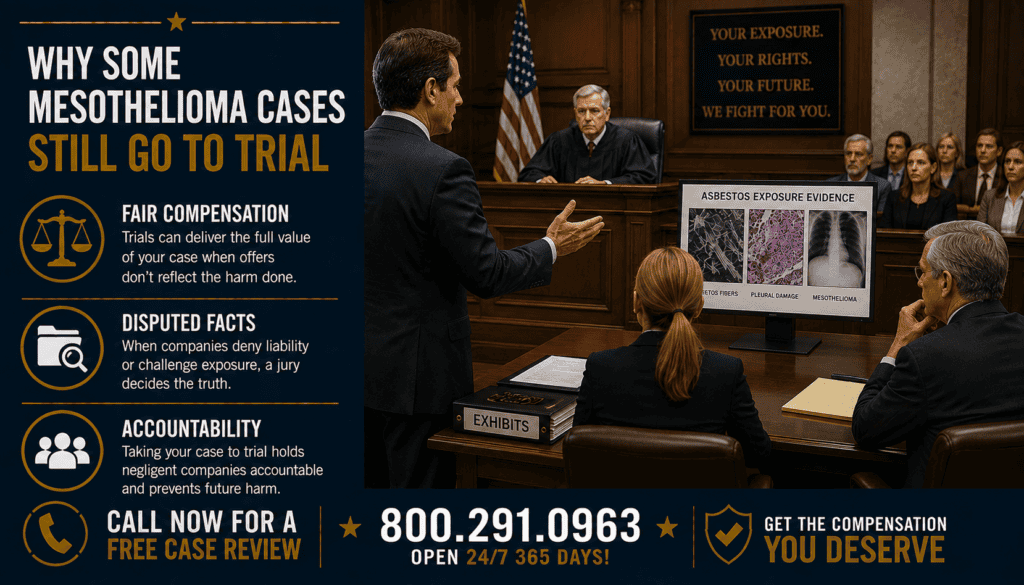
Why Some Mesothelioma Cases Still Go to Trial
Most civil lawsuits do not end with a trial, but some mesothelioma cases do. The federal judiciary explains that civil disputes often resolve through settlement or a court ruling before trial; when no settlement or dispositive ruling resolves the remaining issues, the court schedules a trial. In an asbestos case, unresolved disputes can involve exposure, defendant responsibility, causation, damages or other material facts.
A trial does not necessarily mean settlement discussions failed because one side acted improperly. Parties can reasonably disagree about what the evidence proves, which defendants are legally responsible, the amount of compensatory damages or whether additional remedies are available. Discovery, depositions, expert evidence and pretrial motions help define those disputes. If genuine material factual issues remain, a judge or jury may ultimately have to resolve them.
⚖️ Why a Mesothelioma Case May Reach Trial
A civil trial is the mechanism for resolving factual and legal issues that remain after pleadings, discovery, motions and settlement efforts. U.S. Courts explains that if parties do not settle, the court schedules a trial; in a jury trial, jurors generally decide responsibility and damages under the law explained by the judge.
Mesothelioma does not create an automatic right to a verdict or establish liability by itself. The claimant still must prove the elements required by the governing law against the defendants whose liability remains disputed.
🤝 Settlement Does Not Resolve Every Case
Courts encourage settlement because trial can involve additional expense, delay and uncertainty. Federal Rule of Civil Procedure 16 expressly authorizes case-management procedures that facilitate settlement, and courts may use conferences or other authorized dispute-resolution procedures.
Settlement remains dependent on agreement. Parties may disagree about liability, evidence, damages, allocation among defendants or acceptable payment terms. If those differences cannot be resolved and no court ruling disposes of the remaining claims, trial may be necessary. See Mesothelioma Settlements & Compensation.
| Dispute | What may remain unresolved |
|---|---|
| Exposure | Whether and how the claimant encountered a defendant-linked asbestos source |
| Liability | Whether a defendant is legally responsible under applicable law |
| Causation | Whether the required causal connection is proved |
| Damages | The nature and amount of compensable losses |
| Settlement value | Whether the parties can agree on acceptable terms |
🏭 Liability and Exposure May Remain Disputed
Asbestos exposure histories can involve multiple employers, premises, products and companies over many years. A defendant may dispute that its product was present, that the claimant encountered it, that the exposure occurred as alleged or that the governing legal requirements for liability are satisfied.
Historical employment records, military records, product documents, jobsites and witness testimony may therefore become important. See the Mesothelioma Lawsuit Evidence & Documentation hub.
🩺 Causation Issues Can Require Fact-Finding
Medical diagnosis and defendant-specific causation are related but distinct issues. A mesothelioma diagnosis can establish the medical condition, while the litigation may separately require proof connecting legally sufficient exposure to particular defendants under the applicable jurisdiction’s causation standard.
Parties can present competing interpretations of medical, industrial-hygiene, pathology, exposure or other evidence. Admissibility and the weight of expert testimony can also become contested issues that affect whether a claim resolves before trial.
💵 Parties May Disagree About Damages
Even when liability is not the only disputed issue, parties may disagree about damages. Claimed losses can include medical expenses, lost earnings, diminished earning capacity and non-economic harm where permitted by applicable law. Wrongful-death claims can involve different categories governed by state law.
Evidence is required to support damages rather than simply asserting a large amount. See Mesothelioma Damages.
| Category | Examples of evidence |
|---|---|
| Medical expenses | Bills, records and insurance documentation |
| Lost income | Employment, wage and tax records |
| Future losses | Medical and economic evidence where appropriate |
| Non-economic harm | Testimony and records describing pain and life impact |
| Wrongful-death losses | Evidence permitted under the governing state statute |
📑 Discovery Can Reveal Issues That Need Trial
U.S. Courts explains that discovery requires litigants to exchange information such as witness identities and relevant documents and can include depositions under oath. Discovery may strengthen a claim, expose weaknesses, narrow disputed facts or create new disagreements.
Federal Rule 16 allows courts to control discovery, identify witnesses and documents, resolve pending motions, manage complex multi-party cases and set trial dates. The purpose is to prepare the unresolved issues for an efficient disposition, whether by settlement, motion or trial.
🔎 Summary Judgment Does Not Always End the Case
Federal Rule of Civil Procedure 56 allows summary judgment when there is no genuine dispute of material fact and the moving party is entitled to judgment as a matter of law. A motion can address an entire case or only part of a claim or defense.
If genuine material disputes remain after the court applies the summary-judgment standard, those issues may require trial. A court may also resolve some issues before trial while leaving others for a judge or jury. State-court procedures use their own governing rules.
👥 Multiple Defendants Can Add Complexity
Some asbestos cases involve several defendants, and they do not necessarily resolve at the same time or on identical terms. One defendant may settle while another contests liability; a court may dismiss some claims while others continue.
Federal Rule 42 permits consolidation of actions involving common questions and also permits separate trials of issues or claims when appropriate for convenience, avoiding prejudice, or promoting efficiency. Case structure depends on the jurisdiction and particular litigation.
🏛️ What Happens When the Case Goes to Trial
At trial, the judge determines which evidence may be presented and instructs the jury on the governing law. Witnesses testify and may be cross-examined, documents and other admissible exhibits may be introduced, and each side presents its arguments.
U.S. Courts explains that in a federal civil jury trial, the jury generally determines whether the defendant is responsible and, if so, the amount of damages. A bench trial places those decisions with the judge. A verdict may later be followed by post-trial motions or appellate proceedings.
❓ Frequently Asked Questions
Why would a mesothelioma case go to trial instead of settling?
A trial may be needed when the parties cannot resolve material disputes about exposure, liability, causation, damages or acceptable settlement terms.
Do most civil cases go to trial?
No. U.S. Courts explains that civil cases frequently resolve before trial through settlement or court rulings.
Can some defendants settle while others go to trial?
Potentially. Multi-defendant cases can resolve differently for different parties depending on the evidence, claims and procedural rulings.
Does a mesothelioma diagnosis guarantee a trial victory?
No. Diagnosis does not by itself establish defendant-specific liability, causation or damages.
What role does discovery play before trial?
Discovery allows parties to obtain documents, identify witnesses, take depositions and develop evidence needed to evaluate or try disputed issues.
Can summary judgment prevent a trial?
Yes, if the applicable standard is met. It can dispose of an entire claim or part of one when there is no genuine dispute of material fact and judgment is legally warranted.
Can settlement still occur after a trial date is set?
Potentially. Settlement discussions can continue during litigation, subject to the parties’ decisions and applicable court procedures.
Does going to trial guarantee a larger recovery?
No. Trial involves uncertainty. A verdict can be higher or lower than prior settlement positions, result in no recovery, and may be subject to post-trial proceedings or appeal.
📞 Submit Your Case
If you or a loved one has a mesothelioma diagnosis, preserve evidence early. Medical records, employment and military history, jobsites, products, coworkers and prior asbestos claims can help clarify which issues may be disputed and what additional investigation is needed.
Call 800.291.0963 for a no-obligation case evaluation. Live chat is available 24/7, 365 days a year. Submit your case here.
📝 Summary
Some mesothelioma cases still go to trial because settlement and pretrial motions do not resolve every disputed issue. Exposure, liability, causation, damages and defendant-specific facts can remain genuinely contested after discovery. Courts use pretrial management, settlement procedures and dispositive motions to narrow or resolve issues, but a judge or jury may ultimately need to decide the disputes that remain. Trial never guarantees a particular verdict or recovery.
🔗 Confirmed Sources
- United States Courts — Civil Cases
- Cornell Legal Information Institute — Federal Rule of Civil Procedure 16
- Cornell Legal Information Institute — Federal Rule of Civil Procedure 56
- Cornell Legal Information Institute — Federal Rule of Civil Procedure 42
This page provides general information, not legal advice. This website is not a law firm. Whether a mesothelioma case settles, proceeds to trial, survives pretrial motions or results in compensation depends on individual facts, evidence, defendants, jurisdiction and applicable law. No settlement, verdict, timeline or outcome is guaranteed.