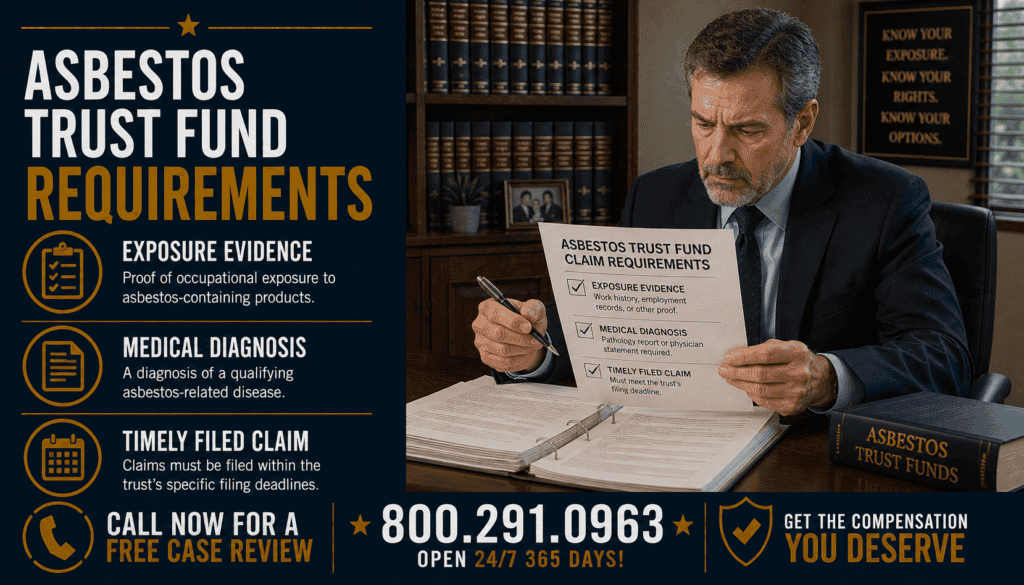
Asbestos Trust Fund Requirements
Asbestos trust fund eligibility is not based on a mesothelioma diagnosis alone. Each bankruptcy trust uses its own governing documents and Trust Distribution Procedures (TDPs) to determine whether a claim satisfies the trust’s medical, exposure, documentation and procedural requirements.
In practical terms, a claimant generally needs evidence supporting the claimed asbestos-related disease and evidence connecting qualifying exposure to the company whose liabilities were transferred to that trust. The exact proof, exposure dates, site rules, review options and filing procedures differ from trust to trust, so the current TDP and claim instructions should control the submission.
🏦 What Asbestos Trust Fund Requirements Mean
Section 524(g) of the U.S. Bankruptcy Code provides a framework through which qualifying Chapter 11 reorganizations can use a trust to address present and future asbestos-related claims. The trust then evaluates claims under the procedures established for that particular trust.
The U.S. Government Accountability Office (GAO) found that asbestos trusts use TDPs to govern claim review, valuation and payment. Those procedures commonly establish disease categories, medical criteria, exposure criteria, review processes and dispute-resolution mechanisms.
📘 Start With the Trust Distribution Procedures
The TDP is the central document for understanding a particular trust’s eligibility rules. Do not assume that satisfying one trust’s requirements means another trust will approve the same evidence.
| TDP issue | What to check |
|---|---|
| Disease level | Which diagnosis category applies |
| Medical criteria | What diagnostic proof is required |
| Exposure criteria | Required connection to the debtor/company |
| Review option | Expedited or individual review |
| Scheduled value | Value assigned under the TDP |
| Payment percentage | Percentage applied to liquidated value |
| Procedures | Forms, signatures, deadlines and deficiency rules |
🩺 Medical Evidence Requirements
GAO reported that claimants typically submit medical reports or records sufficient to support the diagnosis for the disease being claimed. The exact evidence depends on the trust and disease level.
For a mesothelioma claim, potentially relevant records can include pathology, cytology, operative reports, imaging, oncology documentation and physician reports. Submit what the current trust instructions require rather than assuming a general medical packet is sufficient.
🧬 Disease-Level Criteria
Trusts commonly organize claims into disease levels. The TDP may specify medical criteria and scheduled values for each category. A claimant must establish the disease level being asserted under that trust’s rules.
A diagnosis that is sufficient for one purpose is not automatically sufficient under every trust’s evidentiary criteria. Review the required form of diagnosis, supporting records and any physician qualifications stated in the TDP.
🏭 Exposure Requirements
Medical proof addresses disease; exposure evidence addresses whether the claimant meets the trust’s asbestos-exposure criteria. GAO reported that trusts may consider evidence such as work histories, Social Security records, invoices, employer records and testimony from claimants or coworkers.
Exposure requirements are trust-specific. The claimant may need to establish work with or around asbestos associated with the relevant company during a qualifying period or at a qualifying site.
🏢 Connecting Exposure to the Trust’s Company
A claimant generally must connect the exposure evidence to the liabilities administered by the particular trust. Working in an industry where asbestos was common does not by itself prove exposure to the debtor company’s products or operations.
Build the connection with specific facts: employer, facility, job, dates, tasks, products, equipment, contractors and witnesses. Separate what records establish from what is inferred.
📍 Approved Sites and Exposure Locations
Some trusts maintain site information or approved-site resources that can assist with exposure review. A site’s appearance on a trust resource can be useful, but the claimant may still need to establish personal presence, qualifying dates and the exposure required by the TDP.
Likewise, absence from a preexisting site list should not automatically be treated as a final determination without checking the trust’s current proof rules.
💼 Employment and Work-History Evidence
Employment evidence can establish where and when a claimant worked. Useful records may include Social Security earnings histories, personnel records, union records, pension files, military records, pay stubs and employer documents.
Employment at a facility is not the same as proof of exposure to every asbestos-containing product at that facility. Pair work-history records with product, task, location or witness evidence when required.
🧱 Product and Company Evidence
Product evidence can include invoices, catalogs, purchase records, specifications, maintenance records and other historical documents. Evaluate what each document actually proves.
An invoice can show that a product was purchased, but it does not necessarily prove that the claimant personally handled or encountered it. A product name can identify equipment without proving who manufactured every replacement component used over decades.
👥 Coworker and Witness Evidence
GAO identified claimant and coworker testimony as examples of evidence trusts may use when evaluating exposure. A useful witness should have a factual basis for the information provided.
Record how the witness knows the claimant, where they worked together, approximate dates, tasks observed and the basis for any product identification. Avoid statements that simply repeat information supplied by someone else without firsthand knowledge.
🕊️ Claims for Deceased Individuals
GAO notes that claims may be filed on behalf of deceased claimants. Trust procedures may require a death certificate and documentation showing who has authority to act.
A claimant’s death does not eliminate the need to satisfy the trust’s disease and exposure criteria. Preserve medical records, employment evidence, prior exposure statements and any claim documents created during the claimant’s lifetime.
🔎 Expedited vs. Individual Review
GAO found that trusts commonly offer expedited and individual review. Under expedited review, a claim meeting the medical and exposure criteria for a disease level generally receives the scheduled value assigned under the TDP, subject to the trust’s payment rules.
Individual review can consider claim-specific factors and may result in a liquidated value above or below the scheduled value. Availability and standards vary by trust and disease category.
⚠️ Deficient Claims and Additional Evidence
If a trust determines that a submission lacks required evidence or information, it may identify a deficiency and request additional material. GAO’s review describes deficient claims being returned for additional evidence or information.
A deficiency is not necessarily the same as a final denial. Read the notice, identify the missing requirement and respond according to the trust’s procedures. See Evidence Needed for Trust Fund Approval.
⏳ Filing and Procedural Deadlines
Trusts can establish filing and procedural requirements through their governing documents. Do not assume that the statute of limitations for a civil lawsuit is the only relevant deadline or that filing a trust claim preserves a separate lawsuit deadline.
Check each trust’s current TDP and claim instructions, and separately review any civil statute of limitations that may apply.
🔀 Eligibility for Multiple Trusts
A worker may have encountered asbestos products associated with several companies during a career. That can create potential claims against more than one trust, but eligibility must be established separately for each trust.
Approval by Trust A does not prove the medical or exposure requirements of Trust B. Maintain trust-specific evidence while keeping the underlying work and exposure chronology consistent.
⚖️ Trust Claims and Civil Lawsuits
Bankruptcy trust claims and civil lawsuits are distinct compensation routes. Trust submissions can involve exposure statements and other evidence that may overlap with civil litigation.
Disclosure, timing, setoff and coordination rules can vary by jurisdiction. Preserve exact copies of all trust submissions and do not assume that information given in one proceeding is irrelevant to another.
💰 Eligibility Does Not Equal Full Scheduled Value
Meeting a trust’s eligibility criteria does not necessarily mean the claimant receives the full scheduled disease value. GAO explains that trusts commonly apply a payment percentage to the liquidated value in order to preserve assets for present and future claimants.
Payment percentages can change under trust procedures. Never treat a scheduled value as a guaranteed payment amount.
🔄 Consistency Across Claims
When multiple trust or lawsuit claims are pursued, compare work dates, jobsites, products and exposure descriptions before filing. Legitimate differences can exist because trusts ask different questions, but unexplained contradictions can lead to additional review.
If new evidence changes an earlier exposure history, preserve the source and explain the correction rather than silently replacing the prior account.
✅ Trust Eligibility Checklist
| Requirement | Evidence to review |
|---|---|
| Correct trust | Company/debtor and trust identity |
| Disease level | Current TDP category |
| Medical proof | Required diagnostic records |
| Exposure | Qualifying work/product/site evidence |
| Dates | Employment and exposure chronology |
| Witness support | Firsthand factual basis |
| Representative authority | Required if filing for another person |
| Review option | Expedited or individual review |
| Procedural requirements | Forms, signatures and deadlines |
| Consistency | Compare other claims and testimony |
❓ Frequently Asked Questions
Who qualifies for an asbestos trust fund claim?
A claimant must satisfy the requirements of the specific trust, commonly including applicable medical and exposure criteria and required documentation.
Is a mesothelioma diagnosis enough to qualify?
No. A diagnosis can satisfy part of the medical requirement, but the claimant generally must also establish qualifying exposure under the trust’s rules.
Do all asbestos trusts have the same requirements?
No. Each trust operates under its own governing documents and TDP.
What can prove asbestos exposure?
Depending on the trust, relevant evidence can include work histories, Social Security records, employer records, invoices and claimant or coworker testimony.
Can a family file for someone who has died?
Potentially. Trust procedures may allow claims for deceased individuals but can require proof of death and representative authority.
What happens if a claim is deficient?
The trust may request additional evidence or information. Follow the deficiency notice and current trust procedures.
Can someone qualify for more than one asbestos trust?
Potentially, if the claimant independently satisfies the requirements of each trust.
Does an approved claim receive the full scheduled value?
Not necessarily. Trusts commonly apply payment percentages under their TDPs.
Are expedited and individual review the same?
No. They are different review paths with trust-specific rules and valuation methods.
Does filing a trust claim replace a lawsuit?
Not automatically. Trust claims and civil litigation are separate processes that can interact under applicable disclosure, timing and offset rules.
📞 Request a Case Evaluation
If you are evaluating asbestos trust eligibility, gather the diagnosis records, employment history, exposure timeline, known products and jobsites, witness information and any previous trust or lawsuit documents. Eligibility should be checked against each trust’s current requirements.
Call 800.291.0963 for a no-obligation case evaluation and to talk to a real person 24/7, 365 days a year. Many mesothelioma law firms handle qualifying cases on a contingency-fee basis; confirm the fee agreement and terms directly with the firm you retain. Submit your case here.
📝 Summary
Asbestos trust fund requirements are trust-specific. A claimant generally needs medical evidence supporting the claimed disease and exposure evidence connecting the claimant to liabilities administered by the trust. The current TDP determines the applicable disease criteria, exposure requirements, review procedures and payment rules. Approval does not guarantee the full scheduled value, and eligibility for one trust does not establish eligibility for another.
🔗 Confirmed Sources
- U.S. Government Accountability Office — Asbestos Injury Compensation: The Role and Administration of Asbestos Trusts
- 11 U.S.C. § 524 — Effect of Discharge and § 524(g) Asbestos Trust Framework
Disclaimer: General information only—not legal advice. This website is not a law firm. Trust eligibility, medical and exposure criteria, filing procedures, review options, deadlines and payment percentages vary by trust and can change. Consult the current trust documents and qualified counsel for a claim-specific review. Past results do not guarantee future outcomes.