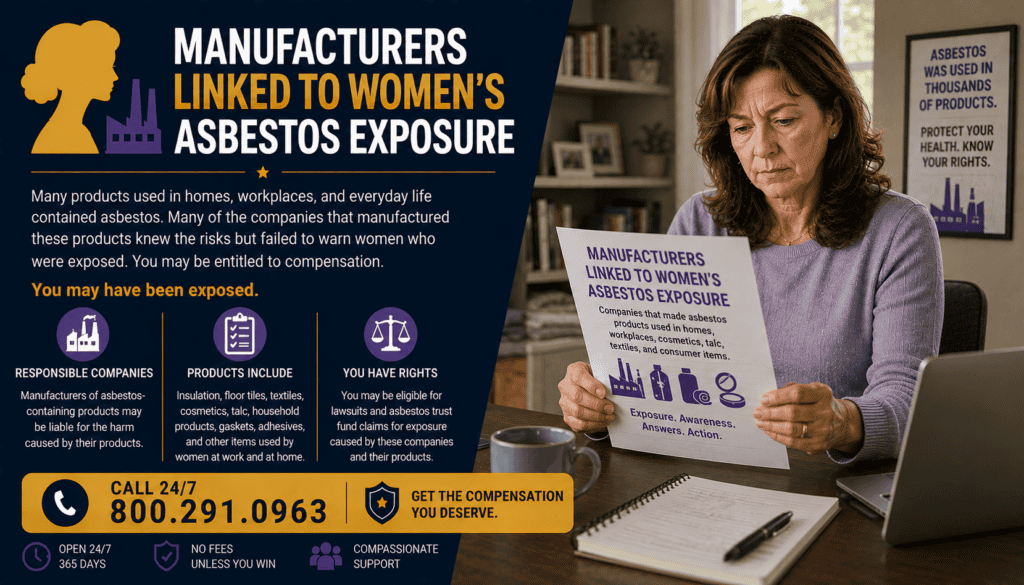
Manufacturers Linked to Women’s Asbestos Exposure
Women with a history of asbestos exposure may have encountered products made, supplied or distributed by many different companies. Those exposures were not limited to women who worked directly in asbestos manufacturing. They can include a woman’s own workplace, asbestos fibers carried home by a spouse or parent, older buildings, renovation work and historically asbestos-containing consumer or industrial products.
Identifying a manufacturer is an evidence question. A company’s historical association with asbestos does not prove that every product it sold contained asbestos, that a particular woman encountered one of those products, or that the company is legally responsible for her disease. Reliable investigation connects a specific product or operation, a relevant time period, an exposure pathway and the claimant.
🏭 Manufacturers & Women’s Asbestos Exposure
Asbestos litigation developed around companies associated with asbestos-containing products and operations used throughout industrial, commercial and household settings. The U.S. Government Accountability Office has documented the long history of asbestos litigation and the later creation of bankruptcy trusts for companies facing substantial asbestos liabilities.
“Linked” Does Not Mean Automatically Liable
For purposes of an individual claim, a manufacturer should be considered potentially relevant only when evidence supports a connection between its product or operations and the person’s actual exposure. Legal responsibility remains defendant-specific.
Company Histories Can Be Complicated
Manufacturers can merge, change names, sell product lines, reorganize or enter bankruptcy. The company name remembered by a worker may therefore differ from the entity legally responsible for the relevant product during the exposure period.
Product Formulations Can Change
A brand may have been manufactured for decades while its ingredients changed. Evidence should establish whether the particular product type and production period involved asbestos rather than assuming every version did.
Women’s Exposure Can Involve Products Used by Someone Else
In a take-home case, the relevant manufacturer may be connected to products handled by a husband, parent or other household worker. The woman’s exposure history can therefore depend partly on reconstructing another person’s employment and product contact.
👩 How Women Encountered Asbestos Products
A manufacturer investigation should begin with the exposure pathway rather than a list of famous asbestos companies.
| Exposure pathway | Manufacturer evidence that may matter |
|---|---|
| Woman’s own occupation | Products used at her facility, department or work area |
| Take-home exposure | Products encountered by the household worker at work |
| Home renovation | Building-product brands, packaging, receipts and contractor records |
| Consumer product | Brand, manufacturer, formulation and purchase period |
| Environmental exposure | Facility ownership, operations, emissions and waste records |
Occupational Exposure
A woman may have worked around insulation, gaskets, flooring, cement materials, machinery components or other products associated historically with asbestos. Actual job duties and proximity are more informative than job title alone.
Take-Home Exposure
When fibers allegedly entered the home on work clothing or other items, investigators may need to identify which asbestos products the occupationally exposed worker handled or worked near.
Household and Consumer Exposure
Historical product use can sometimes be reconstructed from photographs, receipts, packaging, catalogs or witness recollection. Brand identification should be tested against manufacturing dates and formulation evidence.
🔎 Identifying Historical Manufacturers
Manufacturer identification often requires combining several sources because decades-old products may no longer exist and witnesses may remember only partial details.
Start With the Product
Record the product category, appearance, purpose, packaging, brand markings and where it was used. Avoid filling gaps in memory with guesses.
Establish the Time Period
A product sold under one brand can have different formulations or owners at different times. Approximate exposure dates can narrow the relevant manufacturer and product version.
Trace Corporate Changes
Historical corporate records can help determine whether a product line was acquired, sold or transferred. Successor-liability rules are legal questions that vary by jurisdiction.
Separate Manufacturer From Supplier
A distributor, contractor or local supplier appearing on an invoice may not be the manufacturer. Conversely, evidence concerning a manufacturer does not automatically establish liability for every company in the distribution chain.
Separate Equipment From Components
A nameplate on a pump, boiler, valve or turbine identifies the equipment maker, but gaskets, packing or insulation may have been manufactured by other companies and replaced repeatedly during the equipment’s life.
📦 Products & Materials to Investigate
Historical asbestos use spanned numerous product categories. The purpose of a product list is to guide evidence collection—not to assume asbestos content.
| Product category | Historical questions to investigate |
|---|---|
| Thermal insulation | Brand, manufacturer, installation date and work activity |
| Gaskets and packing | Equipment, replacement history, manufacturer and material |
| Flooring and adhesives | Product type, brand, installation/removal period |
| Cement products | Panels, siding, pipe or board and manufacturer |
| Friction products | Brake/clutch product, vehicle/equipment and manufacturer |
| Textiles/heat-resistant materials | Product function, label, supplier and workplace use |
| Surfacing/building materials | Building age, product records and disturbance history |
Presence Is Different From Exposure
An invoice can establish that a product was purchased for a facility without proving that the claimant worked with or near it. Additional evidence may be needed to establish proximity and frequency.
Asbestos Content Must Be Supported
A historical product category known to have included asbestos does not establish that every manufacturer or formulation did so. Specifications, catalogs, corporate records, testing and other reliable evidence can help resolve the question.
Explore Women’s Consumer Products & Household Asbestos Exposure.
📂 Evidence Linking Products to Exposure
Product-identification evidence is strongest when independent records and firsthand testimony reinforce one another.
| Evidence | What it may help establish |
|---|---|
| Invoices/purchase orders | Product delivery to a facility during a period |
| Catalogs/specifications | Product design, manufacturer and historical composition |
| Photographs | Packaging, equipment, work areas or product appearance |
| Employment records | Claimant or household worker presence at a jobsite |
| Coworker testimony | Products, tasks, frequency and proximity |
| Family testimony | Take-home routines or household product use |
| Maintenance records | Replacement parts and materials used with equipment |
| Corporate records | Manufacture, sale, warnings and product history |
Firsthand Knowledge Matters
A witness should distinguish what she personally saw from information learned later. Memory uncertainty should be acknowledged rather than converted into false precision.
Documents Need Context
A catalog proves what was offered for sale, not necessarily what was used at a particular site. An invoice proves a transaction, not necessarily the claimant’s contact with the product.
Build a Chronology
Align employment dates, residence periods, product manufacturing years and witness memories. A timeline can reveal both supporting evidence and inconsistencies that require further investigation.
🏦 Bankrupt Manufacturers & Asbestos Trusts
Some companies facing substantial asbestos liabilities reorganized under Chapter 11 and established asbestos personal-injury trusts under 11 U.S.C. § 524(g). GAO reported that approximately 100 companies had declared bankruptcy at least partly because of asbestos liabilities by the time of its 2011 review, and it examined 60 trusts established under § 524(g).
Claims Can Be Channeled to a Trust
When a qualifying § 524(g) trust and channeling injunction are established, asbestos personal-injury liabilities covered by the reorganization can be directed to the trust.
Trusts Have Company-Specific Exposure Criteria
Trust Distribution Procedures generally establish disease and exposure requirements. A claimant must satisfy the requirements of the particular trust rather than merely show exposure to asbestos somewhere.
Bankruptcy Does Not Mean the Exposure History Is Irrelevant
Trust claims still require evidence connecting the claimant to products, operations or worksites associated with the debtor under the trust’s procedures.
Solvent Companies May Still Be Investigated
GAO notes that asbestos claimants can also seek compensation through the tort system from potentially liable companies that did not enter bankruptcy. How trust compensation interacts with tort litigation can depend on applicable law and court procedures.
⚖️ Manufacturer Liability & Legal Proof
Historical association with asbestos is not the same as legal liability in an individual case. A lawsuit must satisfy the elements required by the governing jurisdiction.
Product Identification
The claimant may need evidence that a defendant made, supplied or was otherwise legally responsible for a relevant product or exposure source.
Exposure
Evidence should connect the woman to the product or source in a manner sufficient under applicable state law. The standards for frequency, proximity and causation vary.
Warnings and Historical Conduct
Depending on the legal theory, evidence concerning warnings, product knowledge, design and historical industry information may become relevant. Those issues should be evaluated for the specific company and period rather than generalized across all manufacturers.
Causation
Proof that asbestos can cause a disease is general scientific evidence. A case also requires whatever individual and defendant-specific causation proof the applicable jurisdiction demands.
Damages and Deadlines
Even when exposure evidence is strong, recoverable damages and statutes of limitation remain governed by applicable law.
Explore Women’s Asbestos Legal Options.
🗂️ Building a Reliable Manufacturer History
A structured research process can reduce mistaken product identifications and help separate promising leads from unsupported assumptions.
1. Start With the Exposure Timeline
List jobs, worksites, residences, family occupations and relevant activities by year or approximate period.
2. Identify Product Categories
Record insulation, gaskets, flooring, brakes, cement materials or other products actually remembered or documented.
3. Find Manufacturer Evidence
Look for packaging, invoices, specifications, photographs, catalogs, maintenance records and knowledgeable witnesses.
4. Confirm Relevant Dates
Determine whether the manufacturer made the product and whether that version contained asbestos during the exposure period.
5. Check Corporate and Bankruptcy History
Determine whether the relevant company remains solvent, reorganized, changed ownership or has liabilities directed to an asbestos trust.
6. Preserve Contradictory Information
If records conflict with a remembered brand or date, preserve both. Reliable exposure analysis should account for evidence that supports and evidence that challenges an identification.
7. Do Not Disturb Suspected Asbestos
Historical product research should not involve cutting, sanding, breaking or collecting suspected asbestos-containing material without appropriate professional controls.
❓ Frequently Asked Questions
Which manufacturers are linked to women’s asbestos exposure?
There is no single women-specific manufacturer list. The relevant companies depend on each woman’s jobs, household exposure, products, worksites and time periods.
Does a company’s history of making asbestos products prove my exposure?
No. Evidence is still needed to connect the claimant to a relevant product or operation during the appropriate period.
Can a manufacturer be relevant if the woman never worked for it?
Yes. Product-related exposure can occur without employment by the manufacturer, depending on the facts and applicable law.
Can a husband’s or parent’s workplace products matter?
Potentially. In a take-home exposure history, products encountered by the occupationally exposed household member can be relevant.
Does an equipment manufacturer automatically make the asbestos gasket or insulation?
No. Original equipment and replacement components can come from different manufacturers, so the evidence should distinguish them.
What if the manufacturer is bankrupt?
A qualifying asbestos trust may exist if the company reorganized under bankruptcy procedures and established a trust covering relevant asbestos liabilities.
Can claims involve both trusts and solvent manufacturers?
Potentially. Their interaction, disclosures and offsets depend on trust procedures, court rules and state law.
Can old invoices prove exposure?
They can help establish product presence, but additional evidence may be needed to connect the claimant personally to the product.
What if the product brand is remembered but the formulation is unknown?
Historical catalogs, specifications, corporate records, testing and production dates may help determine whether the relevant version contained asbestos.
Should a family make a list of every famous asbestos company?
No. Start with the actual exposure history and use evidence to identify companies connected to the claimant rather than adding manufacturers without a factual basis.
📞 Request a Case Evaluation
If a woman diagnosed with mesothelioma or another asbestos-related disease may have encountered historical asbestos products through work, take-home exposure, household materials or consumer products, reconstructing the product and manufacturer history can help identify companies and bankruptcy trusts that warrant investigation.
Call 800.291.0963 for a no-obligation case evaluation and to talk to a real person 24/7, 365 days a year. Many mesothelioma law firms handle qualifying cases on a contingency-fee basis; confirm the terms with the firm you retain. Submit your case here.
📝 Summary
Manufacturers can be relevant to women’s asbestos exposure through occupational products, take-home contamination, older buildings and household or consumer products. The reliable approach is not to begin with a generic company list, but to reconstruct the woman’s exposure history and connect specific products, manufacturers, dates and pathways with supporting evidence. Bankruptcy history should also be checked because some manufacturers’ asbestos liabilities are administered through § 524(g) trusts.
🔗 Confirmed Sources
- U.S. Government Accountability Office — Asbestos Injury Compensation: The Role and Administration of Asbestos Trusts
- Cornell Legal Information Institute — 11 U.S.C. § 524
- National Cancer Institute — Asbestos Exposure and Cancer Risk
- CDC/NIOSH — About Take-Home Exposures
Disclaimer: General information only—not legal or medical advice. This website is not a law firm. Product identification, exposure, liability and deadlines vary by case and jurisdiction. Do not disturb suspected asbestos. Past results do not guarantee future outcomes.