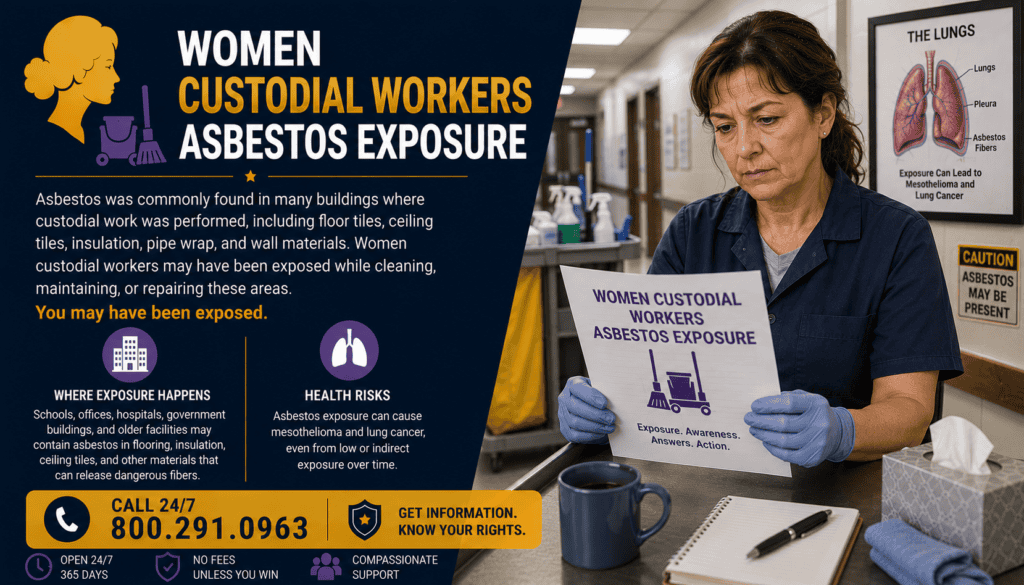
Women Custodial Workers Asbestos Exposure
Women who worked as custodians, janitors, cleaners or building-service employees may have spent years maintaining schools, offices, hospitals, factories, government buildings and other older facilities where asbestos-containing materials were present. Custodial employment alone does not prove exposure. A meaningful investigation identifies the building, dates, cleaning duties, damaged or disturbed materials, nearby renovation work and records confirming asbestos-containing material.
Custodial exposure histories can differ from construction or abatement work. Routine cleaning may involve little or no contact with asbestos, while cleaning dust or debris after asbestos disturbance can present a different concern. OSHA specifically addresses housekeeping involving asbestos, and EPA provides operations-and-maintenance practices for custodial staff. This guide explains how to reconstruct tasks, identify useful building records and preserve medical and legal evidence.
🧹 Women Custodial Workers: Exposure Overview
OSHA asbestos rules include housekeeping provisions, and OSHA describes Class IV asbestos work as maintenance and custodial activities involving contact with, but not disturbance of, asbestos-containing material, as well as cleanup of dust, waste and debris resulting from certain asbestos work. The exact standard that applies depends on the setting and activity.
Start with the Women’s Occupations & Workplace Asbestos Exposure hub. Record each employer, building, department, shift, work area and approximate date, then list the cleaning and maintenance tasks actually performed.
| Question | Details to document |
|---|---|
| Where? | Building, floor, room, mechanical area or facility |
| When? | Employment dates and renovation periods |
| What task? | Cleaning, floor care, debris removal or minor maintenance |
| What material? | Surveyed ACM, flooring, insulation, surfacing or debris source |
🏢 Buildings and Work Areas to Investigate
Custodians often work throughout a facility, which can make building records especially useful. EPA recommends operations-and-maintenance programs for buildings containing asbestos-containing material, including training, occupant notification, monitoring, safe work practices and recordkeeping. A building’s age alone does not prove that a custodian encountered airborne asbestos.
See Women Working in Asbestos-Containing Buildings. Useful records can include asbestos surveys, management plans, floor plans, maintenance logs, renovation specifications, abatement reports and incident records documenting damaged materials.
| Record | What it may establish |
|---|---|
| Asbestos survey | Location and type of documented ACM |
| O&M/management plan | Known materials and control procedures |
| Work order | Repair or disturbance near custodial duties |
| Abatement record | Removal area, dates and contractor |
🧽 Cleaning Tasks and Potential Fiber Disturbance
EPA distinguishes routine tasks unlikely to disturb asbestos-containing material from work where accidental or intentional disturbance is possible. Cleaning shelves with a damp cloth, for example, presents a different scenario from working around damaged surfacing material or cleaning debris after asbestos-related work.
Document whether the worker swept, dry-dusted, vacuumed, removed debris, entered mechanical rooms, cleaned above ceilings or worked during renovation. The presence of dust does not establish asbestos; the source and material must be investigated.
| Task | Evidence question |
|---|---|
| Routine cleaning | Was documented ACM nearby and intact? |
| Debris cleanup | What work generated the debris? |
| Mechanical-room cleaning | Were pipes, boilers or insulation damaged? |
| Post-renovation cleanup | What materials were disturbed during the project? |
🧼 Flooring, Stripping and Buffing
Floor care can be relevant when a facility had asbestos-containing flooring. OSHA states that its general-industry and construction asbestos standards contain requirements for care of asbestos-containing flooring material, including stripping and buffing. Whether a historical flooring product actually contained asbestos must be established through records or reliable material evidence.
For an individual history, document floor locations, tile or backing information, stripping and buffing methods, equipment used, renovation dates and any known flooring surveys or replacement projects.
🏫 School Custodians and AHERA Records
School custodians may have unusually useful records because EPA’s Asbestos Hazard Emergency Response Act rules require public and nonprofit private schools to inspect for asbestos-containing building materials, maintain asbestos management plans and perform periodic surveillance. EPA also requires asbestos-awareness training for custodial and maintenance staff who may work in buildings containing asbestos-containing building materials.
EPA states that school asbestos management plans document asbestos locations, response actions and related records. A trained custodian or maintenance worker may also perform six-month surveillance checks. These records can help reconstruct what materials were known to be present during a woman’s employment.
| Record | Potential value |
|---|---|
| AHERA management plan | Identifies known ACBM and locations |
| Reinspection record | Documents condition over time |
| Six-month surveillance | May document deterioration or damage |
| Training record | May establish custodial asbestos-awareness training |
🗂️ Employment and Exposure Evidence
Build a chronological employment history that connects the worker with specific buildings and tasks. Preserve personnel records, payroll records, job descriptions, union records, training certificates, work orders, building surveys, management plans and coworker names. Photographs can provide context but generally cannot establish asbestos content from appearance alone.
The Mesothelioma Lawsuit Evidence & Documentation hub provides additional record-gathering guidance. Keep firsthand memories separate from facts verified by building or product records.
🫁 Medical Documentation and Exposure History
The National Cancer Institute classifies asbestos as a known human carcinogen and states that asbestos exposure causes mesothelioma and cancers including lung, laryngeal and ovarian cancer. Risk is affected by factors including dose, duration, fiber characteristics and exposure source.
Use the Women’s Asbestos Diseases hub for focused health information. Medical records establish diagnosis and treatment, while employment and building evidence addresses where exposure may have occurred. A diagnosis alone does not identify a particular building or employer as the exposure source.
⚖️ Potential Claim Questions
A custodial-worker claim investigation may examine employment records, premises conditions, asbestos-containing products, renovation contractors, manufacturers, suppliers or other entities depending on the evidence and governing law. Working in an older building does not automatically establish liability.
Review the Women’s Asbestos Legal Options hub and the Mesothelioma Lawsuits in All 50 States hub. Potential workers’ compensation, civil or asbestos trust routes have different requirements. Compensation is not guaranteed.
🛡️ Current Asbestos Safety and Work Practices
Current EPA guidance emphasizes training, monitoring, safe work practices, job-site controls and appropriate worker protection when custodial or maintenance tasks may affect asbestos-containing material. EPA advises that activities beyond appropriate operations-and-maintenance work should be performed by specially trained and accredited asbestos professionals.
Do not disturb a suspect material today to recreate or prove an old exposure. Existing surveys, management plans, laboratory records and qualified professionals are safer sources of material information.
❓ Frequently Asked Questions
Could women custodial workers have encountered asbestos?
Yes, particularly in buildings where documented asbestos-containing materials were damaged, disturbed or involved in cleanup activities. Individual evidence is still required.
Does working in an old building prove asbestos exposure?
No. Building age is a research clue, not proof of asbestos content or fiber release.
Does OSHA address custodial asbestos work?
Yes. OSHA asbestos standards include housekeeping provisions and define certain maintenance and custodial activities as Class IV work.
Can floor stripping or buffing be relevant?
Yes, when flooring is documented as asbestos-containing. OSHA has specific housekeeping requirements for asbestos-containing flooring.
Are school custodians covered by special asbestos requirements?
EPA’s AHERA rules require asbestos management plans and asbestos-awareness training for custodial and maintenance staff in covered schools with asbestos-containing building materials.
What school record is especially useful?
The AHERA asbestos management plan can identify asbestos-containing materials, locations, inspections, surveillance and response actions.
What if the building has since been renovated or demolished?
Historical surveys, management plans, work orders, abatement files, employment records and witnesses may still help reconstruct conditions.
Is compensation guaranteed?
No. Exposure evidence, responsible parties, medical documentation, deadlines and applicable law affect whether a claim is available.
📞 Submit Your Case
If you or a loved one has a mesothelioma diagnosis and a history of custodial or janitorial work, gather employer names, building locations, work dates, cleaning duties, renovation history, training records and any known asbestos-management documents. Unknown details should remain research leads rather than guesses.
Call 800.291.0963 for a no-obligation case evaluation. Live chat is available 24/7, 365 days a year. Submit your case here.
📝 Summary
Women custodial workers may have encountered asbestos while cleaning or maintaining buildings containing asbestos materials, particularly where materials were damaged or work generated asbestos-containing dust or debris. A reliable investigation connects the worker to a specific facility, time, task and documented material using employment, building, training, witness and medical records.
🔗 Confirmed Sources
- OSHA — 29 CFR 1910.1001 Asbestos
- U.S. EPA — Asbestos Safe Work Practices
- U.S. EPA — Asbestos and School Buildings
- U.S. EPA — AHERA School Responsibilities
- National Cancer Institute — Asbestos Exposure and Cancer Risk
This page provides general information, not legal or medical advice. This website is not a law firm. Exposure, eligibility, filing deadlines and compensation depend on individual facts and applicable law. No outcome is guaranteed.