Guide to Asbestos Trust Fund Claims - (800) 291-0963

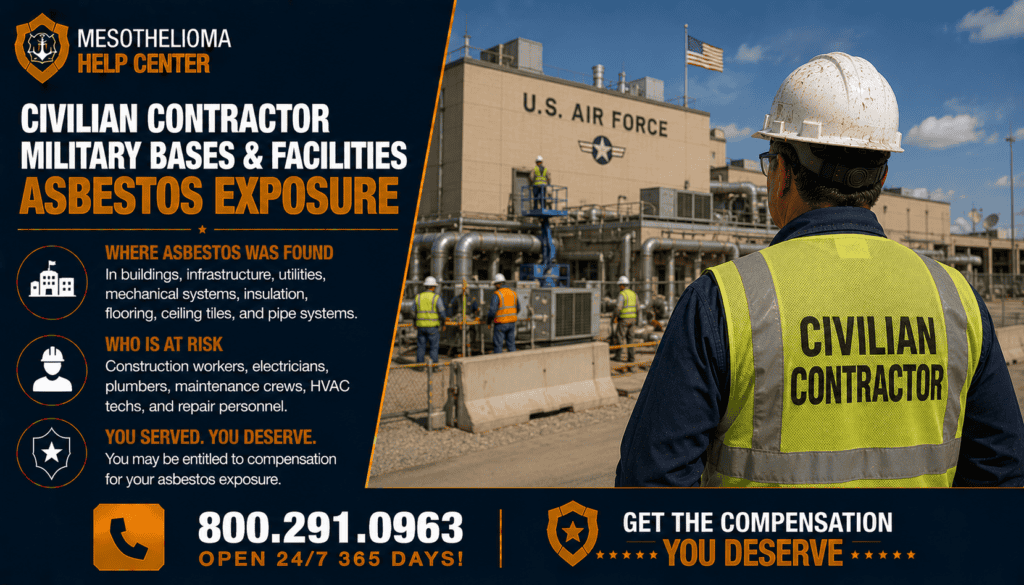
Civilian Contractor Military Bases & Facilities Asbestos Exposure

Civilian Contractor Military Bases & Facilities Asbestos Exposure - Mesothelioma

Civilian Contractor Military Bases & Facilities Asbestos Exposure

Civilian contractors have played an important role in constructing, maintaining, repairing, renovating, and operating U.S. military bases and government facilities. Contractors could work alongside active-duty personnel, federal civilian employees, engineers, maintenance crews, and other private companies while performing specialized work throughout military installations.

Historical military facilities contained extensive heating, steam, electrical, mechanical, utility, transportation, and building systems. Certain materials historically used in these systems could contain asbestos, including some pipe insulation, boiler insulation, gaskets, packing, fireproofing, cement products, flooring, roofing, electrical materials, and other heat-resistant products.

Civilian contractors could potentially encounter these materials while performing construction, maintenance, equipment repair, renovation, demolition, utility work, or other assignments.

The Civilian Contractor Military Bases & Facilities Asbestos Exposure hub organizes exposure information according to the military installations and facility types where civilian contractors worked.

A worker’s presence at a military installation alone does not establish asbestos exposure. Research should identify the contractor, base, facility, occupation, work area, equipment, task, products, and employment dates whenever possible.


Civilian Contractors at U.S. Military Installations

Military installations functioned much like small cities.

Large bases could contain:

  • Barracks
  • Administrative buildings
  • Hospitals
  • Aircraft hangars
  • Maintenance shops
  • Motor pools
  • Boiler plants
  • Powerhouses
  • Utility buildings
  • Warehouses
  • Training facilities
  • Dining facilities
  • Communications buildings
  • Fire stations
  • Mechanical rooms

Construction and maintenance of these facilities frequently required civilian contractors.

The potential for asbestos exposure depended on what work the contractor actually performed.


Why Military Bases Used Civilian Contractors

Military installations required continuous construction, maintenance, modernization, and repair.

Civilian companies could receive contracts involving:

  • Building construction
  • Building renovation
  • Mechanical maintenance
  • Electrical work
  • Plumbing
  • HVAC systems
  • Boiler maintenance
  • Utility systems
  • Equipment repair
  • Vehicle maintenance
  • Aircraft support
  • Demolition
  • Insulation
  • Roofing
  • Flooring

Some projects lasted months or years, while others involved short-term maintenance assignments.


Historical Asbestos Use at Military Facilities

Military installations constructed during periods of widespread asbestos use could contain certain asbestos-containing materials.

Potential historical product categories included some:

  • Pipe insulation
  • Boiler insulation
  • Mechanical insulation
  • Fireproofing
  • Gaskets
  • Packing
  • Cement products
  • Flooring materials
  • Roofing materials
  • Wall and ceiling materials
  • Electrical materials
  • Heat-resistant products

Not every military building contained asbestos.

Not every product within these categories contained asbestos.

The building’s construction date, renovation history, equipment, and individual product should be investigated whenever possible.


Civilian Contractors and Military Base Construction

Military expansion required civilian construction companies to build and improve installations.

Contractors could participate in construction of:

  • Barracks
  • Hospitals
  • Hangars
  • Warehouses
  • Administrative buildings
  • Powerhouses
  • Boiler plants
  • Maintenance facilities
  • Training buildings
  • Utility systems

Potential occupations included:

  • Carpenters
  • Electricians
  • Plumbers
  • Pipefitters
  • Insulators
  • Sheet metal workers
  • Welders
  • Laborers
  • Equipment operators

Potential exposure depended heavily on the materials used and tasks performed.


Civilian Contractors and Military Base Renovation

Renovation can be particularly important when investigating historical exposure.

Older materials that had remained undisturbed for decades could potentially be disturbed during:

  • Remodeling
  • Mechanical upgrades
  • Electrical upgrades
  • Boiler replacement
  • HVAC replacement
  • Pipe replacement
  • Wall removal
  • Ceiling removal
  • Flooring replacement
  • Demolition

A contractor performing newer work could therefore encounter materials installed many years earlier.


Civilian Contractors and Military Base Demolition

Military installations periodically demolished obsolete:

  • Barracks
  • Warehouses
  • Shops
  • Boiler plants
  • Utility buildings
  • Administrative structures
  • Training buildings

Demolition could disturb numerous building systems simultaneously.

Potential historical asbestos-containing materials could include certain:

  • Insulation
  • Fireproofing
  • Cement products
  • Flooring
  • Roofing
  • Gaskets
  • Boiler materials
  • Mechanical insulation

The actual materials present should be verified rather than assumed.


Civilian Contractors in Military Barracks

Barracks required ongoing:

  • Heating maintenance
  • Plumbing
  • Electrical repairs
  • Roofing
  • Flooring
  • Remodeling
  • HVAC work

Potential historical asbestos-containing building materials could have been located in:

  • Mechanical rooms
  • Heating systems
  • Piping
  • Flooring
  • Roofing
  • Wall assemblies

Contractors could encounter these materials during repair or renovation.


Civilian Contractors in Military Hospitals

Military hospitals contained complex mechanical and utility systems.

Potential contractor work could involve:

  • Boilers
  • Steam piping
  • Heating systems
  • Ventilation
  • Electrical systems
  • Plumbing
  • Mechanical rooms
  • Building renovation

Hospital operations required reliable heating and steam, potentially resulting in substantial mechanical infrastructure.

Historical product use varied according to facility and period.


Civilian Contractors in Aircraft Hangars

Military aircraft hangars required:

  • Electrical systems
  • Heating
  • Ventilation
  • Fire protection
  • Mechanical equipment
  • Building maintenance

Contractors could perform:

  • Electrical work
  • HVAC maintenance
  • Roofing
  • Structural repairs
  • Equipment maintenance
  • Renovation

Potential exposure could involve building materials or nearby aircraft maintenance operations depending on the assignment.


Civilian Contractors in Vehicle Maintenance Facilities

Military installations maintained large fleets of:

  • Trucks
  • Jeeps
  • Construction vehicles
  • Heavy equipment
  • Support vehicles

Civilian contractors could repair vehicles or maintain the buildings where vehicle work occurred.

Potential historical asbestos exposure pathways differed between vehicle mechanics and building maintenance contractors.

Certain historical vehicle friction materials could contain asbestos, including some brake and clutch components.


Civilian Contractors in Military Motor Pools

Motor pools combined vehicle storage, maintenance, repair, and support operations.

Potential contractor occupations included:

  • Vehicle mechanics
  • Electricians
  • Maintenance workers
  • Construction workers
  • Equipment mechanics

Exposure research should distinguish between:

Vehicle-related products and building-related products.

These represent different potential exposure pathways.


Civilian Contractors in Military Boiler Rooms

Boiler rooms were important components of many military facilities.

Potential equipment included:

  • Boilers
  • Pumps
  • Valves
  • Steam piping
  • Feedwater systems
  • Mechanical controls

Certain historical materials associated with boiler and steam systems could contain asbestos.

Potential categories included some:

  • Boiler insulation
  • Pipe insulation
  • Gaskets
  • Packing
  • Refractory materials
  • Insulating cement

Contractors could perform maintenance directly or work nearby while another trade disturbed these materials.


Civilian Contractors at Military Boiler Plants

Large installations could operate centralized boiler plants supplying steam or heat to multiple buildings.

Civilian contractor assignments could involve:

  • Boiler repair
  • Pump maintenance
  • Valve maintenance
  • Pipe replacement
  • Insulation work
  • Electrical maintenance
  • Equipment modernization

Major maintenance projects could involve several trades working in the same area.


Civilian Contractors at Military Powerhouses

Military powerhouses could contain:

  • Boilers
  • Turbines
  • Generators
  • Pumps
  • Valves
  • Steam piping
  • Electrical equipment
  • Compressors

Contractors could be hired for:

  • Turbine overhauls
  • Generator repair
  • Boiler maintenance
  • Pipe work
  • Electrical upgrades
  • Equipment replacement

Potential exposure depended on the equipment, products, and work activities involved.


Civilian Contractors in Military Utility Buildings

Military utility systems could provide:

  • Steam
  • Electricity
  • Water
  • Sewage treatment
  • Compressed air
  • Heating
  • Cooling

Potential contractor work could involve:

  • Pumps
  • Valves
  • Boilers
  • Piping
  • Electrical equipment
  • Mechanical systems

Older utility infrastructure could remain operational for decades.


Civilian Contractors in Utility Tunnels

Some large installations used underground utility tunnels carrying:

  • Steam piping
  • Hot-water piping
  • Electrical systems
  • Communications lines
  • Mechanical utilities

Contractors could enter these spaces to perform:

  • Pipe repair
  • Valve replacement
  • Electrical maintenance
  • Insulation work
  • Utility upgrades

Historical insulated steam systems can be particularly relevant when reconstructing potential exposure.


Civilian Contractors in Military Maintenance Shops

Maintenance facilities could contain:

  • Machine shops
  • Welding areas
  • Mechanical shops
  • Electrical shops
  • Vehicle repair areas
  • Equipment rebuilding areas

Potential occupations included:

  • Machinists
  • Millwrights
  • Mechanics
  • Electricians
  • Welders
  • Maintenance workers

Exposure research should identify both the equipment repaired and the surrounding building materials.


Civilian Contractors in Military Machine Shops

Machine shops could be used to repair components from:

  • Pumps
  • Valves
  • Motors
  • Generators
  • Vehicles
  • Industrial machinery

Machinists could receive equipment that had been removed from boiler rooms, powerhouses, ships, or other facilities.

Potential historical exposure could involve certain gaskets, packing, insulation residue, or other equipment materials.


Civilian Contractors in Military Warehouses

Military warehouses stored:

  • Equipment
  • Replacement parts
  • Construction materials
  • Vehicle components
  • Mechanical supplies
  • Building products

Potential exposure depended on what materials were stored and whether contractors handled, installed, removed, or disturbed them.

Simply working inside a warehouse does not establish asbestos exposure.


Civilian Contractors in Military Administrative Buildings

Administrative buildings could contain older:

  • Heating systems
  • Steam piping
  • Flooring
  • Roofing
  • Mechanical equipment
  • Building materials

Contractors could encounter historical materials during:

  • Renovation
  • HVAC work
  • Electrical upgrades
  • Plumbing repairs
  • Demolition

Building age and renovation history can help focus research.


Civilian Contractors in Military Training Facilities

Training installations contained a variety of buildings, including:

  • Classrooms
  • Barracks
  • Shops
  • Warehouses
  • Mechanical buildings
  • Utility facilities

Contractors could perform construction, repair, and maintenance across these structures.

Different buildings on the same base could have entirely different material histories.


Civilian Contractors in Military Communications Facilities

Communications facilities required:

  • Electrical systems
  • Emergency power
  • Cooling equipment
  • Mechanical systems
  • Building maintenance

Contractors could perform electrical, HVAC, generator, and building work.

Potential exposure depended on the equipment and materials actually encountered.


Civilian Contractors in Military Fire Stations

Military fire stations could contain:

  • Vehicle bays
  • Mechanical rooms
  • Heating systems
  • Roofing
  • Flooring
  • Building insulation

Contractors could perform building maintenance, renovation, or mechanical repairs.


Civilian Contractors at Army Bases

Army installations required civilian contractors for:

  • Construction
  • Utilities
  • Vehicle maintenance
  • Building maintenance
  • Boiler operations
  • Electrical work
  • Plumbing
  • Mechanical repairs

Potential work areas included:

  • Barracks
  • Motor pools
  • Maintenance shops
  • Hospitals
  • Warehouses
  • Boiler plants
  • Powerhouses

Army base exposure research should identify the specific installation and facility whenever possible.


Civilian Contractors at Navy Bases

Navy shore installations required extensive:

  • Mechanical systems
  • Utility infrastructure
  • Maintenance facilities
  • Warehouses
  • Administrative buildings
  • Barracks

Civilian contractors could perform construction, maintenance, and equipment repair.

Work performed at naval shipyards or aboard ships should be researched separately from general Navy base exposure when possible.


Civilian Contractors at Air Force Bases

Air Force installations could employ contractors for:

  • Hangar maintenance
  • Aircraft support
  • Vehicle maintenance
  • Utilities
  • Electrical work
  • Boiler maintenance
  • Construction
  • Building renovation

Potential exposure could involve either facility materials or equipment associated with aviation operations.


Civilian Contractors at Marine Corps Bases

Marine Corps installations required civilian contractors for:

  • Building construction
  • Vehicle maintenance
  • Aircraft support
  • Utility systems
  • Electrical maintenance
  • Plumbing
  • Boiler repair
  • Facility modernization

Specific duties and facilities should be identified rather than assuming exposure based on the installation alone.


Civilian Contractors at Coast Guard Bases

Coast Guard shore facilities could require civilian contractors for:

  • Building maintenance
  • Utility systems
  • Marine equipment
  • Electrical systems
  • Boiler systems
  • Construction
  • Vessel support

Contractors could potentially have both shore-based and maritime exposure histories.


Civilian Contractors at National Guard Facilities

National Guard installations could include:

  • Armories
  • Training facilities
  • Vehicle maintenance shops
  • Aircraft hangars
  • Warehouses
  • Utility buildings

Civilian contractors could perform construction, renovation, mechanical work, and maintenance.

Older armories and maintenance facilities may require building-specific historical research.


Civilian Contractors at Military Armories

Armories could contain:

  • Vehicle areas
  • Administrative offices
  • Mechanical rooms
  • Training areas
  • Storage areas

Potential contractor assignments could involve:

  • HVAC work
  • Plumbing
  • Electrical systems
  • Flooring
  • Roofing
  • Renovation

The age and renovation history of the armory can be important.


Civilian Contractors at Military Aircraft Maintenance Facilities

Aircraft maintenance facilities could contain:

  • Hangars
  • Engine shops
  • Electrical shops
  • Parts storage
  • Mechanical systems
  • Utility equipment

Contractors could work on the building itself or directly support aircraft maintenance.

These potential exposure pathways should be investigated separately.


Civilian Contractors at Military Vehicle Maintenance Facilities

Contractors could perform:

  • Vehicle repair
  • Building maintenance
  • Electrical work
  • HVAC work
  • Equipment maintenance
  • Renovation

Potential exposure could involve vehicle components, mechanical equipment, or older building materials.


Civilian Contractors at Military Medical Facilities

Military medical facilities could include:

  • Hospitals
  • Clinics
  • Laboratories
  • Utility buildings
  • Mechanical rooms

Potential contractor work could involve:

  • Steam systems
  • Boilers
  • HVAC
  • Plumbing
  • Electrical systems
  • Building renovation

Facility age and individual work assignment remain important.


Civilian Contractors at Military Storage Facilities

Storage facilities and warehouses could require:

  • Roofing repair
  • Electrical work
  • Heating maintenance
  • Flooring
  • Structural repair
  • Renovation

Potential exposure should be based on the products and work performed rather than the building classification alone.


Civilian Contractors at Military Power Facilities

Military installations needed reliable electricity and emergency power.

Potential facilities included:

  • Powerhouses
  • Generating stations
  • Emergency generator buildings
  • Electrical substations

Contractors could maintain:

  • Generators
  • Turbines
  • Motors
  • Switchgear
  • Boilers
  • Pumps
  • Electrical equipment

Historical product research can then be organized around the specific machinery.


Civilian Contractors at Military Water and Pumping Facilities

Military water systems could contain:

  • Pumps
  • Valves
  • Piping
  • Motors
  • Treatment equipment

Contractors could repair or replace mechanical components.

Certain historical gaskets or packing associated with pumps and valves could contain asbestos.

Not every gasket or packing product contained asbestos.


Civilian Contractors at Overseas Military Bases

U.S. civilian contractors have also worked at military installations outside the United States.

Potential assignments could involve:

  • Construction
  • Maintenance
  • Utilities
  • Equipment repair
  • Facility modernization

Exposure research involving overseas work can be more complicated because records, contractors, products, and applicable legal issues may differ.

The installation, country, employer, occupation, and dates should be documented carefully.


Base Closures and Historical Exposure Research

Some military installations where civilian contractors once worked have:

  • Closed
  • Been transferred
  • Been redeveloped
  • Changed names
  • Changed missions
  • Demolished older buildings

Closure does not necessarily eliminate the possibility of reconstructing historical employment.

Potential records could remain in:

  • Government archives
  • Contractor files
  • Military records
  • Historical engineering documents
  • Local archives
  • Employment records
  • Coworker histories

Base Realignment and Modernization

Military installations can undergo repeated periods of:

  • Expansion
  • Modernization
  • Consolidation
  • Renovation
  • Demolition

These projects can help establish when older building systems were disturbed.

A contractor’s employment dates should be compared with known construction or renovation periods whenever documentation is available.


Direct Asbestos Exposure at Military Facilities

Potential direct exposure could occur when contractors personally:

  • Removed insulation
  • Repaired boilers
  • Removed old gaskets
  • Replaced packing
  • Removed flooring
  • Demolished walls or ceilings
  • Handled friction materials
  • Removed older mechanical systems

Whether these activities resulted in asbestos exposure depends on the specific material and work conditions.


Nearby Asbestos Exposure at Military Facilities

Civilian contractors could also work near other trades performing potentially dust-generating work.

Nearby activities could include:

  • Insulation removal
  • Pipe replacement
  • Boiler repair
  • Demolition
  • Gasket removal
  • Fireproofing removal
  • Mechanical equipment overhaul

The contractor’s proximity and work environment can therefore be relevant to historical research.


Civilian Contractors Working Beside Military Personnel

Private contractors could work alongside:

  • Active-duty personnel
  • Federal civilian workers
  • Other contractors
  • Maintenance departments
  • Construction crews

Two people working in the same building could nevertheless have very different exposure histories depending on their duties.


Civilian Contractors Working Beside Other Trades

Military construction and maintenance projects could involve:

  • Insulators
  • Pipefitters
  • Plumbers
  • Electricians
  • Boilermakers
  • Machinists
  • Millwrights
  • Welders
  • Mechanics
  • Laborers

Exposure research should consider both the contractor’s own activities and work performed nearby.


Prime Contractors and Military Subcontractors

A military project could involve several organizational layers:

Military Branch → Federal Agency → Prime Contractor → Subcontractor → Worker

For example, the military might contract with a large construction company that then hires specialized subcontractors for:

  • Insulation
  • Electrical work
  • Plumbing
  • Boiler repair
  • Mechanical maintenance

Identifying these relationships can help reconstruct historical employment.


Contractor Name vs. Military Base

Employment records may identify the private contractor without identifying every military installation where the employee worked.

Conversely, a worker may remember the military base but not the contractor’s exact legal name.

Both pieces of information should be reconstructed whenever possible.


Equipment Manufacturer vs. Product Manufacturer

The manufacturer of a:

  • Boiler
  • Pump
  • Valve
  • Turbine
  • Generator
  • Vehicle

may not have manufactured the insulation, gasket, packing, friction material, or replacement components used with the equipment.

These companies should not automatically be treated as the same entity.


Original Equipment vs. Replacement Materials

Military equipment and facility systems could remain operational for decades.

During that time, contractors could repeatedly replace:

  • Gaskets
  • Packing
  • Insulation
  • Seals
  • Brake components
  • Electrical components

Replacement products could differ from the products originally installed.

Maintenance dates therefore matter.


Take-Home Exposure From Military Contractor Work

Historical workplace dust could potentially leave military facilities on:

  • Clothing
  • Work shoes
  • Jackets
  • Tools
  • Personal belongings

When household exposure is investigated, the contractor’s own occupational history should first be reconstructed.

Important information includes:

  • Employer
  • Military installation
  • Facility
  • Occupation
  • Work activities
  • Products
  • Equipment
  • Employment dates

Records That May Help Identify Military Contractor Exposure

Potential records include:

  • Social Security earnings records
  • Contractor employment files
  • Union records
  • Pension records
  • Government contracts
  • Military installation records
  • Construction documents
  • Engineering records
  • Work orders
  • Maintenance records
  • Equipment records
  • Historical photographs
  • Coworker statements

Several sources may need to be combined.


Government Contract Records

Government contracting records can sometimes help identify:

  • Contractor
  • Military branch
  • Installation
  • Project
  • Contract period
  • Scope of work

A contract alone does not establish that an individual worker handled asbestos.

It can help establish where and when the contractor operated.


Military Installation Records

Historical installation documents may help identify:

  • Buildings
  • Construction dates
  • Renovations
  • Boiler plants
  • Utility systems
  • Maintenance projects
  • Contractors

These records can help narrow a broad base assignment to a particular work environment.


Social Security Employment Records

Social Security earnings records may help establish:

  • Contractor employers
  • Approximate employment periods
  • Employment chronology

They may not identify individual military installations.

Additional project research may therefore be required.


Union Records

Union documentation may help identify:

  • Trade
  • Contractor
  • Job assignments
  • Geographic area
  • Work periods

These records can be particularly useful for contractors who moved among multiple military projects.


Coworker Evidence

Former coworkers may help identify:

  • Military installations
  • Buildings
  • Contractors
  • Equipment
  • Products
  • Work practices
  • Nearby trades

Coworker evidence can become important when original companies no longer exist.


Building a Military Contractor Exposure Timeline

A useful sequence is:

Employer → Contractor → Military Branch → Base → Facility → Dates → Occupation → Task → Equipment → Product → Manufacturer

For example, someone may remember working as a civilian pipefitter at an Air Force installation.

Research could then identify:

  1. Private employer.
  2. Contract period.
  3. Air Force base.
  4. Specific buildings.
  5. Mechanical systems.
  6. Pipefitting duties.
  7. Steam piping.
  8. Insulation encountered.
  9. Pumps and valves repaired.
  10. Product or manufacturer information.

This creates a more useful exposure history than identifying only the military base.


Civilian Military Contractors and Mesothelioma

A mesothelioma diagnosis may lead a former contractor or family to investigate military facility work performed decades earlier.

Potential research can involve:

  • Contractor employers
  • Military bases
  • Government facilities
  • Buildings
  • Occupations
  • Equipment
  • Products
  • Work activities
  • Employment dates

A diagnosis does not establish where asbestos exposure occurred.

Historical exposure should be reconstructed as specifically as possible.


Civilian Military Contractors and Asbestos Lung Cancer

Historical occupational asbestos exposure can also be relevant to certain lung cancer histories.

Research may involve:

  • Contractor
  • Military installation
  • Occupation
  • Worksite
  • Products
  • Equipment
  • Exposure period

Smoking history and other lung cancer risk factors should also be documented.


Civilian Military Contractor Mesothelioma Lawsuits

A mesothelioma or other asbestos-related diagnosis may lead a former civilian contractor or family to investigate possible legal claims.

Potential investigation can involve:

  • Contractor employers
  • Product manufacturers
  • Equipment manufacturers
  • Suppliers
  • Worksites
  • Military installations
  • Exposure periods
  • Medical documentation
  • Applicable filing deadlines

The availability and outcome of any claim depend on the facts and governing law.


Working on a Military Base Does Not Automatically Mean a Claim Is Against the Government

A military installation can involve numerous private companies.

Potential entities associated with historical work could include:

  • Prime contractors
  • Subcontractors
  • Equipment manufacturers
  • Product manufacturers
  • Suppliers
  • Maintenance companies

The role of each entity should be evaluated separately.


Asbestos Trust Fund Claims

Some companies historically associated with asbestos-containing products later entered bankruptcy proceedings and established asbestos trusts.

Working at a military base does not by itself establish eligibility for an asbestos trust.

Trust research generally requires evidence satisfying the particular trust’s requirements concerning matters such as:

  • Diagnosis
  • Product exposure
  • Worksite
  • Employment
  • Exposure dates
  • Supporting documentation

Product identification can therefore become an important part of military contractor exposure research.


Wrongful Death Claims

When a former civilian contractor dies from mesothelioma or another asbestos-related disease, surviving family members may need to reconstruct military facility work performed decades earlier.

Potential evidence can include:

  • Medical records
  • Employment records
  • Social Security history
  • Union records
  • Contractor records
  • Government contracts
  • Military facility records
  • Product evidence
  • Equipment information
  • Coworker statements

The availability of a wrongful death claim and applicable filing deadline depend on the circumstances and governing law.


Frequently Asked Questions About Civilian Contractor Military Bases & Facilities Asbestos Exposure

Could civilian contractors work on U.S. military bases?

Yes. Private contractors have performed construction, maintenance, mechanical, electrical, utility, vehicle, aviation, and other work at military installations.

Does working at a military base prove asbestos exposure?

No.

The specific contractor, facility, occupation, equipment, products, tasks, and employment dates should be identified.

Which military facilities could be relevant?

Potential facilities include barracks, hospitals, hangars, maintenance shops, motor pools, boiler plants, powerhouses, utility buildings, warehouses, armories, and administrative buildings.

Could military boiler rooms contain asbestos products?

Certain historical boiler and steam-system materials could contain asbestos, including some insulation, gaskets, packing, refractory materials, and insulating cement.

Could contractors be exposed during renovation?

Potentially.

Renovation could disturb older insulation, flooring, roofing, fireproofing, mechanical systems, and other materials.

Could contractors be exposed without personally handling asbestos?

Potentially.

A contractor could work near another trade removing insulation, repairing boilers, replacing piping, or demolishing older building systems.

Could contractors work at several bases for the same employer?

Yes.

One private contractor could assign employees to multiple government or military projects.

Could a civilian contractor also be a veteran?

Yes.

Military service and later civilian contractor employment should be documented as separate periods.

Does working at a military facility mean a lawsuit is necessarily against the federal government?

No.

Historical exposure can involve private contractors, product manufacturers, equipment manufacturers, suppliers, and other entities.

What if the military base has closed?

Historical research may still be possible using employment records, government contracts, installation documents, archives, union records, and coworker information.

What if the contractor no longer exists?

Social Security records, government contracts, union records, historical project documents, and coworker evidence may still help reconstruct employment.

Can military contractor exposure be relevant to asbestos trust claims?

Potentially, but eligibility depends on evidence meeting the requirements of the particular asbestos trust.


Civilian Contractor Military Bases & Facilities Asbestos Exposure Articles

This hub can organize more specific child pages involving:

Civilian Contractors at Army Bases Asbestos Exposure

Focuses on civilian construction, maintenance, vehicle, mechanical, utility, and building work at Army installations.

Civilian Contractors at Navy Bases Asbestos Exposure

Covers civilian contractor work at Navy shore installations outside the more specialized shipyard and ship exposure category.

Civilian Contractors at Air Force Bases Asbestos Exposure

Focuses on civilian work involving hangars, aircraft support facilities, utilities, maintenance shops, and base buildings.

Civilian Contractors at Marine Corps Bases Asbestos Exposure

Covers civilian construction, maintenance, utilities, vehicle facilities, aviation support, and building work.

Civilian Contractors at Coast Guard Bases Asbestos Exposure

Focuses on shore installations, marine support facilities, mechanical systems, utilities, and buildings.

Civilian Contractors at National Guard Facilities Asbestos Exposure

Covers civilian contractor work at armories, training facilities, vehicle shops, aircraft facilities, warehouses, and utility buildings.

Civilian Contractors in Military Barracks Asbestos Exposure

Focuses on renovation, heating systems, piping, flooring, roofing, and other historical building materials.

Civilian Contractors in Military Aircraft Hangars Asbestos Exposure

Covers hangar construction, renovation, HVAC, electrical systems, mechanical systems, and aircraft-support environments.

Civilian Contractors in Military Vehicle Maintenance Facilities Asbestos Exposure

Focuses on motor pools, maintenance shops, vehicle repair areas, mechanical systems, and building materials.

Civilian Contractors in Military Boiler Rooms Asbestos Exposure

Covers boilers, steam piping, pumps, valves, insulation, gaskets, packing, and related maintenance.

Civilian Contractors in Military Powerhouses Asbestos Exposure

Focuses on boilers, turbines, generators, pumps, valves, steam systems, and electrical equipment.

Civilian Contractors in Military Hospitals Asbestos Exposure

Covers heating, steam, HVAC, plumbing, electrical systems, mechanical rooms, renovation, and construction.

Civilian Contractors in Military Warehouses Asbestos Exposure

Focuses on building maintenance, roofing, heating, electrical systems, renovation, and stored industrial materials.

Civilian Contractors in Military Utility Facilities Asbestos Exposure

Covers steam plants, pumping facilities, utility tunnels, electrical facilities, water systems, and mechanical infrastructure.


Explore Civilian Contractor Jobs & Occupations

The occupational hub addresses a different search question:

What job did the civilian contractor perform?

Related occupations can include:

Civilian Contractor Machinists Asbestos Exposure

Civilian Contractor Millwrights Asbestos Exposure

Civilian Contractor Mechanics Asbestos Exposure

Civilian Contractor Pipefitters Asbestos Exposure

Civilian Contractor Boilermakers Asbestos Exposure

Civilian Contractor Insulators Asbestos Exposure

Civilian Contractor Electricians Asbestos Exposure

Civilian Contractor Welders Asbestos Exposure

Civilian Contractor Maintenance Workers Asbestos Exposure

These pages can focus on occupational duties while this hub concentrates on where civilian contractors worked on military installations.


Explore Civilian Contractor Shipyard & Maritime Exposure

Civilian contractor work involving:

  • Naval shipyards
  • Commercial shipyards
  • Military vessels
  • Engine rooms
  • Boiler rooms
  • Machinery spaces
  • Ship repair
  • Vessel overhauls

should be organized under the separate Civilian Contractor Shipyard & Maritime Asbestos Exposure hub.

That keeps maritime search intent separate from general military base exposure.


Explore Civilian Contractor Buildings & Construction Exposure

Building-specific research involving:

  • Construction
  • Renovation
  • Demolition
  • Roofing
  • Flooring
  • Fireproofing
  • Mechanical rooms
  • Older building materials

can be organized under Civilian Contractor Buildings & Construction Asbestos Exposure.


Explore Civilian Contractor Equipment & Machinery Exposure

Equipment-specific research can be organized around:

  • Boilers
  • Pumps
  • Valves
  • Turbines
  • Generators
  • Compressors
  • HVAC equipment
  • Vehicles
  • Aircraft equipment
  • Industrial machinery

under Civilian Contractor Equipment & Machinery Asbestos Exposure.


Explore Civilian Contractor Asbestos Products

Product-specific research can address:

  • Pipe insulation
  • Boiler insulation
  • Gaskets
  • Packing
  • Fireproofing
  • Cement products
  • Flooring
  • Roofing
  • Friction products
  • Electrical materials

under Civilian Contractor Asbestos Products Exposure.


Explore Civilian Contractor Mesothelioma Lawsuits & Claims

Legal information involving:

  • Mesothelioma lawsuits
  • Asbestos lung cancer claims
  • Asbestos trust funds
  • Wrongful death claims
  • Filing deadlines
  • Exposure documentation

can be organized under Civilian Contractor Mesothelioma Lawsuits & Claims.

This keeps legal search intent separate from occupational and worksite exposure content.


Civilian Contractor Silo Structure

The Civilian Contractor silo can organize historical exposure through five fundamental questions:

Who? — Civilian Contractor Jobs & Occupations

Where? — Military Bases & Facilities, Shipyards & Maritime, Buildings & Construction

What equipment? — Equipment & Machinery

What product? — Asbestos Products

What legal options? — Mesothelioma Lawsuits & Claims

A visitor researching a former contractor can therefore move from:

Contractor → Worksite → Occupation → Equipment → Product → Claim

without requiring every individual page to repeat the entire exposure history.


Call 800.291.0963 — Open 24/7, 365 Days

MesotheliomaHelp.Center provides legal and medical information to help civilian contractors, veterans, retirees, workers, and families understand historical asbestos exposure at military bases and facilities, occupational histories, equipment, products, mesothelioma claims, and possible next steps.


Find Out If You Qualify Today!

25 Years Working With Diagnosed Mesothelioma Victims!

Our Mesothelioma lawyers work on a contingency fee basis.

This means NO MONEY OUT OF POCKET EXPENSES by the asbestos victims or their families. You will find the contingency fees to be among the lowest in the country.

Talk to a real live person!
Contact a mesothelioma lawyer today for a free, no-obligation case evaluation. 

Call (800) 291-0963 to find out if you have a valid claim.

Free Mesothelioma Case Evaluation

Get Answers From Expert Mesothelioma Attorneys