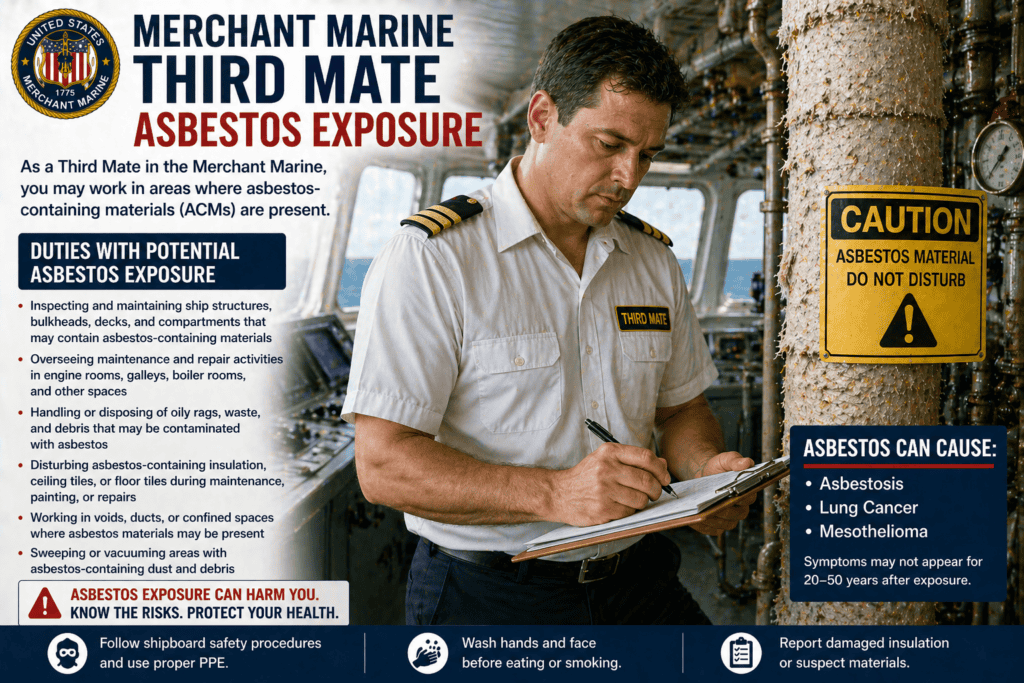
Merchant Marine Third Mate Asbestos Exposure
Exposure, Evidence and Claims
Merchant Marine Third Mate Asbestos Exposure requires a careful distinction between a documented job or service assignment and actual contact with asbestos-containing materials. Historical military and maritime facilities could include insulation, gaskets, flooring or other products made with asbestos, but a job title or location by itself does not prove that any specific person inhaled asbestos fibers.
This article examines the particular duties and records relevant to merchant marine third mate asbestos exposure, explains how to reconstruct possible exposure without overstatement, and identifies practical next steps after a mesothelioma diagnosis. The emphasis is on accurate dates, work locations, specific activities and corroborating evidence rather than generic assertions about military service.
Third Mate Duties Aboard Merchant Ships
The third mate is a licensed deck officer commonly assigned navigation watches and safety-related responsibilities. Work can include bridge duty, inspections, drills and oversight of deck operations. Unlike engine-room ratings, third mates generally do not spend their entire shifts repairing machinery, so exposure analysis should follow actual vessel routines.
When discussing third mate duties aboard merchant ships with a physician or legal reviewer, keep medical and occupational questions separate. Medical specialists establish the diagnosis and treatment plan; records and witnesses help evaluate potential exposure sources. Neither a mesothelioma diagnosis nor an old military or contractor assignment identifies a responsible manufacturer automatically. That distinction is important for trustworthy information and for evaluating any compensation option.
For this part of the investigation, the useful starting point is a precise account of third mate duties aboard merchant ships. Record the approximate month and year, the organization involved, the location within the facility or vessel, and the work occurring nearby. A credible description explains what the person actually saw or did. If a material was never identified, describe it as suspect rather than naming asbestos as an established fact.
Related reading: Navy Ships Asbestos Exposure — Compare the related military or contractor setting while keeping the duties, dates and supporting evidence for this article distinct.
Related reading: Navy Submarines — Compare the related military or contractor setting while keeping the duties, dates and supporting evidence for this article distinct.
Merchant Vessel Construction Eras
Many older merchant ships used asbestos-containing thermal insulation and other marine products. Vessel age, refits and maintenance history are relevant but do not prove exposure to a specific third mate. Identify the ship by name and official number where possible, then establish dates aboard and major overhaul periods.
For this part of the investigation, the useful starting point is a precise account of merchant vessel construction eras. Record the approximate month and year, the organization involved, the location within the facility or vessel, and the work occurring nearby. A credible description explains what the person actually saw or did. If a material was never identified, describe it as suspect rather than naming asbestos as an established fact.
The evidentiary value of merchant vessel construction eras depends on corroboration. Contemporary orders, correspondence, pay records, work orders, photographs, product catalogs or statements from people who witnessed the same activity can provide different pieces of the story. Those sources may conflict or be incomplete. Preserve the original wording, note the source of each fact and avoid converting an uncertain memory into a definite historical assertion.
Related reading: Nimitz Class Supercarriers Asbestos Exposure — Compare the related military or contractor setting while keeping the duties, dates and supporting evidence for this article distinct.
Related reading: 1. Two Different Carrier Classes — Compare the related military or contractor setting while keeping the duties, dates and supporting evidence for this article distinct.
Firefighting and Emergency Equipment
Deck officers may inspect firefighting systems, participate in drills and respond to emergencies. Some historical heat-resistant protective items contained asbestos, but not every suit, blanket or fire curtain did. Product labels, inventories and the period of service can help distinguish an actual asbestos-containing item from generic safety gear.
The evidentiary value of firefighting and emergency equipment depends on corroboration. Contemporary orders, correspondence, pay records, work orders, photographs, product catalogs or statements from people who witnessed the same activity can provide different pieces of the story. Those sources may conflict or be incomplete. Preserve the original wording, note the source of each fact and avoid converting an uncertain memory into a definite historical assertion.
When discussing firefighting and emergency equipment with a physician or legal reviewer, keep medical and occupational questions separate. Medical specialists establish the diagnosis and treatment plan; records and witnesses help evaluate potential exposure sources. Neither a mesothelioma diagnosis nor an old military or contractor assignment identifies a responsible manufacturer automatically. That distinction is important for trustworthy information and for evaluating any compensation option.
Related reading: Military Veterans Asbestos Exposure — Compare the related military or contractor setting while keeping the duties, dates and supporting evidence for this article distinct.
Related reading: Civilian Contractors Asbestos Exposure — Compare the related military or contractor setting while keeping the duties, dates and supporting evidence for this article distinct.
Passage Through Machinery Spaces
A third mate may enter engine rooms, boiler spaces or service passages during inspections, emergencies or coordination. These visits differ from regular insulation handling. Record why the officer entered, whether repairs were occurring and whether visible dust came from a known material rather than assuming machinery-space access equals asbestos exposure.
When discussing passage through machinery spaces with a physician or legal reviewer, keep medical and occupational questions separate. Medical specialists establish the diagnosis and treatment plan; records and witnesses help evaluate potential exposure sources. Neither a mesothelioma diagnosis nor an old military or contractor assignment identifies a responsible manufacturer automatically. That distinction is important for trustworthy information and for evaluating any compensation option.
For this part of the investigation, the useful starting point is a precise account of passage through machinery spaces. Record the approximate month and year, the organization involved, the location within the facility or vessel, and the work occurring nearby. A credible description explains what the person actually saw or did. If a material was never identified, describe it as suspect rather than naming asbestos as an established fact.
Related reading: Civilian Contractor Jobs With Asbestos Exposure — Compare the related military or contractor setting while keeping the duties, dates and supporting evidence for this article distinct.
Related reading: Getting Civilian Contractor Employment Records For Asbestos Exposure — Compare the related military or contractor setting while keeping the duties, dates and supporting evidence for this article distinct.
Cargo Operations and Port Repairs
Merchant deck officers supervised cargo watches and shipboard safety while shore crews performed maintenance. Potential exposure scenarios may involve dusty repairs near accommodation spaces or passageways, but cargo itself cannot be assumed to contain asbestos. Port records, maintenance logs and crew testimony may clarify the circumstances.
For this part of the investigation, the useful starting point is a precise account of cargo operations and port repairs. Record the approximate month and year, the organization involved, the location within the facility or vessel, and the work occurring nearby. A credible description explains what the person actually saw or did. If a material was never identified, describe it as suspect rather than naming asbestos as an established fact.
Related reading: Trenchers Asbestos Exposure — Compare the related military or contractor setting while keeping the duties, dates and supporting evidence for this article distinct.
Related reading: Military Aircraft Asbestos Exposure — Compare the related military or contractor setting while keeping the duties, dates and supporting evidence for this article distinct.
Shipboard Accommodations and Piping
Cabins, mess spaces and corridors on older vessels sometimes bordered insulated piping or mechanical systems. Intact insulation behind a wall is different from material disturbed during repair. A reliable history records leaks, pipe replacement, ceiling opening or other events that could have released fibers.
The evidentiary value of shipboard accommodations and piping depends on corroboration. Contemporary orders, correspondence, pay records, work orders, photographs, product catalogs or statements from people who witnessed the same activity can provide different pieces of the story. Those sources may conflict or be incomplete. Preserve the original wording, note the source of each fact and avoid converting an uncertain memory into a definite historical assertion.
Related reading: T-38 Talon Asbestos Exposure — Compare the related military or contractor setting while keeping the duties, dates and supporting evidence for this article distinct.
Related reading: Medical Corpsmen Hospital Staff Asbestos Exposure — Compare the related military or contractor setting while keeping the duties, dates and supporting evidence for this article distinct.
Sea Service Records and Vessel Identification
Discharge certificates, merchant mariner credentials, Coast Guard records and union shipping records can help identify ships and service dates. Logbooks and crew lists may fill gaps. Preserve vessel names, operators and voyage periods, since similarly named ships can otherwise lead to incorrect exposure histories.
When discussing sea service records and vessel identification with a physician or legal reviewer, keep medical and occupational questions separate. Medical specialists establish the diagnosis and treatment plan; records and witnesses help evaluate potential exposure sources. Neither a mesothelioma diagnosis nor an old military or contractor assignment identifies a responsible manufacturer automatically. That distinction is important for trustworthy information and for evaluating any compensation option.
Related reading: Military Vehicles Asbestos Exposure — Compare the related military or contractor setting while keeping the duties, dates and supporting evidence for this article distinct.
Related reading: Kaiser Jeep M-715 Army — Compare the related military or contractor setting while keeping the duties, dates and supporting evidence for this article distinct.
Diagnosis and Exposure Documentation
Mesothelioma can arise long after maritime service. A specialist diagnosis should be documented separately from the exposure investigation. Families can gather ship photographs, sailing records, letters and recollections of specific repairs, while also considering shore employment and military service that may have contributed.
For this part of the investigation, the useful starting point is a precise account of diagnosis and exposure documentation. Record the approximate month and year, the organization involved, the location within the facility or vessel, and the work occurring nearby. A credible description explains what the person actually saw or did. If a material was never identified, describe it as suspect rather than naming asbestos as an established fact.
Related reading: O 7 Army Brigadier General Bg Asbestos Exposure — Compare the related military or contractor setting while keeping the duties, dates and supporting evidence for this article distinct.
Related reading: U.S. Navy Asbestos Exposure — Compare the related military or contractor setting while keeping the duties, dates and supporting evidence for this article distinct.
Maritime Claims and Compensation Questions
Merchant mariners may face distinct maritime-law and employment questions compared with uniformed Navy veterans. Potential claims depend on employment status, defendants, timing and evidence; a maritime lawyer can evaluate the appropriate route. A third-mate license alone does not establish asbestos exposure or compensation eligibility.
The evidentiary value of maritime claims and compensation questions depends on corroboration. Contemporary orders, correspondence, pay records, work orders, photographs, product catalogs or statements from people who witnessed the same activity can provide different pieces of the story. Those sources may conflict or be incomplete. Preserve the original wording, note the source of each fact and avoid converting an uncertain memory into a definite historical assertion.
❓ Frequently Asked Questions
Does merchant marine third mate asbestos exposure automatically prove asbestos exposure?
No. Exposure must be evaluated using particular materials, tasks, dates, locations and credible records. A title, rank, vessel assignment or employer name is a starting point for research, not proof of a specific product or inhaled dose.
What documents are most useful after a mesothelioma diagnosis?
Medical and pathology records establish the diagnosis. Service or employment records, vessel or facility identification, work histories and witnesses may help establish an exposure timeline. The best documents depend on the individual’s actual duties and circumstances.
Can family members request information when records are missing?
Families may be able to locate copies of correspondence, union records, official histories or public archives. Access to private personnel and medical files can require authorization. An experienced professional can advise on record requests and relevant filing deadlines.
📞 Get the Mesothelioma Help & Compensation You Deserve — Contact Us Today!
A mesothelioma diagnosis can raise urgent questions about historic military or contractor exposure and possible compensation. Our team has 25+ years of experience helping people explore their options.
We can help you organize the questions to ask about employment, military assignments and possible legal claims. Eligibility and outcomes depend on individual evidence and applicable law.
📲 Contact Us Today — Three Easy Ways!
CALL: 800.291.0963 to discuss your questions.
LIVE CHAT: Available 24/7/365.
CONTACT FORM: Submit the form below to request assistance.
Disclaimer: This information is not be considered as legal or medical advice. Mesothelioma Help Center is not a law firm or medical provider and does not determine legal or VA eligibility.