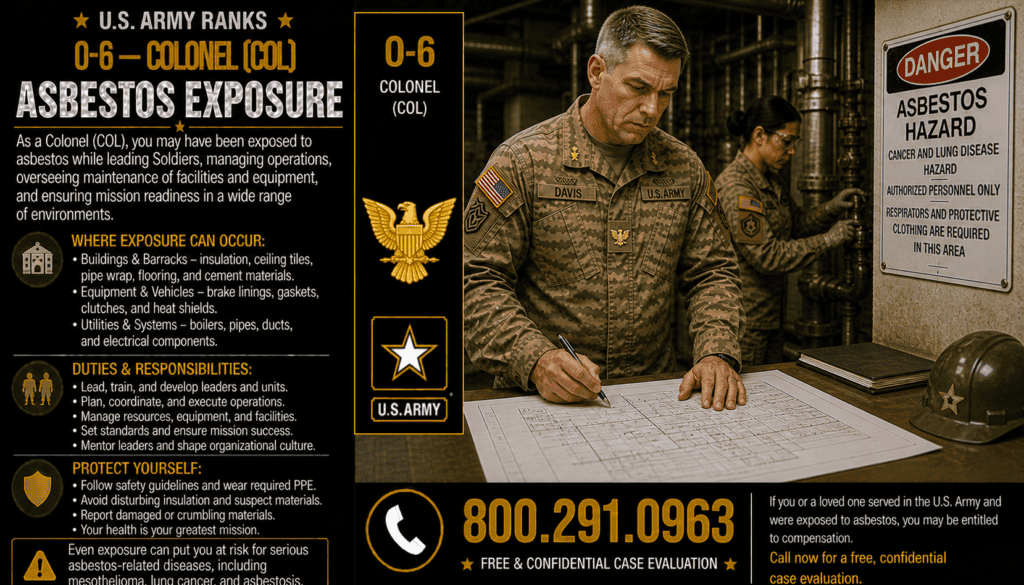
O-7 Army Brigadier General (BG) Asbestos Exposure
Exposure, Evidence and Claims
O-7 Army Brigadier General (BG) Asbestos Exposure requires a careful distinction between a documented job or service assignment and actual contact with asbestos-containing materials. Historical military and maritime facilities could include insulation, gaskets, flooring or other products made with asbestos, but a job title or location by itself does not prove that any specific person inhaled asbestos fibers.
This article examines the particular duties and records relevant to o-7 army brigadier general (bg) asbestos exposure, explains how to reconstruct possible exposure without overstatement, and identifies practical next steps after a mesothelioma diagnosis. The emphasis is on accurate dates, work locations, specific activities and corroborating evidence rather than generic assertions about military service.
The O-7 Rank and Army Responsibilities
A brigadier general is an Army general officer whose duties commonly involve command, planning and oversight. Rank alone is not a meaningful measure of asbestos exposure. An O-7 officer’s career may include decades of earlier assignments as a junior officer, staff officer or field commander, each with different locations and potential hazards.
The evidentiary value of the o-7 rank and army responsibilities depends on corroboration. Contemporary orders, correspondence, pay records, work orders, photographs, product catalogs or statements from people who witnessed the same activity can provide different pieces of the story. Those sources may conflict or be incomplete. Preserve the original wording, note the source of each fact and avoid converting an uncertain memory into a definite historical assertion.
When discussing the o-7 rank and army responsibilities with a physician or legal reviewer, keep medical and occupational questions separate. Medical specialists establish the diagnosis and treatment plan; records and witnesses help evaluate potential exposure sources. Neither a mesothelioma diagnosis nor an old military or contractor assignment identifies a responsible manufacturer automatically. That distinction is important for trustworthy information and for evaluating any compensation option.
Related reading: Military Veterans Asbestos Exposure — Compare the related military or contractor setting while keeping the duties, dates and supporting evidence for this article distinct.
Related reading: Civilian Contractors Asbestos Exposure — Compare the related military or contractor setting while keeping the duties, dates and supporting evidence for this article distinct.
Earlier Career Assignments Matter
Review the entire service chronology rather than only the period after promotion. Earlier duties in maintenance units, engineering organizations, logistics commands or installation operations may be more relevant than later headquarters work. Service records can identify units and postings but usually do not name every building material encountered.
When discussing earlier career assignments matter with a physician or legal reviewer, keep medical and occupational questions separate. Medical specialists establish the diagnosis and treatment plan; records and witnesses help evaluate potential exposure sources. Neither a mesothelioma diagnosis nor an old military or contractor assignment identifies a responsible manufacturer automatically. That distinction is important for trustworthy information and for evaluating any compensation option.
For this part of the investigation, the useful starting point is a precise account of earlier career assignments matter. Record the approximate month and year, the organization involved, the location within the facility or vessel, and the work occurring nearby. A credible description explains what the person actually saw or did. If a material was never identified, describe it as suspect rather than naming asbestos as an established fact.
Related reading: Civilian Contractor Jobs With Asbestos Exposure — Compare the related military or contractor setting while keeping the duties, dates and supporting evidence for this article distinct.
Related reading: Getting Civilian Contractor Employment Records For Asbestos Exposure — Compare the related military or contractor setting while keeping the duties, dates and supporting evidence for this article distinct.
Headquarters and Installation Buildings
Some older Army offices, barracks and command facilities contained asbestos-containing insulation or flooring. Occupancy of such a building is not itself evidence of significant airborne exposure. Renovation dates, pipe repairs, demolition work and documented disturbance provide more useful facts than the building’s age alone.
For this part of the investigation, the useful starting point is a precise account of headquarters and installation buildings. Record the approximate month and year, the organization involved, the location within the facility or vessel, and the work occurring nearby. A credible description explains what the person actually saw or did. If a material was never identified, describe it as suspect rather than naming asbestos as an established fact.
The evidentiary value of headquarters and installation buildings depends on corroboration. Contemporary orders, correspondence, pay records, work orders, photographs, product catalogs or statements from people who witnessed the same activity can provide different pieces of the story. Those sources may conflict or be incomplete. Preserve the original wording, note the source of each fact and avoid converting an uncertain memory into a definite historical assertion.
Related reading: Trenchers Asbestos Exposure — Compare the related military or contractor setting while keeping the duties, dates and supporting evidence for this article distinct.
Related reading: Merchant Marine Third Mate Asbestos Exposure — Compare the related military or contractor setting while keeping the duties, dates and supporting evidence for this article distinct.
Visits to Motor Pools and Depots
Senior officers may inspect vehicle maintenance shops, depots or industrial installations. Brief inspections differ from daily mechanical work and should not be described as equivalent. If an officer regularly supervised repairs or spent time near dusty tasks, record the frequency, duration, shop layout and identifiable materials.
The evidentiary value of visits to motor pools and depots depends on corroboration. Contemporary orders, correspondence, pay records, work orders, photographs, product catalogs or statements from people who witnessed the same activity can provide different pieces of the story. Those sources may conflict or be incomplete. Preserve the original wording, note the source of each fact and avoid converting an uncertain memory into a definite historical assertion.
When discussing visits to motor pools and depots with a physician or legal reviewer, keep medical and occupational questions separate. Medical specialists establish the diagnosis and treatment plan; records and witnesses help evaluate potential exposure sources. Neither a mesothelioma diagnosis nor an old military or contractor assignment identifies a responsible manufacturer automatically. That distinction is important for trustworthy information and for evaluating any compensation option.
Related reading: Military Aircraft Asbestos Exposure — Compare the related military or contractor setting while keeping the duties, dates and supporting evidence for this article distinct.
Related reading: T-38 Talon Asbestos Exposure — Compare the related military or contractor setting while keeping the duties, dates and supporting evidence for this article distinct.
Engineering and Construction Oversight
Army engineering and facilities assignments may involve oversight of utility systems, renovation and infrastructure. A command role does not imply hands-on insulation removal. Evaluate whether the officer entered active work zones, witnessed material disturbance or held an earlier engineering position with direct contact.
When discussing engineering and construction oversight with a physician or legal reviewer, keep medical and occupational questions separate. Medical specialists establish the diagnosis and treatment plan; records and witnesses help evaluate potential exposure sources. Neither a mesothelioma diagnosis nor an old military or contractor assignment identifies a responsible manufacturer automatically. That distinction is important for trustworthy information and for evaluating any compensation option.
Related reading: Medical Corpsmen Hospital Staff Asbestos Exposure — Compare the related military or contractor setting while keeping the duties, dates and supporting evidence for this article distinct.
Related reading: Military Vehicles Asbestos Exposure — Compare the related military or contractor setting while keeping the duties, dates and supporting evidence for this article distinct.
Deployment and Temporary Duty Locations
Temporary assignments can be overlooked in retirement biographies. Overseas bases, training centers and wartime facilities varied widely in construction and maintenance. Orders, travel vouchers, unit histories and personal correspondence may help reconstruct dates and buildings, while avoiding assumptions based solely on deployment theater.
For this part of the investigation, the useful starting point is a precise account of deployment and temporary duty locations. Record the approximate month and year, the organization involved, the location within the facility or vessel, and the work occurring nearby. A credible description explains what the person actually saw or did. If a material was never identified, describe it as suspect rather than naming asbestos as an established fact.
Related reading: Kaiser Jeep M-715 Army — Compare the related military or contractor setting while keeping the duties, dates and supporting evidence for this article distinct.
Related reading: U.S. Navy Asbestos Exposure — Compare the related military or contractor setting while keeping the duties, dates and supporting evidence for this article distinct.
Evidence Beyond Rank Insignia
Promotion orders and official biographies can establish service chronology, but asbestos attribution needs more specific evidence. Relevant materials may include facility records, photographs, coworker recollections and documented products. Distinguish first-hand knowledge from general claims that every military installation used the same asbestos materials.
The evidentiary value of evidence beyond rank insignia depends on corroboration. Contemporary orders, correspondence, pay records, work orders, photographs, product catalogs or statements from people who witnessed the same activity can provide different pieces of the story. Those sources may conflict or be incomplete. Preserve the original wording, note the source of each fact and avoid converting an uncertain memory into a definite historical assertion.
Related reading: Navy Ships Asbestos Exposure — Compare the related military or contractor setting while keeping the duties, dates and supporting evidence for this article distinct.
Related reading: Navy Submarines — Compare the related military or contractor setting while keeping the duties, dates and supporting evidence for this article distinct.
Medical History and Latency
Mesothelioma may be diagnosed decades after a potentially relevant military assignment. Clinicians determine the diagnosis through appropriate tests; a rank or exposure suspicion cannot substitute for pathology. A full history should include civilian jobs, household contacts and non-Army exposures so no plausible source is overlooked.
When discussing medical history and latency with a physician or legal reviewer, keep medical and occupational questions separate. Medical specialists establish the diagnosis and treatment plan; records and witnesses help evaluate potential exposure sources. Neither a mesothelioma diagnosis nor an old military or contractor assignment identifies a responsible manufacturer automatically. That distinction is important for trustworthy information and for evaluating any compensation option.
Related reading: Nimitz Class Supercarriers Asbestos Exposure — Compare the related military or contractor setting while keeping the duties, dates and supporting evidence for this article distinct.
Related reading: 1. Two Different Carrier Classes — Compare the related military or contractor setting while keeping the duties, dates and supporting evidence for this article distinct.
VA and Civil Claims Assessment
A retired general may seek advice about VA service connection and possible third-party asbestos claims. Military rank does not create automatic entitlement or determine legal liability. Eligibility depends on medical findings, service history, exposure evidence and applicable rules; counsel can help review potentially responsible product manufacturers.
For this part of the investigation, the useful starting point is a precise account of va and civil claims assessment. Record the approximate month and year, the organization involved, the location within the facility or vessel, and the work occurring nearby. A credible description explains what the person actually saw or did. If a material was never identified, describe it as suspect rather than naming asbestos as an established fact.
❓ Frequently Asked Questions
Does o-7 army brigadier general (bg) asbestos exposure automatically prove asbestos exposure?
No. Exposure must be evaluated using particular materials, tasks, dates, locations and credible records. A title, rank, vessel assignment or employer name is a starting point for research, not proof of a specific product or inhaled dose.
What documents are most useful after a mesothelioma diagnosis?
Medical and pathology records establish the diagnosis. Service or employment records, vessel or facility identification, work histories and witnesses may help establish an exposure timeline. The best documents depend on the individual’s actual duties and circumstances.
Can family members request information when records are missing?
Families may be able to locate copies of correspondence, union records, official histories or public archives. Access to private personnel and medical files can require authorization. An experienced professional can advise on record requests and relevant filing deadlines.
📞 Get the Mesothelioma Help & Compensation You Deserve — Contact Us Today!
A mesothelioma diagnosis can raise urgent questions about historic military or contractor exposure and possible compensation. Our team has 25+ years of experience helping people explore their options.
We can help you organize the questions to ask about employment, military assignments and possible legal claims. Eligibility and outcomes depend on individual evidence and applicable law.
📲 Contact Us Today — Three Easy Ways!
CALL: 800.291.0963 to discuss your questions.
LIVE CHAT: Available 24/7/365.
CONTACT FORM: Submit the form below to request assistance.
Disclaimer: This information is not be considered as legal or medical advice. Mesothelioma Help Center is not a law firm or medical provider and does not determine legal or VA eligibility.