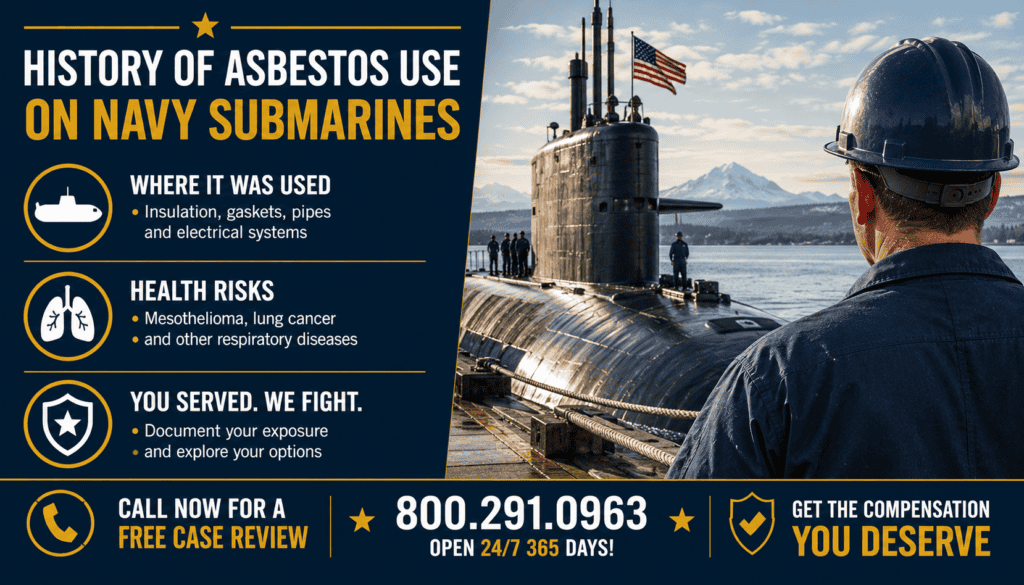
History of Asbestos Use on Navy Submarines
The history of asbestos use on Navy submarines is part of the broader history of asbestos-containing materials aboard U.S. Navy ships. VA documents historical Navy use of asbestos-containing materials in engine and boiler rooms and other below-deck spaces, including pipe coverings or lagging, gaskets, valves, cements, adhesives, and other heat-resistant products used for fire safety, insulation, sealing, and equipment maintenance.
Submarine exposure history should be reconstructed boat by boat and task by task. Class, construction date, shipyard, compartment, rating, overhaul period, replacement materials, and maintenance duties can all change the evidence. Veterans should therefore connect their service records with submarine histories, shipyard availabilities, technical documents, and product information rather than assuming every submarine or every insulation material contained asbestos.
History of Asbestos Use on Navy Submarines
Asbestos use aboard U.S. Navy vessels reflected the material’s historical value for heat resistance, insulation, fire protection, sealing, and friction applications. VA states that asbestos-containing materials were used on Navy ships built before the mid-1970s, particularly in engine and boiler rooms and other below-deck spaces. Submarine research should focus on the exact boat, service period, compartment, product, and maintenance task rather than assuming every submarine contained the same materials.
This historical page belongs to the Military History & Timeline of Asbestos Exposure hub within the U.S. Military Veterans Asbestos Exposure silo. Veterans researching submarine-specific exposure can also use the Navy Submarines Asbestos Exposure hub and broader U.S. Navy Asbestos Exposure hub.
Navy Asbestos Use and the Submarine Timeline
VA identifies Navy ships and shipyards as major historical military asbestos settings. Its Veterans Health Library notes widespread asbestos-containing material in Navy shipbuilding and shipyards and identifies personnel who worked below deck before the early 1990s as a potentially exposed group. VA also identifies Navy veterans who served on ships whose keels were laid before 1983 as a group that may have encountered asbestos.
These dates are useful screening points, not proof that a particular submarine component contained asbestos. Construction specifications, overhaul records, technical manuals, shipyard documents, and product records are needed to narrow the history for an individual boat.
Below-Deck Spaces and Submarine Work Areas
Submarines concentrate propulsion, piping, electrical, ventilation, machinery, and living systems within enclosed spaces. VA specifically identifies below-deck Navy work as historically relevant because asbestos was used aboard ships and ventilation could be poor. Potentially relevant submarine research can include machinery spaces, piping runs, engineering areas, auxiliary machinery spaces, ventilation systems, and other compartments where heat-resistant or insulating materials were installed or maintained.
For broader vessel context, review Navy Ships Asbestos Exposure. Personnel whose duties involved heat, steam, piping, or machinery can also compare their history with Military Boiler Room Personnel Asbestos Exposure and the Military Occupations Asbestos Exposure hub.
Materials Historically Relevant to Navy Research
VA lists military asbestos use in friction products and heat-resistant materials including gaskets, valves, cements, adhesives, floor coverings, and pipe coverings or lagging. VA also describes Navy veterans removing damaged asbestos lagging in engine rooms and using asbestos paste to re-wrap pipes. These documented categories provide starting points for submarine product research.
- Pipe coverings and lagging: thermal insulation around piping and related systems.
- Gaskets and sealing materials: products used where heat, pressure, or fluid sealing was required.
- Valves and mechanical components: assemblies that could incorporate packing, gaskets, or other heat-resistant materials.
- Cements, adhesives, and compounds: materials used in installation, repair, or insulation work.
- Other insulation: composition must be verified; not every historical submarine insulation product was asbestos.
Use the Military Products Asbestos Exposure hub and High-Risk Asbestos Components Used by Veterans for product-focused research.
Shipyard Overhauls, Repairs and Asbestos Disturbance
Submarines periodically underwent upkeep, restricted availabilities, overhauls, repairs, and modernization. Naval History and Heritage Command records, for example, document USS Blueback entering Pearl Harbor Naval Shipyard for restricted availability in 1971 and a lengthy overhaul beginning in 1972. Such records can help establish when and where a submarine was opened for major maintenance, but they do not by themselves prove asbestos disturbance.
VA states that asbestos is most hazardous when asbestos-containing material is damaged or disturbed and fibers become airborne. Research should therefore identify the specific repair, removal, replacement, cutting, scraping, insulation, or cleanup task. Continue through the Navy Shipyards Asbestos Exposure hub and Pearl Harbor Naval Shipyard Asbestos Exposure when shipyard history is relevant.
Records for Reconstructing Submarine Exposure
A strong historical reconstruction combines the veteran’s service timeline with the submarine’s construction and maintenance history. Useful evidence can include personnel records, ratings and specialties, boat assignments, deck logs where applicable, command histories, shipyard availability records, overhaul documents, technical manuals, piping and machinery records, work packages, parts information, and credible firsthand statements.
Use the Military Records & Documentation for Asbestos Exposure hub and How to Request Complete Service Records to establish service dates and assignments. Veterans who know the submarine but not the suspected product can use Veterans Help With Identifying Asbestos Exposure to connect duties, compartments, maintenance periods, and products without guessing.
Historical Exposure Evidence and VA Claims
VA states that veterans may qualify for disability compensation when they have a health condition caused by asbestos exposure and had contact with asbestos during military service. VA identifies medical records, service records listing the veteran’s job or specialty, and a doctor’s statement connecting military asbestos exposure with the health condition as evidence for a claim.
Submarine service can establish an important time and place for investigation, but assignment to a submarine alone does not prove asbestos exposure. Veterans researching benefits can continue to the VA Benefits & Claims for Veterans With Mesothelioma hub. Separate civil-claim and survivor information is available through the Veterans Asbestos Legal Options hub.
Frequently Asked Questions
Was asbestos historically used on Navy ships?
Yes. VA states that asbestos-containing materials were used on Navy ships and shipyards, particularly in engine and boiler rooms and other below-deck areas for heat resistance and fire safety.
Did every Navy submarine contain the same asbestos products?
No. Boat class, construction date, shipyard, component, supplier, overhaul history, and replacement materials can differ. Product-specific documentation is important.
Why are below-deck duties relevant?
VA identifies Navy personnel who regularly worked below deck before the early 1990s as a group potentially at risk because asbestos was historically used aboard ships and ventilation could be poor.
Were all types of submarine insulation asbestos?
No. Insulation composition must be verified. Naval History and Heritage Command, for example, identifies rockwool thermal insulation recovered from USS Thresher and described it as a type used in U.S. submarines, illustrating why insulation should not automatically be labeled asbestos.
Why are shipyard overhaul records useful?
They can identify when a submarine underwent extensive repair, modernization, removal, or replacement work and help narrow which technical and product records should be investigated.
Where should veterans continue submarine research?
Start with the Navy Submarines Asbestos Exposure hub, then connect the specific boat, rating, compartment, shipyard periods, and maintenance duties with service and technical records.
Confirmed Sources
Build the Navy Submarine Exposure Timeline
Record the submarine name and hull number, class, dates aboard, rating or specialty, compartments worked in, maintenance duties, shipyard availabilities, and any remembered insulation, piping, gasket, valve, or repair products. Compare those facts with technical, shipyard, overhaul, and product records before concluding that a particular material contained asbestos. Return to the Military History & Timeline of Asbestos Exposure hub for broader historical research.
Call 800.291.0963 for a no-obligation case evaluation and to speak with a real person 24/7, 365 days a year. Mesothelioma Help Center is not a law firm or medical provider and does not determine VA eligibility.
Disclaimer: General information only—not legal or medical advice. This website is not a law firm. Exposure, VA eligibility, liability and deadlines vary by case and jurisdiction. Do not disturb suspected asbestos. Past results do not guarantee future outcomes.