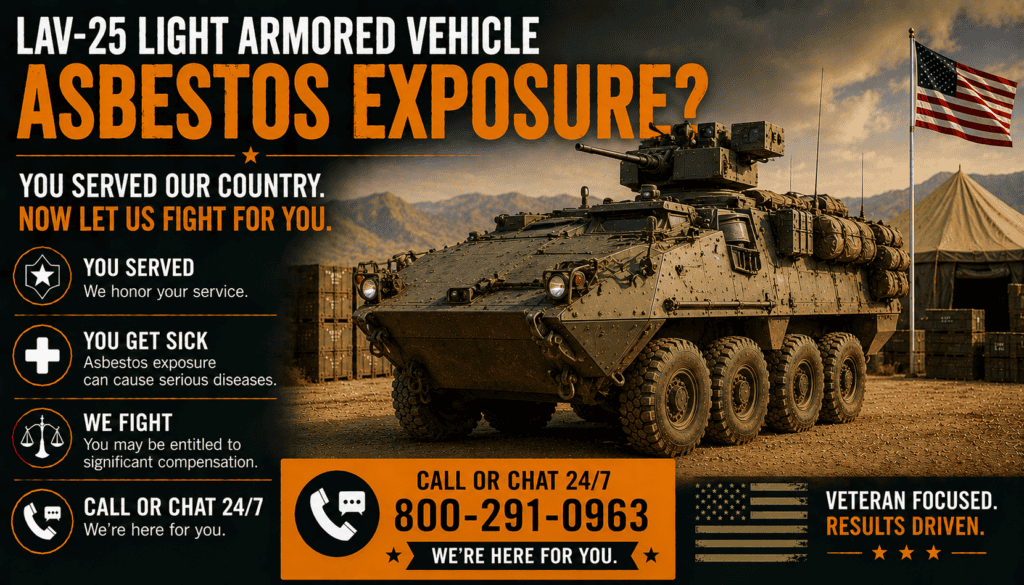
LAV-25 Light Armored Vehicle Army Asbestos Exposure
The LAV-25 is an eight-wheeled armored vehicle best known for long service with the U.S. Marine Corps, but it also has a documented U.S. Army history. Army records show that the service tested the LAV-25 in the early 1980s and later obtained 16 vehicles from the Marine Corps in December 1989 for evaluation as a rapidly deployable armored scout vehicle. Those Army LAV-25s deployed with 3-73 Armor during Operation Desert Shield and Desert Storm.
VA identifies brakes, gaskets, valves and other friction or heat-resistant products among historical military asbestos sources and specifically identifies servicing clutch facings and brake linings as a potential exposure activity. OSHA also recognizes asbestos hazards in brake and clutch repair involving asbestos-containing friction products. These facts make vehicle maintenance worth investigating, but they do not establish that every LAV-25, model year or replacement component contained asbestos.
🛡️ LAV-25 History & U.S. Military Service
The LAV-25 was developed as a fast, amphibious, wheeled armored vehicle armed with the M242 25mm automatic cannon. Army reporting from 1983 described plans to evaluate and potentially field the vehicle, and Army acquisition reporting documented extensive testing at Aberdeen Proving Ground during the 1980s.
The Marine Corps became the vehicle’s principal U.S. operator. Marine Corps Systems Command states that the first LAVs were initially fielded in 1983. Marine Corps doctrine describes the LAV-25A2 as an armored reconnaissance and assault vehicle carrying a crew of three plus scouts and an additional enabler.
The Army also used a small number. Army ARMOR reported that 16 LAV-25s were obtained from the Marine Corps in December 1989 and assigned to the scout platoon of 3-73 Armor at Fort Bragg. The platoon deployed to Saudi Arabia in 1990 and employed the vehicles during the Gulf War.
Because the page URL identifies the Army, this distinction is important: the LAV-25 has a legitimate Army service history, but its much broader and longer U.S. service is associated with the U.S. Marine Corps.
⚙️ Potential Asbestos Components to Investigate
VA’s Veterans Health Library identifies historical military asbestos use in friction products and heat-resistant materials, including brakes, gaskets and valves. For an LAV-25 investigation, those are product categories to research rather than proof of asbestos content in a specific vehicle.
| Component/system | Historical asbestos question | Evidence to seek |
|---|---|---|
| Brake/friction components | Did the installed or replacement friction material contain asbestos? | Parts lists, NSNs, packaging, technical manuals |
| Gaskets and seals | Were any heat-resistant sealing materials asbestos-containing? | Specifications, parts catalogs, manufacturer records |
| Powerpack/drivetrain | Were asbestos-containing gaskets or friction materials serviced? | Maintenance manuals, overhaul records, part numbers |
| Replacement components | Did material composition change by supplier or upgrade? | Procurement records, packaging, modification records |
| Maintenance-shop products | Were asbestos-containing products used around LAV repair? | Shop inventories, supply records, witness statements |
Do not identify a LAV-25 component as asbestos-containing solely because similar military or automotive parts historically used asbestos. See Military Products Asbestos Exposure for broader product research.
🔧 LAV-25 Maintenance & Repair Exposure
Marine Corps reporting confirms that LAV maintenance includes drivetrain, engine, cooling, steering and other automotive work. Later LAV modernization programs included new powerpacks, drivetrains and steering components, demonstrating how substantially vehicle systems and replacement parts can change during a long service life.
Potential asbestos exposure would require a documented asbestos-containing component and a task capable of disturbing it. Relevant work could include servicing an asbestos-containing friction part, removing an old asbestos gasket, cleaning component debris or handling dusty replacement material.
VA specifically recognizes brake-lining and clutch-facing service as potential military asbestos-exposure activities. OSHA’s automotive guidance addresses inspection, disassembly, repair and assembly where brakes or clutches contain asbestos.
Veterans who maintained LAVs should also review Military Mechanics Asbestos Exposure and Vehicle Mechanics & Motor Pool Crews Asbestos Exposure.
👨🔧 Crew, Mechanics & Support Personnel
Potentially relevant personnel include LAV mechanics, wheeled-vehicle maintainers, motor-pool personnel, recovery crews, depot workers, supply personnel handling replacement components and crew members who directly assisted with maintenance.
Simply operating, riding in or scouting from an LAV-25 does not establish asbestos exposure. The strongest history identifies the veteran’s branch, unit, installation or deployment, dates, maintenance tasks and exact components handled.
🚛 LAV Variants & Related Military Vehicles
The LAV family includes multiple mission variants, and later A2/A3 upgrades changed systems and components. Marine Corps doctrine lists LAV-25 assault/reconnaissance configurations and specialized variants for anti-tank, mortar, logistics, command, recovery and other missions.
Veterans with broader armored-vehicle maintenance careers may also have worked on:
| Vehicle | Relationship |
|---|---|
| M2 Bradley Infantry Fighting Vehicle | Tracked armored fighting vehicle; Army testing compared LAV performance with the Bradley |
| HMMWV (Humvee) | Wheeled tactical vehicle used alongside light and airborne forces |
| M113 Armored Personnel Carrier | Earlier tracked personnel carrier with a distinct maintenance history |
| M60 Patton Tank | Tracked tank from overlapping Cold War service decades |
| M88 Hercules Recovery Vehicle | Armored recovery vehicle relevant to maintenance and recovery personnel |
Each vehicle should be documented separately because its component design, suppliers and service dates differ.
📂 Documenting LAV-25 Asbestos Exposure
VA says an asbestos disability claim requires evidence of asbestos exposure during military service, a related health condition and medical evidence connecting the condition to the military exposure. VA notes that military occupation and duty location may help establish exposure.
Start with Military Records & Documentation for Asbestos Exposure, Military Service Records & Exposure and How Veterans Prove Asbestos Exposure in the Military.
| Evidence | What it may establish |
|---|---|
| Personnel/MOS records | LAV crew or maintenance duties |
| Unit records | Assignment to an LAV-equipped unit |
| Deployment records | Time and location of Army or Marine LAV service |
| Technical manuals | Maintenance procedures and component identity |
| Parts lists/NSNs | Specific replacement components |
| Procurement records | Manufacturer, supplier and date |
| Maintenance logs | Work actually performed |
| Packaging/product literature | Material composition where documented |
| Buddy/coworker statements | Firsthand corroboration of maintenance work |
An LAV assignment or photograph does not prove a particular component contained asbestos. Product-specific records are stronger evidence.
🫁 Mesothelioma & Lung Cancer After Military Asbestos Exposure
VA explains that asbestos-containing material is most hazardous when disturbed or damaged so fibers become airborne. VA also notes that symptoms of asbestos-related disease may not appear until decades after exposure.
A mesothelioma or lung-cancer diagnosis does not identify an LAV-25 component as the exposure source. Diagnosis, exposure history and product identification require separate evidence. Veterans diagnosed with lung cancer can review the Asbestos Lung Cancer Lawsuit resource for separate legal information.
⚖️ VA Benefits, Asbestos Trust Funds & Legal Options
VA states that veterans who had asbestos contact during military service and developed a related health condition may qualify for disability compensation when the required evidence supports service connection.
Private asbestos claims are separate from VA benefits. If LAV parts, procurement records or product documentation identify a manufacturer that later established an asbestos bankruptcy trust, review What Are Asbestos Trust Funds?. LAV service alone does not establish eligibility for a particular trust.
❓ Frequently Asked Questions
Did the U.S. Army use the LAV-25?
Yes. Army historical reporting states that the Army obtained 16 LAV-25s from the Marine Corps in December 1989 for evaluation and assigned them to 3-73 Armor at Fort Bragg. Those vehicles deployed to Saudi Arabia during the Gulf War period.
Is the LAV-25 mainly a Marine Corps vehicle?
Yes. The Marine Corps became the principal U.S. operator and fielded the LAV family beginning in the 1980s. The Army’s operational fleet was much smaller.
Did LAV-25 vehicles contain asbestos?
VA confirms historical military asbestos use in friction products and gaskets generally, but the authoritative sources reviewed do not establish that every LAV-25 or every LAV component contained asbestos. Component-specific documentation is required.
Could LAV brake work involve asbestos?
Potentially, if the specific friction product being serviced contained asbestos. VA recognizes brake-lining service generally as a potential military asbestos-exposure activity.
Could gaskets be relevant?
Potentially. VA identifies gaskets among historical military asbestos-containing materials, but the exact LAV gasket and its composition should be documented.
Does riding in an LAV prove asbestos exposure?
No. Crew or passenger status alone does not establish exposure to asbestos-containing material.
Why does the service year matter?
LAVs have undergone extensive upgrades and component replacements. The exact year, variant, part and supplier can affect whether a historical asbestos question is relevant.
What records are most useful?
Personnel and unit records, technical manuals, parts lists, NSNs, maintenance logs, procurement records, product literature and coworker statements can help reconstruct a vehicle-specific exposure history.
Can LAV maintenance support VA, trust or civil claims?
Potentially, when the evidence requirements for the particular claim are met, including proof of exposure and the relevant medical or product connection.
📞 Review Your LAV-25 Maintenance History
If you or a family member has been diagnosed with mesothelioma after operating or maintaining LAV-25 vehicles, gather the branch, unit, installation or deployment, service dates, MOS, LAV variant, maintenance duties, components handled, part numbers or NSNs, coworkers and medical records.
Call 800.291.0963 for a no-obligation case evaluation. Talk to a real person 24/7, 365 days a year.
Many mesothelioma law firms handle qualifying civil cases on a contingency-fee basis; confirm fees and expenses with the firm you retain.
📝 Summary
The LAV-25 is primarily associated with the Marine Corps, but the Army also tested and operationally employed a small fleet, including 16 vehicles assigned to 3-73 Armor and deployed during the Gulf War period. VA recognizes historical asbestos use in military friction products and gaskets, but those general facts do not prove asbestos was present in a specific LAV component. A strong exposure investigation connects the veteran’s actual maintenance task to an identified component, manufacturer, supplier and service period using technical manuals, parts records, procurement documents and firsthand evidence.
🔗 Confirmed Sources
- U.S. Department of Veterans Affairs — Veterans Asbestos Exposure
- VA Veterans Health Library — Veteran Exposure to Asbestos
- Veterans Benefits Administration — Asbestos Exposure Compensation
- OSHA — Automotive Brake & Clutch Asbestos Work Practices
- U.S. Army ARMOR — The LAV-25 in the Scout Role
- U.S. Army Research, Development & Acquisition — LAV-25 Testing
- U.S. Marine Corps — Light Armored Reconnaissance Doctrine
- Marine Corps Systems Command — LAV Service-Life & Upgrade History
General information only—not legal or medical advice. This website is not a law firm. Product identification, exposure, VA eligibility, liability and deadlines vary by case and jurisdiction. Do not disturb suspected asbestos. Past results do not guarantee future outcomes.
🔍 Indexing Tags — Editor Use Only
SEO Title: LAV-25 Asbestos Exposure: Army & Military Veterans Guide
SEO Title Count: 56 characters
Meta Description: Learn how LAV-25 maintenance may have involved asbestos friction products or gaskets and how veterans can document exposure. Call 800.291.0963.
Meta Description Count: 143 characters
Editorial SEO Score: 9.9/10 (editorial content assessment, not a Google or Bing measurement)
Disclaimer: General information only—not legal or medical advice. This website is not a law firm. Exposure, VA eligibility, liability and deadlines vary by case and jurisdiction. Do not disturb suspected asbestos. Past results do not guarantee future outcomes.