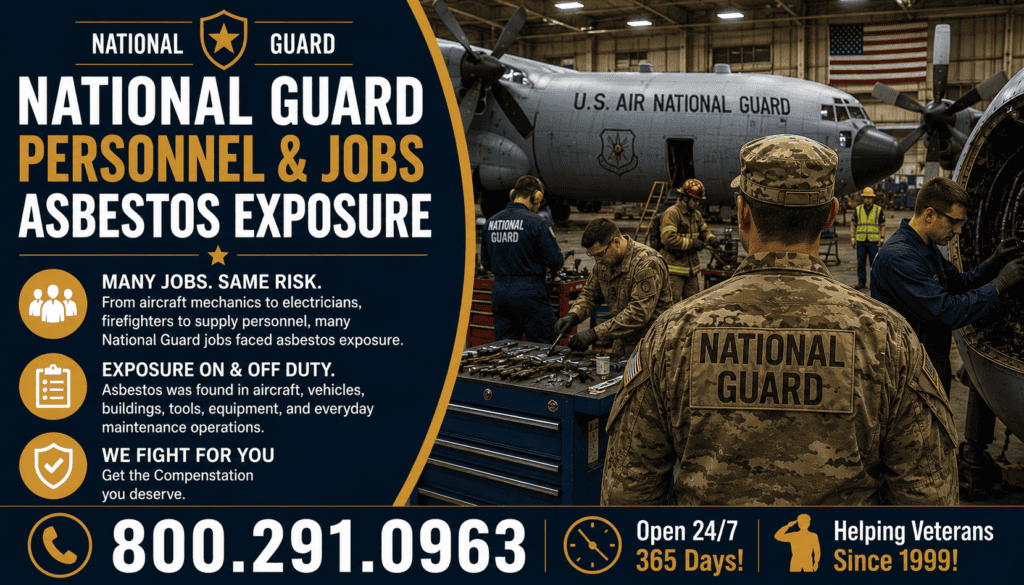
National Guard Personnel & Jobs Asbestos Exposure
National Guard personnel have served in military occupations supporting aviation, engineering, transportation, vehicle maintenance, construction, logistics, healthcare, facility operations, and emergency response. While each assignment involved different duties, many placed service members near asbestos-containing buildings, machinery, vehicles, aircraft, and mechanical systems.
For much of the twentieth century, asbestos was widely used because it resisted heat, flame, friction, electricity, and chemical damage. Manufacturers incorporated it into military equipment, vehicle brakes, aircraft components, boilers, generators, pumps, electrical systems, HVAC equipment, insulation, roofing, flooring, and fireproof construction materials.
Personnel who repaired equipment, maintained older facilities, renovated buildings, replaced friction components, or worked inside mechanical spaces could disturb asbestos-containing materials and release microscopic fibers into the air. Other service members could be exposed while working nearby, even if they never directly handled an asbestos product.
Because mesothelioma, asbestos-related lung cancer, and asbestosis often develop decades after exposure, National Guard veterans may not immediately connect a recent diagnosis with duties performed earlier in their military careers.
This guide explains which National Guard occupations historically faced higher asbestos exposure risks, how daily work activities released fibers, and where hazardous products may have been encountered.
👷 Why Certain National Guard Jobs Carried Greater Asbestos Risks
Asbestos exposure risk varied according to a service member’s occupation, assigned facility, equipment responsibilities, and frequency of maintenance work.
Personnel who regularly repaired vehicles, serviced aircraft, maintained boilers, upgraded electrical systems, removed insulation, or renovated older buildings generally faced greater exposure than those working exclusively in newer administrative offices.
Higher-risk work activities included repairing vehicle brakes and clutch systems; servicing aircraft brakes and engine components; removing insulation from boilers and pipes; scraping old gaskets from machinery; maintaining generators and electrical systems; renovating older military facilities; operating construction and demolition equipment; entering damaged buildings during emergency response; cleaning dusty maintenance shops; and handling contaminated uniforms and tools.
Personnel working inside National Guard vehicle maintenance facilities, National Guard aircraft hangars, National Guard power facilities, and older National Guard armories could encounter asbestos from both equipment and building materials.
Learn more about these locations through the National Guard Facilities Asbestos Exposure hub.
🔧 National Guard Mechanics Asbestos Exposure
Mechanics were among the National Guard personnel most likely to experience repeated occupational asbestos exposure.
Military vehicles manufactured during the twentieth century commonly contained asbestos in brake linings, brake pads, clutch plates, gaskets, heat shields, engine insulation, transmission components, and fire-resistant materials.
National Guard mechanics could disturb asbestos while removing brake drums; replacing brake linings; blowing dust from wheel assemblies; sanding friction materials; replacing clutch components; scraping old gaskets; repairing engines and transmissions; and cleaning contaminated tools and work areas.
Compressed air was historically used to clean brake assemblies and engine components. This practice could disperse asbestos-containing dust throughout maintenance shops, exposing mechanics and nearby personnel.
Brake and clutch work created particular risks because friction products wore down during normal use. The resulting dust could accumulate inside vehicle assemblies and become airborne when those systems were opened.
Mechanics could also encounter asbestos while maintaining National Guard vehicle equipment, National Guard generator equipment, National Guard pump equipment, and National Guard heavy machinery.
🚛 Vehicle Maintenance Duties That Released Asbestos
Vehicle maintenance often took place inside enclosed repair bays where ventilation was limited. Dust released from one repair could spread to nearby workstations, uniforms, benches, floors, and tools.
Potential exposure activities included removing worn brake shoes; grinding or sanding brake linings; replacing clutches; cleaning brake drums; opening engine compartments; removing heat shields; replacing exhaust gaskets; rebuilding transmissions; and sweeping contaminated shop floors.
Personnel assigned to National Guard vehicle maintenance facilities could inhale fibers released by their own repairs or by work being performed elsewhere in the shop.
More information about contaminated vehicle systems is available in the National Guard Equipment Asbestos Exposure guide.
✈️ National Guard Aircraft Mechanics Asbestos Exposure
Aircraft mechanics maintained military aircraft, aviation support systems, engines, braking assemblies, electrical components, hydraulic systems, and ground-support equipment.
Aircraft manufactured during decades of widespread asbestos use frequently contained heat-resistant and friction-based asbestos products.
Potential exposure sources included aircraft brake linings; engine insulation; heat shields; fire-resistant blankets; gaskets and seals; electrical insulation; cockpit insulation; exhaust components; auxiliary power equipment; and ground-support machinery.
National Guard aircraft mechanics could release asbestos fibers while removing aircraft brakes, opening engine compartments, replacing gaskets, repairing electrical systems, or removing deteriorated insulation.
Aircraft braking systems generated substantial heat and historically relied on asbestos-containing friction materials. Worn brake dust could accumulate inside assemblies and become airborne during inspection or replacement.
Aircraft mechanics also worked around National Guard aircraft equipment and inside National Guard aircraft hangars containing insulated piping, boilers, HVAC systems, electrical equipment, and fireproof construction materials.
🔥 Asbestos Hazards Inside Aircraft Hangars
Aircraft hangars presented both equipment-related and building-related asbestos risks.
Older hangars could contain asbestos in heating-system insulation; steam pipes; boiler rooms; HVAC ductwork; electrical panels; roofing materials; floor tile; fireproof wall panels; ceiling materials; and structural fireproofing.
Maintenance performed on aircraft could release asbestos from brakes, heat shields, gaskets, and engine components. At the same time, facility repairs could disturb asbestos-containing building materials.
Personnel working inside National Guard aircraft hangars could therefore experience exposure from multiple sources during the same assignment.
🏗️ National Guard Engineers Asbestos Exposure
National Guard engineers supported military construction, infrastructure maintenance, utility operations, transportation projects, demolition, bridge work, and disaster recovery.
National Guard engineers could encounter asbestos while renovating older buildings, repairing utilities, removing damaged materials, or demolishing structures.
Engineering activities that could disturb asbestos included cutting wallboard; removing ceiling materials; drilling through asbestos cement; replacing insulated pipes; repairing boiler rooms; removing old flooring; demolishing damaged structures; restoring utilities after disasters; and clearing contaminated debris.
Older military buildings frequently contained asbestos in roofing, flooring, insulation, ceiling panels, cement products, fireproof walls, pipe coverings, boilers, HVAC systems, and electrical rooms.
Engineering personnel could encounter these materials inside National Guard bases, National Guard training facilities, National Guard armories, and National Guard emergency operations centers.
🚨 Engineering Work During Emergency Response
National Guard engineers are frequently deployed after hurricanes, tornadoes, floods, fires, earthquakes, and structural failures.
Damaged buildings may release asbestos when walls collapse, roofs fail, insulation is torn apart, or contaminated debris is moved.
During National Guard disaster response, engineers may inspect buildings, clear roads, restore utilities, demolish unstable structures, and remove debris.
National Guard flood response may expose personnel to damaged floor tile, wallboard, insulation, roofing, and mechanical systems.
During National Guard fire response, heat and structural collapse can damage asbestos-containing materials and contaminate surrounding debris.
These operations may occur before the presence of asbestos has been fully identified.
⚡ National Guard Electricians Asbestos Exposure
Electricians maintained power-distribution systems, circuit breakers, electrical panels, generators, wiring, transformers, motors, switchgear, lighting, and emergency electrical equipment.
Asbestos was historically used in electrical products because it resisted heat, sparks, flame, and electrical current.
Potential asbestos-containing electrical components included switchgear; circuit breakers; arc shields; electrical panels; wiring insulation; cable coverings; motor insulation; generator insulation; fire-resistant electrical boards; and fuse boxes.
National Guard electricians could disturb asbestos when replacing wiring, opening electrical panels, repairing generators, drilling through fireproof walls, or working near deteriorating pipe insulation.
Electricians often worked inside confined utility spaces where asbestos-containing materials surrounded electrical and mechanical equipment.
Exposure could occur while servicing National Guard electrical equipment, National Guard generator equipment, and systems located inside National Guard power facilities.
🔌 Electrical Work Inside Older Facilities
Electrical upgrades frequently required workers to open walls, remove panels, access ceiling spaces, and drill through fire-resistant materials.
Older facilities could contain asbestos in wall panels; ceiling tiles; pipe insulation; boiler coverings; electrical backing boards; cable insulation; fireproof doors; and mechanical-room materials.
Even when electricians were not directly repairing asbestos-containing equipment, nearby construction or maintenance work could release fibers into shared workspaces.
The National Guard Facilities Asbestos Exposure guide explains how asbestos was used throughout military buildings where electrical work was performed.
🔨 National Guard Maintenance Workers Asbestos Exposure
Maintenance workers were responsible for keeping National Guard buildings, utilities, mechanical systems, and support equipment operational.
Unlike workers who specialized in a single trade, maintenance personnel often performed many different tasks throughout an installation.
Common duties included plumbing repairs; boiler servicing; HVAC maintenance; electrical repairs; flooring replacement; roof repairs; painting and renovation; pipe replacement; mechanical maintenance; and general building repairs.
National Guard maintenance workers could encounter asbestos hidden in pipe insulation, floor tiles, ceiling panels, roofing materials, wallboard, boilers, HVAC systems, pumps, gaskets, and fireproof construction materials.
Maintenance frequently required workers to cut, drill, sand, scrape, remove, or demolish materials that had remained undisturbed for decades.
🌡️ Mechanical Systems Maintained by National Guard Workers
Maintenance personnel regularly entered boiler rooms, mechanical spaces, utility tunnels, and equipment areas where asbestos was widely used.
Potential exposure sources included National Guard boiler equipment, National Guard HVAC equipment, National Guard pump equipment, National Guard generator equipment, and National Guard electrical equipment.
Boilers and steam systems were especially hazardous because asbestos was frequently used around the equipment, access doors, valves, gaskets, pumps, and connected pipes.
Removing deteriorated insulation or scraping old gaskets could create concentrated dust in poorly ventilated rooms.
🧹 Exposure During Cleanup and Routine Repairs
Asbestos exposure did not occur only during major renovations. Routine cleaning and repair activities could also disturb hazardous dust.
Examples included sweeping maintenance-shop floors; cleaning boiler rooms; removing damaged ceiling panels; repairing leaking pipes; replacing cracked floor tiles; cleaning ventilation equipment; handling contaminated tools; and removing dusty insulation debris.
Dry sweeping or using compressed air could redistribute asbestos fibers throughout a building.
Personnel who worked nearby—including logistics staff, administrative personnel, and medical workers—could inhale fibers released during maintenance.
🚜 National Guard Heavy Equipment Operators Asbestos Exposure
National Guard heavy equipment operators supported construction, engineering, transportation, debris removal, infrastructure repair, and emergency-response missions. These personnel frequently operated bulldozers, loaders, graders, cranes, excavators, forklifts, dump trucks, and other specialized machinery.
Older military equipment often contained asbestos in components designed to resist heat, friction, and fire.
Potential asbestos-containing parts included:
🔹 Brake linings
🔹 Clutch assemblies
🔹 Engine gaskets
🔹 Heat shields
🔹 Transmission components
🔹 Exhaust insulation
🔹 Electrical insulation
🔹 Fire-resistant panels
🔹 Hydraulic-system gaskets
🔹 Cab insulation
National Guard heavy equipment operators could encounter asbestos while inspecting machinery, replacing worn parts, assisting mechanics, cleaning equipment, or operating older vehicles containing asbestos components.
Operators also faced environmental exposure during demolition, disaster recovery, and debris removal. Heavy machinery could crush asbestos-containing roofing, wallboard, insulation, floor tile, cement products, and mechanical equipment, releasing fibers into the air.
Additional information is available through National Guard heavy machinery asbestos exposure and the broader National Guard Equipment Asbestos Exposure resource.
🏗️ Construction and Demolition Risks
National Guard engineering units often used heavy equipment to renovate buildings, demolish unsafe structures, repair roads, clear storm debris, and restore damaged infrastructure.
Older buildings could contain asbestos in:
🔹 Pipe insulation
🔹 Boiler coverings
🔹 Roofing materials
🔹 Floor tiles
🔹 Ceiling panels
🔹 Cement siding
🔹 Wallboard
🔹 HVAC insulation
🔹 Fireproof coatings
🔹 Electrical equipment
When bulldozers, excavators, loaders, or other machinery disturbed these materials, asbestos-containing dust could spread across large work areas.
Personnel assigned to National Guard disaster response may have worked around damaged structures before asbestos hazards were fully identified.
📦 National Guard Logistics Personnel Asbestos Exposure
National Guard logistics personnel coordinated equipment, supplies, transportation, fuel, maintenance parts, medical materials, and operational support.
Although logistics specialists did not always repair asbestos-containing equipment, they frequently worked inside warehouses, supply buildings, transportation centers, armories, maintenance shops, and older military facilities where asbestos materials were present.
National Guard logistics personnel may have been exposed while:
🔹 Handling replacement equipment parts
🔹 Moving brake and clutch components
🔹 Working near vehicle repairs
🔹 Entering boiler and mechanical rooms
🔹 Managing warehouse renovations
🔹 Loading and unloading machinery
🔹 Cleaning dusty storage areas
🔹 Supporting emergency operations
🔹 Handling damaged equipment
🔹 Working in poorly ventilated buildings
Older National Guard storage warehouses could contain asbestos in heating systems, ceiling materials, roofing, floor tiles, electrical components, pipe insulation, and fireproof construction products.
Logistics workers could also inhale fibers released by maintenance or renovation activities elsewhere in the building.
🧰 Exposure From Stored Parts and Equipment
Supply facilities often stored replacement brake linings, gaskets, insulation, electrical parts, machinery components, and vehicle equipment.
Some older replacement parts contained asbestos and could release dust when unpacked, moved, dropped, or damaged.
Potential exposure sources included:
🔹 Vehicle brake components
🔹 Clutch assemblies
🔹 Boiler gaskets
🔹 Pump packing
🔹 Electrical panels
🔹 Heat-resistant insulation
🔹 Machinery seals
🔹 Fireproof blankets
🔹 Generator components
🔹 Aircraft parts
Personnel handling National Guard vehicle equipment or National Guard aircraft equipment could encounter asbestos even when they were not responsible for installation or repair.
🏥 National Guard Medical Personnel Asbestos Exposure
National Guard medical personnel served in clinics, hospitals, aid stations, temporary treatment facilities, emergency operations centers, and mobile medical units.
Doctors, nurses, medics, technicians, and support personnel generally faced lower direct exposure than mechanics or maintenance workers. However, many healthcare buildings constructed before the 1980s contained asbestos throughout their mechanical and structural systems.
National Guard medical personnel may have worked around asbestos-containing:
🔹 Pipe insulation
🔹 Boiler systems
🔹 HVAC equipment
🔹 Ceiling tiles
🔹 Floor tiles
🔹 Roofing materials
🔹 Electrical panels
🔹 Fireproof wall materials
🔹 Mechanical-room insulation
🔹 Laboratory equipment
Exposure could occur when these materials deteriorated or were disturbed during repairs, renovations, or emergency restoration.
Learn more through National Guard medical facilities asbestos exposure.
🚑 Medical Support During Emergency Operations
Medical personnel were frequently deployed during fires, floods, storms, building collapses, and other emergencies.
They could encounter asbestos while:
🔹 Treating injured responders
🔹 Entering damaged buildings
🔹 Operating temporary clinics near debris
🔹 Handling contaminated clothing
🔹 Working near demolition areas
🔹 Supporting fire-response teams
🔹 Providing care in damaged hospitals
🔹 Cleaning contaminated medical equipment
During National Guard fire response, heat and structural damage could release asbestos from insulation, roofing, walls, ceilings, and mechanical systems.
National Guard flood response could disturb flooring, insulation, wallboard, boilers, and electrical equipment inside water-damaged buildings.
🏢 National Guard Facilities Where Personnel Worked
A National Guard member’s occupation often determined the types of facilities entered and the asbestos-containing materials encountered.
Higher-risk work commonly occurred at:
🔹 National Guard bases
🔹 National Guard armories
🔹 National Guard training facilities
🔹 National Guard vehicle maintenance facilities
🔹 National Guard aircraft hangars
🔹 National Guard storage warehouses
🔹 National Guard power facilities
🔹 National Guard medical facilities
🔹 National Guard emergency operations centers
🔹 National Guard base housing
These buildings frequently contained asbestos in mechanical rooms, heating systems, electrical equipment, flooring, roofing, wall materials, ceilings, and fireproof construction products.
The complete National Guard Facilities Asbestos Exposure guide explains how asbestos was used throughout these locations.
⚙️ National Guard Equipment Connected to Job Exposure
Occupational exposure often depended on the equipment a service member operated, maintained, stored, transported, or repaired.
Common equipment sources included:
🔹 National Guard vehicle equipment
🔹 National Guard aircraft equipment
🔹 National Guard generator equipment
🔹 National Guard boiler equipment
🔹 National Guard electrical equipment
🔹 National Guard pump equipment
🔹 National Guard HVAC equipment
🔹 National Guard heavy machinery
Many asbestos-containing components were hidden inside equipment and could not be identified by sight alone.
The National Guard Equipment Asbestos Exposure hub provides more detailed information about these systems.
🚨 National Guard Emergency Response Jobs and Asbestos
National Guard personnel regularly respond to hurricanes, tornadoes, floods, wildfires, earthquakes, industrial accidents, and building collapses.
These missions may place service members inside damaged residential, commercial, industrial, and military buildings where asbestos-containing materials have been broken apart.
Exposure could occur during:
🔹 Debris removal
🔹 Building inspections
🔹 Utility restoration
🔹 Demolition
🔹 Road clearing
🔹 Fire suppression support
🔹 Flood cleanup
🔹 Search-and-rescue operations
🔹 Equipment maintenance
🔹 Medical support
Personnel involved in National Guard emergency response asbestos exposure may not have known that damaged insulation, roofing, floor tile, cement products, and mechanical equipment contained asbestos.
Emergency conditions could increase the risk because work often began before environmental testing or containment measures were completed.
🏠 Family Secondhand Asbestos Exposure
Asbestos fibers released during occupational duties could cling to uniforms, boots, gloves, tools, hair, and personal equipment.
National Guard personnel who returned home without changing or decontaminating could unknowingly carry fibers into family vehicles and residences.
Household exposure could occur when family members:
🔹 Washed dusty uniforms
🔹 Shook out contaminated clothing
🔹 Cleaned work boots
🔹 Handled military equipment
🔹 Cleaned personal vehicles
🔹 Stored contaminated gear
🔹 Hugged a service member wearing dusty clothing
This is commonly called take-home, household, or secondary asbestos exposure.
More information is available in the National Guard family secondhand asbestos exposure resource.
🫁 Health Risks for National Guard Personnel
Asbestos fibers are microscopic and may be inhaled without causing immediate symptoms. Once inside the lungs or surrounding tissue, fibers can remain there for decades.
Diseases linked to asbestos exposure include:
🔹 Mesothelioma
🔹 Asbestos-related lung cancer
🔹 Asbestosis
🔹 Pleural plaques
🔹 Pleural thickening
🔹 Pleural effusion
🔹 Other chronic asbestos-related conditions
These diseases often have latency periods of 20 to 50 years. A veteran may complete military service and work for decades before symptoms appear.
Common symptoms may include:
🔹 Persistent coughing
🔹 Shortness of breath
🔹 Chest pain
🔹 Unexplained weight loss
🔹 Fatigue
🔹 Difficulty breathing
🔹 Reduced exercise tolerance
The National Guard asbestos exposure health risks guide explains the illnesses associated with military exposure.
Veterans can also review the National Guard asbestos exposure timeline to better understand how historical service dates may relate to asbestos use.
📄 Documenting National Guard Occupational Exposure
A complete exposure history can help identify where, when, and how a veteran encountered asbestos.
Helpful records may include:
🔹 Military occupational specialty
🔹 Unit assignment records
🔹 Duty station history
🔹 Training records
🔹 Maintenance logs
🔹 Equipment manuals
🔹 Facility records
🔹 Repair orders
🔹 Coworker statements
🔹 Medical records
🔹 Civilian employment records
🔹 Social Security employment history
Veterans do not always need to remember the exact brand name of a product. Detailed information about job duties, equipment, facilities, and work practices can still help identify likely exposure sources.
The National Guard equipment manufacturers asbestos exposure resource may help identify companies connected to military equipment and replacement parts.
⚖️ Legal Options for National Guard Veterans
National Guard veterans diagnosed with an asbestos-related illness may have several potential legal and financial options.
Eligibility depends on the diagnosis, service history, occupational duties, equipment involved, product identification, and applicable filing deadlines.
Potential options may include:
🔹 National Guard mesothelioma lawsuits
🔹 National Guard asbestos trust fund claims
🔹 VA benefits for National Guard asbestos exposure
🔹 National Guard asbestos wrongful death lawsuits
An asbestos lawsuit generally seeks compensation from companies that manufactured, supplied, or sold asbestos-containing products. Claims are typically directed at private companies rather than the military.
Asbestos trust funds were established by certain bankrupt manufacturers to compensate eligible individuals exposed to their products.
Some veterans may also qualify for VA benefits when medical evidence and qualifying service records support a connection between military asbestos exposure and disease.
Because filing deadlines vary by state, veterans and families should review the National Guard asbestos statute of limitations promptly after a diagnosis or death.
📚 Additional National Guard Asbestos Resources
Understanding occupational exposure often requires examining a veteran’s job together with the facilities, equipment, assignments, and emergency operations connected to military service.
Additional resources include:
🔹 National Guard Asbestos Exposure
🔹 National Guard Facilities Asbestos Exposure
🔹 National Guard Equipment Asbestos Exposure
🔹 National Guard Emergency Response Asbestos Exposure
🔹 National Guard asbestos articles
Together, these pages help veterans and families understand where exposure may have occurred, which occupations carried greater risks, and what steps may be available following an asbestos-related diagnosis.
📝 Request a Free National Guard Asbestos Case Evaluation
National Guard veterans and families affected by mesothelioma, asbestos-related lung cancer, asbestosis, or another asbestos-related disease may benefit from a detailed review of military service and occupational history.
A case evaluation may help identify:
🔹 High-risk military occupations
🔹 Facilities where exposure may have occurred
🔹 Equipment containing asbestos components
🔹 Manufacturers connected to exposure
🔹 Potential asbestos trust fund claims
🔹 Available legal options
🔹 Records needed to document exposure