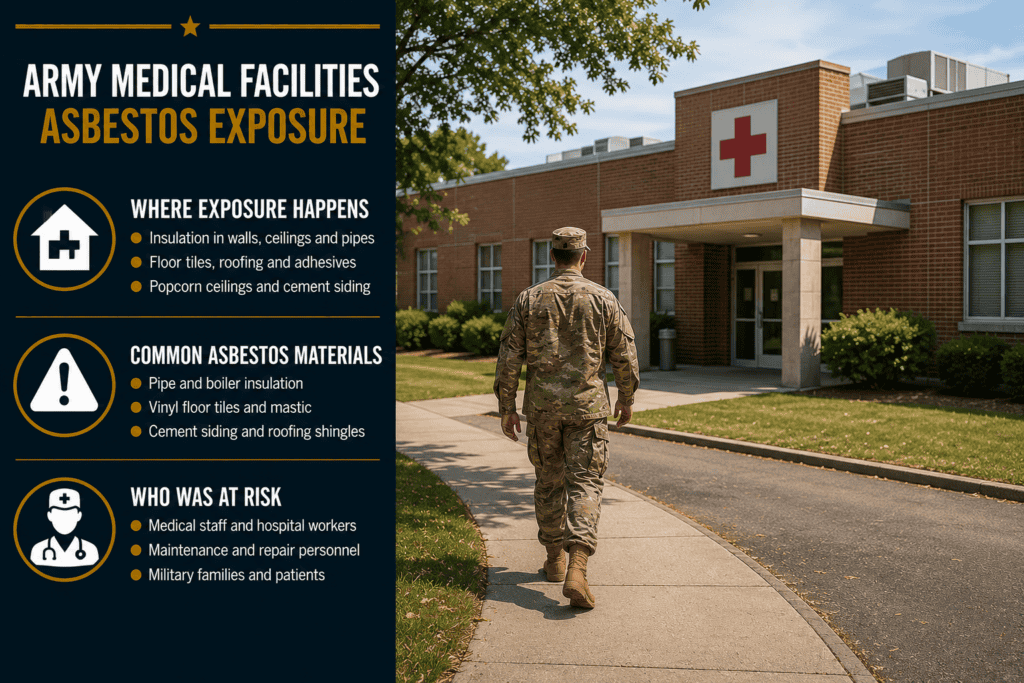
Army Medical Facilities Asbestos Exposure
U.S. Army medical facilities have included hospitals, clinics, dental facilities, laboratories, treatment buildings, and supporting mechanical and utility spaces constructed across many decades of military service. Official Army records document long histories of medical operations at installations such as Fort McClellan, while VA guidance identifies older buildings, pipes, insulation, flooring, roofing, and related products as potential sources requiring asbestos research.
This guide explains how to research asbestos exposure in Army medical facilities, including hospitals and clinics, older building materials, mechanical rooms, maintenance and renovation work, medical and support occupations, military and facility records, VA disability evidence, and other potential compensation options for Army veterans diagnosed with mesothelioma.
Army Medical Facilities Asbestos Exposure Overview
Army medical facilities have included hospitals, community hospitals, clinics, dental clinics, dispensaries, laboratories, treatment buildings, administrative areas, utility rooms, laundries, and other support spaces constructed across different eras. Older medical buildings can warrant asbestos research because military installations often used the same historical construction and mechanical materials found in other institutional buildings.
Official U.S. Army Corps of Engineers records for Fort McClellan show that medical facilities operated there throughout the life of the post. The 1998 Environmental Baseline Survey identified two dental clinics, a former hospital, and Noble Army Community Hospital, which was constructed in 1962. Army records also document extensive environmental review of the former hospital property.
These records do not establish that every Army hospital or clinic contained asbestos or that every patient, medical worker, Soldier, contractor, or maintenance employee was exposed. Exposure depends on the specific building, material, condition, disturbance, work activity, proximity, frequency, and duration.
This page connects medical-facility research with Army bases asbestos exposure, Army maintenance buildings asbestos exposure, and the broader U.S. Army asbestos exposure section.
Army Hospitals, Clinics, and Medical Buildings
Army medical complexes can be substantial institutional facilities. A hospital may contain patient wards, operating rooms, laboratories, pharmacies, kitchens, offices, mechanical rooms, utility spaces, storage areas, dental services, morgues, and other specialized areas. Clinics and dispensaries may be smaller but can still contain heating, plumbing, electrical, ventilation, flooring, roofing, and fire-resistant building materials.
Fort McClellan illustrates how Army medical infrastructure changed over time. Corps records identify a former hospital and Noble Army Community Hospital, while Army historical materials describe an earlier hospital that was refurbished for specialized treatment before closing in the 1950s. Noble Army Community Hospital was later constructed in 1962.
Building age and medical use alone do not establish asbestos content. Research should focus on asbestos surveys, construction specifications, renovation records, environmental files, work orders, mechanical-system documentation, and abatement records for the individual hospital, clinic, dental facility, laboratory, or support building.
Veterans whose medical-facility histories overlap with other installation areas may also need major Army installations asbestos exposure, Army power plants asbestos exposure, or Army warehouses asbestos exposure.
Where Asbestos May Have Been Found
VA identifies asbestos as a mineral fiber historically used in older buildings and military products. Relevant product categories include flooring, roofing, cement sheet, pipes, insulation, gaskets, valves, adhesives, and floor and pipe coverings. In an older institutional medical building, these categories can guide research but should not be treated as proof that a particular facility contained asbestos.
Mechanical rooms can be especially important when building surveys identify thermal-system insulation. U.S. Army Corps of Engineers Fort McClellan property records document friable asbestos-containing material in the form of pipe and fitting insulation in mechanical rooms of certain Army buildings. Those findings are building-specific, but they illustrate the type of material that researchers may encounter in installation records.
Potential medical-facility research may therefore involve steam and hot-water piping, boiler or heating systems, pipe fittings, floor tile and mastic, roofing, wall or ceiling materials, ventilation components, gaskets, and other older construction products. Laboratories and treatment spaces can also undergo repeated renovations as medical technology and facility standards change.
The correct approach is to identify the medical building, determine its construction and renovation dates, locate available asbestos surveys or environmental records, and connect documented materials to the veteran’s actual work area and duties.
Repairs, Renovation, and Maintenance Work
VA Public Health states that asbestos becomes a serious health concern when asbestos-containing material is disturbed in a way that releases particles and fibers into the air. Intact and properly managed material presents a different circumstance from material that is damaged, friable, cut, drilled, sanded, scraped, removed, renovated, or demolished.
Potentially relevant work in an older Army medical facility can include pipe repair, boiler and heating-system work, flooring replacement, ceiling or wall renovation, ventilation repairs, roof work, electrical upgrades, plumbing changes, installation of medical equipment, remodeling of patient areas, and demolition or modernization projects.
Maintenance workers may enter mechanical rooms, utility tunnels, crawl spaces, ceiling spaces, and equipment areas that most clinical personnel rarely access. Renovation contractors, engineers, plumbers, electricians, and construction personnel can therefore have different potential exposure histories from nurses, physicians, medics, technicians, or administrative workers in the same building.
For each suspected event, document the hospital or clinic name, building number, room or department, dates, task, material or component, condition, disturbance mechanism, dust if remembered, ventilation, distance, frequency, duration, protective controls, and witnesses. Do not disturb suspected asbestos today to investigate a historical event.
Medical and Support Personnel
Army medical facilities can involve physicians, nurses, medics, dental personnel, laboratory technicians, pharmacy personnel, administrative staff, custodial workers, maintenance personnel, engineers, plumbers, electricians, construction workers, laundry personnel, and contractors. Being assigned to a medical facility does not by itself establish asbestos exposure.
Clinical personnel may have spent most of their time in patient-care areas, while maintenance and engineering personnel may have worked directly around pipes, insulation, heating equipment, ventilation systems, floors, ceilings, and renovation projects. Custodial or support personnel may also have been present during repairs or cleanup.
The Army jobs and occupations asbestos exposure section can help organize occupational histories. Potentially relevant work histories include Army maintenance workers, Army engineers, and Army construction units.
The U.S. Army ranks asbestos exposure section can help reconstruct changes in assignments and responsibilities across a military career. Rank and medical occupation alone do not prove exposure; actual work location, documented materials, disturbance, proximity, and duration are more useful evidence.
Records for Documenting Medical-Facility Exposure
Begin with military records establishing the veteran’s location and duties. Useful documents can include the DD-214, Official Military Personnel File, MOS records, assignment orders, evaluation reports, unit records, medical-unit histories, duty rosters, training records, and other documents identifying the hospital, clinic, or medical organization.
Facility evidence can include the medical building number, construction date, real-property records, architectural drawings, engineering specifications, asbestos surveys, environmental baseline surveys, mechanical-system plans, renovation files, work orders, abatement records, demolition documents, photographs, contractor records, and historical maps.
Fort McClellan demonstrates the value of environmental records. Its Environmental Baseline Survey identifies specific medical facilities and their historical use, while separate Army decision documents preserve information about the old hospital property. Similar installation repositories can help establish when facilities operated and how buildings changed over time.
Create a chronology listing installation, medical facility, building number, department or work area, dates, rank, MOS, duties, repairs or renovations, suspected material, disturbance, proximity, frequency, duration, and witnesses. The Army asbestos exposure timeline can provide broader historical context, but individual records should support the veteran’s account.
Mesothelioma, Health, and VA Benefits
VA Public Health states that symptoms of asbestos-related diseases often do not appear until 20 to 50 years after exposure. This long latency can make decades-old medical-facility records, personnel files, building surveys, maintenance documents, renovation records, photographs, and witness statements important when reconstructing military service.
VA states that veterans may be eligible for disability compensation when they have a health condition caused by asbestos and had contact with asbestos during military service. Evidence includes medical records showing the condition, service records listing the veteran’s job or specialty, and a doctor’s statement connecting military asbestos contact with the health condition.
Veterans Benefits Administration guidance states that evidence of military asbestos exposure may include military occupational specialty and where the veteran was stationed. Exposure by itself is not a condition subject to service connection; a related disease or disability must be claimed and supported by evidence.
Army veterans can review Army VA benefits for mesothelioma. Veterans concerned about possible exposure-related health effects should discuss their complete military and civilian occupational history with a qualified health care provider or VA Environmental Health Coordinator.
Army Veterans’ Compensation Options
VA disability compensation is separate from private asbestos litigation and bankruptcy trust claims. Depending on the complete exposure history, different processes may examine military service, civilian employment, building materials, mechanical systems, manufacturers, suppliers, contractors, premises, or other possible sources.
The Army asbestos legal options section provides Army-specific information about VA benefits and other potential compensation pathways. Eligibility requirements, evidence standards, trust criteria, potential defendants, and filing deadlines vary by process and individual circumstances.
Keep factual exposure histories consistent across medical records, VA submissions, trust claims, and civil litigation. Do not identify a particular Army hospital, clinic, contractor, manufacturer, or building product as an asbestos source unless reliable evidence supports that conclusion.
Veterans and families considering civil claims should obtain advice from a qualified attorney concerning applicable deadlines and their individual circumstances. Mesothelioma Help Center is not a law firm and does not determine VA eligibility, liability, or filing deadlines.
Frequently Asked Questions
Did every Army medical facility contain asbestos?
No. Older military buildings can warrant asbestos research, but presence, type, location, condition, and disturbance vary by facility and construction history.
Are there official records for older Army hospitals?
Yes. U.S. Army Corps of Engineers records for Fort McClellan identify a former hospital, two dental clinics, and Noble Army Community Hospital, which was constructed in 1962.
Where might asbestos have been found in an older medical building?
Depending on the facility, research may involve pipe or fitting insulation, flooring, roofing, pipes, ventilation systems, gaskets, adhesives, cement products, and other older building materials.
Could hospital renovation create an exposure concern?
Potentially. Cutting, drilling, sanding, scraping, removal, or demolition can release fibers when asbestos-containing material is present and disturbed.
Were medical personnel automatically exposed?
No. Assignment to a hospital or clinic does not prove exposure. The work area, documented materials, disturbance conditions, proximity, frequency, and duration should be evaluated.
Could maintenance personnel have different exposure histories?
Yes. Maintenance and engineering personnel may have worked in mechanical rooms, utility spaces, ceilings, and other areas containing building systems not routinely accessed by clinical staff.
What records can help document medical-facility exposure?
Personnel files, MOS records, building surveys, environmental reports, construction plans, maintenance work orders, renovation files, photographs, and witness statements may help.
Can an Army veteran with mesothelioma seek VA disability compensation?
Potentially. VA requires a health condition caused by asbestos and military contact with asbestos, supported by applicable medical and service evidence.
Why can records from decades ago matter?
VA states that symptoms of asbestos-related disease often do not appear until 20 to 50 years after exposure, making historical records potentially important.
Review Your Army Medical-Facility History
If you or a family member has been diagnosed with mesothelioma after Army medical-facility service or work, gather the DD-214, personnel file, MOS records, assignment orders, medical-unit histories, hospital or clinic name, building number, construction and renovation records, asbestos surveys when available, environmental reports, mechanical plans, maintenance work orders, abatement records, photographs, contractor information, witness statements, pathology reports, treatment records, VA correspondence, and civilian employment history. Reconstruct each potentially relevant medical-facility assignment separately.
Call 800.291.0963 for a no-obligation case evaluation. Talk to a real person 24/7, 365 days a year. You can also submit your case here.
Many mesothelioma law firms handle qualifying civil cases on a contingency-fee basis; confirm fees and expenses with the firm you retain. Mesothelioma Help Center is not a law firm and does not provide legal or medical advice.
🔗 Confirmed Sources
- U.S. Army Corps of Engineers — Fort McClellan Environmental Baseline Survey: Medical Facilities
- U.S. Army — Fort McClellan Old Hospital Decision Document
- U.S. Army Medical Department Center of History and Heritage — Camp McClellan Base Hospital
- VA Veterans Health Library — Veteran Exposure to Asbestos
- U.S. Department of Veterans Affairs — Veterans Asbestos Exposure
- Veterans Benefits Administration — Asbestos Exposure Compensation
- VA Public Health — Asbestos
Disclaimer: General information only—not legal or medical advice. This website is not a law firm. Record availability, asbestos identification, exposure, VA eligibility, liability, and deadlines vary by individual circumstances. Do not disturb suspected asbestos. Past results do not guarantee future outcomes.