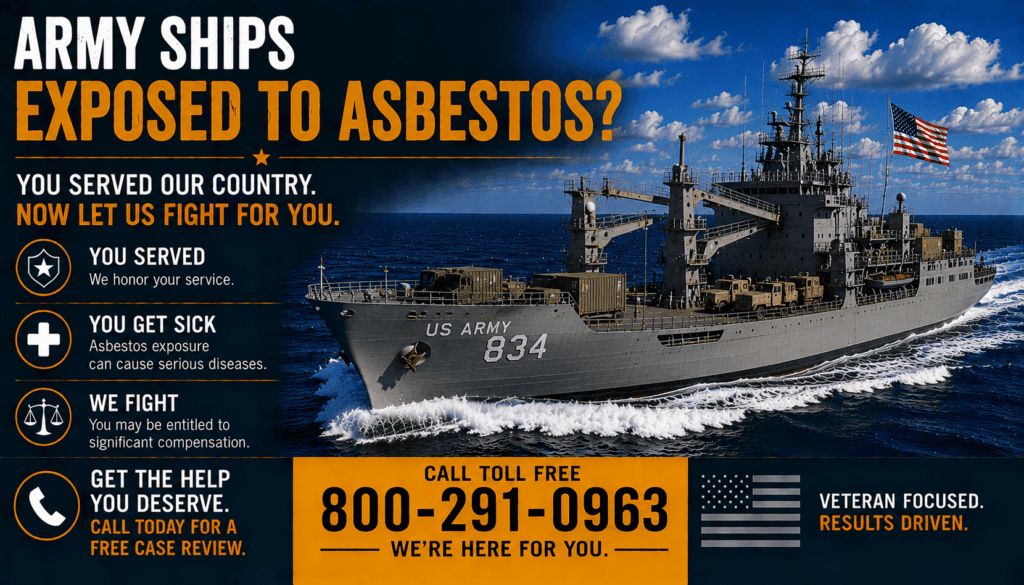
Army Ships Asbestos Exposure
Army ships and watercraft have supported transportation, logistics, harbor operations, landing missions, maintenance, and overseas supply movements. Veterans who served aboard or repaired older Army vessels may have worked around insulated piping, machinery, gaskets, valves, friction components, electrical systems, and other materials that warrant careful historical asbestos research when exposure is suspected.
This guide explains Army ships asbestos exposure, including where potentially asbestos-containing materials may have been encountered, which shipboard duties deserve closer review, how equipment and product evidence can be identified, and which military records can help reconstruct vessel service. It also covers asbestos-related health concerns, VA disability benefits, bankruptcy trust claims, civil legal options, and practical documentation steps.
Army Ships Asbestos Exposure Overview
Army maritime service has included vessels and watercraft used for transportation, logistics, harbor operations, landing support, maintenance, and other missions. Veterans who served aboard, repaired, maintained, loaded, or worked around older Army vessels may want to reconstruct whether their duties brought them into contact with asbestos-containing insulation, gaskets, valves, pipe coverings, friction materials, electrical components, or other heat-resistant products.
VA identifies shipyard work, insulation work, construction, demolition, and work with products such as pipes, insulation, clutch facings, and brake linings as potential military asbestos exposure settings. VA’s Veterans Health Library also identifies historical military asbestos use in brakes, gaskets, valves, cements, adhesives, and pipe coverings. These sources provide useful context, but they do not establish that a particular Army vessel or component contained asbestos.
Exposure research should therefore be vessel-specific and task-specific. Useful questions include which vessel the veteran served on, when the service occurred, the veteran’s MOS and duties, where aboard the vessel work occurred, what machinery or components were handled, whether insulation or other materials were disturbed, and whether maintenance took place aboard ship, at a pier, or in a repair facility.
This page is part of the main U.S. Army asbestos exposure section and connects with U.S. Army asbestos exposure articles, occupational, equipment, medical, VA, and legal resources.
Army Ships and Watercraft Service
Although naval vessels are more commonly associated with military shipboard asbestos discussions, Army veterans can also have maritime service histories. Army watercraft have supported transportation of personnel, vehicles, equipment, fuel, supplies, and other cargo and have operated from ports, harbors, coastal areas, rivers, and overseas logistics locations.
For asbestos research, the vessel’s age and maintenance history can matter more than a broad label such as “Army ship.” Older vessels may have undergone repairs, modernization, component replacement, insulation removal, engine work, electrical work, or other maintenance during different periods. Materials present at one point in a vessel’s life should not automatically be assumed to have been present throughout its service.
Veterans should record the vessel name, hull or identification number when known, unit, port, duty station, dates aboard, deployment or operating area, berthing arrangement, machinery spaces entered, maintenance activities, and repair facilities used. Crew rosters, orders, personnel records, photographs, unit histories, vessel manuals, and maintenance documents may help confirm these details.
If a veteran also performed shore-side work, keep that exposure history separate. Pier facilities, warehouses, maintenance shops, boiler rooms, barracks, and other Army facilities can involve different potential sources and should not be automatically attributed to shipboard exposure.
Where Asbestos Could Be Encountered
Potential exposure locations aboard an older vessel can include machinery spaces, engine areas, boiler or heating equipment areas, pipe runs, electrical spaces, maintenance compartments, deck machinery, cargo areas, and spaces where insulated systems were repaired. Whether asbestos was actually present requires supporting historical evidence.
Heat-resistant insulation was historically used around some piping, machinery, boilers, and other hot systems. Gaskets and packing could be used at valves, pumps, flanges, and mechanical connections. Friction materials could be associated with brakes or other mechanical systems. Electrical and heat-resistant products could also be encountered during repair work.
VA explains that asbestos becomes hazardous when asbestos-containing material is disturbed and fibers become airborne. Tasks such as removing deteriorated insulation, scraping old gasket material, cutting or fitting insulation, cleaning dusty machinery spaces, or performing repairs near disturbed material may therefore warrant closer historical investigation when asbestos-containing products can be documented.
General equipment research can continue through Army equipment asbestos exposure, including Army boiler equipment asbestos exposure and Army electrical equipment asbestos exposure.
Army Shipboard Jobs and Maintenance Duties
Potential exposure depended heavily on the work actually performed. Personnel involved in engine maintenance, mechanical repair, electrical work, piping, heating systems, cargo equipment, preventive maintenance, cleaning, overhaul, and repair support may have encountered different materials and components.
A formal MOS can provide a starting point, but daily duties should be documented separately. Soldiers may have assisted with repairs outside their primary specialty, worked in confined machinery spaces, removed worn components, cleaned after maintenance, or supervised others performing hands-on work.
Useful occupational resources include Army mechanics asbestos exposure, Army maintenance workers asbestos exposure, and Army engineers asbestos exposure. These pages provide occupational context but should not replace vessel-specific evidence.
For each suspected event, record the task, compartment or work area, component, product if known, condition of the material, how it was removed or repaired, tools used, dust generated, ventilation, frequency, duration, protective practices, and coworkers who observed the work. Mark unknown details as unknown rather than guessing.
Equipment, Components, and Materials
Historical military asbestos research can involve pipe coverings, thermal insulation, gaskets, valve packing, friction products, cements, adhesives, flooring, and other heat-resistant materials. VA’s Veterans Health Library specifically identifies brakes, gaskets, valves, cements, adhesives, floor coverings, and pipe lagging among historical military asbestos-use categories.
Army vessel research may also involve engines, generators, electrical systems, pumps, valves, heating equipment, deck machinery, and auxiliary systems. The presence of asbestos in a category of historical products does not prove that a specific vessel component contained asbestos during the veteran’s service.
Product identification can be strengthened by technical manuals, parts catalogs, National Stock Numbers, manufacturer literature, procurement records, specifications, maintenance logs, invoices, photographs, packaging, repair records, and testimony from people familiar with the vessel.
The Army generator equipment asbestos exposure page may help with auxiliary power research. Avoid disturbing surviving vessel materials or suspected asbestos-containing components to determine composition; historical documentation and professional testing procedures are safer sources of evidence.
Documenting Army Ship Exposure
The National Archives states that Official Military Personnel Files can contain duty stations and assignments, training, qualifications, performance information, awards, separation records, and other personnel actions. DD Form 214 can include active-duty dates, last duty assignment, rank, military specialty, foreign service, and separation information.
Those records can establish the framework for a maritime exposure history. Additional evidence may include assignment orders, unit records, vessel rosters, port records, photographs, repair logs, technical manuals, parts lists, procurement files, shipyard or maintenance-facility records, environmental documents, and witness statements.
The Army asbestos exposure timeline page explains how to organize service records chronologically. Create entries for vessel assignment, port or duty station, dates, MOS, rank, work area, machinery, product or component, task, maintenance event, and supporting record.
Veterans and eligible next of kin can request many military service records from the National Archives. Preserve copies of records already in the family’s possession and do not send irreplaceable originals when a copy is sufficient.
Health Risks and Medical Follow-Up
VA Public Health states that asbestos-related disease symptoms often do not appear until 20 to 50 years after exposure. This latency means a veteran may be diagnosed decades after the shipboard work being investigated. Mesothelioma and lung cancer are among the cancers associated with asbestos exposure.
Exposure history alone cannot diagnose disease. Veterans concerned about historical asbestos exposure should discuss their military and civilian occupational histories with a qualified health care provider. VA advises veterans with concerns about military asbestos exposure to speak with their health care provider or a local VA Environmental Health Coordinator.
Medical documentation can include imaging, pathology reports, biopsy results, specialist evaluations, treatment records, and physician opinions. Exposure documentation answers a different question: where and how the veteran may have encountered asbestos. Both histories may become relevant to a VA claim or legal review.
See Army asbestos exposure health risks for additional medical background. Do not disturb suspected asbestos on an old vessel, component, or stored military equipment in an attempt to recreate or prove exposure.
VA Benefits and Legal Options
VA states that a veteran may qualify for disability compensation based on asbestos exposure when the veteran has a health condition caused by asbestos and had contact with asbestos during military service. VA requires medical records, service records listing the veteran’s job or specialty, and medical evidence connecting military asbestos contact with the condition.
VBA explains that evidence of military exposure may include the veteran’s occupational specialty and where the veteran was stationed. Exposure alone is not a compensable condition; the evidence must establish a related disease or disability.
Civil asbestos claims and bankruptcy trust claims are separate from VA benefits. A civil case may require identification of manufacturers, suppliers, contractors, premises entities, or other potentially responsible parties. A trust claim must satisfy the governing requirements of a particular asbestos bankruptcy trust.
Review Army asbestos legal options, VA benefits vs Army mesothelioma lawsuits, Army asbestos trust fund claims, and Army asbestos statute of limitations. Filing deadlines and liability rules vary by jurisdiction and claim type.
Frequently Asked Questions
Did the U.S. Army operate ships and watercraft?
Yes. Army maritime operations have used watercraft for transportation, logistics, harbor, landing, cargo, and other support missions. Exposure research should identify the specific vessel and service period.
Does serving on an older Army vessel prove asbestos exposure?
No. Vessel age can guide research, but evidence should connect the veteran to a specific asbestos-containing material, component, task, or work environment when possible.
Where could asbestos-related materials have been encountered aboard a vessel?
Potential areas can include insulated piping and machinery, mechanical connections using gaskets or packing, friction components, electrical systems, and maintenance areas, depending on the vessel and period.
Which shipboard tasks may warrant closer research?
Mechanical repair, insulation work, gasket removal, piping work, electrical maintenance, cleaning after repairs, and work near disturbed materials may warrant investigation when asbestos-containing products can be documented.
What records can help identify Army vessel service?
DD-214 and OMPF records, assignment orders, unit records, vessel information, photographs, maintenance documents, technical manuals, and witness statements may help reconstruct service.
Can VA benefits apply to Army shipboard asbestos exposure?
Potentially. VA requires a health condition caused by asbestos, military asbestos contact, service records, and medical evidence connecting the condition with military exposure.
Is an Army ship asbestos claim the same as a Navy ship claim?
No. The veteran’s branch, vessel, assignments, duties, records, products, and exposure evidence should be documented accurately rather than assuming a Navy exposure history applies to Army service.
Can asbestos trust claims be relevant?
Potentially, if evidence connects the veteran to a product or company covered by a particular asbestos trust and the trust’s current criteria are satisfied.
Should veterans wait to gather every vessel record before reviewing a claim?
No. Because civil filing deadlines may apply, a legal review can begin while military, vessel, product, and maintenance records are still being collected.
Review an Army Ship Asbestos Exposure History
If you or a family member has been diagnosed with mesothelioma after Army maritime service, gather pathology and treatment records, DD-214, Official Military Personnel File, MOS history, assignment orders, unit and vessel information, port and duty-station records, technical manuals, parts catalogs, maintenance and repair documents, National Stock Numbers, photographs, witness information, civilian employment records, VA decisions, bankruptcy trust submissions, prior lawsuits, settlements, and releases. Build a dated chronology separating shipboard exposure from shore-side and civilian exposure.
Call 800.291.0963 for a no-obligation case evaluation. Talk to a real person 24/7, 365 days a year. You can also submit your case here.
Many mesothelioma law firms handle qualifying civil cases on a contingency-fee basis; confirm fees, expenses, representation scope, potential defendants, governing jurisdiction, and deadlines with the firm you retain. Mesothelioma Help Center is not a law firm and does not provide legal or medical advice.
🔗 Confirmed Sources
- U.S. Department of Veterans Affairs — Veterans Asbestos Exposure
- Veterans Benefits Administration — Asbestos Exposure Compensation
- VA Public Health — Asbestos
- VA Veterans Health Library — Veteran Exposure to Asbestos
- National Archives — Military Service Records and OMPFs
- National Archives — DD Form 214 and Separation Documents
Disclaimer: General information only—not legal or medical advice. This website is not a law firm. Exposure, VA eligibility, liability and deadlines vary by case and jurisdiction. Do not disturb suspected asbestos. Past results do not guarantee future outcomes.