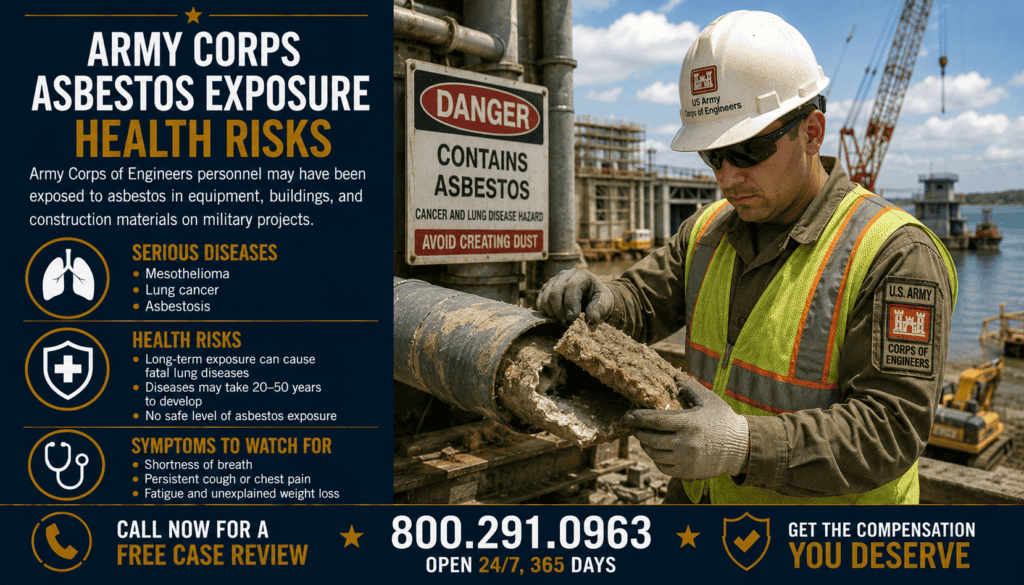
Army Corps Asbestos Exposure Health Risks
U.S. Army Corps of Engineers veterans, civilian workers, contractors, and family members may have questions about the long-term health effects of asbestos exposure connected with construction, maintenance, engineering, mechanical, electrical, demolition, and facility work. Asbestos fibers can remain in the lungs and other tissues for years, and some asbestos-related diseases may not become apparent until decades after exposure.
A history of Army Corps service or employment does not by itself prove asbestos exposure, and a diagnosis does not identify a specific exposure source. Risk depends on the actual materials encountered, intensity and duration of exposure, work practices, proximity to disturbed asbestos-containing materials, and individual medical factors.
For broader Army Corps exposure information, see the U.S. Army Corps of Engineers Asbestos Exposure guide and the Army Corps of Engineers Asbestos Exposure Articles section.
🫁 Army Corps Asbestos Exposure Health Risks
When asbestos-containing materials are cut, sanded, drilled, scraped, removed, repaired, or otherwise disturbed, microscopic fibers can become airborne. Inhaled fibers may lodge in the lungs or surrounding tissues.
Potential Army Corps exposure settings can include older buildings, mechanical rooms, boiler and utility spaces, construction and renovation projects, equipment maintenance, demolition sites, and work involving insulation, gaskets, packing, cement products, fireproofing, friction materials, or other historical asbestos-containing products.
⚕️ Diseases Linked to Asbestos Exposure
Asbestos exposure is associated with several serious diseases, including:
- Mesothelioma: a rare cancer that most often affects the lining of the lungs but can also develop in other mesothelial tissues.
- Lung cancer: asbestos exposure can increase lung cancer risk, and smoking can further increase risk in people who were exposed to asbestos.
- Asbestosis: a chronic noncancerous lung disease caused by asbestos-related scarring.
- Pleural disease: asbestos exposure may also be associated with pleural plaques, pleural thickening, or pleural effusions.
These conditions are medically distinct. A qualified physician should evaluate symptoms, imaging, pathology, occupational history, and other clinical findings.
⏳ Why Asbestos Diseases Can Appear Decades Later
Asbestos-related diseases often have long latency periods. A person may have been exposed during military or civilian work many years before symptoms or a diagnosis appear.
This delayed onset is one reason older Army Corps assignments, project records, equipment histories, and coworker information can become important when reconstructing possible exposure. The Army Corps Asbestos Exposure Timeline can also help organize historical work and exposure periods.
📊 Factors That Affect Individual Risk
Health risk can vary based on:
- Amount and concentration of asbestos fibers encountered
- How often and how long exposure occurred
- Whether asbestos-containing materials were intact or disturbed
- Type of task performed and distance from the work
- Ventilation and work practices
- Use of respiratory protection
- Other occupational or household exposures
- Smoking history and other personal health factors
Even people with similar job titles may have very different exposure histories. Individual duties and work settings matter more than title alone.
🩺 Symptoms, Screening, and Medical Follow-Up
Symptoms that can occur with asbestos-related disease may include persistent shortness of breath, chest pain, chronic cough, unexplained weight loss, fatigue, or other respiratory changes. These symptoms can have many causes and do not by themselves indicate an asbestos-related disease.
People with a meaningful history of asbestos exposure should discuss that history with a qualified medical professional. A doctor can determine whether imaging, pulmonary testing, specialist referral, or other evaluation is appropriate based on the individual’s history and symptoms.
Anyone experiencing severe or rapidly worsening breathing problems, chest pain, or another medical emergency should seek urgent medical care.
Need help now? If you are trying to reconstruct an Army Corps asbestos exposure history after a mesothelioma or lung cancer diagnosis, Call 800.291.0963, use our 24/7 live chat, or Submit Your Case.
🏠 Family and Secondhand Exposure
Asbestos fibers could sometimes be carried away from a worksite on dusty clothing, shoes, tools, equipment, or vehicles. Family members may therefore investigate possible secondhand exposure when a worker regularly returned home with contaminated work clothing or gear.
This pathway depends on the actual work conditions and whether asbestos-containing materials were present and disturbed. For more detail, see Army Corps Family Secondhand Asbestos Exposure.
📋 Evidence That Can Help Reconstruct Exposure
Useful evidence may include:
- DD-214 and military personnel records
- Army Corps duty stations, units, projects, and facility assignments
- Job titles and descriptions of actual work duties
- Construction, renovation, demolition, and maintenance records
- Equipment manuals, parts catalogs, and procurement records
- Manufacturer and supplier information
- Coworker, contractor, and supervisor statements
- Photographs of work areas, equipment, and materials
- Medical records, pathology reports, and treatment records
Occupation-specific histories may also overlap with Army Corps maintenance workers and Army Corps mechanics, depending on the person’s actual duties.
⚖️ Legal and Benefits Considerations
Veterans, workers, and surviving family members dealing with mesothelioma or asbestos-related lung cancer may be able to investigate legal claims, asbestos trust claims, veterans benefits, or other options depending on the evidence and individual circumstances.
A diagnosis does not automatically establish where exposure occurred, who may be legally responsible, or whether compensation or benefits are available. Those questions depend on service and employment history, product and facility evidence, medical evidence, jurisdiction, and applicable filing deadlines.
❓ Frequently Asked Questions
What diseases are associated with asbestos exposure?
Asbestos exposure is associated with mesothelioma, lung cancer, asbestosis, and certain pleural diseases.
How long can asbestos-related disease take to develop?
Many asbestos-related diseases have long latency periods and may not become apparent until decades after exposure.
Does Army Corps service automatically mean someone was exposed to asbestos?
No. Exposure depends on the specific facility, project, equipment, materials, duties, and work conditions.
Does a mesothelioma diagnosis prove where asbestos exposure happened?
No. A diagnosis establishes a medical condition, but exposure source and legal causation require a separate factual investigation.
Can secondhand asbestos exposure affect family members?
Potentially. If asbestos fibers were carried home on contaminated clothing, tools, shoes, or equipment, family members may have had secondary exposure.
Should former Army Corps workers tell their doctor about asbestos exposure?
Yes. Anyone with a meaningful exposure history should discuss it with a qualified medical professional so the doctor can decide whether additional evaluation is appropriate.
Can smoking and asbestos exposure both affect lung cancer risk?
Yes. Smoking and asbestos exposure can both increase lung cancer risk, and combined exposure may substantially increase that risk.
What records help investigate an Army Corps asbestos exposure history?
Personnel records, project files, facility records, work orders, equipment records, procurement documents, witness statements, photographs, and medical records can all be useful.
☎️ Help Investigating Army Corps Asbestos Exposure Health Risks
If you or a family member served or worked with the Army Corps of Engineers and later developed mesothelioma or asbestos-related lung cancer, an investigation can examine duty assignments, projects, facilities, materials, equipment, coworkers, contractors, service records, and medical evidence to help reconstruct possible exposure.
Call 800.291.0963 to discuss an Army Corps asbestos exposure history. Live chat is available 24/7, 365 days a year. You can also Submit Your Case online.
There is no guarantee that a diagnosis or work history will qualify for compensation or benefits. Eligibility, liability, and filing deadlines depend on the individual facts, evidence, responsible parties, jurisdiction, and applicable rules.
⚕️ Legal & Medical Information Disclaimer
This page provides general educational information and is not medical or legal advice. It does not establish diagnosis, asbestos exposure, causation, liability, eligibility, or compensation. Consult qualified medical and legal professionals for guidance specific to your situation.