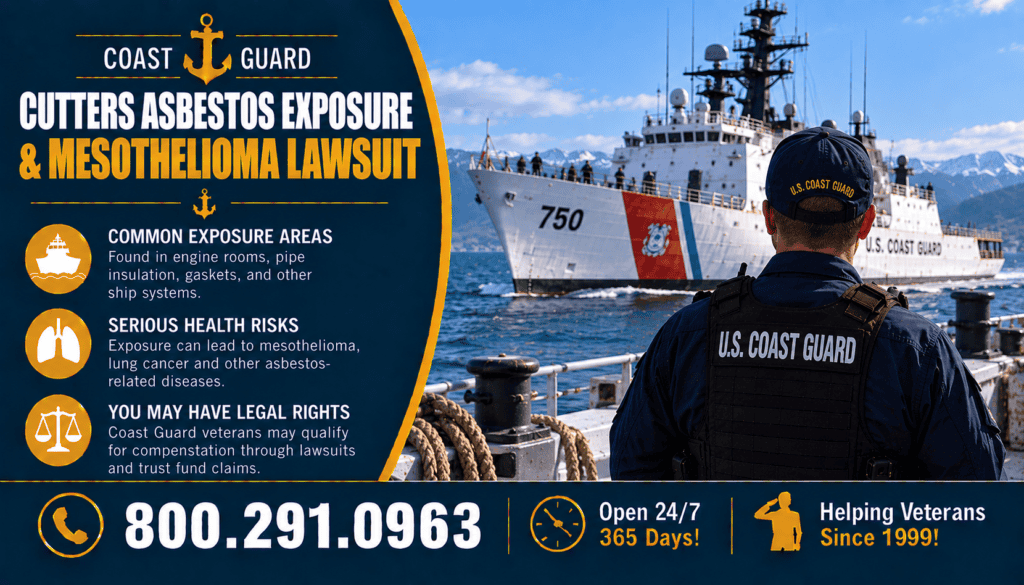
Coast Guard Cutters Asbestos Exposure Mesothelioma Lawsuit
Coast Guard veterans diagnosed with mesothelioma after service aboard cutters may be able to investigate private asbestos lawsuits, asbestos trust fund claims, VA disability benefits, or more than one compensation path. Eligibility depends on the medical diagnosis, cutter assignments, exposure evidence, responsible companies, jurisdiction, and filing deadlines.
Serving aboard a Coast Guard cutter does not automatically prove asbestos exposure or legal liability. A strong case identifies the specific vessel, work areas, maintenance periods, products or components involved, and evidence showing how asbestos-containing materials were disturbed.
Veterans researching cutter exposure can also review Coast Guard Ship Asbestos Exposure and the broader U.S. Coast Guard Asbestos Exposure resources.
⚖️ When a Coast Guard Cutter Asbestos Lawsuit May Be Investigated
A veteran diagnosed with mesothelioma may be able to investigate a civil asbestos claim when evidence connects the disease to asbestos-containing products, equipment, or materials supplied by private companies and encountered during Coast Guard service.
Important questions can include:
- Which cutter or cutters did the veteran serve aboard?
- What rating, division, or duty assignment did the veteran have?
- Which compartments and equipment were involved?
- Was the cutter undergoing major maintenance or overhaul?
- Were asbestos-containing products actually present and disturbed?
- Can responsible companies or bankruptcy trusts be identified?
A diagnosis alone does not establish a viable lawsuit, and a cutter assignment alone does not prove exposure.
⚓ How Asbestos Exposure May Have Occurred on Coast Guard Cutters
Historical Coast Guard cutters used propulsion, steam, piping, electrical, heating, and fire-protection systems that required frequent maintenance. Depending on cutter class, manufacturer, component, and era, asbestos-containing materials may have been used in certain insulation, gaskets, packing, pipe covering, paneling, boiler materials, or other heat-resistant products.
Potential exposure areas can include:
| Cutter Area | Possible Exposure Pathway | Evidence to Investigate |
|---|---|---|
| Engine rooms | Repair or disturbance of insulation, machinery, gaskets, pumps, or valves | Engineering logs, equipment manuals, maintenance records |
| Boiler and steam spaces | Pipe covering, thermal insulation, refractory products, gaskets | Ship plans, work orders, overhaul files |
| Passageways and berthing areas | Nearby insulated piping or interior materials disturbed during maintenance | Cutter specifications, repair records, witness statements |
| Damage-control and maintenance spaces | Cutting, scraping, removal, repair, or cleanup | Deck logs, casualty reports, work records |
| Shipyard availability | Removal or replacement of older materials during overhaul | Shipyard files, work packages, contractor records |
Coast Guard historical records provide vessel-specific examples. For instance, Coast Guard history for the Reliance-class cutter Dauntless states that major maintenance between 1986 and 1996 included replacement of asbestos paneling. That type of record is valuable because it documents asbestos on a specific cutter class and during a specific modernization period. It should not be generalized to every cutter.
📁 Cutter Records and Evidence to Investigate
Mesothelioma cases often involve exposure that occurred decades earlier, so service and vessel records can be essential.
| Evidence | What It May Help Establish |
|---|---|
| DD-214 and personnel records | Service dates, ratings, and duty assignments |
| Cutter assignment records | Specific vessels and periods aboard |
| Deck logs | Repairs, casualties, shipyard periods, and operational events |
| Engineering logs | Machinery work, failures, maintenance, and overhaul activity |
| Shipyard records | Material removal, modernization, contractor work, and major repairs |
| Technical manuals | Equipment models, parts, and historical component specifications |
| Shipmate statements | Work areas, dust conditions, and firsthand descriptions of repairs |
| Medical records | Mesothelioma diagnosis, pathology, imaging, and treatment |
A useful investigation combines vessel records with product and work-practice evidence rather than relying solely on memories from decades earlier.
🔧 Major Maintenance and Overhaul Evidence
Major Maintenance Availability and other shipyard periods can be particularly important because they may involve extensive renovation, equipment replacement, piping work, insulation removal, and demolition of older interior materials.
Useful records can include:
- Coast Guard Yard work packages
- Commercial shipyard records
- Dry-dock availability files
- Engineering work orders
- Renovation and modernization documents
- Contractor invoices and procurement records
- Asbestos surveys or abatement records
These records can help determine whether asbestos-containing materials were actually present and disturbed while the veteran was assigned to the cutter.
🏭 Identifying Asbestos Products and Responsible Companies
Private asbestos litigation generally focuses on companies responsible for asbestos-containing products or materials—not simply on the fact that exposure occurred aboard a Coast Guard cutter.
Depending on the evidence, an investigation may examine manufacturers or suppliers of:
- Thermal insulation and pipe covering
- Gaskets and packing
- Boiler and steam-system components
- Pumps and valves
- Turbines and other machinery
- Interior panels and fire-resistant materials
A manufacturer should not be named merely because its product category was used aboard ships. Product identification should be supported by technical records, parts lists, procurement documents, witness testimony, or other evidence.
💰 Asbestos Trust Fund Claims
Some asbestos companies entered bankruptcy and established trusts for qualifying claimants. A Coast Guard veteran with mesothelioma may be able to file trust claims when the medical and exposure evidence meets a trust’s requirements.
| Trust Issue | What May Be Required |
|---|---|
| Diagnosis | Medical evidence confirming a qualifying asbestos-related disease |
| Product or company connection | Evidence linking exposure to a trust-covered company |
| Exposure period | Dates that satisfy the trust’s criteria |
| Supporting documentation | Personnel, vessel, product, or coworker evidence |
Trust requirements differ, and a veteran may qualify for some trusts but not others.
See Coast Guard Veterans Asbestos Trust Fund Claims for more information.
🎖️ VA Benefits vs. Private Mesothelioma Lawsuits
VA disability compensation and private asbestos lawsuits are separate systems. VA states that a veteran may be eligible for disability compensation if the veteran has a health condition caused by asbestos exposure and had contact with asbestos during military service.
| VA Claim | Private Asbestos Lawsuit |
|---|---|
| Focuses on service connection | Focuses on legally responsible companies |
| Requires medical and military exposure evidence | Requires diagnosis, product exposure, defendant responsibility, and jurisdiction |
| Handled through the VA system | Handled under civil law |
| Decided case by case | Depends on evidence and applicable state law |
See VA Benefits vs. Coast Guard Mesothelioma Lawsuits for a more detailed comparison.
⏳ Filing Deadlines and Jurisdiction
Mesothelioma lawsuits are subject to statutes of limitations that vary by state. Wrongful death claims may have different deadlines from personal injury claims, and asbestos bankruptcy trusts may apply separate filing rules.
Jurisdiction can depend on where the veteran lived, where exposure occurred, where responsible companies conducted business, and other legal factors.
Because mesothelioma claims are time-sensitive, veterans and families should not assume that a single national filing deadline applies.
🔎 What a Cutter Mesothelioma Case Review Should Examine
A useful case review should reconstruct the veteran’s Coast Guard cutter history in detail.
- Specific cutter names and hull numbers
- Dates of assignment
- Rating, division, and work center
- Engine-room, boiler-room, or machinery-space duties
- Maintenance and shipyard periods
- Equipment, insulation, gaskets, packing, and other materials encountered
- Product and manufacturer evidence
- Possible asbestos trust connections
- VA service-connection evidence
- Applicable statutes of limitations
Diagnosed with mesothelioma after Coast Guard cutter service? Call 800.291.0963 or Submit Your Case. Live help is available 24/7, 365 days a year.
❓ Frequently Asked Questions
Can a Coast Guard cutter veteran file a mesothelioma lawsuit?
Potentially. Eligibility depends on diagnosis, cutter exposure evidence, responsible companies, jurisdiction, and filing deadlines.
Does serving aboard a Coast Guard cutter prove asbestos exposure?
No. Cutter service is a starting point for investigation, but exposure should be supported by evidence showing asbestos-containing materials were present and disturbed.
Did Coast Guard cutters contain asbestos?
Some Coast Guard historical records document asbestos-containing materials on specific cutters. For example, Coast Guard history records asbestos panel replacement during major maintenance of Reliance-class cutters. Vessel-specific evidence is still necessary.
What cutter records are most useful?
Personnel records, cutter assignments, deck logs, engineering logs, shipyard files, work orders, technical manuals, and witness statements can all help.
Can Coast Guard veterans file asbestos trust claims?
Potentially. Eligibility depends on whether exposure can be connected to companies or products covered by particular bankruptcy trusts.
Can veterans pursue VA benefits and a private lawsuit?
Potentially. VA disability compensation and private asbestos litigation are separate systems with different evidence and eligibility requirements.
Who can be legally responsible in a cutter asbestos case?
Potential defendants can include asbestos-product manufacturers, suppliers, distributors, contractors, or other companies when the evidence and law support responsibility.
How long do veterans have to file?
Deadlines vary by state and claim type. The applicable statute of limitations should be reviewed promptly after diagnosis or death.
📞 Coast Guard Cutter Veteran Diagnosed With Mesothelioma?
A strong cutter asbestos case starts with the veteran’s actual service history—specific cutters, duty periods, ratings, compartments, maintenance work, equipment, products, and shipyard activity. Those details can help determine whether a private lawsuit, asbestos trust claims, VA benefits, or multiple options should be investigated.
Call 800.291.0963 to discuss the veteran’s Coast Guard cutter service and possible asbestos exposure. Live help is available 24/7, 365 days a year.
Submit Your Case for a case-specific review of potential legal options. Compensation is not guaranteed and depends on diagnosis, exposure evidence, responsible companies, jurisdiction, and filing deadlines.
For broader ship-related legal information, see Coast Guard Ship Asbestos Exposure Mesothelioma Lawsuit.
⚕️ Legal & Medical Information Disclaimer
This page provides general educational information only. It does not establish diagnosis, causation, legal liability, VA eligibility, or compensation. Consult qualified medical and legal professionals about your situation.