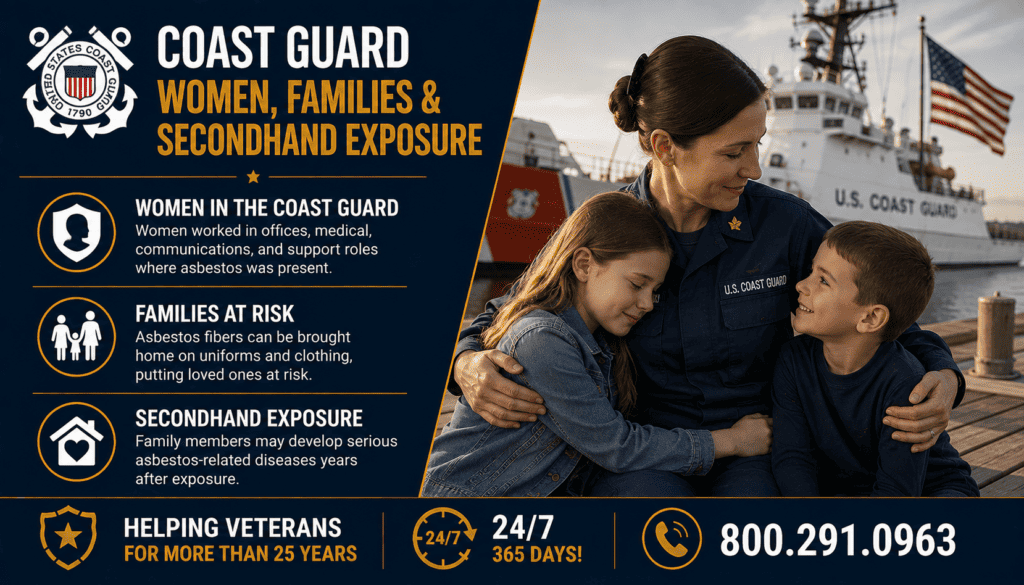
Coast Guard Women & Families Secondhand Exposure
Coast Guard spouses, children, and other household members may have experienced secondhand asbestos exposure when fibers were carried home from ships, maintenance areas, shipyards, or older Coast Guard facilities on uniforms, work clothes, shoes, tools, bags, or other personal items. This type of take-home exposure is most relevant when the service member’s own workplace exposure can be connected to documented asbestos-containing materials and repeated household contact.
Family relationship alone does not prove asbestos exposure. A credible secondhand exposure history identifies the Coast Guard member’s actual asbestos source, the pathway by which fibers may have entered the home, and the frequency and duration of contact with the family member.
Families can also review Secondhand Asbestos Exposure in Coast Guard Families, Military Spouse Asbestos Exposure – Coast Guard Service, and the broader U.S. Coast Guard Asbestos Exposure resources.
🏠 How Coast Guard Families May Experience Secondhand Asbestos Exposure
Secondhand asbestos exposure generally occurs when fibers leave the original workplace on clothing, footwear, tools, equipment, or personal belongings and are later released inside the home.
| Possible Pathway | How It May Affect a Family Member |
|---|---|
| Uniforms and work clothes | Dust may be released while clothing is handled, stored, or laundered. |
| Boots and footwear | Dust may be carried onto floors, vehicles, or household surfaces. |
| Tools and work gear | Contaminated equipment or bags may be brought into the home. |
| Repeated close contact | Family members may encounter fibers on clothing or belongings after work. |
The strongest histories connect these household pathways to documented asbestos exposure from the Coast Guard member’s service.
👕 Take-Home Asbestos Pathways From Coast Guard Service
Potential take-home exposure can arise when a service member works near disturbed asbestos-containing materials and returns home without changing or decontaminating clothing or gear.
- Dust on uniforms or coveralls
- Dust on jackets, gloves, or boots
- Contaminated tool bags or personal equipment
- Work clothes placed in household laundry areas
- Vehicle interiors contaminated after dusty work
- Household surfaces contacted by work gear
Not every dusty item carried asbestos fibers. The pathway should be tied to a specific asbestos-containing source whenever possible.
👨👩👧👦 Spouses, Children, and Other Household Members at Risk
Potential secondhand exposure can involve people who regularly shared the home with a Coast Guard member during a period of occupational asbestos exposure.
This may include:
- Spouses
- Children
- Parents
- Siblings
- Other long-term household members
The family relationship itself is not the key issue. The relevant question is whether the person had repeated contact with clothing, gear, dust, or household surfaces contaminated by asbestos from a documented Coast Guard source.
⚓ Coast Guard Service Settings Linked to Possible Take-Home Exposure
| Service Setting | Possible Exposure Source | Related Resource |
|---|---|---|
| Cutters and ships | Insulation, gaskets, packing, machinery-space repairs | Coast Guard Ship Asbestos Exposure |
| Maintenance shops | Mechanical equipment, gaskets, packing, brakes, building materials | Coast Guard Jobs Asbestos Exposure |
| Older shore facilities | Flooring, pipe insulation, roofing, fireproofing, HVAC, renovation debris | Coast Guard Facilities Asbestos Exposure |
| Shipyard overhaul | Removal of insulation, piping, interior materials, or machinery components | Coast Guard Ship Asbestos Exposure |
Secondhand exposure becomes more plausible when the service member’s actual duties involved confirmed asbestos-containing materials that were disturbed.
🧺 Laundry, Uniforms, Gear, and Repeated Household Contact
Laundry is one of the most commonly investigated household pathways because fibers may be released when dusty clothing is shaken, sorted, brushed, or handled before washing.
Other potentially relevant household activities include:
- Greeting or hugging the service member after work
- Handling work boots or shoes
- Cleaning dusty tools or equipment
- Storing work clothes in bedrooms or laundry rooms
- Vacuuming or sweeping areas where contaminated clothing or gear was kept
- Cleaning a vehicle used after dusty maintenance work
Frequency and duration matter. Repeated contact over months or years can be more relevant than a single isolated event.
📚 Coast Guard Family and Secondhand Exposure Guides
These pages can help narrow a family exposure investigation:
- Secondhand Asbestos Exposure in Coast Guard Families
- Military Spouse Asbestos Exposure – Coast Guard Service
These resources focus on take-home exposure pathways, household contact, laundry, spouse exposure, records, health risks, and legal distinctions.
🩺 Mesothelioma, Lung Cancer, and Other Health Risks
Asbestos exposure is associated with mesothelioma, lung cancer, asbestosis, and certain other asbestos-related conditions. These diseases can develop after long latency periods, so secondhand household exposure from decades earlier may remain medically relevant.
Symptoms such as persistent cough, shortness of breath, chest pain, unexplained weight loss, or difficulty breathing require medical evaluation but do not establish asbestos causation by themselves.
Family members concerned about possible secondhand exposure should provide healthcare professionals with a detailed household and occupational exposure history.
⚖️ Legal Claims, Trust Funds, and VA-Related Distinctions
A family member diagnosed with mesothelioma after secondhand exposure may be able to investigate private asbestos claims depending on the evidence, responsible companies, jurisdiction, and filing deadlines.
| Potential Path | What May Need to Be Established |
|---|---|
| Private asbestos lawsuit | Diagnosis, household exposure pathway, responsible companies, jurisdiction, and deadline |
| Asbestos trust fund claim | Trust-specific medical and exposure requirements |
| Wrongful death claim | Eligible claimant, diagnosis, exposure evidence, responsible parties, and filing deadline |
| VA-related survivor benefits | Separate eligibility rules tied to the veteran’s service and circumstances |
VA disability compensation generally applies to qualifying veterans, while spouses and other family members may have different survivor or dependency-related benefit pathways in qualifying circumstances.
See Coast Guard Veterans Asbestos Trust Fund Claims and VA Benefits vs. Coast Guard Mesothelioma Lawsuits for additional information.
🔎 What a Coast Guard Family Exposure Review Should Examine
A useful secondhand exposure review should reconstruct both the Coast Guard member’s workplace exposure and the family member’s household contact.
- Specific Coast Guard ships, bases, facilities, or work locations
- Dates and duration of the service member’s exposure
- Asbestos-containing materials or products disturbed
- Uniform, coverall, shoe, tool, or gear contamination
- Laundry and clothing-handling practices
- Household contact frequency and duration
- Ship, facility, job, and product records
- Coworker and family statements
- Medical diagnosis and pathology
- Applicable legal deadlines
Coast Guard family member diagnosed after possible secondhand asbestos exposure? Call 800.291.0963 or Submit Your Case. Live help is available 24/7, 365 days a year.
❓ Frequently Asked Questions
Can Coast Guard family members be exposed to asbestos secondhand?
Potentially. Fibers may be carried home on clothing, shoes, tools, or gear when a service member works around disturbed asbestos-containing materials.
Does living with a Coast Guard veteran prove secondhand exposure?
No. A supported history should connect the veteran to a documented asbestos source and show a plausible household pathway.
Can laundering uniforms create exposure?
Potentially. Handling, shaking, sorting, or washing contaminated clothing can release fibers if asbestos dust was actually present.
Can spouses develop mesothelioma from take-home exposure?
Potentially. A case-specific review would examine the veteran’s occupational exposure, the spouse’s household contact, and medical evidence.
Can children be exposed through household dust?
Potentially. Children living in the home may have contact with contaminated clothing, floors, furniture, or other surfaces if fibers were carried home.
What records can help prove secondhand exposure?
Service records, ship or facility documents, maintenance records, product evidence, coworker statements, family testimony, and medical records may help.
Can Coast Guard family members file asbestos claims?
Potentially. Eligibility depends on diagnosis, exposure evidence, responsible companies, jurisdiction, and filing deadlines.
Does secondhand exposure automatically prove mesothelioma causation?
No. Medical diagnosis and a supported exposure history are both important, and causation is evaluated based on the facts of the individual case.
📞 Coast Guard Family Member Diagnosed After Possible Secondhand Asbestos Exposure?
A strong family exposure investigation starts with the Coast Guard member’s actual service history and the family member’s household contact—specific ships or facilities, asbestos-containing materials, dusty work, uniforms, laundry routines, gear, and repeated exposure pathways.
Call 800.291.0963 to discuss the family’s Coast Guard asbestos exposure history. Live help is available 24/7, 365 days a year.
Submit Your Case for a case-specific review. Compensation and legal eligibility depend on diagnosis, exposure evidence, responsible companies, jurisdiction, and applicable requirements.
For detailed household-exposure information, see Secondhand Asbestos Exposure in Coast Guard Families. For spouse-specific information, see Military Spouse Asbestos Exposure – Coast Guard Service.
⚕️ Legal & Medical Information Disclaimer
This page provides general educational information only. It does not establish diagnosis, causation, legal liability, VA eligibility, or compensation. Consult qualified medical and legal professionals about your situation.