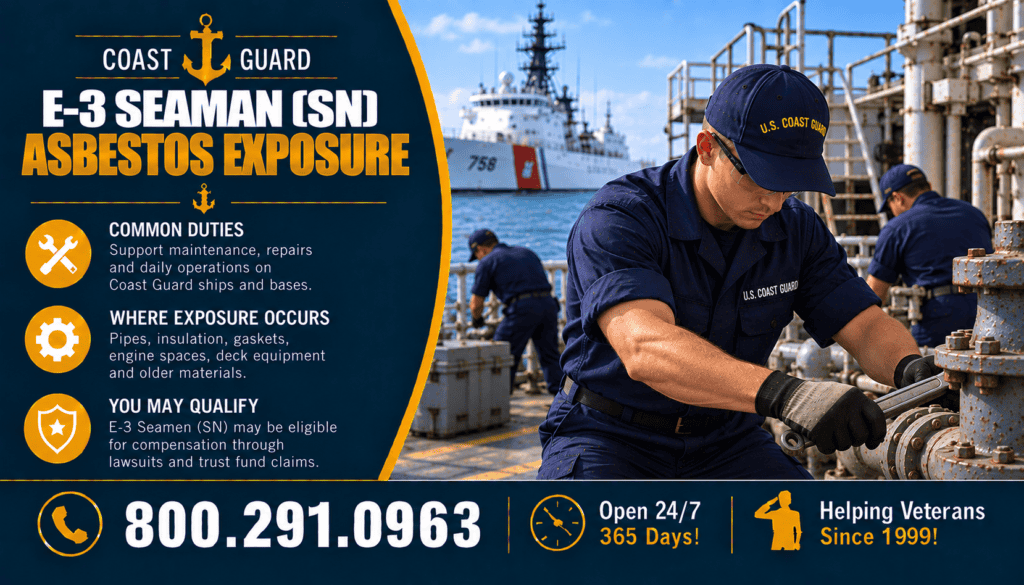
E-3 Coast Guard Seaman (SN) Asbestos Exposure
Seaman (SN), pay grade E-3, is a junior enlisted rank in the U.S. Coast Guard. E-3 veterans may serve aboard cutters, in deck departments, engineering-support areas, maintenance shops, stations, shore facilities, and other operational assignments while learning a rating or preparing for advancement to petty officer.
If asbestos exposure occurred, it may have taken place during hands-on work aboard older vessels, near machinery spaces, during repair or shipyard periods, in technical work areas, or at older Coast Guard facilities. The rank itself does not prove exposure.
Veterans reconstructing their service can review the U.S. Coast Guard Ranks Asbestos Exposure resources and the broader U.S. Coast Guard Asbestos Exposure guide to investigate specific assignments and work environments.
🎖️ Coast Guard Seaman E-3 Rank and Early-Career Duties
Seaman is pay grade E-3 in the U.S. Coast Guard. E-3 personnel often perform hands-on operational, deck, maintenance, watchstanding, and support duties while gaining experience for a specific rating.
For asbestos research, earlier E-1 and E-2 assignments can also matter because a veteran may have worked in the same cutter, shop, station, or maintenance environment before advancing to E-3.
Related rank pages include E-2 Coast Guard Seaman Apprentice (SA) Asbestos Exposure and E-4 Coast Guard Petty Officer Third Class (PO3) Asbestos Exposure.
🧭 Early Assignments and Possible Asbestos Exposure
Coast Guard Seamen can serve in different operational and support environments, so asbestos exposure should be reconstructed assignment by assignment rather than inferred from rank.
| Assignment or Work Setting | Possible Exposure Pathway | Evidence to Investigate |
|---|---|---|
| Cutter deck or support duty | Work near older insulation, piping, machinery, gaskets, or maintenance activity | Personnel records, cutter histories, deck logs, maintenance files |
| Engineering-support work | Cleaning, assisting repairs, moving equipment, or working near machinery spaces | Watch records, evaluations, engineering logs, work orders |
| Shipyard availability | Nearby removal or replacement of older vessel materials | Shipyard files, work packages, overhaul histories |
| Shore assignment | Older mechanical rooms, utility areas, renovation, repair, or maintenance | Facility records, asbestos surveys, project files |
These are possible exposure pathways only. A strong history identifies a specific vessel, building, component, material, or maintenance activity involving confirmed asbestos-containing material.
⚓ Cutter Duty and Machinery-Space Exposure
Many Coast Guard Seamen serve aboard cutters where they may stand watches, perform deck maintenance, support damage-control activities, assist senior personnel, clean work areas, and move throughout the vessel.
Historical Coast Guard records document asbestos-containing materials on some specific cutters. That makes vessel-specific research important, but those records should not be generalized to every cutter or every E-3 assignment.
Potential exposure circumstances can include working near pipe-insulation repair, boiler maintenance, machinery overhaul, gasket or packing replacement, or cleanup in enclosed spaces where confirmed asbestos-containing materials were disturbed.
See Coast Guard Ship Asbestos Exposure and Engine Rooms Asbestos Exposure on Coast Guard Vessels for deeper vessel-specific context.
🔧 Maintenance, Repair, and Shipyard Environments
Seamen may assist with scheduled maintenance, repair, painting, cleanup, equipment movement, damage-control preparation, or other tasks during shipyard and overhaul periods. These projects can involve opening machinery spaces, replacing piping, removing older interior materials, and repairing propulsion or utility systems.
An E-3 veteran may have been exposed directly through hands-on work or indirectly by working near more senior personnel or contractors disturbing asbestos-containing materials.
Relevant factors include the exact material disturbed, proximity, duration, ventilation, containment, work methods, and whether asbestos controls were in place.
🏢 Shore Facilities and Support Assignments
E-3 personnel may also serve at stations, bases, sectors, training facilities, yards, air stations, communications facilities, and other Coast Guard installations.
Older buildings can warrant investigation when maintenance, deterioration, renovation, or demolition disturbed asbestos-containing materials. Potential historical materials varied by building and era and could include certain pipe and boiler insulation, flooring, roofing, fireproofing, cement products, and mechanical-system components.
See Coast Guard Facilities Asbestos Exposure for additional shore-based exposure information.
🌫️ Bystander and Nearby-Work Exposure
Seamen can work near engineers, mechanics, maintenance crews, shipyard workers, or contractors disturbing asbestos-containing materials. Potential bystander exposure depends on the actual work conditions.
Important factors include:
- Distance from the work
- Frequency and duration
- Confined machinery spaces or enclosed rooms
- Ventilation
- Condition of the material
- Cutting, scraping, removal, repair, or cleanup methods
Being assigned to a cutter or working near maintenance does not establish asbestos exposure. Evidence should connect the veteran to a specific place and activity involving confirmed asbestos-containing material.
📁 Evidence to Investigate
| Record | What It May Help Establish |
|---|---|
| Personnel and assignment records | Vessels, facilities, units, dates, and duty locations |
| Enlisted evaluations and training records | Duties, watchstanding, work assignments, and developing rating skills |
| Cutter histories and deck logs | Operations, repairs, casualties, and maintenance periods |
| Engineering and maintenance records | Equipment work and repairs occurring during the assignment |
| Shipyard and overhaul files | Modernization, material removal, replacement, and contractor activity |
| Asbestos surveys or abatement records | Identification of asbestos-containing materials |
| Shipmate or coworker statements | Work locations, repair conditions, and nearby disturbance |
| Medical records | Diagnosis, pathology, imaging, and treatment history |
Because E-3 is an early-career rank, records identifying the veteran’s cutter, division, work center, and daily duties can be especially valuable.
🩺 Asbestos-Related Health Risks
Asbestos exposure is associated with serious diseases including mesothelioma, lung cancer, and asbestosis. These conditions can develop after long latency periods, so exposures from early Coast Guard assignments may remain relevant decades later.
Persistent cough, shortness of breath, chest pain, unexplained weight loss, or other respiratory symptoms require medical evaluation. Symptoms and military service history alone do not establish an asbestos-related diagnosis or causation.
Veterans concerned about historical exposure should provide healthcare professionals with a detailed Coast Guard and civilian occupational history.
⚖️ VA Benefits and Legal Options
A Coast Guard veteran diagnosed with an asbestos-related disease may be able to investigate VA disability compensation and separate private legal claims depending on the evidence and applicable requirements.
| Potential Path | What May Need to Be Established |
|---|---|
| VA disability benefits | Current condition, military exposure evidence, service connection, and VA requirements |
| Asbestos lawsuit | Diagnosis, exposure history, responsible defendants, jurisdiction, and filing deadline |
| Asbestos trust fund claim | Trust-specific medical and exposure criteria tied to qualifying companies or products |
| Wrongful death claim | Eligible claimant, diagnosis, exposure evidence, responsible parties, and deadline |
VA benefits and private asbestos claims are separate systems, and neither is guaranteed by military service or diagnosis alone. See Coast Guard Asbestos Exposure Legal Options for additional information.
Coast Guard Seaman diagnosed after possible asbestos exposure? Call 800.291.0963 or Submit Your Case. Live help is available 24/7, 365 days a year.
❓ Frequently Asked Questions
What pay grade is Coast Guard Seaman?
Seaman (SN) is pay grade E-3 in the U.S. Coast Guard.
Does serving as a Coast Guard Seaman prove asbestos exposure?
No. Rank does not establish exposure. The veteran’s actual cutter, facilities, duties, maintenance periods, and work environments must be investigated.
Could asbestos exposure occur during early enlisted service?
Potentially. Early-career personnel may perform hands-on work or support maintenance in spaces where asbestos-containing materials were present and disturbed.
Could a Seaman work around engineering spaces?
Potentially. Depending on assignment and training, E-3 personnel may enter machinery spaces, support damage-control activities, assist maintenance, or work near engineering crews.
Could a Seaman have bystander asbestos exposure?
Potentially. A Seaman could be near maintenance or repair work disturbing asbestos-containing materials, depending on proximity, duration, ventilation, and the work performed.
What records can help investigate exposure?
Personnel records, evaluations, cutter histories, deck logs, engineering records, shipyard files, asbestos surveys, witness statements, and medical records may be useful.
Can Coast Guard veterans investigate VA disability compensation for asbestos disease?
Potentially. Eligibility depends on the current medical condition, evidence of military asbestos exposure, service connection, and VA requirements.
Can VA benefits and private asbestos claims both be investigated?
Potentially. They are separate systems with different medical, exposure, legal, and filing requirements.
📞 Coast Guard Seaman or Veteran Diagnosed With an Asbestos-Related Disease?
An E-3 Coast Guard assignment can involve cutter duty, hands-on maintenance support, shipyard periods, machinery spaces, and shore facilities. Reconstructing those assignments can help identify where meaningful asbestos exposure may have occurred.
Call 800.291.0963 to discuss the veteran’s Coast Guard service and possible asbestos exposure. Live help is available 24/7, 365 days a year.
Submit Your Case for a case-specific review of potential legal options. Compensation and VA eligibility depend on the evidence and applicable requirements.
⚕️ Legal & Medical Information Disclaimer
This page provides general educational information only. It does not establish diagnosis, causation, legal liability, VA eligibility, or compensation. Consult qualified medical and legal professionals about your situation.