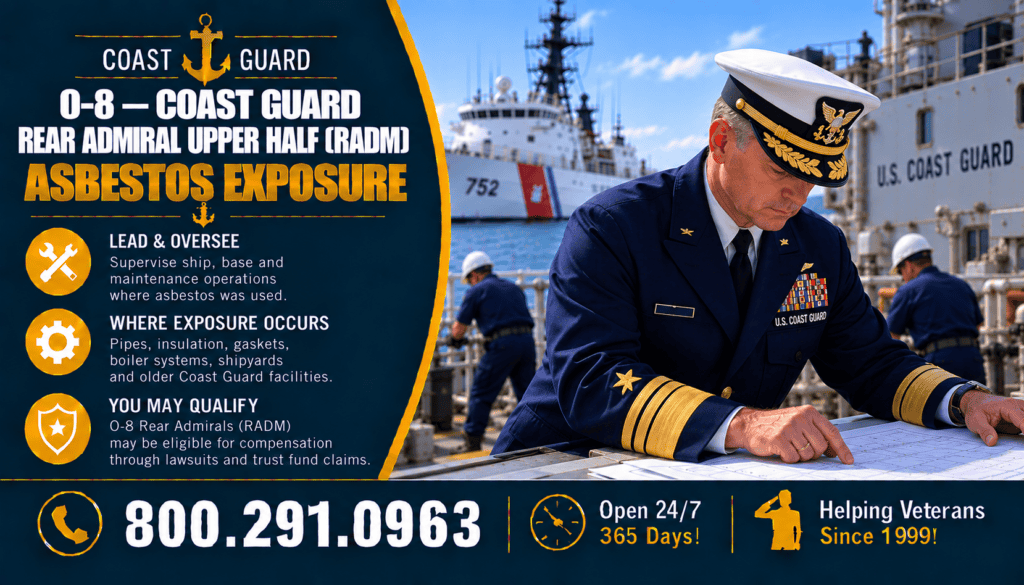
O-8 Coast Guard Rear Admiral Upper Half (RADM) Asbestos Exposure
Rear Admiral (RADM), pay grade O-8, is the Coast Guard’s two-star flag-officer rank, often described as Rear Admiral Upper Half. Veterans who eventually reached O-8 commonly had long careers involving operational, cutter, shore, staff, and command assignments. If asbestos exposure occurred, it may have taken place years or decades before promotion to Rear Admiral.
For an O-8 veteran, the strongest exposure investigation focuses on the complete service history: vessels assigned, facilities occupied, shipyard periods, engineering and maintenance environments entered, and whether confirmed asbestos-containing materials were disturbed nearby. The rank itself does not prove asbestos exposure.
Additional service-history research is available through the U.S. Coast Guard Ranks Asbestos Exposure resources and the U.S. Coast Guard Asbestos Exposure guide.
🎖️ Coast Guard Rear Admiral O-8 Rank and Career Context
Coast Guard materials identify Rear Admiral (RADM) as pay grade O-8 and a two-star flag-officer rank. The service also uses Rear Admiral (Lower Half), RDML, at O-7, making the O-8 grade commonly known as Rear Admiral Upper Half.
By the time an officer reaches O-8, the career may span many different vessels, units, districts, facilities, and leadership roles. For asbestos research, earlier assignments can be particularly important because they may have occurred during periods when asbestos-containing materials remained in older ships and buildings.
Higher flag-officer resources include O-9 Coast Guard Vice Admiral (VADM) Asbestos Exposure and O-10 Coast Guard Admiral (ADM) Asbestos Exposure.
🧭 Where Exposure May Have Occurred During a Long Coast Guard Career
Potential asbestos exposure should be evaluated assignment by assignment. An O-8 veteran may have served in operational and technical environments long before assuming senior flag-level duties.
| Career Setting | Possible Exposure Pathway | Evidence to Investigate |
|---|---|---|
| Cutter duty | Presence near older insulation, piping, machinery, gaskets, or repair activity | Personnel records, cutter histories, deck logs, maintenance records |
| Engineering or operational spaces | Inspections, watches, drills, casualty response, or maintenance oversight | Officer evaluations, qualifications, engineering logs |
| Shipyard availability | Nearby removal or replacement of older vessel materials | Shipyard records, work packages, overhaul histories |
| Shore assignment | Older mechanical rooms, utilities, renovation, maintenance, or demolition | Facility records, asbestos surveys, project records |
These settings identify areas to investigate; they do not establish that a particular Rear Admiral inhaled asbestos fibers.
⚓ Cutters, Ships, and Engineering Spaces
Historical Coast Guard cutters contained propulsion, piping, heating, electrical, and fire-protection systems that required regular inspection and maintenance. Some Coast Guard historical records specifically document asbestos-containing materials aboard particular cutters.
For example, Coast Guard history for Reliance-class cutters states that major maintenance conducted between 1986 and 1996 included replacement of asbestos paneling. This is useful evidence that asbestos was present on those specific vessels, but it should not be generalized to every Coast Guard cutter or every officer assignment.
Possible officer exposure circumstances can include time in engine rooms or machinery spaces during inspections, drills, emergencies, repairs, or overhaul activity. Confined spaces and poor ventilation can be relevant when asbestos-containing material was actually disturbed.
See Coast Guard Ship Asbestos Exposure for more vessel-specific exposure information.
🔧 Shipyard, Maintenance, and Overhaul Exposure
Major maintenance and modernization can involve removal of interior panels, insulation, piping, machinery components, and other older materials. Coast Guard records documenting asbestos panel replacement during cutter modernization illustrate why overhaul periods deserve careful investigation.
An officer might have remained aboard during portions of an availability, inspected work, coordinated operations, supervised personnel, or entered repair areas. Whether those activities resulted in exposure depends on the material disturbed, work methods, proximity, duration, ventilation, and controls in place.
Useful evidence can include Coast Guard Yard records, commercial shipyard files, maintenance availability records, contractor documents, work packages, and shipmate testimony.
🏢 Shore Facilities and Command Assignments
Rear Admirals may have earlier career assignments at bases, districts, sectors, training facilities, headquarters, yards, air stations, and other Coast Guard installations. Older buildings can be relevant when asbestos-containing materials were damaged or disturbed during maintenance, repair, renovation, or demolition.
Historical building materials potentially containing asbestos varied by manufacturer, product, installation date, and facility. Certain pipe and boiler insulation, flooring, roofing, fireproofing, cement products, and mechanical-system components may warrant investigation, but their presence should not be assumed.
See Coast Guard Facilities Asbestos Exposure for additional information about shore-based environments.
🌫️ Bystander and Supervisory Exposure
Officers did not necessarily need to personally remove insulation or replace gaskets to experience potential asbestos exposure. Earlier duties could place them near engineers, mechanics, maintenance personnel, shipyard workers, or contractors disturbing asbestos-containing materials.
Important factors include proximity, frequency, duration, ventilation, confined-space conditions, the condition of the material, and whether work involved cutting, scraping, removal, or cleanup.
Command or supervisory responsibility alone does not establish exposure. Evidence should connect the veteran to a specific location and activity involving confirmed asbestos-containing material.
📁 Evidence to Investigate
| Record | What It May Help Establish |
|---|---|
| Personnel and assignment records | Vessels, stations, commands, dates, and career progression |
| Officer evaluations | Duties, responsibilities, and operating environments |
| Cutter histories and deck logs | Operations, repairs, casualties, and maintenance periods |
| Engineering records | Machinery repairs and system maintenance |
| Shipyard and overhaul files | Modernization, material removal, and contractor work |
| Asbestos surveys or abatement records | Identification of asbestos-containing materials |
| Shipmate or coworker statements | Work locations, repair conditions, and nearby disturbance |
| Medical records | Diagnosis, pathology, imaging, and treatment history |
For a long-career officer, a chronological list of assignments can help identify the vessels, facilities, and periods most likely to warrant detailed exposure research.
🩺 Asbestos-Related Health Risks
Asbestos exposure is associated with serious diseases including mesothelioma, lung cancer, and asbestosis. These conditions may develop decades after exposure, making early and mid-career Coast Guard assignments relevant even if a veteran later served primarily in senior command positions.
Persistent cough, shortness of breath, chest pain, unexplained weight loss, or other respiratory symptoms require medical evaluation. Symptoms alone do not establish an asbestos-related disease or its cause.
Veterans concerned about historical exposure should provide healthcare professionals with a detailed military and civilian occupational history.
⚖️ VA Benefits and Legal Options
A Coast Guard veteran diagnosed with an asbestos-related disease may be able to investigate VA disability compensation and separate private legal claims, depending on the medical and exposure evidence.
| Potential Path | What May Need to Be Established |
|---|---|
| VA disability benefits | Current condition, military exposure, service connection, and VA eligibility requirements |
| Asbestos lawsuit | Diagnosis, exposure evidence, responsible defendants, jurisdiction, and filing deadline |
| Asbestos trust fund claim | Trust-specific medical and exposure criteria tied to qualifying companies or products |
| Wrongful death claim | Eligible claimant, diagnosis, exposure history, responsible parties, and deadline |
These compensation systems have different requirements, and eligibility is never guaranteed. See Coast Guard Asbestos Exposure Legal Options for additional information.
Coast Guard veteran diagnosed after possible asbestos exposure? Call 800.291.0963 or Submit Your Case. Live help is available 24/7, 365 days a year.
❓ Frequently Asked Questions
What rank is Rear Admiral Upper Half in the Coast Guard?
Rear Admiral (RADM), commonly described as Rear Admiral Upper Half, is pay grade O-8 and a two-star flag-officer rank.
What is the difference between O-7 and O-8 Rear Admirals?
O-7 is Rear Admiral (Lower Half), abbreviated RDML, while O-8 is Rear Admiral, abbreviated RADM and commonly called Rear Admiral Upper Half.
Does reaching O-8 prove asbestos exposure?
No. Rank does not prove exposure. The veteran’s actual assignments, vessels, facilities, duties, and work environments must be investigated.
Could an O-8 veteran’s exposure have occurred earlier in the officer’s career?
Yes. Earlier cutter, shipyard, operational, engineering-area, or shore-facility assignments may be more relevant than later flag-level duties.
Did Coast Guard cutters contain asbestos?
Some historical Coast Guard records document asbestos-containing materials on specific cutters. Vessel, material, era, and work circumstances should be verified rather than assumed.
Could an officer have bystander asbestos exposure?
Potentially. An officer could be near maintenance or repair work that disturbed asbestos-containing materials, depending on proximity, duration, ventilation, and the specific activity.
What records can help document exposure?
Personnel records, evaluations, cutter histories, deck logs, engineering records, shipyard files, asbestos surveys, witness statements, and medical records may help reconstruct exposure.
Can Coast Guard veterans investigate both VA benefits and private asbestos claims?
Potentially. VA benefits and private asbestos claims are separate systems with different evidence, eligibility, and filing requirements.
📞 Coast Guard Rear Admiral or Veteran Diagnosed With an Asbestos-Related Disease?
A long Coast Guard career may include numerous cutters, shore facilities, shipyards, commands, and maintenance environments. Reconstructing those assignments can help identify where meaningful asbestos exposure may have occurred.
Call 800.291.0963 to discuss the veteran’s Coast Guard service and possible asbestos exposure. Live help is available 24/7, 365 days a year.
Submit Your Case for a case-specific review of potential legal options. Compensation and VA eligibility depend on the evidence and applicable requirements.
⚕️ Legal & Medical Information Disclaimer
This page provides general educational information only. It does not establish diagnosis, causation, legal liability, VA eligibility, or compensation. Consult qualified medical and legal professionals about your situation.