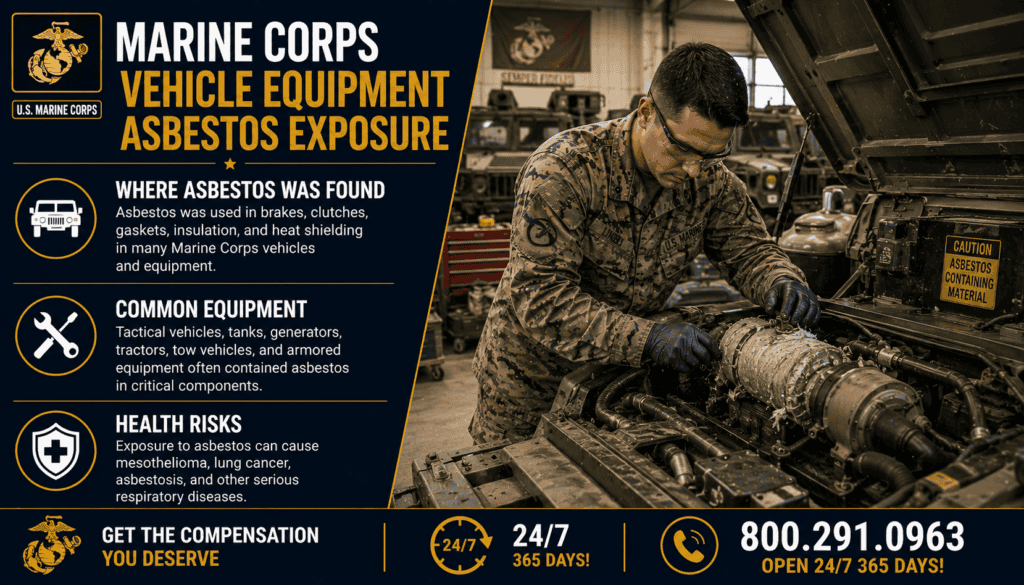
Marine Corps Equipment Asbestos Exposure
Marine Corps personnel relied on a vast array of military vehicles, aircraft, engineering equipment, generators, boilers, HVAC systems, pumps, electrical equipment, heavy machinery, and industrial support equipment to accomplish missions around the world. From World War II through much of the Cold War, many of these products incorporated asbestos because of its exceptional resistance to heat, fire, friction, electricity, and corrosion.
Although asbestos helped improve the durability of military equipment, maintenance, repairs, rebuilding, and replacement often disturbed asbestos-containing insulation, gaskets, brake components, packing materials, and fireproof products. These activities released microscopic asbestos fibers that could be inhaled by Marines working in motor pools, maintenance shops, engineering units, aircraft maintenance facilities, utility buildings, and aboard naval vessels supporting Marine Corps operations.
Mechanics, engineers, electricians, aircraft mechanics, maintenance crews, heavy equipment operators, and utility personnel generally faced the greatest opportunities for occupational asbestos exposure. However, Marines assigned nearby could also encounter airborne fibers while working inside the same facilities.
If you developed mesothelioma, asbestos-related lung cancer, asbestosis, or another asbestos disease after Marine Corps service, identifying the equipment you worked with may help document your exposure history for VA benefits or potential legal claims.
📞 Call 800.291.0963 to discuss Marine Corps equipment asbestos exposure, military records, VA benefits, and potential legal options.
⚙️ What You’ll Learn
This guide explains:
- ⚙️ Why asbestos was widely used in Marine Corps equipment
- 🚛 Types of military equipment that commonly contained asbestos
- 🔧 Equipment most likely to release asbestos fibers
- 👷 Occupations with the highest equipment exposure risk
- 🚚 Vehicle and heavy equipment maintenance
- 🏭 Industrial utility equipment
- ⚡ Electrical and HVAC systems
- 🩺 Diseases associated with equipment exposure
- 🇺🇸 VA benefits available to Marines
- ⚖️ Legal options involving asbestos manufacturers
🔥 Why Asbestos Was Used in Marine Corps Equipment
Marine Corps equipment frequently operated in combat environments where reliability was critical.
Manufacturers selected asbestos because it provided:
- 🔥 Excellent heat resistance
- 🛡️ Fire protection
- ⚡ Electrical insulation
- 🧪 Chemical resistance
- ⚙️ Friction resistance
- ⏳ Long service life
- 💲 Low manufacturing cost
- 💪 Mechanical durability
Asbestos became common in equipment manufactured for:
- 🚛 Military vehicles
- ✈️ Aircraft
- 🚢 Amphibious operations
- 🏗️ Engineering units
- ⚡ Utilities
- 📡 Communications
- 🏥 Medical facilities
- 📦 Logistics
- 🪖 Combat support
Most Marine Corps equipment was produced by private manufacturers that routinely incorporated asbestos into thousands of military products before the health hazards became widely recognized.
🚛 Marine Corps Equipment That Commonly Contained Asbestos
Marine Corps installations and expeditionary units depended upon thousands of pieces of industrial and military equipment.
Potential asbestos-containing equipment included:
- 🔥 Boilers
- ⚡ Generators
- 💧 Pumps
- 🔩 Valves
- 🌬️ HVAC equipment
- ⚡ Electrical switchgear
- 🛠️ Motors
- 🔧 Welding equipment
- 🚜 Heavy machinery
- 🚚 Vehicle equipment
- ✈️ Aircraft equipment
- 🧱 Fireproof materials
- 🧵 Insulation products
- 🛑 Brake systems
- ⚙️ Clutches
- 🔩 Gaskets
- 🪢 Packing materials
Most asbestos components were found where equipment generated heat, friction, steam, pressure, or electricity.
🚚 Marine Corps Vehicle Equipment
Marine vehicles operated in extremely demanding conditions and required frequent maintenance.
Common vehicles included:
- Tactical trucks
- Cargo trucks
- Amphibious vehicles
- Humvees
- Armored vehicles
- Engineering vehicles
- Recovery vehicles
- Construction equipment
Potential asbestos-containing components included:
- 🛑 Brake linings
- ⚙️ Clutches
- 🔩 Engine gaskets
- 🔥 Heat shields
- 🚗 Exhaust insulation
- 🪢 Packing materials
Routine brake and clutch replacement frequently generated airborne asbestos dust inside maintenance facilities.
Related page
➡️ Marine Corps Vehicle Equipment Asbestos Exposure
✈️ Marine Corps Aircraft Equipment
Marine aviation relied upon aircraft containing numerous heat-resistant components.
Potential asbestos-containing products included:
- Aircraft brakes
- Engine insulation
- Fire-resistant panels
- Exhaust insulation
- Heat shields
- Gaskets
- Packing materials
Aircraft maintenance personnel routinely serviced these systems inside aviation maintenance hangars.
Related page
➡️ Marine Corps Aircraft Equipment Asbestos Exposure
🔥 Boiler Equipment
Marine Corps bases relied on industrial boilers to provide steam and heating.
Potential asbestos-containing materials included:
- Boiler insulation
- Refractory materials
- Pipe insulation
- Gaskets
- Packing
- Expansion joints
- Fireproof panels
Boiler maintenance frequently required removing deteriorated insulation before servicing equipment.
Personnel commonly working around boilers included:
- Boiler operators
- Mechanics
- Maintenance crews
- Engineers
- Utility workers
Related page
➡️ Marine Corps Boiler Equipment Asbestos Exposure
⚡ Generator Equipment
Generators supplied electrical power throughout Marine Corps installations.
Potential asbestos-containing components included:
- Engine insulation
- Exhaust insulation
- Electrical insulation
- Gaskets
- Packing
- Heat shields
Generators were commonly located in:
- Power facilities
- Hospitals
- Communications centers
- Maintenance buildings
- Training facilities
- Utility buildings
Generator overhauls often disturbed insulation surrounding engines and exhaust systems.
Related page
➡️ Marine Corps Generator Equipment Asbestos Exposure
🌬️ HVAC Equipment
Heating, ventilation, and air conditioning systems were installed throughout Marine Corps bases.
Potential asbestos-containing components included:
- Duct insulation
- Pipe insulation
- Boiler insulation
- Heating units
- Air handlers
- Fire dampers
- Gaskets
HVAC technicians frequently encountered deteriorating insulation while replacing or repairing older equipment.
Related page
➡️ Marine Corps HVAC Equipment Asbestos Exposure
⚡ Electrical Equipment
Marine Corps electrical systems required durable insulation capable of withstanding high temperatures.
Potential asbestos-containing equipment included:
- Switchgear
- Electrical panels
- Transformers
- Motors
- Circuit breakers
- Arc barriers
- Electrical insulation
Marine electricians frequently worked around this equipment inside:
- Utility buildings
- Power plants
- Maintenance facilities
- Communications centers
- Aircraft maintenance buildings
Related page
➡️ Marine Corps Electrical Equipment Asbestos Exposure
💧 Pumps
Industrial pumps moved water, fuel, hydraulic fluids, wastewater, and other materials throughout Marine Corps installations.
Potential asbestos-containing components included:
- Packing
- Gaskets
- Mechanical seals
- Thermal insulation
Routine pump rebuilding often required removing old packing and gaskets, creating opportunities for asbestos exposure.
Related page
➡️ Marine Corps Pump Equipment Asbestos Exposure
🚜 Heavy Machinery
Marine Corps engineering units operated heavy construction equipment worldwide.
Examples included:
- Bulldozers
- Excavators
- Loaders
- Cranes
- Graders
- Earthmovers
- Trenching machines
Potential asbestos-containing components included:
- Brake systems
- Clutches
- Engine gaskets
- Exhaust insulation
- Heat shields
Maintenance personnel generally experienced greater exposure than operators because they routinely disassembled these machines for repairs.
Related page
➡️ Marine Corps Heavy Machinery Asbestos Exposure
🏭 Equipment Manufacturers
The Marine Corps purchased equipment from numerous private manufacturers rather than manufacturing most equipment itself.
Many manufacturers supplied:
- Boilers
- Pumps
- Generators
- Electrical equipment
- HVAC systems
- Construction equipment
- Vehicle components
- Aircraft components
- Industrial machinery
Understanding which manufacturers supplied equipment to specific Marine Corps installations may help reconstruct historical asbestos exposure.
Related page
➡️ Marine Corps Equipment Manufacturers & Asbestos Use
🛠️ Equipment Maintenance Created the Greatest Exposure Risk
Simply operating equipment did not always create significant asbestos exposure.
The greatest risks generally occurred during:
- Brake replacement
- Clutch replacement
- Gasket removal
- Pump rebuilding
- Valve repairs
- Boiler maintenance
- Generator overhauls
- Electrical upgrades
- Insulation removal
- Equipment demolition
Maintenance activities frequently disturbed aging asbestos-containing materials that had remained intact for years.
👷 Marine Corps Occupations Most Frequently Associated with Equipment Exposure
Occupations commonly associated with equipment-related asbestos exposure included:
- 🔧 Mechanics
- 👷 Engineers
- ⚡ Electricians
- ✈️ Aircraft mechanics
- 🚜 Heavy equipment operators
- 🏗️ Maintenance crews
- 🌬️ HVAC technicians
- 🔥 Boiler operators
- ⚙️ Utility workers
- 🚒 Firefighters
These Marines routinely repaired equipment rather than simply operating it, increasing opportunities for asbestos exposure.
🔧 Welding Equipment
Marine Corps welders repaired vehicles, aircraft support equipment, amphibious vehicles, engineering machinery, structural steel, pipelines, and military facilities throughout the world. Although welding itself did not require asbestos, many of the materials surrounding welding operations contained asbestos because of their heat-resistant properties.
Potential asbestos-containing products included:
- 🔥 Welding blankets
- 🛡️ Fire curtains
- 🔥 Heat shields
- 🧤 Protective pads
- 🪢 Pipe insulation
- 🏭 Boiler insulation
- 🧱 Fireproof barriers
- 🔩 Gaskets
- ⚙️ Packing materials
Marine welders commonly worked inside:
- Motor pools
- Maintenance shops
- Engineering facilities
- Aircraft maintenance hangars
- Utility buildings
- Machine shops
- Ship maintenance facilities
Repairing insulated equipment frequently required removing asbestos insulation before welding could begin.
Related page
➡️ Marine Corps Welding Equipment Asbestos Exposure
🌬️ Air Compressors
Compressed air powered numerous tools and industrial systems throughout Marine Corps installations.
Compressors were commonly located in:
- Maintenance facilities
- Vehicle repair shops
- Engineering buildings
- Aviation maintenance hangars
- Machine shops
- Utility buildings
Potential asbestos-containing components included:
- Gaskets
- Packing
- Thermal insulation
- Valve insulation
- Pipe insulation
Routine maintenance often required dismantling compressors and replacing worn seals.
Related page
➡️ Marine Corps Compressor Equipment Asbestos Exposure
⚙️ Turbines
Larger Marine Corps installations sometimes used steam or gas turbines as part of electrical generation and utility systems.
Potential asbestos-containing materials included:
- Thermal insulation
- Turbine gaskets
- Packing materials
- Steam pipe insulation
- Expansion joints
- Valve insulation
Maintenance personnel frequently removed insulation before repairing turbine equipment.
Related page
➡️ Marine Corps Turbine Equipment Asbestos Exposure
🔥 Fireproofing Materials
Fire protection was essential throughout Marine Corps facilities.
Historically, asbestos-containing fireproofing materials appeared in:
- Structural steel coatings
- Fire doors
- Fire walls
- Spray-on fireproofing
- Mechanical rooms
- Utility tunnels
- Boiler rooms
- Aircraft maintenance facilities
Renovation and demolition frequently disturbed these materials.
Related page
➡️ Marine Corps Fireproofing Materials Asbestos Exposure
🧱 Insulation Products
Few categories contained more asbestos than insulation.
Marine Corps facilities commonly used asbestos insulation around:
- Boilers
- Steam lines
- HVAC equipment
- Generators
- Pumps
- Valves
- Electrical equipment
- Exhaust systems
- Aircraft equipment
- Industrial machinery
Workers frequently encountered deteriorating insulation during repairs and modernization projects.
Related page
➡️ Marine Corps Insulation Products Asbestos Exposure
🛑 Brake Systems
Marine Corps vehicles and heavy equipment relied upon durable braking systems capable of operating under severe conditions.
Historically, brake components commonly contained asbestos because it resisted:
- High temperatures
- Friction
- Heavy loads
- Continuous operation
Maintenance personnel routinely replaced:
- Brake shoes
- Brake linings
- Brake pads
- Brake drums
Cleaning brake assemblies often released significant quantities of asbestos dust.
⚙️ Clutches
Marine Corps trucks, engineering equipment, recovery vehicles, and heavy machinery frequently contained asbestos clutch materials.
Routine clutch repairs involved:
- Transmission removal
- Cleaning clutch housings
- Replacing clutch discs
- Removing worn friction materials
These maintenance procedures frequently generated airborne asbestos fibers.
🔩 Gaskets & Packing Materials
Asbestos gaskets and packing materials were installed throughout Marine Corps equipment because they tolerated heat, steam, fuel, chemicals, and pressure.
Common equipment included:
- Boilers
- Pumps
- Valves
- Compressors
- Turbines
- Engines
- Heat exchangers
Maintenance crews often scraped away deteriorated gasket material before installing replacements.
This process frequently released asbestos fibers into surrounding work areas.
🚰 Steam Systems
Steam systems operated throughout Marine Corps bases.
Potential asbestos-containing materials included:
- Pipe insulation
- Elbow insulation
- Valve insulation
- Steam traps
- Flange insulation
- Expansion joints
- Pipe coverings
Steam system repairs commonly disturbed aging insulation.
🏭 Equipment Repair Shops
Marine Corps repair facilities represented some of the highest-risk occupational environments for asbestos exposure.
Typical maintenance activities included:
- Engine rebuilding
- Brake replacement
- Clutch replacement
- Pump rebuilding
- Valve repairs
- Generator maintenance
- Electrical repairs
- Welding
- Equipment overhauls
Many of these repairs occurred simultaneously inside enclosed maintenance buildings where asbestos dust could accumulate over time.
🏢 Marine Corps Facilities Using Industrial Equipment
Industrial equipment appeared throughout nearly every Marine Corps installation.
Examples included:
- Power plants
- Motor pools
- Maintenance buildings
- Aircraft maintenance hangars
- Engineering facilities
- Hospitals
- Warehouses
- Utility buildings
- Communications centers
- Training facilities
Marines assigned to several bases often encountered the same categories of equipment throughout their careers.
👷 Marines with the Highest Equipment Exposure Risk
Marine Corps occupations commonly associated with equipment-related asbestos exposure included:
- 🔧 Mechanics
- ✈️ Aircraft mechanics
- 👷 Engineers
- ⚡ Electricians
- 🔥 Boiler operators
- 🌬️ HVAC technicians
- 🚜 Heavy equipment operators
- 🏗️ Maintenance crews
- ⚙️ Utility workers
- 🔥 Welders
- 🚒 Firefighters
Although these occupations generally experienced the greatest exposure potential, asbestos fibers could also affect nearby Marines working in adjacent maintenance bays, utility tunnels, or mechanical rooms.
🩺 Diseases Associated with Equipment Exposure
Long-term inhalation of asbestos fibers has been linked to several serious diseases.
Mesothelioma
Mesothelioma is a rare cancer affecting the lining of the lungs, abdomen, heart, or testes. Most diagnosed cases are associated with asbestos exposure.
Asbestos-Related Lung Cancer
Marine veterans with prolonged occupational asbestos exposure may face an increased risk of lung cancer. Smoking further increases this risk, although smoking is not considered a cause of mesothelioma.
Asbestosis
Asbestosis is a chronic scarring disease of the lungs caused by inhaling asbestos fibers over many years.
Common symptoms include:
- Shortness of breath
- Persistent cough
- Chest discomfort
- Fatigue
- Reduced exercise tolerance
Pleural Disease
Occupational asbestos exposure may also lead to:
- Pleural plaques
- Pleural thickening
- Pleural effusions
These conditions affect the lining surrounding the lungs and may reduce respiratory function.
🚨 Symptoms That Should Prompt Medical Evaluation
Marine veterans with a history of equipment maintenance or repair should seek medical evaluation if they experience persistent symptoms such as:
- Shortness of breath
- Persistent cough
- Chest pain
- Fatigue
- Unexplained weight loss
- Fluid around the lungs
- Difficulty swallowing
- Abdominal swelling
- Abdominal pain
Veterans should tell their healthcare provider about:
- Marine Corps service
- Military Occupational Specialty (MOS)
- Equipment maintenance duties
- Vehicle repairs
- Aircraft maintenance
- Engineering assignments
- Boiler work
- Generator maintenance
- Utility system repairs
Providing a complete occupational history can help physicians evaluate possible asbestos-related diseases.
🛠️ Equipment Manufacturers Frequently Associated with Marine Corps Installations
Throughout much of the twentieth century, the Marine Corps purchased equipment from numerous private manufacturers. These companies supplied products ranging from boilers and generators to pumps, valves, electrical systems, and heavy machinery.
Marine Corps equipment often incorporated asbestos-containing:
- Thermal insulation
- Pipe coverings
- Gaskets
- Packing
- Friction materials
- Brake linings
- Clutch facings
- Fireproofing materials
- Electrical insulation
During exposure investigations, procurement records and technical manuals may help identify which manufacturers supplied specific equipment to Marine Corps installations.
🚢 Amphibious Equipment
Marine Corps operations depended heavily on amphibious vehicles and support equipment capable of operating in harsh marine environments.
Examples included:
- Amphibious assault vehicles
- Landing craft support equipment
- Recovery vehicles
- Amphibious engineering equipment
Potential asbestos-containing components included:
- Brake systems
- Clutches
- Engine gaskets
- Exhaust insulation
- Heat shields
- Fire-resistant panels
Maintenance personnel assigned to amphibious units often repaired these systems under demanding operational conditions.
✈️ Ground Support Equipment
Aircraft required extensive ground support equipment before and after every mission.
Marine aviation support equipment included:
- Aircraft tow tractors
- Ground power units
- Air compressors
- Hydraulic carts
- Fuel servicing equipment
- Portable generators
Many of these machines contained:
- Gaskets
- Packing
- Brake components
- Electrical insulation
- Heat-resistant materials
Mechanics responsible for servicing both aircraft and support equipment could encounter multiple sources of asbestos exposure during routine maintenance.
⚓ Expeditionary Engineering Equipment
Marine Corps combat engineers routinely operated and maintained equipment used during construction and combat support missions.
Examples included:
- Bulldozers
- Excavators
- Graders
- Cranes
- Earthmovers
- Bridge construction equipment
- Portable pumps
- Field generators
Potential asbestos-containing products included:
- Brake linings
- Clutch assemblies
- Engine insulation
- Exhaust insulation
- Hydraulic seals
- Gaskets
Repairing this equipment often required dismantling engines, transmissions, and braking systems where asbestos-containing components were commonly installed.
🏭 Utility Systems Supporting Marine Corps Bases
Beyond vehicles and machinery, Marine Corps installations relied upon industrial utility systems containing asbestos.
These systems included:
- Steam distribution
- Heating systems
- Electrical generation
- Water distribution
- Wastewater treatment
- Fuel systems
- Mechanical rooms
Equipment associated with these systems frequently incorporated:
- Pipe insulation
- Valve packing
- Pump gaskets
- Boiler insulation
- Expansion joints
- Electrical insulation
Utility personnel often worked throughout older installations where asbestos-containing materials remained in service for decades.
🧰 Routine Maintenance Activities That Increased Exposure
Certain maintenance procedures historically created much greater opportunities for asbestos exposure than simply operating equipment.
Higher-risk tasks included:
- Removing worn brake linings
- Replacing clutch assemblies
- Scraping old gasket material
- Removing valve packing
- Cutting insulated pipe
- Rebuilding pumps
- Servicing generators
- Replacing boiler insulation
- Demolishing mechanical rooms
- Renovating utility systems
These activities frequently released fine asbestos dust into enclosed work areas.
🌍 Equipment Exposure During Deployments
Marine Corps personnel were exposed not only at permanent bases but also during deployments and overseas operations.
Equipment maintenance commonly occurred:
- At expeditionary bases
- On amphibious assault ships
- In combat maintenance areas
- At forward operating bases
- In temporary repair facilities
- During humanitarian missions
Because many deployed maintenance facilities relied on older military equipment, Marines performing repairs may have encountered asbestos-containing materials in multiple operational settings.
⚠️ Factors That Influenced Exposure Risk
Not every Marine experienced the same level of asbestos exposure.
Exposure often depended on:
- Military Occupational Specialty (MOS)
- Length of service
- Number of duty stations
- Frequency of maintenance work
- Age of the equipment serviced
- Condition of insulation and mechanical components
- Ventilation inside maintenance facilities
- Type of repair being performed
Generally, Marines who routinely repaired, rebuilt, or overhauled equipment experienced greater exposure potential than those who only operated it.
🔬 Why Equipment History Matters Today
Mesothelioma and other asbestos-related diseases often develop 20 to 50 years after exposure.
As a result, identifying the specific equipment, maintenance shops, and facilities where a Marine worked can be an important part of documenting an exposure history.
Even if a veteran cannot remember specific product names, records describing:
- Duty assignments
- MOS
- Maintenance responsibilities
- Equipment operated
- Base assignments
- Engineering projects
may help reconstruct likely exposure pathways.
📁 Military Records That Can Help Document Equipment Exposure
Many Marine veterans remember the vehicles, generators, aircraft, or heavy equipment they worked on but do not remember the manufacturers or individual asbestos-containing components decades later. Military records often help reconstruct an exposure history long after service has ended.
Helpful records include:
- DD Form 214
- Official Military Personnel File (OMPF)
- Military Occupational Specialty (MOS) records
- Unit assignment records
- Permanent Change of Station (PCS) orders
- Deployment records
- Performance evaluations
- Maintenance logs
- Equipment repair records
- Aircraft maintenance records
- Engineering records
- Technical manuals
- Military medical records
- VA records
Veterans should also prepare a personal equipment history documenting:
- Every Marine Corps installation where they served
- Motor pools
- Aircraft maintenance hangars
- Engineering facilities
- Utility buildings
- Power plants
- Maintenance shops
- Equipment maintained
- Vehicles repaired
- Aircraft serviced
- Heavy machinery operated
These details frequently help identify likely asbestos-containing products encountered during military service.
📚 Equipment Documentation
Technical manuals and maintenance records often provide valuable information regarding Marine Corps equipment.
Helpful documentation may include:
- Equipment maintenance manuals
- Technical publications
- Engineering drawings
- Procurement records
- Parts catalogs
- Maintenance schedules
- Depot overhaul records
- Aircraft maintenance logs
- Vehicle maintenance records
Historical Marine Corps equipment documentation may identify the manufacturers and products used at particular installations during specific periods.
🏭 Identifying Equipment Manufacturers
The Marine Corps relied upon numerous private manufacturers for equipment and replacement parts.
Products frequently supplied included:
- Boilers
- Generators
- Pumps
- Valves
- Compressors
- Turbines
- HVAC systems
- Electrical equipment
- Aircraft components
- Vehicle brake systems
- Clutches
- Gaskets
- Packing materials
- Pipe insulation
- Fireproofing materials
Exposure investigations often compare military procurement records with historical manufacturer information to identify products likely encountered by Marines.
🔍 How Equipment Exposure Investigations Are Conducted
Equipment exposure investigations generally involve reviewing multiple sources of information.
These may include:
- Military personnel records
- MOS history
- Unit assignments
- Duty station history
- Equipment maintenance records
- Technical manuals
- Procurement records
- Engineering documents
- Historical equipment specifications
- Witness statements
- Medical documentation
Veterans are not expected to remember every manufacturer or product used during their military careers. Historical documentation often helps identify likely exposure sources.
🇺🇸 VA Benefits for Marine Veterans
Marine veterans diagnosed with asbestos-related diseases may qualify for Department of Veterans Affairs benefits when medical evidence connects the disease to military asbestos exposure.
Potential benefits include:
- VA Disability Compensation
- VA Health Care
- Dependency and Indemnity Compensation (DIC)
- Survivor Benefits
- Special Monthly Compensation
- Aid and Attendance Benefits
Successful claims generally require:
- A confirmed asbestos-related diagnosis
- Evidence of asbestos exposure during Marine Corps service
- A medical nexus opinion linking the disease to military service
Marines who maintained vehicles, aircraft, generators, boilers, heavy equipment, electrical systems, or industrial equipment may have occupational histories supporting VA claims.
💰 Asbestos Trust Funds
Many manufacturers that produced asbestos-containing products later established bankruptcy trust funds to compensate individuals diagnosed with asbestos-related diseases.
Depending upon a Marine’s occupational history, trust fund claims may involve products such as:
- Boilers
- Pumps
- Valves
- Gaskets
- Packing materials
- Pipe insulation
- Electrical equipment
- HVAC systems
- Vehicle components
- Aircraft components
Trust fund claims are separate from VA disability benefits and generally involve private manufacturers rather than the U.S. Marine Corps.
Eligibility depends upon:
- Medical diagnosis
- Exposure history
- Product identification
- Individual trust requirements
⚖️ Legal Options
Marine veterans diagnosed with mesothelioma or another asbestos-related disease may have legal claims against companies that manufactured asbestos-containing products supplied to the military.
Potential legal claims include:
- Mesothelioma lawsuits
- Lung cancer lawsuits
- Product liability claims
- Asbestos trust fund claims
- Wrongful death lawsuits
Potential compensation may include:
- Medical expenses
- Future treatment costs
- Lost wages
- Pain and suffering
- Home healthcare
- Travel expenses
- Funeral expenses
- Family losses
These claims generally involve private asbestos manufacturers—not the U.S. Marine Corps or the federal government.
❓ Frequently Asked Questions
Did all Marine Corps equipment contain asbestos?
No. Not every piece of Marine Corps equipment contained asbestos. However, asbestos was widely used in equipment manufactured throughout much of the twentieth century, particularly in components exposed to heat, friction, steam, electricity, or high pressure.
Which Marine Corps occupations experienced the highest equipment exposure?
Historically, mechanics, aircraft mechanics, engineers, electricians, welders, boiler operators, HVAC technicians, maintenance crews, utility workers, and heavy equipment operators generally experienced the greatest opportunities for asbestos exposure.
Can Marines receive VA benefits and pursue legal claims?
In many situations, yes.
VA disability claims and lawsuits against asbestos manufacturers are separate legal processes. Eligible veterans may be able to pursue both.
What if I don’t remember the equipment I worked on?
Many Marines remember their occupational duties but not individual manufacturers or product names.
Military records, technical manuals, maintenance records, procurement documents, and historical equipment specifications often help identify likely exposure sources.
Can family members pursue claims?
Depending on the circumstances and applicable law, surviving spouses and other eligible family members may have legal rights through wrongful death claims, asbestos trust fund claims, or certain VA survivor benefits.
✅ What You Should Do Next
If you believe Marine Corps equipment exposed you to asbestos, consider taking the following steps:
- Obtain your DD Form 214 and Official Military Personnel File (OMPF).
- List every Marine Corps installation where you served.
- Record your Military Occupational Specialty (MOS).
- Document the equipment, vehicles, aircraft, and facilities where you worked.
- Gather medical records and pathology reports.
- Inform your healthcare provider about possible asbestos exposure during Marine Corps service.
- Review potential VA disability benefits.
- Determine whether asbestos trust fund claims or other legal options may apply.
- Preserve military records, technical manuals, photographs, and witness information whenever possible.
- Create a detailed timeline of your Marine Corps assignments and equipment maintenance responsibilities.
Even if exposure occurred decades ago, military records and historical equipment documentation may still help identify where asbestos exposure likely occurred.
Marine Corps Equipment Asbestos Exposure Help
Marine Corps personnel maintained and operated thousands of vehicles, aircraft, generators, boilers, pumps, electrical systems, HVAC equipment, heavy machinery, and industrial utility systems throughout the world. Many of these products historically incorporated asbestos-containing insulation, gaskets, brake materials, packing, and fireproof components.
If you or a loved one has been diagnosed with mesothelioma, asbestos-related lung cancer, asbestosis, or another asbestos disease after maintaining or working around Marine Corps equipment, documenting your occupational history is an important first step.
We can help review:
- ⚙️ Military Occupational Specialty (MOS)
- 🚚 Equipment assignments
- ✈️ Aircraft maintenance history
- 🚛 Vehicle maintenance records
- 🏗️ Engineering assignments
- 📁 Military service records
- 🩺 Medical documentation
- 🇺🇸 VA benefit options
- 💰 Asbestos trust fund claims
- ⚖️ Mesothelioma legal options
- 👨👩👧 Wrongful death claims
📞 Call 800.291.0963 to discuss Marine Corps equipment asbestos exposure, available records, and potential legal options.