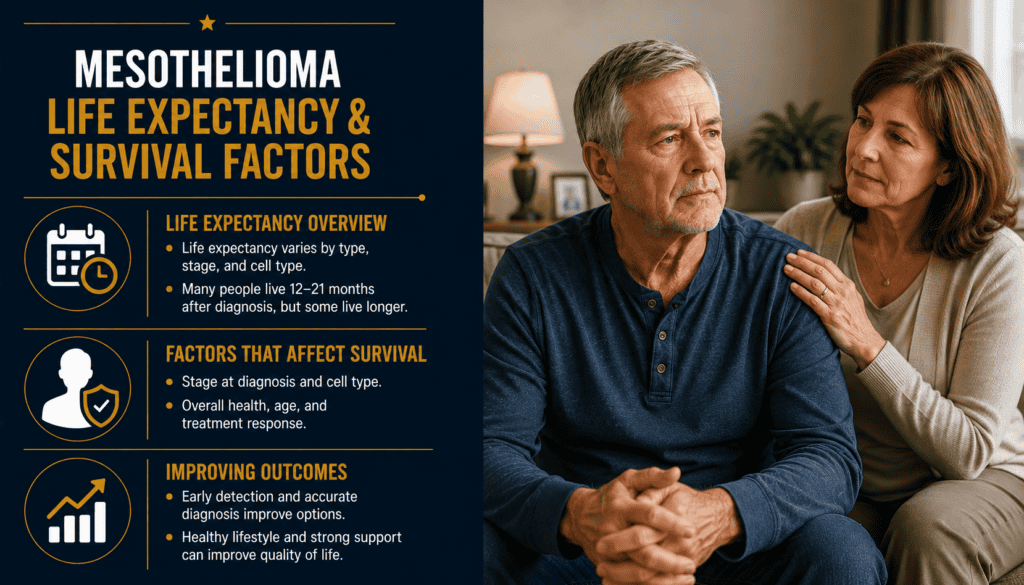
Mesothelioma Life Expectancy & Survival Factors: What Influences Prognosis?
A practical guide to the medical factors doctors consider—and the limits of predicting any one person’s future.
Learning about mesothelioma life expectancy can bring urgent questions: Which findings matter? Does a treatment change the outlook? What do survival percentages mean for my family? A prognosis is an informed medical estimate, not a deadline. The most useful discussion is one that connects your pathology, scans, health, treatment preferences and goals with your own oncology team.
What Life Expectancy and Prognosis Mean
Life expectancy describes an estimate of how long a person may live. Prognosis is broader: it considers how the disease may behave, the likelihood of responding to treatment, symptoms and quality of life. Neither can be established from an asbestos exposure history alone. A diagnosis must first be confirmed, typically through tissue pathology interpreted with imaging and clinical findings.
Doctors may revise an outlook as new information becomes available, including additional staging tests, treatment response, changes in fitness or a second pathology review. A prognosis discussion can include uncertainty and several plausible scenarios rather than one number. For definitions and population-based estimates, see mesothelioma life expectancy and the broader mesothelioma prognosis overview.
| Term | What it describes | What it does not tell you |
|---|---|---|
| Median survival | The time at which half of a studied group has died and half remains alive. | The date a particular patient will die. |
| Overall survival | Time from a defined study starting point to death from any cause. | Whether treatment alone caused an observed difference. |
| Relative survival | Observed survival compared with expected survival in a similar general population. | An individual’s probability or exact remaining time. |
| Progression-free survival | Time in a study before progression or death, as defined by its protocol. | The same thing as overall survival or a cure. |
Cancer Location and Disease Extent
Mesothelioma may arise in the lining around the lungs (pleura), the abdomen (peritoneum), or, much less commonly, other linings. These are distinct clinical situations. Results from pleural mesothelioma studies should not automatically be applied to peritoneal disease.
Extent of disease can affect which treatments are feasible. For pleural disease, doctors assess tumor spread and involvement of nearby structures, lymph nodes and distant sites. For peritoneal disease, the amount and distribution of tumor throughout the abdomen, and whether it can be removed safely, can be particularly important. Imaging cannot always establish the complete picture; the team may need additional testing.
| Finding | Why the team considers it | Important qualification |
|---|---|---|
| Pleural versus peritoneal location | Different disease patterns and treatment approaches. | Do not compare survival figures across locations without matching populations. |
| Localized versus extensive disease | May affect the feasibility of local procedures and systemic therapy. | Stage is only one factor, not a standalone prediction. |
| Lymph node or distant involvement | Can influence treatment planning and clinical-trial eligibility. | A scan finding may require confirmation. |
| Tumor distribution in the abdomen | Helps assess potential suitability for cytoreductive surgery. | An experienced peritoneal specialist must assess operability. |
For a separate explanation of cancer returning after prior treatment, visit recurrent mesothelioma. Recurrence and initial disease extent should not be treated as interchangeable.
Cell Type and Pathology
A pathologist examines biopsy tissue to identify mesothelioma and its histologic subtype. The major categories include epithelioid, sarcomatoid and biphasic (mixed). These categories can be associated with different patterns of behavior and treatment response at the population level, but pathology alone cannot determine an individual outcome.
Because mesothelioma is uncommon and can resemble other tumors, patients may ask whether an experienced mesothelioma pathologist should review the specimen. Molecular or additional pathology tests may sometimes help clarify a diagnosis or clinical-trial options; they do not automatically identify a proven targeted treatment.
| Pathology detail | Potential relevance | Question to ask |
|---|---|---|
| Epithelioid subtype | Often associated with more favorable group outcomes than sarcomatoid histology. | Has an expert confirmed the subtype? |
| Sarcomatoid subtype | May behave differently and influence systemic treatment discussions. | Which evidence applies to this subtype? |
| Biphasic subtype | Contains both epithelioid and sarcomatoid components. | Was enough tissue sampled to characterize the tumor? |
| Uncertain or limited biopsy | May leave diagnostic or subtype uncertainty. | Would a pathology review or further sampling change care? |
A favorable subtype is not a guarantee of long survival; an unfavorable subtype is not a personal deadline. Interpret all pathology results with the treating clinician.
Age, Health and Functional Status
Age can appear in survival studies, but chronological age alone is an incomplete measure of treatment suitability. Doctors also assess how independently a patient can perform daily activities, lung and heart function, kidney and liver health, nutrition, frailty, other illnesses and personal goals. These findings influence the safety and practicality of treatment.
Some issues may be treatable or modifiable: dehydration, poorly controlled pain, low appetite, breathlessness, anemia or medication side effects may interfere with daily function. Addressing them can improve comfort and sometimes help a patient participate in care, although it does not guarantee a longer lifespan.
| Factor | What the care team evaluates | Helpful next step |
|---|---|---|
| Performance status | Ability to walk, perform self-care and manage everyday activities. | Describe a typical day and recent changes accurately. |
| Heart and lung health | Reserve for procedures and tolerance of therapies. | Bring pulmonary and cardiac records to consultations. |
| Nutrition and weight | Unintentional weight loss, appetite and muscle strength. | Ask for an oncology dietitian when intake is difficult. |
| Other medical conditions | How existing conditions interact with treatment risks. | Share a complete diagnosis and medication list. |
Patients should not undertake strenuous exercise or start supplements to “improve prognosis” without discussing safety with their clinicians. Supportive care is valuable even when disease-directed treatment is not feasible.
Treatment and Specialist Evaluation
Mesothelioma treatment depends on disease location, extent, histology, prior therapies, fitness and patient preferences. Options can include systemic chemotherapy, immunotherapy, selected surgery, radiation for particular indications and symptom-directed procedures. An approach used for one patient may be unsuitable for another.
Some people with unresectable pleural mesothelioma may receive approved immunotherapy-based or chemotherapy-based regimens. Selected patients with peritoneal mesothelioma may be evaluated for cytoreductive surgery with heated intraperitoneal chemotherapy (HIPEC) at an experienced center. Surgery for pleural mesothelioma is highly selective and requires careful discussion of risks and uncertain benefit. Clinical trials may provide access to investigational strategies but do not promise better results.
| Care consideration | Possible relevance | What to verify |
|---|---|---|
| Systemic therapy | May control disease for some patients; response varies. | Which regimen is appropriate for this subtype and prior treatment history? |
| Specialized surgery | May be considered for carefully selected patients. | What are the procedure-specific risks and expected goals? |
| Radiation | May be used for particular local or symptom-related indications. | Is the goal symptom relief, local control or part of a broader plan? |
| Palliative care | Treats symptoms and supports quality of life alongside cancer care. | Can this team be involved now, regardless of treatment stage? |
Read more about surgery for mesothelioma, chemotherapy, and palliative care. These pages explain treatment pathways; they are not substitutes for an individualized recommendation.
How to Read Survival Statistics Without Misusing Them
Survival statistics describe groups diagnosed and treated during particular periods. A figure may reflect older therapies, differing diagnostic practices, disease locations, ages or eligibility rules. Studies conducted at specialist centers can include highly selected patients and should not be assumed to represent everyone with mesothelioma.
For example, a five-year relative survival rate describes a population comparison, not a countdown. A median is a midpoint in a studied group, not a limit beyond which nobody lives. Treatment-trial results must be interpreted with their exact study population, comparator and follow-up period. Avoid combining numbers from unrelated studies into a personalized prediction.
| Check before using a statistic | Why it matters |
|---|---|
| Diagnosis years and publication date | Patients may have received different treatments than those available now. |
| Pleural or peritoneal disease | These populations cannot be assumed equivalent. |
| Stage and cell type | A mixed cohort may not match the patient’s findings. |
| Study design and patient selection | Clinical trials and surgical series may exclude less-fit patients. |
| Outcome measured | Median overall survival differs from relative or progression-free survival. |
For numerical data with a clearly stated reporting period, see mesothelioma survival rates and mesothelioma cancer statistics. This page deliberately avoids presenting one survival figure as applicable to every patient.
Questions for Your Care Team
Bring a written list to an appointment, and ask permission to record the discussion or have a trusted person take notes. You may request a plain-language explanation of the pathology, scans and proposed treatment goals. It is reasonable to ask for a second opinion at a center experienced in the relevant type of mesothelioma.
| Question | What you are trying to understand |
|---|---|
| What is my confirmed mesothelioma type, location and extent? | Whether the diagnosis and staging are complete. |
| Which findings most affect my outlook? | How the clinician weighs pathology, health and disease distribution. |
| What is the goal of each treatment option? | Whether it aims at disease control, symptom relief or both. |
| What are the best-case, typical and difficult scenarios? | The range of uncertainty rather than a single number. |
| What changes should prompt an earlier appointment? | A clear safety and follow-up plan. |
If discussing prognosis feels overwhelming, ask the clinician to explain information in stages or to speak with a designated family member, consistent with your preferences. See monitoring for recurrence for follow-up considerations.
Planning, Support and Next Steps
People can plan for uncertainty without giving up on treatment. Useful steps include identifying a primary care contact, documenting medication and symptom changes, discussing priorities, reviewing insurance and travel needs, and arranging practical support. Advance care planning is a way to express preferences, not a prediction that death is imminent.
Ask the care team about palliative care for pain, breathlessness, sleep difficulties and emotional distress. Hospice is a different service generally considered when the focus shifts toward comfort under applicable eligibility rules; palliative care can begin much earlier. Family members may also benefit from counseling and caregiver respite.
| This week | Who can help | Result to aim for |
|---|---|---|
| Gather pathology, imaging and treatment records. | Oncology nurse or medical records team. | A clear, shareable medical summary. |
| Write down symptoms and daily activity changes. | Patient and caregiver. | More specific questions for the clinician. |
| Request a prognosis conversation or second opinion. | Treating oncologist and specialist center. | An individualized discussion of uncertainty and options. |
| Identify financial and caregiving needs. | Social worker, family and benefits counselor. | A practical support plan with named contacts. |
For additional context, read advances in survival and treatment. New research can create options for some patients, but hope should not be presented as a guarantee.
Frequently Asked Questions
What is the most important factor in mesothelioma life expectancy?
There is no single most important factor for everyone. Doctors combine cancer location and extent, cell type, overall health, treatment history and individual goals.
Does mesothelioma stage determine exactly how long someone will live?
No. Stage helps guide treatment and population-level prognosis, but it cannot determine an individual lifespan.
Is peritoneal mesothelioma life expectancy the same as pleural mesothelioma?
No. They involve different anatomy, treatment pathways and study populations. Figures from one should not automatically be applied to the other.
Can treatment improve survival?
Some treatments improve outcomes in defined patient groups, but benefit and risk vary. Ask your oncology team which evidence applies to your diagnosis.
Does age alone rule out treatment?
Not necessarily. Functional status, organ health, other conditions and preferences often matter alongside age.
Does a five-year survival rate mean a patient has five years to live?
No. It is a population statistic describing outcomes over a defined period; it does not predict a personal deadline.
Can a second opinion change prognosis discussions?
A specialist review may clarify pathology, staging or treatment options and therefore change the discussion, but it does not guarantee a different outcome.
When should I ask about palliative care?
At any stage when symptoms, stress or practical concerns need support. Palliative care can be provided alongside cancer-directed treatment.
Medical Sources and Further Reading
These primary medical and public-health resources explain treatment, survival measures and supportive care. Check the source’s update date and population before applying a statistic.
- National Cancer Institute: Malignant Mesothelioma Treatment (Patient Version)
- National Cancer Institute: Understanding Cancer Prognosis
- National Cancer Institute: Palliative Care in Cancer
- American Cancer Society: Mesothelioma Survival Rates
Editorial note: External resource URLs and any updated figures should be checked before publication.
Need Help Understanding Your Options?
Call 800.291.0963. Live chat is available 24/7, 365 days a year. Submit Your Case to ask about potential asbestos-related legal resources. No outcome or compensation is guaranteed.
⚕️ Legal & Medical Information Disclaimer
This page provides general information, not medical or legal advice. Prognosis and treatment decisions require your licensed care team; consult a qualified attorney about legal questions. Seek urgent medical attention for severe or rapidly worsening symptoms.