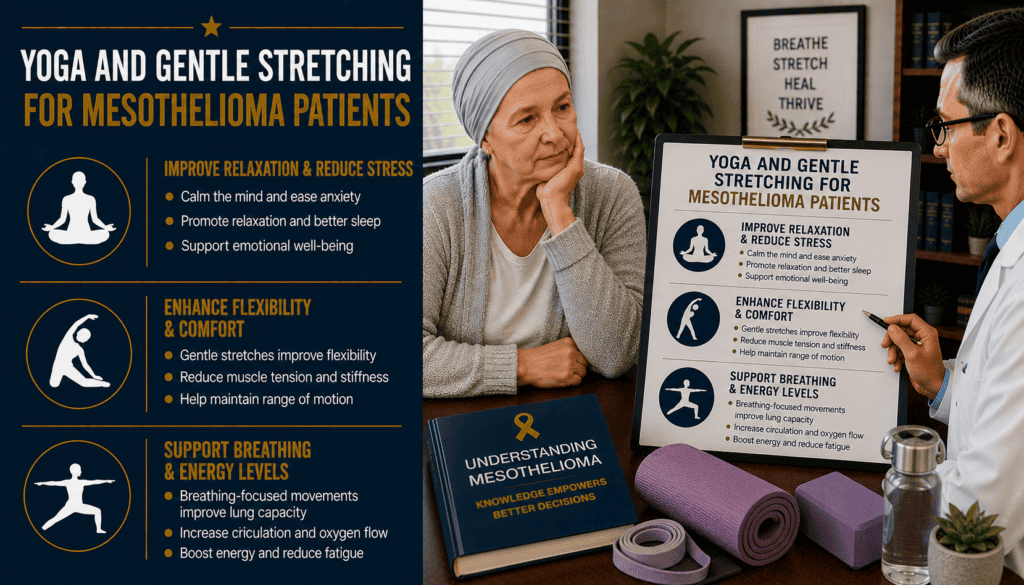
Yoga and Gentle Stretching for Mesothelioma Patients
Safe, adaptable movement and relaxation ideas to discuss with your mesothelioma care team.
Living with mesothelioma can make ordinary movement difficult. Gentle, modified yoga may help some patients feel more comfortable, but there is no single routine suitable for everyone. Start with medical clearance and choose comfort over intensity.
How gentle movement may help
Yoga combines movement, attention and sometimes breathing or meditation. For someone living with mesothelioma, an adapted session may offer a way to maintain comfortable mobility, practice relaxation and reconnect with everyday activity. It is supportive care, not a treatment for mesothelioma. Research on yoga in cancer populations suggests possible improvements in some symptoms and quality-of-life measures, but results cannot be assumed to apply to every person with mesothelioma.
The right activity depends on where the cancer is located, treatment history, breathing capacity, pain, balance and the person’s preferences. Some days, sitting comfortably and gently moving the hands may be enough. On other days, rest is the appropriate choice.
| Potential goal | Realistic expectation |
|---|---|
| Comfortable movement | May help maintain range of motion when approved by the care team. |
| Stress management | Gentle attention and relaxation may ease distress for some people. |
| Cancer control | Yoga has not been shown to remove tumors or replace oncology treatment. |
Ask your care team before starting
Ask your oncologist or surgeon whether you need activity restrictions, especially after thoracic or abdominal surgery, with a pleural catheter or other drain, during chemotherapy, or when receiving oxygen. A physical therapist, occupational therapist or oncology rehabilitation specialist can help tailor movements to your abilities. If your breathing is limited, ask whether pulmonary rehabilitation is appropriate.
Tell the team about bone involvement, dizziness, recent falls, low blood counts, blood clots, fever, neuropathy, swelling and new pain. Do not start a new exercise program while experiencing unexplained symptoms.
| Question | Why it matters |
|---|---|
| Are there lifting, twisting or arm-motion restrictions? | Incisions and surgical healing may require modifications. |
| Is chair-based movement safer than standing? | Weakness, dizziness and neuropathy can increase fall risk. |
| Should I avoid pressure on a catheter or port? | Devices need protection from pulling or compression. |
Create a safe space
Choose a quiet, well-ventilated room with a stable chair that does not roll. Wear comfortable clothing and supportive footwear if standing. Keep prescribed oxygen, mobility aids and a phone within reach. Have a caregiver nearby if you need help with transfers or balance. Avoid floor-based poses when getting down or standing up is difficult.
Start with a few minutes, not a target number of poses. Move slowly within a comfortable range; never push through pain, strain to hold a pose or compete with a video instructor. Avoid hot yoga, strenuous flows, breath-holding and forceful breathing exercises. People with chest discomfort or breathlessness should not be asked to take unusually deep breaths.
| Potential issue | Safer adjustment |
|---|---|
| Unsteady balance | Use seated movements or clinician-approved support. |
| Chest or abdominal incision | Follow surgical restrictions; avoid pressure and twisting. |
| Fatigue | Shorten the session or choose rest. |
A gentle chair-based practice
Only try these movements if your care team approves them. Sit upright in a sturdy chair with feet supported, or use the position your therapist recommends. The aim is comfortable motion, not stretching as far as possible.
- Arrive: Notice the support of the chair and allow your breathing to remain natural for several moments.
- Hands and wrists: Open and close your hands gently, then move your wrists through a small comfortable range.
- Shoulder release: If cleared after surgery, raise and lower your shoulders slightly without pulling on a port or incision.
- Ankles: Slowly point and relax your toes or make small ankle movements while seated.
- Finish: Rest and notice whether you feel comfortable. Stop if symptoms increase.
Skip any movement that causes pulling, pain, dizziness or breathlessness. Neck movements, overhead arm stretches and trunk twists may not be suitable after certain procedures; ask your therapist first.
| Stage | Option |
|---|---|
| Beginning | One minute of seated settling and natural breathing. |
| Movement | Two to three minutes of approved small movements with pauses. |
| Ending | One minute of rest and symptom check. |
Breathing and relaxation without strain
Yoga classes sometimes include structured breathing. With pleural mesothelioma, effusions, recent chest surgery or limited lung function, forceful breathing, long breath holds and instructions to inhale deeply may be uncomfortable or unsafe. Follow the breathing plan given by your respiratory therapist instead.
A gentler option is simply to notice ordinary breathing while relaxing your jaw and shoulders. If a clinician has taught you pursed-lip breathing or another technique, use it as instructed. Meditation and imagery can be practiced while sitting or lying in a medically comfortable position without changing the breathing pattern.
For more focused rehabilitation guidance, see breathing exercises and pulmonary rehabilitation and breathing therapy and long-term lung health.
| Class instruction | Mesothelioma-sensitive alternative |
|---|---|
| Hold your breath | Do not hold it; breathe naturally. |
| Take the deepest breath possible | Use a comfortable pattern approved by your clinician. |
| Continue through breathlessness | Stop, rest and follow your medical action plan. |
Adapt movement to treatment and recovery
During chemotherapy or immunotherapy, fatigue, anemia, neuropathy and infection risk may change what is safe. After surgery, incision healing, drains and lifting restrictions take priority. During radiation, skin irritation and fatigue may call for shorter sessions. Patients receiving palliative care can choose movement solely for comfort, or choose not to exercise.
Exercise should not be used to push through new symptoms. A physical therapist can help with safe mobility and transfers; see exercise and rehabilitation after surgery and managing treatment-related fatigue.
| Circumstance | Discussion with care team |
|---|---|
| Recent operation | Confirm incision, arm-motion and lifting restrictions. |
| Neuropathy or falls | Prioritize chair-based movement and supervised mobility. |
| Advanced illness | Choose comfort-focused movement, relaxation or rest. |
When to stop and seek help
Stop immediately for chest pain, sudden or markedly worsening shortness of breath, fainting, new confusion, unusual bleeding, or severe new pain. Call emergency services for severe breathing difficulty, chest pain or collapse. For new or worsening symptoms that are not immediately life-threatening, contact the oncology team promptly and follow its individualized instructions.
Do not stretch through a painful or swollen limb, new back pain with weakness, or symptoms around a drain or surgical wound. Fever during chemotherapy can be an emergency; follow the oncology team’s fever instructions rather than waiting to see whether rest helps.
| What happens | Action |
|---|---|
| Severe breathlessness, chest pain, collapse | Call emergency services. |
| Fever during chemotherapy or new significant symptoms | Contact oncology urgently using the team’s plan. |
| Mild fatigue without other concerning symptoms | Stop, rest and adjust future activity with the care team. |
Build a realistic weekly movement plan
Choose a goal that reflects how you feel rather than a rigid daily quota. Ask the care team whether a short seated practice, supervised walking or formal rehabilitation is most appropriate. Track how you feel before, during and afterward. If symptoms worsen later in the day, discuss reducing intensity or duration.
Caregivers can prepare a stable chair, keep the room clear and ask what kind of support the patient wants. They should not physically stretch the patient’s limbs or insist on exercise when the patient prefers rest. For broader guidance, see nutrition and exercise during treatment and alternative and complementary treatment information.
| Record | Example prompt |
|---|---|
| Clearance | Which movements has my clinician approved? |
| Plan | Which short, comfortable activity will I try? |
| Response | Did pain, fatigue or breathing change afterward? |
Frequently Asked Questions
Can yoga cure mesothelioma?
No. Yoga is a supportive activity and does not replace surgery, chemotherapy, immunotherapy, radiation or other prescribed care.
Is chair yoga safer than floor yoga?
It may reduce the need to get onto the floor, but it is not automatically safe. Ask the care team about balance, surgery and device restrictions.
Can I practice yoga after lung surgery?
Only after the surgeon or rehabilitation team clears specific movements. Restrictions depend on the procedure and healing.
Should I use deep-breathing exercises?
Do not force deep breaths or hold your breath. Follow breathing techniques prescribed by your respiratory or rehabilitation team.
What if I feel breathless during a session?
Stop immediately. Follow your personalized medical action plan; seek emergency help for severe or sudden breathing difficulty.
Is hot yoga appropriate during chemotherapy?
Hot yoga and strenuous classes are generally poor choices when dehydration, fatigue or treatment complications are concerns. Ask your oncology team about safer alternatives.
Can a caregiver help me stretch?
A caregiver can help set up a safe space but should not force a stretch or move an injured or restricted limb. Ask a therapist for hands-on instructions.
What if I am too tired to exercise?
Rest is a valid choice. Discuss persistent or worsening fatigue with your oncology team and consider a very short relaxation practice only if comfortable.
Medical Sources and Further Reading
These independent resources provide background on complementary approaches and physical activity. Confirm individual recommendations with your own care team.
Speak With Our Team
Questions about mesothelioma and possible asbestos exposure? Call 800.291.0963. Live chat is available 24/7, 365 days a year. Submit Your Case. No legal outcome or compensation is guaranteed.
⚕️ Legal & Medical Information Disclaimer
This page provides general education, not medical or legal advice. Ask your oncology team before exercising and consult a qualified attorney for legal advice.