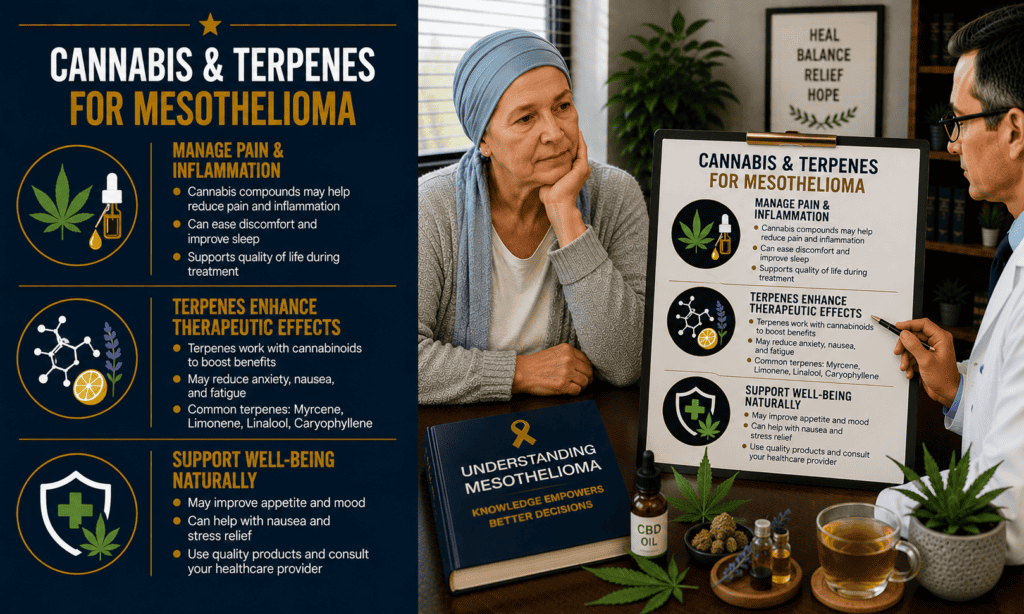
Cannabis Terpenes for Mesothelioma: Evidence, Risks and Questions to Ask
A patient-focused look at plant compounds, unproven anticancer claims and safer conversations about supportive care.
Key point: No cannabis terpene has been proven to treat, shrink or cure mesothelioma in people. Laboratory findings do not establish a clinical benefit. Do not replace prescribed cancer treatment with terpene products.
What Are Cannabis Terpenes?
Terpenes are aromatic compounds found in many plants, including cannabis, citrus fruits and herbs. They contribute to scent and flavor. Cannabis also contains cannabinoids such as THC and CBD; these are different chemical groups. A product advertised as “terpene-rich” may contain cannabinoids, added fragrances or other ingredients, depending on its formulation.
People diagnosed with mesothelioma may encounter claims that a particular terpene attacks cancer or makes THC and CBD work better. These claims require careful examination: a mechanism proposed in a cell culture is not evidence of tumor control in a patient.
| Term | What it means | What it does not prove |
|---|---|---|
| Terpene | Plant-derived aromatic compound | That it treats mesothelioma |
| Cannabinoid | Compound such as THC or CBD | That it cures cancer |
| Entourage effect | Proposed interaction among plant constituents | A demonstrated benefit for mesothelioma |
| Clinical trial | Study involving people under a protocol | That every product sold is equivalent |
Cancer Claims Versus Clinical Evidence
Researchers can expose cells to concentrated compounds in a laboratory. Such experiments may generate hypotheses, but they cannot establish effective or safe doses, delivery methods, survival benefits or interactions in people. Animal findings also need confirmation in carefully designed human studies.
The National Cancer Institute reports that cannabis and cannabinoids have been investigated for cancer-related symptoms, but cannabis and cannabinoids are not FDA-approved cancer treatments. Evidence specific to isolated terpenes in people with mesothelioma is insufficient to establish anticancer effectiveness.
| Claim you may see | What the evidence supports | Responsible interpretation |
|---|---|---|
| “Kills mesothelioma cells” | A laboratory experiment may study cell responses | Does not establish patient benefit |
| “Shrinks tumors naturally” | Requires reliable human tumor-response data | Not established for cannabis terpenes |
| “Boosts chemotherapy” | Interaction hypotheses require clinical testing | Do not combine without clinician review |
| “Works better with THC/CBD” | Sometimes called an entourage effect | Not proven as mesothelioma therapy |
Common Terpenes: What We Know and Do Not Know
Names such as myrcene, limonene, pinene, linalool and beta-caryophyllene appear frequently on cannabis product labels. They occur in other plants too. The presence of a named terpene does not establish that the amount, purity, route or formulation is medically useful. Studies involving isolated compounds cannot automatically be applied to a commercial blend.
| Compound | Commonly associated plant sources | Mesothelioma treatment evidence |
|---|---|---|
| Myrcene | Hops and some herbs | No established clinical benefit |
| Limonene | Citrus peel | No established clinical benefit |
| Pinene | Pine and rosemary | No established clinical benefit |
| Linalool | Lavender and other plants | No established clinical benefit |
| Beta-caryophyllene | Black pepper and cloves | No established clinical benefit |
These examples are descriptive, not product recommendations or dosing guidance. Claims of cancer treatment should be evaluated against human clinical outcomes, not aroma, marketing language or isolated molecular experiments.
Can Terpenes Help Mesothelioma Symptoms?
Breathlessness, pain, nausea, poor appetite and anxiety deserve individualized assessment. Research on cannabis or prescription cannabinoids for some cancer-related symptoms does not demonstrate that isolated terpenes provide the same benefits. For example, prescription dronabinol and nabilone have specific FDA-approved uses for chemotherapy-induced nausea and vomiting after inadequate response to conventional antiemetics; that approval does not extend to terpene products.
Ask the oncology team about established approaches, including breathlessness and pleural effusion care, nutrition support and palliative care.
| Symptom | Questions for the care team | Do not assume |
|---|---|---|
| Pain | Is the cause treatable? What medicines or supportive options fit? | A terpene will replace pain treatment |
| Nausea | Can the antiemetic regimen be adjusted? | Terpene blends equal approved drugs |
| Breathlessness | Is fluid, infection, anemia or another cause involved? | Inhaled products are safe for damaged lungs |
| Anxiety or sleep trouble | Would counseling, symptom treatment or sleep support help? | A scented product is risk-free |
Safety, Lung Health and Treatment Interactions
Smoking or vaping cannabis products may irritate the respiratory tract and introduce substances that are especially concerning for someone with pleural mesothelioma or reduced lung function. Essential oils and concentrated terpene liquids are not interchangeable with prescribed medicines; do not ingest, inhale or apply concentrated formulations as cancer treatment without medical advice.
Products that contain THC or CBD can cause sedation, dizziness and other effects. CBD can affect drug-metabolizing enzymes, creating potential interactions with cancer medicines. Clinical observations about cannabis use alongside immunotherapy raise questions but do not prove causation; patients should discuss all products with their oncology team rather than abruptly changing prescribed treatment.
| Risk area | Why it matters | Safer next step |
|---|---|---|
| Inhalation | Airway irritation or lung exposure | Ask the pulmonary/oncology team; avoid assuming inhalation is safe |
| Drug interactions | Cannabinoids or other ingredients may alter drug effects | Review full product label and medication list |
| Sedation and falls | THC-containing products may impair alertness | Discuss with clinician, especially with opioids |
| Contamination | Labels may not reliably reflect purity or ingredients | Do not assume a marketing certificate proves clinical safety |
| Treatment delay | Unproven products may displace effective care | Keep oncology follow-up and prescribed therapy |
How to Read Product Labels and Marketing
A product sold as “full-spectrum,” “terpene-enhanced,” “medical grade” or “natural” is not necessarily tested to treat cancer. Read the ingredient list for THC, CBD, solvents, flavoring agents and other additives. A laboratory certificate may address selected contaminants or concentrations, but it cannot prove that a product improves mesothelioma outcomes.
| Label phrase | What to ask | What it cannot establish |
|---|---|---|
| “Terpene profile” | Which compounds and concentrations were measured? | An effective cancer dose |
| “Full spectrum” | Does it contain THC, CBD or other actives? | Better survival |
| “Third-party tested” | Which batch, analytes and lab? | Clinical effectiveness |
| “Oncology support” | Is there a relevant human trial? | FDA approval or safety with chemotherapy |
Be cautious of testimonials, guaranteed remission claims, claims that doctors are hiding a cure, or instructions to stop chemotherapy or immunotherapy. The herbal medicines overview explains similar evidence and safety issues.
How to Discuss Cannabis Terpenes With Your Oncology Team
Patients can discuss cannabis products openly without embarrassment. Bring the packaging or a photo of the complete ingredient panel and explain what symptom you hope to address. Your oncologist or oncology pharmacist can review possible interactions, especially during immunotherapy, chemotherapy or radiation.
| Question | Why ask it |
|---|---|
| Could this interact with my current medicines? | Identify drug-specific concerns |
| Is the product inhaled, swallowed or applied? | Route changes exposure and risk |
| Is there evidence for my particular symptom? | Separate symptom care from anticancer claims |
| What proven options should we try first? | Avoid delaying effective symptom treatment |
| What side effects should prompt a call? | Agree on a safety plan |
A Practical, Evidence-Based Next-Step Checklist
First, identify the specific symptom or concern. Second, tell the oncology team about every supplement and cannabis product you use or are considering. Third, ask for the evidence in people with mesothelioma, not just cell or animal studies. Fourth, agree on a measurable symptom goal and a follow-up plan if the clinician considers a supportive intervention appropriate.
Do not start concentrated terpene products, inhale oils or substitute cannabis preparations for treatment. For broader options, see mesothelioma treatments, medical cannabis for mesothelioma and evidence-based complementary care.
| Step | Action |
|---|---|
| 1 | Write down the symptom and how it affects daily life |
| 2 | List medications, supplements and cannabis products |
| 3 | Bring exact product ingredients to your clinician |
| 4 | Ask about established symptom treatments and potential interactions |
| 5 | Keep cancer treatment and follow-up appointments |
Frequently Asked Questions
Can cannabis terpenes cure mesothelioma?
No. There is no reliable clinical evidence that cannabis terpenes cure mesothelioma or replace established cancer treatment.
Do terpenes shrink mesothelioma tumors?
Tumor shrinkage in patients has not been established for terpene products. Cell-culture findings do not demonstrate clinical benefit.
Are terpenes the same as THC or CBD?
No. Terpenes are aromatic plant compounds; THC and CBD are cannabinoids. Products may contain both.
What is the entourage effect?
It is a proposed interaction among cannabis constituents. It has not been established as an effective mesothelioma treatment.
Are terpene oils safe to inhale?
Do not assume so. Inhaled oils or concentrated compounds can pose respiratory risks, especially for patients with breathing problems.
Can I take terpenes during immunotherapy or chemotherapy?
Ask your oncologist or oncology pharmacist before using any cannabis blend or supplement. Ingredients and potential interactions vary.
Are prescription cannabinoids the same as terpene products?
No. Certain prescription cannabinoids have specific FDA-approved indications for chemotherapy-related nausea and vomiting; terpene blends do not share those approvals.
What should I do if a product promises to cure my cancer?
Do not stop prescribed treatment. Ask your oncology team to evaluate the claim and look for well-designed human clinical evidence.
Primary Medical Sources
- National Cancer Institute: Cannabis and Cannabinoids (Health Professional)
- National Cancer Institute: Cannabis and Cannabinoids (Patient)
- NIH NCCIH: Cannabis and Cannabinoids
Sources describe cannabis and cannabinoid evidence; they do not establish terpene-specific benefits for mesothelioma. Confirm the latest medical guidance with your care team.
Help for Patients and Families
Call 800.291.0963. Live chat is available 24/7, 365 days a year. Submit Your Case to ask about potential legal options. Compensation is not guaranteed, and eligibility depends on individual circumstances.
⚕️ Legal & Medical Information Disclaimer
This article is educational and is not medical or legal advice. Consult your oncology team before using cannabis, terpene products or supplements; consult a qualified attorney for advice about claims.