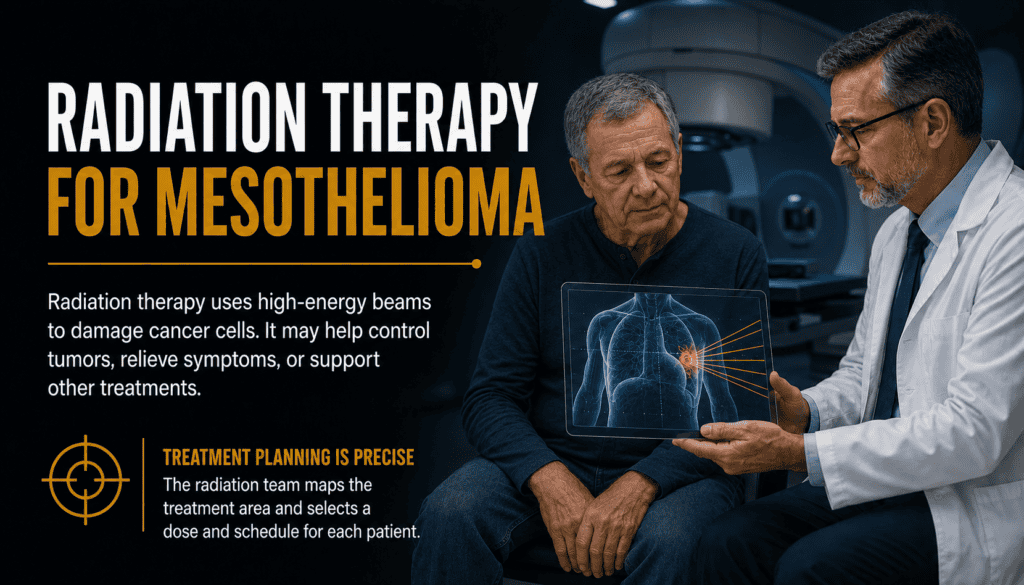
Radiation Therapy for Mesothelioma
Understand when radiation may help, how treatment is planned, what side effects to watch for and how to discuss options with your cancer care team.
Radiation therapy directs high-energy beams at a defined area of cancer. For mesothelioma, it may relieve painful or obstructive tumors, sometimes form part of a carefully selected treatment plan around surgery, or be considered when surgery is not planned. It is not automatically appropriate for every patient: mesothelioma often spreads along thin tissue surfaces near the lungs, heart and other sensitive structures, which makes safe targeting difficult. A radiation oncologist should explain the goal, expected benefit, uncertainties and risks for your specific situation.
Start with our mesothelioma treatments overview, or explore multimodal therapy when several treatment approaches are being considered.
What Is Radiation Therapy for Mesothelioma?
External-beam radiation is the principal approach used in mesothelioma. A machine outside the body aims radiation at a mapped treatment area. Radiation damages cells in that area; healthy tissue may also be affected, so the dose and beam arrangement are chosen with particular care. The treatment itself is not the same as a diagnostic CT scan and does not make the patient radioactive after an ordinary external-beam session.
Radiation is a local treatment. It does not circulate through the body like systemic chemotherapy or immunotherapy. This difference helps explain why doctors may use radiation for a specific painful chest-wall deposit even when other treatments address cancer elsewhere.
| Key term | Plain-language meaning |
|---|---|
| Radiation oncologist | Doctor who designs and supervises radiation treatment. |
| Treatment field | The body region targeted by the radiation beams. |
| Fraction | One scheduled treatment session or portion of the prescribed dose. |
| Palliative radiation | Radiation intended mainly to reduce symptoms rather than eradicate all cancer. |
| Adjuvant radiation | Radiation delivered after another treatment, sometimes surgery, to address possible remaining cancer. |
When and Why Doctors Recommend Radiation
The most useful question is not simply “Can radiation treat mesothelioma?” but “What specific problem would radiation address for me?” The answer depends on the cancer location, symptoms, prior surgery or radiation, lung function and the surrounding organs.
| Possible goal | When it may be discussed | Important limitation |
|---|---|---|
| Reduce localized pain | A painful chest-wall or other defined tumor deposit | Relief varies and may not last. |
| Relieve a focal symptom | A tumor contributes to bleeding, swallowing difficulty or another localized problem | Other causes of the symptom may need separate treatment. |
| After selected surgery | A specialist team considers treating possible microscopic residual disease | Survival benefit is not established for every surgical approach. |
| Part of non-surgical care | A specific region can be targeted safely | Diffuse disease and organ proximity may limit its use. |
Radiation is not routine for every mesothelioma diagnosis. It may be particularly valuable for symptom relief, but any proposed whole-chest or post-operative course deserves detailed discussion of benefits and organ-at-risk constraints. The National Cancer Institute describes radiation as an option within individualized care, including palliative treatment.
Radiation Techniques and How They Differ
Radiation specialists select a technique according to the treatment goal, tumor shape, prior treatment and how close the target lies to healthy tissue. More technically advanced does not automatically mean better for every patient.
| Technique | What it does | Question to ask |
|---|---|---|
| Conventional external-beam radiation | Delivers beams from outside the body to a planned region. | How much healthy lung and heart tissue receives radiation? |
| 3D conformal radiation | Shapes treatment fields using three-dimensional imaging. | Does this adequately cover my target? |
| Intensity-modulated radiation therapy (IMRT) | Adjusts beam intensity to fit complex shapes. | What are the lung-dose limits and expected trade-offs? |
| Stereotactic body radiation therapy (SBRT) | Delivers precisely planned radiation in fewer, often higher-dose sessions for selected focal targets. | Is my tumor location suitable? |
| Proton therapy | Uses particle beams with different dose distribution characteristics. | Is there a demonstrated benefit in my case, and is expertise available? |
IMRT, SBRT and proton therapy may be considered in selected settings; they are not interchangeable. Treating a large pleural surface is especially challenging because the opposite lung, remaining lung, heart, esophagus and spinal cord may be at risk. Ask whether your plan is reviewed by a mesothelioma-experienced multidisciplinary team. An expert consensus paper addresses postoperative and symptom-focused scenarios while recognizing evidence gaps.
Planning and Preparing for Treatment
Before treatment, your team generally reviews pathology, recent imaging, prior operations, medications, previous radiation and your ability to lie in the treatment position. A planning appointment, often called simulation, may use CT imaging and positioning supports to make sessions reproducible.
| Planning step | Why it matters | What to bring or ask |
|---|---|---|
| Confirm treatment goal | Defines what success would look like. | Is the goal pain relief, local control or postoperative treatment? |
| Review scans and biopsy | Identifies the target and nearby structures. | Do you need my original imaging and pathology? |
| Review lung and general health | Helps estimate treatment tolerance. | Will breathing tests or other assessments be needed? |
| Review previous radiation | Limits overlap with previously treated areas. | Can my previous radiation records be obtained? |
| Discuss schedule and logistics | Helps patients plan transportation and caregiving. | How many visits and how much setup time? |
Tell the team about worsening breathlessness, a pacemaker or implanted device, pregnancy possibility, inability to lie flat, or difficulty traveling. Do not stop medications without instructions from your clinician.
Need help now? Call 800.291.0963 / Live chat available 24/7, 365 days a year / Submit Your Case.
What Happens During Radiation Sessions?
At each session, therapists position you as they did during simulation, check alignment and leave the room while operating the machine. They can observe and communicate with you. Beam delivery is generally painless, though lying still or raising an arm may be uncomfortable. Setup usually takes longer than the beam delivery itself.
| Time point | What usually happens |
|---|---|
| Before the first session | Consent, treatment-plan review, simulation and safety checks. |
| At each visit | Positioning, imaging or alignment checks, then beam delivery. |
| During the course | The team asks about symptoms and adjusts supportive care as needed. |
| After completion | Follow-up evaluates symptom response and delayed effects. |
The schedule may range from a short symptom-directed course to several weeks for more complex plans. There is no single standard schedule for all patients. Ask your team for your exact number of fractions, expected start date and whom to call after hours.
Side Effects and Safety
Possible short-term effects include fatigue, redness or irritation of skin within the treatment field, and temporary discomfort. Chest radiation can irritate the esophagus or affect lung tissue; abdominal radiation may cause nausea, diarrhea or appetite changes. Some effects appear after treatment, so follow-up matters even if sessions were initially easy.
| Possible issue | What to tell your team |
|---|---|
| Fatigue | Report if it limits eating, walking or daily activities. |
| Skin irritation | Ask which creams or dressings are appropriate; avoid unapproved products on the field. |
| Swallowing pain | Report reduced fluid intake, weight loss or trouble swallowing. |
| New or worsening breathlessness | Contact the treatment team promptly; lung inflammation and other causes require assessment. |
| Nausea or diarrhea | Ask about medications, hydration and nutrition support. |
| Delayed lung injury | Ask about your individualized risk, particularly if lung tissue is in the field. |
Seek urgent medical assessment for severe or rapidly worsening breathing trouble, chest pain, fainting or other emergency symptoms. Do not assume these are expected radiation effects. Side-effect risk depends on the dose, treatment location, baseline health and other therapies. The American Cancer Society outlines mesothelioma-specific radiation effects and why targeting is difficult.
Radiation With Other Mesothelioma Treatments
Radiation may be discussed alongside surgery, chemotherapy, immunotherapy or supportive care. The timing and combination matter: treating an entire chest surface after surgery differs greatly from delivering a short course to one painful lesion. Combining treatments can increase toxicity, and evidence supporting particular sequences is not equally strong.
| Treatment alongside radiation | Why the team may discuss it | Planning consideration |
|---|---|---|
| Surgery | Possible treatment of residual local disease in carefully selected cases. | Type of operation, remaining lung and healing. |
| Chemotherapy | Addresses disease beyond one radiation field. | Overlapping side effects and treatment timing. |
| Immunotherapy | Treats cancer through immune mechanisms. | Potential lung inflammation and sequencing need specialist review. |
| Supportive or palliative care | Manages pain, breathlessness, nutrition and daily function. | Can begin early and continue alongside cancer treatment. |
Learn more about multimodal treatment and immunotherapy. For some patients, symptom control through fluid drainage, medicines or other measures may be preferable to radiation for a particular complaint. A personalized comparison is essential.
Questions, Follow-Up and Next Steps
Use the following checklist at your radiation-oncology consultation. Request answers in writing or ask a trusted person to take notes. A mesothelioma specialist or second opinion may help when a complex postoperative or whole-chest plan is proposed.
| Ask your team | Why it matters |
|---|---|
| What is the main goal and how will we measure success? | Separates symptom relief from attempts at longer-term local control. |
| Why radiation rather than another treatment now? | Clarifies alternatives and timing. |
| Which organs are at risk, and what limits are you using? | Makes safety planning concrete. |
| What is my schedule and what happens if I miss a visit? | Helps coordinate care. |
| Which symptoms require an immediate call? | Creates a clear safety plan. |
| When will we assess whether it helped? | Sets realistic follow-up expectations. |
Keep copies of the treatment summary, dose and field information, especially if you may seek care at another cancer center. Follow-up imaging and clinical visits depend on the broader cancer plan. For general treatment context, review the NCI mesothelioma treatment guide.
Frequently Asked Questions
Can radiation cure mesothelioma?
Radiation alone is generally not considered a reliable cure for diffuse mesothelioma. Its role may be symptom relief or part of selected combined-treatment plans; ask what outcome is realistic for your case.
Is radiation painful?
External-beam radiation delivery is typically painless. Holding a treatment position can be uncomfortable, and side effects may develop during or after a course.
How many radiation sessions will I need?
The number depends on the goal, tumor location, prescribed dose and technique. A short palliative course and a complex postoperative plan may have very different schedules.
Can radiation help mesothelioma pain?
It can reduce pain caused by a localized tumor for some patients, although relief is not guaranteed and may be temporary. Your team should also address pain with other supportive measures.
Can I receive radiation after mesothelioma surgery?
Some carefully selected patients may be considered for postoperative radiation. The operation performed, remaining lung and other organ risks strongly influence the decision.
Is proton therapy better than IMRT?
Neither is automatically preferable. Your radiation oncologist should compare the actual proposed plans, normal-tissue doses, available expertise and evidence for your clinical situation.
What side effects need urgent attention?
Severe or rapidly worsening shortness of breath, chest pain or fainting warrant urgent medical evaluation. Report other new or persistent symptoms promptly to your treatment team.
Does radiation replace chemotherapy or immunotherapy?
Usually not. Radiation treats a defined area; systemic therapies work throughout the body. Whether to combine, sequence or omit treatments depends on the individualized plan.
Medical Sources and Further Reading
- National Cancer Institute: Mesothelioma Treatment — treatment choices and palliative radiation.
- American Cancer Society: Radiation Therapy for Mesothelioma — indications, techniques and side effects.
- NCI/IASLC/Mesothelioma Applied Research Foundation expert consensus — specialist radiation planning scenarios.
Sources provide general education; your treating team must assess your individual diagnosis and treatment plan.
Get Help With Mesothelioma Questions and Next Steps
Call 800.291.0963. Live chat is available 24/7, 365 days a year. Submit Your Case to discuss possible next steps and available resources.
Every diagnosis and legal situation is different. No treatment result, compensation amount or case outcome is guaranteed.
⚕️ Legal & Medical Information Disclaimer
This page provides general information, not medical or legal advice. A qualified cancer care team should evaluate treatment choices, and a licensed attorney can advise on legal rights and deadlines.