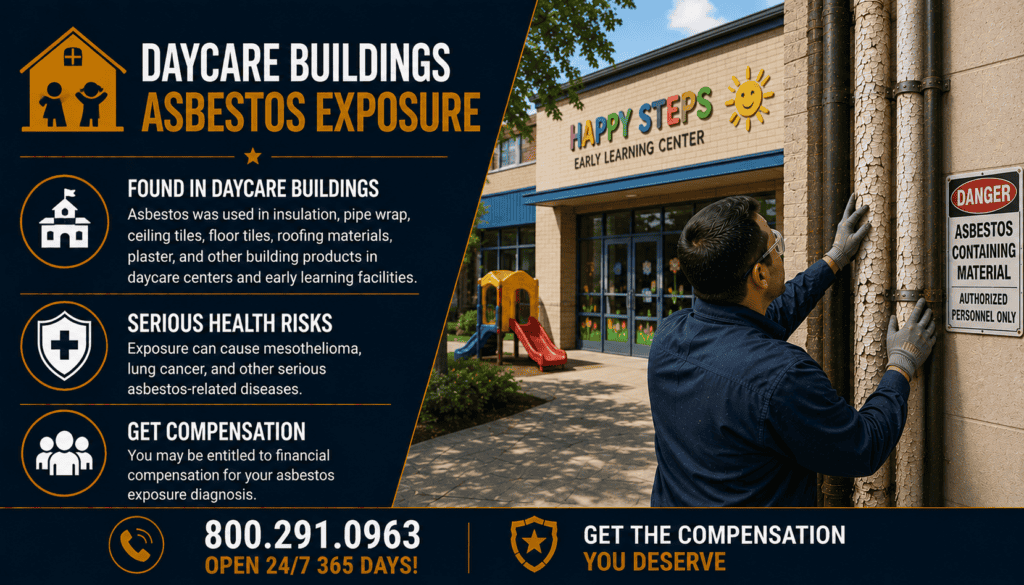
🧸 Daycare Buildings Asbestos Exposure
Daycare centers can operate in purpose-built childcare facilities, converted homes, former schools, church buildings, community facilities and older commercial properties. Depending on the building, construction era, materials and renovation history, some daycare buildings may contain asbestos-containing flooring, insulation, ceiling materials, roofing, wall systems or mechanical components.
Working in, attending or having a child enrolled in an older daycare does not by itself prove asbestos exposure. A useful investigation should connect the person to a specific daycare facility, building area, work or activity, time period, renovation or maintenance project and asbestos-containing material.
This page is part of the Educational Buildings Asbestos Exposure hub and the broader Buildings Asbestos Exposure resource.
🧸 How Asbestos Exposure Could Occur in Daycare Buildings
Potential exposure depends on whether asbestos-containing material was actually present and whether it became damaged or was disturbed. EPA explains that asbestos-containing material in good condition can often be managed in place; concern increases when material is damaged or disturbed and fibers can become airborne.
Activities worth investigating include:
- Removing or replacing older flooring.
- Opening walls or ceilings during remodeling.
- Repairing boilers, pipes or heating systems.
- Replacing HVAC equipment.
- Roof repairs or replacement.
- Renovating bathrooms, kitchens or classrooms.
- Demolishing older additions or partitions.
- Cleaning construction or maintenance debris.
A daycare’s prior use can be especially important. A childcare center operating in a converted school, church, residence or commercial building may have inherited materials installed decades before the daycare opened.
🏫 Daycare Building Types and Areas to Investigate
🧸 Purpose-Built Childcare Facilities
The original construction date, additions and major remodeling projects can help identify which materials and building systems deserve investigation.
🏫 Former School Buildings
A daycare operating in a former or shared school facility may require review of the building’s earlier school use, asbestos records and renovation history. See School Buildings Asbestos Exposure.
⛪ Church and Religious Facilities
Childcare programs sometimes operate in church classrooms, fellowship buildings or other religious facilities. See Church Buildings Asbestos Exposure.
🏢 Converted Commercial or Community Buildings
When a building was converted to daycare use, records from the earlier owner or occupancy may reveal renovations, mechanical systems or historical building materials.
⚙️ Mechanical and Utility Areas
Boiler rooms, pipe chases, utility spaces and HVAC areas can be particularly relevant for maintenance workers and contractors.
🧱 Asbestos-Containing Materials to Investigate
No building material should be labeled asbestos-containing solely from appearance or age. Records, professional inspection and appropriate laboratory analysis may be needed.
| Daycare Area | Material or System to Investigate | Potential Disturbance |
|---|---|---|
| Floors | Certain floor coverings and adhesives | Removal, scraping or replacement |
| Ceilings | Certain ceiling or surfacing materials | Repair, access or remodeling |
| Walls | Certain compounds, plasters and panels | Cutting, drilling or demolition |
| Mechanical areas | Pipe, boiler and equipment insulation | Maintenance, repair or removal |
| HVAC systems | Certain insulation and associated materials | Upgrade or replacement |
| Roofs | Certain historical roofing materials | Repair or tear-off |
For additional historical building-material categories, see Common Asbestos Materials Found in Pre-1970s Buildings.
👷 Daycare Employees, Maintenance Workers and Contractors
Potential exposure depends on actual contact with or proximity to disturbed asbestos-containing material. People whose histories may warrant investigation include:
- Daycare maintenance employees.
- Custodians and janitorial workers.
- Building engineers.
- Plumbers and pipefitters.
- Electricians.
- HVAC technicians.
- Carpenters and remodelers.
- Roofers.
- Construction and demolition contractors.
- Daycare staff working near renovation activity.
Childcare staff and occupants should be evaluated differently from tradespeople who directly cut, removed or repaired building materials. Presence in an older facility alone does not establish exposure.
🔨 Renovation, Repair and Maintenance Exposure
Renovation can be an important exposure event in an older daycare building. OSHA’s asbestos construction requirements cover alteration, repair, maintenance, renovation and demolition work involving asbestos-containing structures or materials.
Projects worth investigating include flooring replacement, ceiling work, plumbing repairs, electrical upgrades, HVAC replacement, roofing, room conversions, additions and demolition.
When an older building is remodeled for childcare use, records from the conversion project may be especially valuable because they can identify materials removed, contractors involved and asbestos surveys or abatement performed.
See Historic Building Renovation Job Sites Asbestos Exposure for additional renovation-related information.
📋 AHERA and Daycare Asbestos Requirements
Daycare facilities should not automatically be treated as schools under the federal Asbestos Hazard Emergency Response Act (AHERA). EPA states that nursery and daycare centers are generally not subject to AHERA because they generally do not fall within the rule’s definition of a school.
There is an important exception: EPA explains that if a nursery or daycare center falls within the definition of a school under applicable state law, portions of the facility that qualify as a school building under the federal rule can be covered by AHERA.
For covered public and nonprofit private schools, AHERA requires asbestos inspections, management plans and actions to prevent or reduce asbestos hazards. Therefore, when a daycare shares space with a school or operates in a facility legally classified as a school, the facility’s regulatory status and available asbestos records should be checked rather than assumed.
State and local asbestos requirements may also differ from federal requirements.
📂 How to Document Daycare Building Asbestos Exposure
A strong reconstruction moves beyond “I worked in an old daycare” toward:
Person → Daycare → Building/Room → Job or Activity → Material → Project → Date
- Identify the daycare and building address.
- Determine the building’s original and prior uses.
- Record employment or contractor dates.
- Identify rooms and building areas where relevant work occurred.
- List renovation, repair or demolition projects.
- Look for asbestos surveys, inspection reports and abatement records.
- Locate permits, building plans and historical specifications.
- Identify property owners and contractors during the relevant period.
- Locate maintenance records, invoices and work orders.
- Identify coworkers, supervisors or other witnesses.
If the daycare operated in a school facility, an applicable asbestos management plan may contain building-specific information. If it operated in another type of property, owner, municipal, contractor or facilities records may be more important.
See Steps to Prove Asbestos Exposure in Older Buildings for a broader evidence framework.
❓ Daycare Buildings Asbestos Exposure Questions
Did every older daycare building contain asbestos?
No. Building age and prior use can justify further investigation, but neither proves that a particular material contained asbestos.
Are daycare centers covered by AHERA?
Generally no, according to EPA. However, a daycare may be covered if it falls within the applicable definition of a school. The facility’s specific status should be checked.
Could a daycare in an old school building have asbestos records?
Potentially. If the property was or remains a covered school, asbestos management, inspection or response-action records may exist.
Where might asbestos-containing materials be investigated in a daycare?
Depending on the building and era, investigators may examine certain flooring, ceilings, walls, pipe and boiler insulation, HVAC areas, roofing and other building materials.
Could daycare employees have been exposed?
Potentially, especially if asbestos-containing material was disturbed in or near their work area. Employment in an older daycare alone does not prove exposure.
Which workers may have had more direct exposure opportunities?
Maintenance workers, custodians, plumbers, electricians, HVAC technicians and renovation contractors may have directly disturbed installed building materials.
Why is the building’s prior use important?
A daycare may occupy a structure originally built as a school, church, residence or commercial property. Earlier construction and renovations may explain materials still present during the daycare period.
🚀 Turn a Daycare Building History Into a Clear Exposure Record
📞 Review the Facility, Prior Use, Work, Projects and Evidence
If you or a loved one worked in a daycare building and later developed mesothelioma or asbestos-related lung cancer, a focused review can help identify possible exposure sources and surviving records.
- Facility — daycare name, address, prior use and relevant dates.
- Work — occupation, maintenance tasks, renovations and nearby trades.
- Exposure — flooring, ceilings, insulation, mechanical systems and other materials.
- Evidence — surveys, permits, plans, work orders, abatement records and witnesses.
Call 800.291.0963 now, use live chat 24/7/365, or Submit Your Case for a free, confidential case review.
Compensation is not guaranteed. Potential legal options depend on the diagnosis, exposure evidence, potentially responsible parties, applicable law and filing deadlines.
⚕️ Legal & Medical Information Disclaimer
This page provides general educational information and is not legal or medical advice. Working in, attending or having a child enrolled in a daycare building does not by itself prove asbestos exposure, disease causation, legal liability or eligibility for compensation.