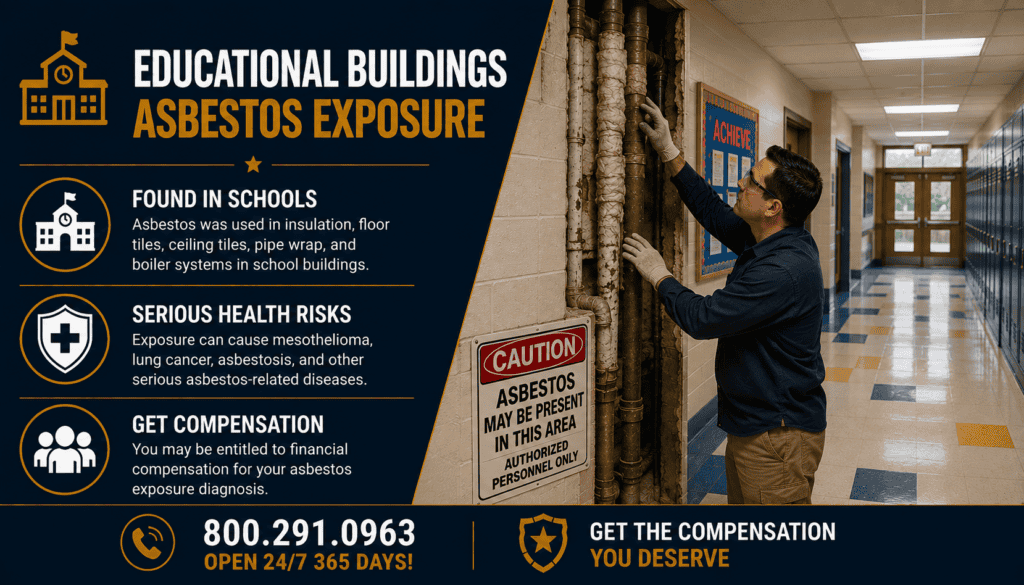
🏫 Educational Buildings Asbestos Exposure
Schools, colleges, universities, libraries, daycare centers and other educational facilities may contain asbestos-containing building materials installed during earlier construction and renovation periods. Depending on the building, era, materials and work performed, teachers, maintenance employees, custodians, contractors and other workers may have encountered asbestos during repairs, remodeling, demolition or routine building maintenance.
Working in an older educational building alone does not prove asbestos exposure. A useful exposure investigation should connect the person’s school or campus, specific building, occupation, work area, dates, renovation or maintenance activities and asbestos-containing materials.
This hub organizes MesotheliomaHelp.Center resources covering asbestos exposure in schools, universities, libraries, daycare facilities, church buildings and other educational properties.
See the broader Buildings Asbestos Exposure guide for other commercial, industrial, government, healthcare, transportation and public-building exposure topics.
🏫 How Asbestos May Have Been Encountered in Educational Buildings
Potential exposure in educational buildings depended heavily on the age and construction history of the property, the materials actually installed and whether asbestos-containing materials were disturbed.
- Removing or replacing older floor tile or flooring materials.
- Repairing insulated pipes, boilers or mechanical systems.
- Cutting or disturbing certain wall, ceiling or cement materials.
- Removing or replacing older roofing products.
- Renovating classrooms, offices, laboratories or common areas.
- Maintaining heating, ventilation and electrical systems.
- Demolishing or remodeling older portions of a campus.
- Working near contractors disturbing asbestos-containing materials.
A building’s age can help identify a period worth investigating, but age alone does not prove asbestos was present or that an individual inhaled asbestos fibers.
🗂️ Explore Educational Building Asbestos Exposure
🏫 School Buildings Asbestos Exposure
Review potential asbestos exposure involving classrooms, hallways, cafeterias, mechanical areas, utility spaces and other portions of elementary and secondary school buildings.
🎓 University Buildings Asbestos Exposure
Explore older university buildings where asbestos-containing materials may have been installed in classrooms, laboratories, offices, mechanical systems and other campus facilities.
🏛️ Colleges & University Campus Buildings Asbestos Exposure
Large campuses may contain buildings constructed and renovated during many different periods. Exposure investigations should identify the specific structure, work location and time period involved.
📚 Library Buildings Asbestos Exposure
Older libraries may require investigation of flooring, ceilings, mechanical spaces, pipe systems and materials disturbed during remodeling or modernization.
🧸 Daycare Buildings Asbestos Exposure
Daycare facilities can occupy purpose-built structures or older buildings converted from another use. The property’s complete construction and renovation history can therefore matter.
⛪ Church Buildings Asbestos Exposure
Churches and religious facilities sometimes contain classrooms, schools, daycare areas and community spaces in addition to worship areas. Older additions and mechanical systems can require separate investigation.
🏫 Asbestos in Schools & Public Buildings
Review asbestos inspection, management and building-safety issues involving schools and other public facilities.
🧱 Asbestos-Containing Materials to Investigate
Not every educational building contained the same products, and not every material installed during an earlier era contained asbestos.
| Building Area | Material or System to Investigate | Potential Disturbance |
|---|---|---|
| Floors | Certain floor tiles, backing and adhesives | Removal, repair or replacement |
| Ceilings | Certain ceiling and surfacing materials | Maintenance or renovation |
| Walls | Certain plaster, compounds and wall systems | Cutting, drilling or demolition |
| Mechanical rooms | Pipe and equipment insulation | Repair and replacement |
| Heating systems | Boilers, piping, valves and insulation | Maintenance and equipment work |
| Roofs | Certain roofing products | Repair, removal and replacement |
Material appearance alone generally cannot establish asbestos content. Historical specifications, asbestos surveys, management plans, abatement records and appropriate material analysis may provide stronger evidence.
The broader Asbestos Exposure in Products resource can help identify other historical product categories that may be relevant to an exposure investigation.
👷 Teachers, Maintenance Workers and Other People at Risk
Potential exposure depended more on a person’s activities and proximity to disturbed material than simply being employed by a school.
- Custodians and janitorial employees.
- Maintenance workers.
- Building engineers.
- Plumbers and pipefitters.
- Electricians.
- HVAC technicians.
- Boiler and heating-system workers.
- Construction and renovation contractors.
- Roofers.
- Teachers and school employees.
- Laboratory and workshop personnel.
- Facilities employees.
Our dedicated Teachers and School Staff Hidden Building Hazards page examines exposure questions involving teachers and other school personnel.
🔨 Renovation, Repair and Maintenance Exposure
Renovation and maintenance history can be particularly important when investigating an older educational facility.
Activities such as cutting, drilling, sanding, removing, demolishing or replacing building materials can disturb asbestos-containing materials if asbestos is present.
The Historic Building Renovation Job Sites Asbestos Exposure resource explains additional issues involving older structures and renovation work.
📞 Need Help Reconstructing Educational Building Exposure?
If you or a loved one developed mesothelioma or asbestos-related lung cancer after working in schools, colleges, universities or other educational facilities, a focused review can help organize the building and employment history.
Call 800.291.0963, use live chat 24/7, 365 days a year, or Submit Your Case for a free, confidential case review.
📋 School Asbestos Inspections and Management Plans
Federal asbestos requirements can make school records particularly valuable when investigating historical exposure.
The U.S. Environmental Protection Agency explains that the Asbestos Hazard Emergency Response Act, commonly called AHERA, requires covered public school districts and nonprofit private schools to inspect school buildings for asbestos-containing building materials, prepare asbestos management plans and take appropriate response actions.
EPA’s Asbestos and School Buildings guidance provides additional information about AHERA and school asbestos management requirements.
🔎 How to Document Educational Building Asbestos Exposure
A useful exposure investigation moves beyond a general statement such as “I worked in an old school.”
Person → School/Campus → Building → Work Area → Material → Activity → Date
- Employment records identifying the school district, institution and employment dates.
- School or campus records identifying the particular buildings where the person worked.
- Asbestos management plans documenting identified or assumed asbestos-containing building materials.
- Inspection reports showing materials and locations that were examined.
- Blueprints and building plans identifying mechanical systems and work areas.
- Renovation records documenting major remodeling projects.
- Asbestos abatement records identifying removal or containment work.
- Maintenance work orders documenting repairs involving particular areas or systems.
- Contractor records identifying companies performing renovation or maintenance.
- Coworker statements describing jobs, work areas and conditions.
The Steps to Prove Asbestos Exposure in Older Buildings guide explains how these different evidence sources can be combined.
❓ Educational Building Asbestos Exposure Questions
Did every older school contain asbestos?
No. Construction age can indicate that further investigation is reasonable, but the materials actually used varied by building, manufacturer, construction project and renovation history.
Does asbestos in a school prove everyone inside was exposed?
No. The presence of asbestos-containing material does not establish that every teacher, student, employee or contractor inhaled asbestos fibers.
Which school workers may have had more direct contact with building materials?
Custodians, maintenance employees, engineers, plumbers, electricians, HVAC technicians and construction contractors may have performed work involving building systems or materials.
Why are school asbestos management plans important?
For schools subject to AHERA, management plans may contain building-specific information about asbestos-containing materials, inspections and response actions.
Can renovation records help establish historical exposure?
Potentially. Renovation records can help establish when work occurred, which parts of a building were affected and whether asbestos inspection or abatement was involved.
🚀 Turn an Educational Building History Into a Clear Exposure Record
📞 Review the School, Building, Job, Materials and Evidence
If you or a loved one worked in an educational building and later developed mesothelioma or asbestos-related lung cancer, a focused investigation can help identify possible exposure sources and determine what records may still exist.
- Location — school, university, campus, building and work area.
- Work — occupation, maintenance activities, renovation projects and nearby trades.
- Exposure — insulation, flooring, ceilings, mechanical systems and other materials.
- Evidence — management plans, inspections, work orders, blueprints, contractor records and witnesses.
Call 800.291.0963 now, use live chat 24/7/365, or Submit Your Case for a free, confidential case review.
⚕️ Legal & Medical Information Disclaimer
This page provides general educational information and is not legal or medical advice. Working in or attending an educational building does not by itself prove asbestos exposure, disease causation, legal liability or eligibility for compensation.