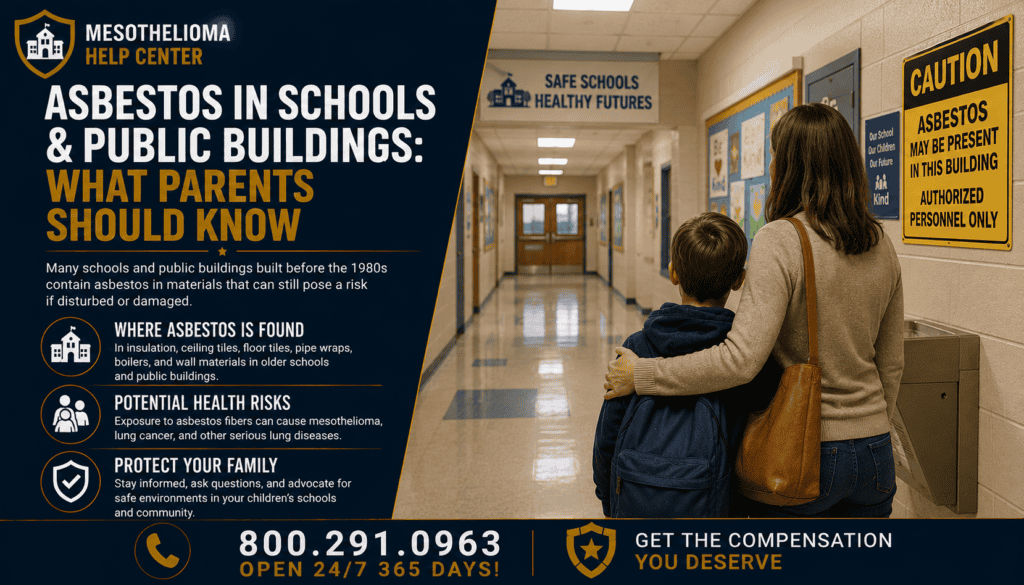
🏫 Asbestos in Schools & Public Buildings
Schools and public buildings can remain in service for decades while undergoing repeated maintenance, remodeling and mechanical upgrades. Depending on a structure’s age, construction history and materials, some buildings may contain asbestos-containing flooring, insulation, ceiling materials, roofing, fireproofing or mechanical-system components.
Being inside an older school or public building does not by itself prove asbestos exposure. Exposure investigations should identify the specific building, area, dates, work or activity, material involved and whether that material was damaged or disturbed.
This page is part of the Educational Buildings Asbestos Exposure hub and the broader Buildings Asbestos Exposure resource.
🏫 Asbestos in Schools and Public Buildings
Asbestos was historically incorporated into various building products because of properties such as heat resistance and durability. Whether asbestos was actually present in a particular school, library, government office or other public facility depends on the products and systems installed there.
Potential exposure can become a concern when asbestos-containing material is damaged or disturbed during activities such as:
- Floor removal or replacement.
- Ceiling repairs and above-ceiling work.
- Pipe, boiler and mechanical-system maintenance.
- HVAC replacement.
- Electrical upgrades.
- Wall demolition or remodeling.
- Roof repair and replacement.
- Major renovation or demolition.
Schools have distinct federal asbestos-management requirements under the Asbestos Hazard Emergency Response Act (AHERA). Other public buildings may be governed by different federal, state and local requirements depending on ownership and the work being performed.
📋 School Asbestos Inspections and AHERA Requirements
EPA states that AHERA and its regulations require public school districts and nonprofit schools, including qualifying charter schools and schools affiliated with religious institutions, to inspect school buildings for asbestos-containing building material, prepare asbestos management plans and take action to prevent or reduce asbestos hazards.
AHERA management is not simply a one-time inspection. Covered schools have ongoing responsibilities concerning known or assumed asbestos-containing building materials, including management-plan implementation and periodic surveillance.
🔎 Why School Asbestos Records Matter
For someone reconstructing historical exposure, school records may help identify:
- Where asbestos-containing materials were identified.
- The condition of those materials.
- Areas included in inspections or sampling.
- Renovation and response actions.
- Maintenance and custodial procedures.
- Abatement projects.
For a more building-specific review, see School Buildings Asbestos Exposure.
🏛️ Asbestos Management in Public Buildings
AHERA’s school-specific requirements should not automatically be applied to every government or public building. EPA separately provides guidance for owners and managers of buildings that contain asbestos and notes that school buildings have distinct regulatory requirements.
EPA describes an asbestos operations and maintenance program as a plan involving training, cleaning, work practices and surveillance intended to maintain asbestos-containing materials in good condition and minimize occupant exposure.
Public buildings that may warrant investigation include government offices, courthouses, libraries, community facilities and other structures used by public agencies. The applicable records can vary by property and jurisdiction.
For broader government-building research, see Government, Municipal & Public Buildings Asbestos Exposure.
🧱 Materials and Building Areas to Investigate
No material should be identified as asbestos-containing based only on appearance or the age of a building. Historical specifications, asbestos surveys, inspection records or appropriate analysis provide stronger evidence.
| Building Area | Material or System to Investigate | Potential Disturbance |
|---|---|---|
| Floors | Certain floor coverings and adhesives | Removal, scraping or replacement |
| Ceilings | Certain ceiling and surfacing materials | Repair, access or remodeling |
| Mechanical rooms | Pipe, boiler and equipment insulation | Maintenance, repair or removal |
| Walls | Certain compounds, plasters and panels | Cutting, drilling or demolition |
| HVAC areas | Certain insulation and associated materials | Upgrade or maintenance |
| Roofs | Certain historical roofing materials | Repair or replacement |
| Structural areas | Certain fireproofing and surfacing materials | Renovation or demolition |
See Common Asbestos Materials Found in Pre-1970s Buildings for additional historical material categories.
👷 Workers and Occupants Potentially at Risk
Potential exposure depends on the material present, its condition, the work performed and a person’s proximity to the disturbance. Relevant work histories may include:
- School and public-building maintenance employees.
- Custodians and janitorial workers.
- Building engineers.
- Plumbers and pipefitters.
- Electricians.
- HVAC technicians.
- Carpenters and remodelers.
- Roofers.
- Construction and demolition contractors.
- Teachers and school staff near renovation work.
- Government or public employees working near disturbed materials.
Tradespeople who directly cut, removed or repaired installed building materials may have different exposure opportunities from people who primarily occupied finished spaces.
For educational employees, see Teachers and School Staff Hidden Building Hazards.
🔨 Renovation, Maintenance and Demolition Exposure
Renovation and maintenance records can be especially important because asbestos exposure often depends on disturbance rather than the mere presence of asbestos-containing material.
OSHA’s asbestos construction standard covers work including demolition or salvage where asbestos is present, removal or encapsulation of asbestos-containing materials, and construction, alteration, repair, maintenance or renovation of structures containing asbestos.
OSHA also assigns information duties to building and facility owners and employers in covered work. These provisions can make historical building, contractor and notification records useful when reconstructing an exposure event.
EPA’s asbestos NESHAP requirements also establish work practices for qualifying renovation and demolition activities involving asbestos. The specific requirements depend on the structure and project.
See Historic Building Renovation Job Sites Asbestos Exposure for additional information.
📂 How to Document School or Public Building Asbestos Exposure
A useful reconstruction moves from a general statement such as “I worked in an old public building” toward:
Person → Building → Room/Area → Job or Activity → Material → Project → Date
- Identify the exact school or public building.
- Record employment, contractor or occupancy dates.
- Identify the person’s occupation and duties.
- List rooms, mechanical spaces and other relevant work areas.
- Identify renovation, maintenance or demolition projects.
- For covered schools, look for AHERA management-plan and inspection information.
- Locate asbestos surveys, sampling and abatement records.
- Review building plans, specifications, permits and work orders.
- Identify contractors and trades working nearby.
- Locate coworkers, supervisors or other witnesses.
School districts, building owners, government agencies, facilities departments, contractors and local archives may each hold different portions of the historical record.
See Steps to Prove Asbestos Exposure in Older Buildings for a broader evidence framework.
❓ Asbestos in Schools & Public Buildings Questions
Did every older school or public building contain asbestos?
No. Building age can justify investigation, but it does not establish that a specific material contained asbestos.
What does AHERA require schools to do?
EPA states that covered public and nonprofit private schools must inspect for asbestos-containing building material, prepare management plans and take action to prevent or reduce asbestos hazards.
Does AHERA apply to every public building?
No. AHERA establishes school-specific requirements. Other public buildings may be subject to other asbestos requirements and building-management obligations.
Where might asbestos-containing materials be investigated?
Depending on the building and era, investigators may examine certain flooring, ceilings, walls, pipe and boiler insulation, HVAC systems, roofing and fireproofing materials.
Could teachers or public employees have been exposed?
Potentially, particularly if asbestos-containing material was disturbed near occupied work areas. Employment or occupancy alone does not prove exposure.
Which workers may have had more direct exposure opportunities?
Maintenance workers, custodians, plumbers, electricians, HVAC technicians, roofers and renovation or demolition contractors may have directly disturbed installed building materials.
Can historical asbestos records help establish exposure?
Potentially. Management plans, surveys, specifications, abatement files, work orders, renovation records and witness accounts can help identify materials, locations and project dates.
🚀 Turn a School or Public Building History Into a Clear Exposure Record
📞 Review the Building, Job, Work Areas, Projects and Evidence
If you or a loved one worked in a school or public building and later developed mesothelioma or asbestos-related lung cancer, a focused review can help identify possible exposure sources and surviving records.
- Building — school or public facility, location and relevant dates.
- Work — occupation, duties, maintenance, renovations and nearby trades.
- Exposure — insulation, flooring, ceilings, mechanical systems and other materials.
- Evidence — AHERA records where applicable, surveys, plans, work orders, abatement files and witnesses.
Call 800.291.0963 now, use live chat 24/7/365, or Submit Your Case for a free, confidential case review.
Compensation is not guaranteed. Potential legal options depend on the diagnosis, exposure evidence, potentially responsible parties, applicable law and filing deadlines.
⚕️ Legal & Medical Information Disclaimer
This page provides general educational information and is not legal or medical advice. Working in, attending or visiting a school or public building does not by itself prove asbestos exposure, disease causation, legal liability or eligibility for compensation.