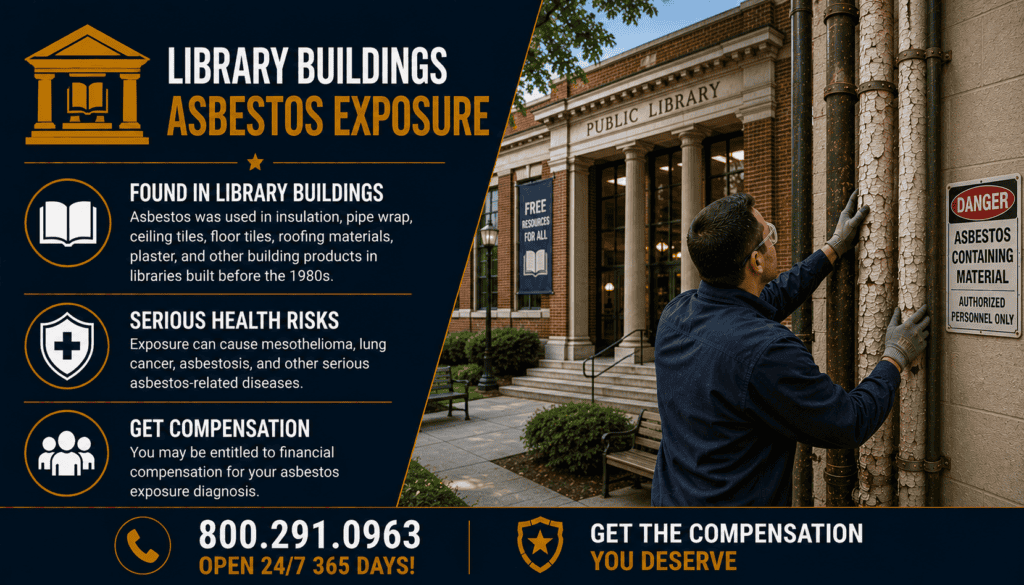
📚 Library Buildings Asbestos Exposure
Libraries can occupy historic civic buildings, older school and university facilities, purpose-built public libraries and structures that have been expanded or renovated repeatedly over many decades. Depending on the building, construction era, materials and work performed, some library buildings may have contained asbestos-containing insulation, flooring, ceiling materials, roofing, fireproofing and mechanical-system components.
Working in or visiting an older library does not by itself prove asbestos exposure. A useful investigation should connect the person to a specific library, building area, job or activity, time period, renovation or maintenance project and asbestos-containing material.
This page is part of the Educational Buildings Asbestos Exposure hub and the broader Buildings Asbestos Exposure resource.
📚 How Asbestos Exposure Could Occur in Library Buildings
Potential exposure depended on the materials actually present and whether work or deterioration disturbed asbestos-containing material. Libraries may remain in service for generations, making renovation and building-system history particularly important.
- Removing or replacing older flooring.
- Accessing ceiling spaces for electrical, lighting or communications work.
- Repairing boilers, pipes, valves or heating systems.
- Upgrading HVAC equipment and duct systems.
- Renovating offices, reading rooms, stacks or public areas.
- Repairing or replacing roofing materials.
- Demolishing walls or older additions.
- Cleaning debris after maintenance or construction work.
EPA notes that asbestos-containing material in a building does not automatically require removal when it remains in good condition and is properly managed; renovation or other work that may disturb it requires greater attention.
📍 Library Areas and Building Systems to Investigate
A library exposure investigation should identify the specific work area rather than assuming that asbestos was distributed uniformly throughout a building.
📖 Reading Rooms and Book Stack Areas
Older flooring, ceilings, walls and mechanical systems may warrant investigation when these areas underwent remodeling or repairs.
⚙️ Boiler and Mechanical Rooms
Heating plants, pipes, valves and related mechanical systems can be important when reconstructing the work history of maintenance personnel, engineers, plumbers and contractors.
🔧 Ceiling and Utility Spaces
Electricians, communications technicians and maintenance workers may have entered concealed spaces during lighting, wiring, fire-alarm, network or building-system upgrades.
🏢 Offices and Administrative Areas
Office renovations may involve flooring, ceilings, partitions and other installed building materials.
🏛️ Historic Library Buildings
Older civic or institutional libraries may have undergone multiple expansions and modernization projects. See Historic Buildings, Renovation & Public Building Research for related investigation issues.
🎓 Campus Libraries
Libraries on college campuses may share utility systems or renovation histories with other academic structures. See Colleges & University Campus Buildings Asbestos Exposure.
🧱 Asbestos-Containing Materials to Investigate
Material appearance alone cannot establish asbestos content. EPA advises that suspect material cannot reliably be identified as asbestos simply by looking at it; appropriate records, inspection or analysis may be necessary.
| Library Area | Material or System to Investigate | Potential Disturbance |
|---|---|---|
| Floors | Certain floor coverings and adhesives | Removal, scraping or replacement |
| Ceilings | Certain ceiling and surfacing materials | Repair, access or remodeling |
| Mechanical rooms | Pipe, boiler and equipment insulation | Maintenance, repair or removal |
| Walls | Certain compounds, plasters and panels | Cutting, drilling or demolition |
| HVAC areas | Certain insulation and associated materials | Upgrades or maintenance |
| Roofs | Certain historical roofing products | Repair or replacement |
| Structural areas | Certain fireproofing or surfacing materials | Renovation or demolition |
For a broader look at historical building products, see Common Asbestos Materials Found in Pre-1970s Buildings.
👷 Library Workers and Contractors Potentially at Risk
Potential exposure generally depends more on duties and proximity to disturbed material than on a person’s job title alone.
- Building maintenance workers.
- Custodians and janitorial employees.
- Building engineers.
- Plumbers and pipefitters.
- Electricians.
- HVAC technicians.
- Carpenters and renovation workers.
- Roofers.
- Outside construction contractors.
- Library employees working near renovation or maintenance activity.
Maintenance and construction personnel may have had more direct contact with installed building systems, while librarians and other occupants may require a different exposure analysis based on nearby disturbance, building conditions and work history.
See High-Risk Jobs for Asbestos Exposure for broader occupation-specific information.
🔨 Renovation, Repair and Maintenance Exposure
Library modernization can involve extensive work above ceilings, behind walls, in mechanical rooms and throughout public spaces. OSHA’s asbestos construction standard covers work including construction, alteration, repair, maintenance, renovation and demolition of structures containing asbestos.
Projects worth investigating include:
- Major interior remodeling.
- Lighting and electrical upgrades.
- Computer and communications wiring.
- HVAC replacement.
- Boiler and pipe repairs.
- Floor replacement.
- Roofing projects.
- Accessibility renovations.
- Additions or demolition.
EPA recommends reviewing asbestos inspection and assessment records before renovation where asbestos-containing materials may be disturbed. Historical project files may therefore provide important evidence about both the materials and the dates of disturbance.
See Historic Building Renovation Job Sites Asbestos Exposure for additional renovation-related exposure information.
📂 How to Document Library Building Asbestos Exposure
A strong reconstruction moves from “I worked in a library” toward a more specific sequence:
Person → Library → Building Area → Job/Task → Material → Project → Date
- Identify the library and exact location.
- Record employment or contractor dates.
- Identify the person’s job and routine duties.
- List mechanical rooms, offices, stack areas and other work locations.
- Identify renovations, repairs or demolition during the relevant years.
- Look for asbestos surveys and inspection records.
- Locate building plans, specifications and maintenance work orders.
- Identify contractors and trades performing nearby work.
- Locate abatement records when asbestos removal occurred.
- Identify coworkers, supervisors or other witnesses.
Municipal records, library systems, universities, school districts, building owners, facilities departments and contractors may hold different portions of the historical record.
See Steps to Prove Asbestos Exposure in Older Buildings for a broader evidence framework.
🫁 Health Risks and Potential Legal Claims
Asbestos exposure is associated with serious diseases including mesothelioma, asbestos-related lung cancer and asbestosis. These conditions can develop long after the exposure period.
A diagnosis does not establish that exposure occurred in a particular library. A complete history may need to examine other buildings, employers, construction projects, products, military service and residential exposure sources.
If evidence connects exposure to identifiable asbestos-containing products or potentially responsible companies, legal options may be investigated. See Mesothelioma Lawsuit and Asbestos Exposure Lawsuit for additional information. Compensation is not guaranteed.
❓ Library Buildings Asbestos Exposure Questions
Did every older library contain asbestos?
No. Building age can indicate that investigation is appropriate, but it does not establish that a particular material contained asbestos.
Where might asbestos-containing materials be investigated in a library?
Potential areas include certain flooring, ceilings, walls, pipe and boiler insulation, mechanical systems, roofing and fireproofing materials, depending on the building and era.
Could librarians have been exposed to asbestos?
Potentially, particularly if asbestos-containing material was damaged or disturbed in or near occupied areas. Simply working in an older library does not prove exposure.
Which library workers may have had more direct exposure opportunities?
Maintenance workers, custodians, engineers, plumbers, electricians, HVAC technicians and construction contractors may have performed work that disturbed installed building materials.
Why are library renovation records important?
They may identify the project dates, work locations, contractors, building materials and asbestos surveys or abatement associated with a renovation.
Can an old library still be investigated after it has been remodeled?
Potentially. Historical plans, maintenance records, asbestos surveys, abatement documents, permits, photographs and witness accounts may still exist.
What if the library was part of a university campus?
The investigation should consider both the library itself and relevant campus facilities records, utility systems and renovation history.
🚀 Turn a Library Work History Into a Clear Exposure Record
📞 Review the Library, Job, Building Areas, Projects and Evidence
If you or a loved one worked in a library building and later developed mesothelioma or asbestos-related lung cancer, a focused review can help identify possible exposure sources and surviving records.
- Location — library, campus or municipality, building areas and dates.
- Work — occupation, maintenance tasks, renovation projects and nearby trades.
- Exposure — insulation, flooring, ceilings, mechanical systems and other materials.
- Evidence — surveys, plans, work orders, abatement files, contractor records and witnesses.
Call 800.291.0963 now, use live chat 24/7/365, or Submit Your Case for a free, confidential case review.
Compensation is not guaranteed. Potential legal options depend on the diagnosis, exposure evidence, potentially responsible parties, applicable law and filing deadlines.
⚕️ Legal & Medical Information Disclaimer
This page provides general educational information and is not legal or medical advice. Working in or visiting a library building does not by itself prove asbestos exposure, disease causation, legal liability or eligibility for compensation.