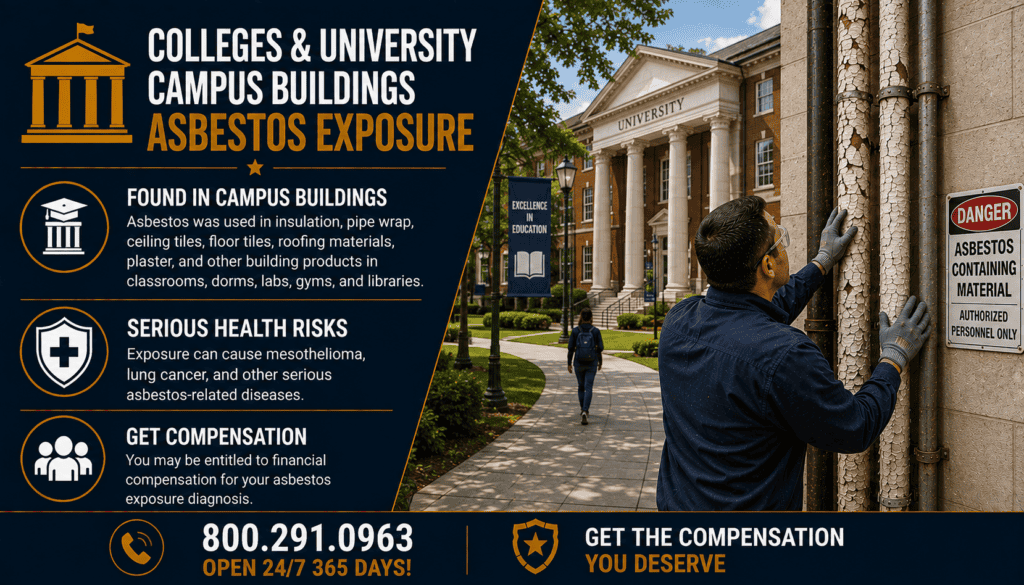
🎓 Colleges & University Campus Buildings Asbestos Exposure
College and university campuses can include dozens or even hundreds of buildings constructed, expanded and renovated during different decades. Depending on the era, building type, materials used and work performed, some campus structures may have contained asbestos-containing insulation, flooring, roofing, wall systems, fireproofing, mechanical components and other building materials.
Attending, teaching or working at a college or university does not by itself prove asbestos exposure. A strong exposure investigation should connect the person to a specific campus, building, department, job, work area, renovation project, material and time period.
This page is part of the Educational Buildings Asbestos Exposure hub. For a building-specific review, see University Buildings Asbestos Exposure.
🏛️ How Asbestos Exposure Could Occur on College and University Campuses
Large campuses often contain buildings from many construction eras. A single university may have older academic halls, mid-century laboratories, newer classroom buildings, historic libraries, utility plants, dormitory-related facilities, athletic structures and administrative offices.
Potential asbestos exposure could occur when workers disturbed asbestos-containing materials during:
- Building renovation and remodeling.
- Boiler and pipe maintenance.
- HVAC upgrades.
- Electrical work.
- Flooring removal or replacement.
- Roof repair or replacement.
- Laboratory modernization.
- Demolition of older campus structures.
- Maintenance in mechanical rooms, tunnels and utility spaces.
The presence of an older building is only a starting point. Exposure reconstruction should identify what materials were present, whether they contained asbestos and whether the person worked in or near activities that disturbed them.
📍 Campus Buildings and Facilities to Investigate
A college or university campus should not be treated as a single exposure location. Each building can have a different construction history, renovation record and asbestos profile.
🎓 Academic Buildings
Classrooms, lecture halls, faculty offices, hallways and departmental buildings may have undergone repeated renovations involving ceilings, floors, walls and building systems.
🔬 Laboratories and Research Buildings
Older science and research buildings may include specialized mechanical systems, heat-resistant materials, laboratory renovations and equipment changes that warrant separate investigation.
📚 Libraries
Older campus libraries may involve historical flooring, ceiling systems, mechanical rooms and renovation projects. See Library Buildings Asbestos Exposure.
🏢 Administrative Buildings
Administrative structures may contain the same categories of historical building materials found in other campus buildings, particularly where older offices were remodeled or modernized.
⚙️ Boiler Plants and Utility Buildings
Central heating plants, mechanical rooms, utility tunnels and maintenance spaces can be especially important for facilities employees who worked around pipes, boilers, pumps, valves and insulation systems.
🏟️ Athletic and Assembly Buildings
Gymnasiums, field houses, auditoriums, arenas and other large campus buildings can have distinctive roofing, mechanical, insulation and renovation histories.
🛠️ Maintenance Shops
Campus maintenance departments may service multiple buildings and equipment systems. A worker’s exposure history may therefore involve many locations rather than one structure.
🧱 Asbestos-Containing Materials and Systems to Investigate
Not every older campus material contained asbestos. Product composition varied by manufacturer, date, specification and building project.
| Campus Area | Material or System to Investigate | Potential Disturbance |
|---|---|---|
| Mechanical rooms | Pipe, boiler and equipment insulation | Repair, removal or replacement |
| Classrooms and offices | Certain flooring, ceiling and wall materials | Renovation and remodeling |
| Utility tunnels | Pipe insulation and mechanical systems | Maintenance and replacement |
| Roofs | Certain roofing products | Tear-off, repair or replacement |
| Laboratories | Certain heat-resistant or building materials | Renovation and equipment changes |
| HVAC systems | Certain insulation and associated components | System upgrades and maintenance |
| Older interior finishes | Certain compounds, panels and surfacing materials | Cutting, drilling or demolition |
Reliable documentation may include asbestos surveys, original specifications, facility records, abatement reports, renovation documents and laboratory analysis of materials.
For broader product information, see Asbestos Exposure in Products.
👷 Campus Workers, Faculty and Contractors Potentially at Risk
Potential exposure depended on actual duties and proximity to disturbed materials. Workers who directly maintained buildings or mechanical systems may have had different exposure opportunities from students or office occupants.
- Facilities and maintenance workers.
- Custodians and janitorial employees.
- Boiler and utility plant workers.
- Plumbers and pipefitters.
- Electricians.
- HVAC technicians.
- Carpenters.
- Roofers.
- Construction and renovation contractors.
- Laboratory and technical workers.
- Faculty and staff working near renovation activity.
See High-Risk Jobs for Asbestos Exposure for additional occupation-specific exposure information.
🔨 Renovation, Maintenance and Demolition Exposure
College and university campuses frequently modernize older buildings while keeping them in service. Renovation history can therefore be one of the most important parts of an exposure investigation.
Projects worth investigating include:
- Classroom and laboratory remodeling.
- Boiler replacement.
- Pipe and utility upgrades.
- HVAC modernization.
- Roofing projects.
- Flooring replacement.
- Electrical renovation.
- Demolition of outdated buildings.
- Expansion of older structures.
When asbestos-containing materials are present, disturbance during construction work can create exposure concerns. The key questions are what material was present, where the work occurred, when it occurred and who was in the area.
The Historic Building Renovation Job Sites Asbestos Exposure page provides additional information about investigating renovation-related exposure.
📂 How to Document College or University Campus Asbestos Exposure
A strong investigation moves beyond a general statement such as “I worked at a university.” The goal is to identify:
Person → Campus → Building → Work Area → Task → Material → Date
- Identify the college or university.
- Record employment, teaching or attendance dates.
- List each building where relevant work occurred.
- Identify the person’s department, trade or job duties.
- Note maintenance, remodeling or demolition projects.
- Locate building plans and historical specifications.
- Look for asbestos surveys and abatement reports.
- Identify outside contractors and nearby trades.
- Locate coworkers, supervisors or witnesses.
- Create a chronological exposure and medical timeline.
Facilities departments, archives, building records, contractor files and historical plans may help establish where specific materials were located.
For additional evidence strategies, see Steps to Prove Asbestos Exposure in Older Buildings.
❓ College & University Campus Asbestos Exposure Questions
Did every older college or university building contain asbestos?
No. Building age may justify investigation, but asbestos content must be established through reliable records, inspection or testing.
Which campus buildings may be most important to investigate?
Academic buildings, laboratories, libraries, mechanical spaces, utility buildings, maintenance shops and older renovated structures may all be relevant depending on the person’s work history.
Could university maintenance workers have been exposed?
Potentially. Facilities employees may have worked directly with pipes, boilers, HVAC systems, flooring, ceilings and other building materials. Actual exposure depends on the materials and tasks involved.
Could faculty or office staff have been exposed?
Potentially, particularly when asbestos-containing materials were disturbed in or near occupied work areas. Occupancy alone does not prove exposure.
Why is a campus-wide exposure history more complicated?
Large campuses may contain many buildings from different eras, and employees can move between multiple locations. Each building should be evaluated separately.
Can renovation records help prove exposure?
Potentially. They may identify project dates, affected buildings, contractors, materials and whether asbestos surveys or abatement occurred.
What if the original campus building was demolished?
Historical plans, facilities records, photographs, asbestos surveys, contractor documents and witness accounts may still help reconstruct the building and work history.
🚀 Turn a College or University Campus History Into a Clear Exposure Record
📞 Review the Campus, Buildings, Job, Projects and Evidence
If you or a loved one worked on a college or university campus and later developed mesothelioma or asbestos-related lung cancer, a focused review can help identify possible exposure sources and surviving records.
- Campus — college or university, departments, buildings and dates.
- Work — occupation, maintenance tasks, renovations and nearby trades.
- Exposure — insulation, flooring, ceilings, mechanical systems and other materials.
- Evidence — plans, surveys, facilities records, work orders, contractor files and witnesses.
Call 800.291.0963 now, use live chat 24/7/365, or Submit Your Case for a free, confidential case review.
Compensation is not guaranteed. Legal options depend on the diagnosis, exposure evidence, potentially responsible parties, applicable law and filing deadlines.
⚕️ Legal & Medical Information Disclaimer
This page provides general educational information and is not legal or medical advice. Working, teaching or attending classes on a college or university campus does not by itself prove asbestos exposure, disease causation, legal liability or eligibility for compensation.