Surgery Options for Mesothelioma Patients: Procedures, Eligibility and Recovery
A patient-focused comparison of surgery for pleural and peritoneal mesothelioma, including eligibility, benefits, uncertainties and recovery.
Understanding surgical goals
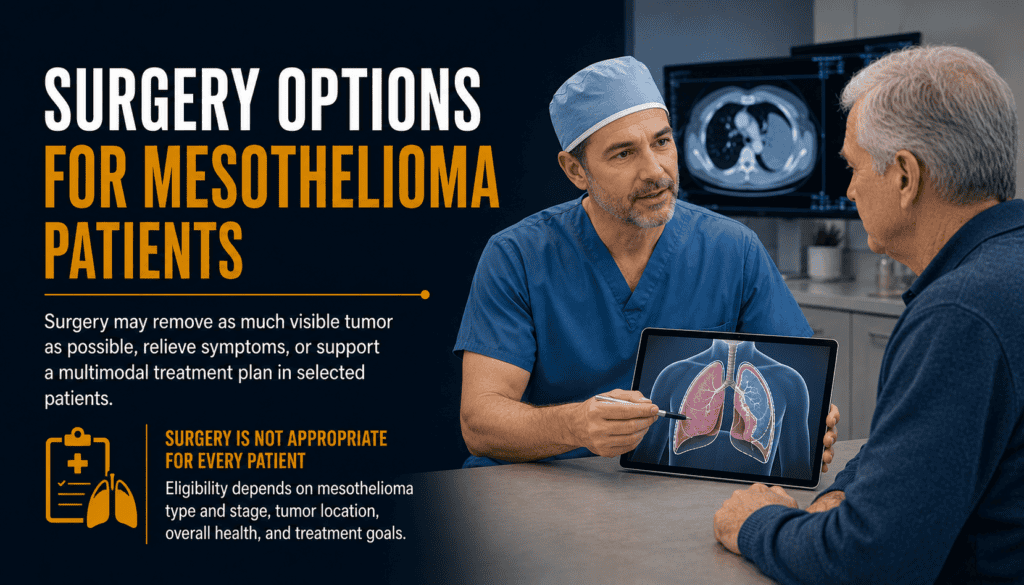
Mesothelioma surgery is not a single operation. The location of the cancer, extent of disease, cell type, heart and lung function, and a patient’s priorities all shape whether surgery makes sense. Some operations aim to remove as much visible cancer as possible; others focus on easing symptoms such as fluid buildup or breathlessness. Surgery is not appropriate for every patient, and removing visible disease does not establish a cure.
A specialist team should explain the intended benefit, realistic limitations and non-surgical alternatives before a patient agrees to an operation. Start with the broader surgery for mesothelioma overview and the surgery preparation guide.
| Surgical goal | What it means | Key question |
|---|---|---|
| Tumor-directed | Attempt to remove visible tumor in selected patients | What benefit is reasonably expected for my case? |
| Symptom-directed | Drain fluid or reduce symptoms without trying to remove all cancer | How quickly might symptoms improve? |
| Diagnostic | Obtain tissue or inspect affected areas | Will this change the diagnosis or treatment plan? |
Pleural mesothelioma surgery options
Pleural mesothelioma develops in the lining around the lungs. Operations vary greatly in how much tissue is removed. Pleurectomy/decortication (P/D) removes diseased pleura and attempts to clear visible tumor while preserving the lung. Extended P/D may also require removal and reconstruction of the diaphragm or pericardium when involved. Extrapleural pneumonectomy (EPP) removes an entire lung along with affected surrounding structures and carries substantial functional consequences.
Current surgical decisions are complex and evidence about survival benefit is uncertain; patients should ask a high-volume mesothelioma team to explain why a particular approach is being considered. Learn about P/D and extended P/D and EPP.
| Procedure | General approach | Important consideration |
|---|---|---|
| Pleurectomy/decortication | Removes pleural tissue and visible tumor while preserving lung | Major surgery; complete tumor removal may not be possible |
| Extended P/D | Lung-sparing removal plus involved diaphragm and/or pericardium | Reconstruction and additional complications may be involved |
| Extrapleural pneumonectomy | Removes an entire lung and additional structures | Highly selected circumstances; significant operative and long-term risk |
| Pleurodesis or indwelling catheter | Controls recurrent pleural fluid | Symptom relief rather than tumor eradication |
Peritoneal mesothelioma surgery options
Peritoneal mesothelioma affects the lining of the abdomen. For carefully selected patients, cytoreductive surgery (CRS) aims to remove visible tumor deposits. An experienced center may combine CRS with heated intraperitoneal chemotherapy (HIPEC), which circulates heated chemotherapy in the abdomen during the operation. HIPEC is a treatment delivered with surgery, not an operation that replaces CRS.
Patients with disease outside the abdomen, extensive tumor that cannot be adequately removed, or serious health limitations may not be suitable candidates. The surgical team must evaluate scans, pathology, functional status and whether meaningful cytoreduction is feasible. Read the dedicated CRS guide and HIPEC explanation.
| Approach | Potential purpose | Questions to clarify |
|---|---|---|
| CRS | Remove visible peritoneal tumor | How much tumor is expected to be removable? |
| CRS plus HIPEC | Combine visible tumor removal with regional chemotherapy | What added benefits and toxicities apply to me? |
| Limited or symptom-directed procedure | Address selected complications or obtain tissue | Will this improve comfort or change treatment? |
Who may be eligible for surgery?
Eligibility is individualized. Doctors review pathology and histologic subtype, scans and disease distribution, functional status, heart and lung reserve, nutritional status, prior treatment, and the patient’s goals. A patient who is medically fit may still have cancer that cannot be safely removed; conversely, some symptom-relief procedures may be possible even when major tumor-directed surgery is not.
A multidisciplinary review involving mesothelioma specialists, surgeons, medical oncologists, radiologists and supportive-care clinicians can help patients understand the options. A preoperative assessment and an independent specialist opinion can clarify uncertainty.
| Assessment | Why it matters |
|---|---|
| Pathology and cell type | Confirms diagnosis and helps estimate whether aggressive surgery is appropriate |
| Imaging and disease extent | Shows spread and whether meaningful tumor removal may be feasible |
| Heart and lung testing | Estimates anesthesia and postoperative breathing risks |
| Daily functioning and nutrition | Identifies recovery vulnerabilities and support needs |
| Patient goals | Aligns burdens of surgery with personal priorities |
Comparing procedures and trade-offs
There is no universal “best surgery” for mesothelioma. Pleural and peritoneal operations treat different anatomy and should not be compared as interchangeable choices. Even among pleural operations, a larger resection is not automatically more effective. Ask for the expected impact on symptoms, hospitalization, complications, quality of life and any planned additional therapy.
Evidence can be limited by patient selection and differences between treatment centers. A published outcome from one hospital cannot reliably predict an individual’s outcome. The care team should discuss whether systemic therapy, including chemotherapy or immunotherapy, is a more suitable approach.
| Decision factor | Questions for the team |
|---|---|
| Intended outcome | Is the goal longer disease control, symptom relief or diagnosis? |
| Extent of surgery | Which organs or tissues will be removed or reconstructed? |
| Evidence | What benefits and uncertainties apply to my diagnosis? |
| Complications | What are the center-specific serious complication and mortality rates? |
| Alternatives | What happens if I choose systemic treatment or supportive care instead? |
Preparing for a surgical consultation
Bring pathology reports, imaging, a medication list, treatment history and a trusted support person if desired. Tell the team about blood thinners, supplements, breathing problems, previous operations and changes in weight or activity. Do not stop prescription medicines without the treating team’s instructions. Ask whether additional scans, pulmonary testing, cardiac assessment or nutritional support are needed.
Discuss time away from work, transportation, caregiving, home equipment, lodging near the hospital and insurance authorization early. The travel and lodging guide and family care planning guide may help organize practical arrangements.
| Bring or arrange | Why |
|---|---|
| Pathology slides/reports and scans | Supports accurate multidisciplinary review |
| Medication and allergy list | Helps anesthesia and medication planning |
| Written questions and personal goals | Keeps the consultation focused |
| Transportation and home assistance | Supports safe discharge and follow-up |
| Insurance and financial questions | Clarifies approvals and possible out-of-pocket costs |
Recovery, risks and follow-up
Major mesothelioma surgery may involve intensive monitoring, pain control, breathing exercises, early supervised movement and a hospital stay. Recovery differs by procedure, baseline health and complications. Possible risks include bleeding, infection, blood clots, pneumonia, breathing difficulty, abnormal heart rhythms and organ injury; abdominal surgery may also cause bowel or nutritional problems. Ask the surgeon for procedure-specific risks rather than relying on a generic list.
Follow the discharge team’s instructions about activity, wound care, medications, nutrition and follow-up imaging. New severe breathlessness, chest pain, fainting, uncontrolled bleeding or sudden confusion warrants emergency evaluation. Fever, increasing wound redness, worsening pain or inability to keep fluids down requires prompt contact with the surgical team. Read recovery after treatment for broader planning.
| Recovery topic | Practical plan |
|---|---|
| Breathing and mobility | Follow individualized respiratory therapy and walking instructions |
| Pain and medication | Use the prescribed plan; report inadequate relief or adverse effects |
| Wound and drain care | Use written instructions and contact numbers |
| Nutrition and fluids | Ask about individualized needs, especially after abdominal surgery |
| Follow-up | Confirm appointments, pathology review and next treatment decisions |
Alternatives and decision checklist
Choosing not to undergo major surgery does not mean choosing no care. Depending on the diagnosis, alternatives may include chemotherapy, immunotherapy, radiation for selected symptoms, clinical trials, pleural fluid drainage and early palliative care. Palliative care can accompany active cancer treatment and focuses on symptoms, functioning and family support.
For an individualized discussion, see treatment comparison and palliative care. Before deciding, ask the team to document the proposed operation, goal, expected benefit, uncertainties, complication risks, recovery needs, other reasonable options and what happens if surgery is delayed or declined.
| Decision checklist | Record your answer |
|---|---|
| Why this operation? | ____________________________ |
| What other treatments are reasonable? | ____________________________ |
| What are my specific risks? | ____________________________ |
| What support will recovery require? | ____________________________ |
| Do I want a second specialist opinion? | ____________________________ |
Frequently Asked Questions
Can surgery cure mesothelioma?
Surgery may remove visible cancer in selected patients, but microscopic disease can remain. A surgeon should explain realistic goals and the possibility of recurrence; a cure cannot be promised.
Is lung-sparing surgery always possible?
No. Tumor distribution, anatomy, overall health and the surgical team’s assessment determine whether a lung-sparing operation is feasible or appropriate.
What is the difference between P/D and EPP?
P/D removes pleural tissue and attempts to preserve the lung. EPP removes an entire lung and additional surrounding structures. Their risks and possible roles differ substantially.
Is HIPEC used for pleural mesothelioma?
HIPEC is chemotherapy circulated in the abdomen and is primarily discussed here with CRS for peritoneal disease. Treatments delivered into the chest are different approaches.
Can older adults have mesothelioma surgery?
Age alone does not decide eligibility. Functional status, other illnesses, disease extent, personal goals and expected recovery burden all matter.
What if the tumor cannot be removed completely?
The team may revise the operation, focus on symptom relief or recommend systemic therapy. Ask what findings would cause the surgical plan to change.
Should I seek a second opinion?
A second opinion from a mesothelioma-experienced multidisciplinary team can help clarify options, particularly before a major irreversible operation.
What symptoms after surgery require urgent care?
Sudden severe shortness of breath, chest pain, fainting, uncontrolled bleeding or acute confusion warrant emergency assessment. Contact the surgical team promptly for fever, worsening wounds or uncontrolled symptoms.
Medical Sources and Further Reading
- National Cancer Institute: Mesothelioma Treatment — patient-oriented treatment overview (updated May 16, 2025).
- National Cancer Institute: Malignant Mesothelioma Treatment (PDQ), Health Professional Version — evidence and selection considerations.
- American Society of Clinical Oncology: Treatment of Malignant Pleural Mesothelioma guideline — surgical selection and procedural guidance; discuss newer evidence with your care team.
- National Cancer Institute: Diagnosis and Prognosis — staging and second opinions.
Questions About Mesothelioma and Your Options?
Call 800.291.0963 for assistance. Live chat is available 24/7, 365 days a year. Submit Your Case using the form below. No particular medical outcome, eligibility or compensation is guaranteed.
⚕️ Legal & Medical Information Disclaimer
This article provides general information, not medical or legal advice. Consult qualified oncology and surgical professionals for treatment decisions and a licensed attorney for legal questions.